Key Takeaways
- Highway-adjacent land can appreciate faster when commercial activity, urban expansion, industrial development, or approved infrastructure reaches the location.
- Land located inside a village usually has a lower entry price and may offer better long-term value when it has clear ownership, road access, water availability, and proximity to a growing town.
- Highway frontage does not automatically provide legal entry and exit. Access permissions, service roads, road-widening plans, and setback requirements must be checked.
- Village land can generate agricultural or leasing income while an investor waits for appreciation, but returns depend heavily on soil, irrigation, access, and local farming demand.
- Highway-adjacent land generally suits investors seeking visibility, commercial potential, and faster resale interest.
- Village land may suit patient investors looking for a lower acquisition cost, larger parcel sizes, farming use, or long-term appreciation.
- The better investment is not always the parcel closest to the highway. It is the parcel with the strongest combination of title clarity, usable access, realistic pricing, infrastructure potential, and buyer demand.
Direct Answer: Village Land or Highway-Adjacent Land?
Highway-adjacent land may offer better returns when it has legal highway access, commercial-use potential, strong traffic movement, nearby industrial activity, and realistic acquisition pricing.
However, village land can provide better risk-adjusted returns when it is available at a significantly lower price, has proper road connectivity, clear ownership, reliable water access, and lies within the future growth path of a city, industrial area, tourism destination, or logistics corridor.
In simple terms:
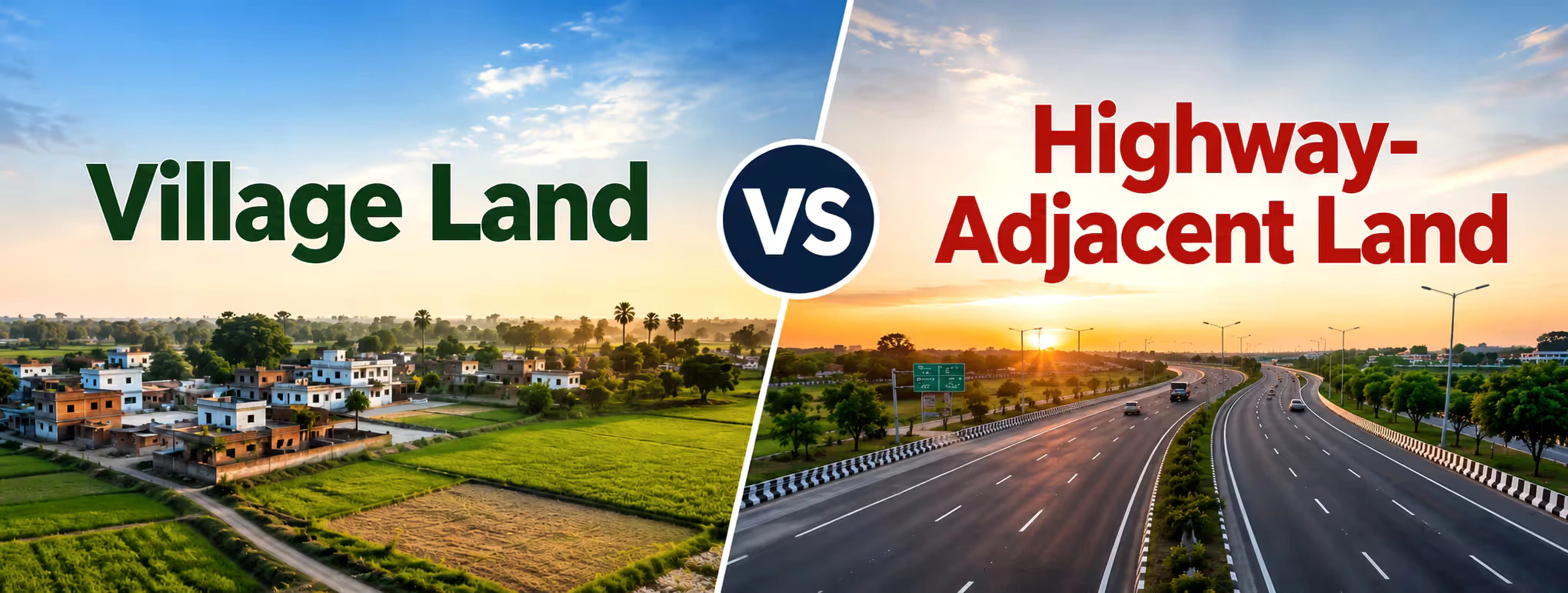
Highway-adjacent land usually offers higher visibility and faster market attention. Village land often offers a lower entry cost and more room for long-term appreciation.
The decision should not depend only on location labels. Investors must compare the actual usability, legal position, surrounding development, acquisition price, holding cost, and exit demand of each parcel.
Why This Comparison Matters to Indian Land Buyers
Indian land buyers often begin with one assumption: land touching a highway must be more valuable than land inside a village.
That assumption is understandable, but it is incomplete.
A highway-facing parcel may look impressive during a site visit. It may have passing vehicles, restaurants, fuel stations, warehouses, and commercial boards nearby. Yet the same parcel may lack approved access, face road-widening risk, fall inside a restricted development zone, or carry a price that already includes ten years of expected growth.
Meanwhile, a parcel located three or four kilometres inside a village may appear less exciting. However, it may offer a wider approach road, a clean rectangular shape, lower pricing, agricultural income, reliable groundwater, and proximity to a future industrial cluster.
The parcel with less visibility can sometimes produce a better return.
That is why buyers conducting a farmland search should compare land based on fundamentals rather than depending on broker descriptions such as “highway touch,” “future commercial,” “next investment hub,” or “guaranteed appreciation.”
Land returns come from what the property can legally, physically, and economically become—not merely from what can be seen from the road.
What is Village Land?
Village Land generally refers to agricultural land, farmland, rural plots, or privately owned parcels located within or around a village settlement. It may be situated near cultivated fields, local roads, habitation areas, water bodies, forest boundaries, or gram panchayat limits.
Not every village parcel is remote.
Some village properties lie only a few kilometres from a city boundary, expressway interchange, tourist destination, industrial area, university, or upcoming residential belt. Others may be far from employment centres and have limited infrastructure.
Village land can be used for agriculture, horticulture, animal husbandry, farm-related activities, or other legally permitted purposes. Any non-agricultural development may require land-use conversion or additional approvals under the applicable state and local regulations.
Common characteristics of village land
Village properties often provide:
- A lower per-acre acquisition cost than prime road-facing land
- Larger parcel sizes within the same investment budget
- Agricultural or lease-income potential
- Access through village, revenue, or private roads
- Dependence on local water, electricity, drainage, and transport infrastructure
- Longer investment horizons
- Greater variation in title, boundaries, possession, and ground-level conditions
The main attraction is affordability. The main challenge is verification.
What is Highway-Adjacent Land?
Highway-adjacent land is a parcel located along or close to a national highway, state highway, expressway, bypass, ring road, major district road, or another high-capacity transport route.
It may directly touch the road boundary, sit beside a service lane, or lie within a short distance of an interchange.
These parcels often attract investors because transport corridors can encourage logistics parks, restaurants, warehouses, institutions, industrial units, vehicle facilities, retail development, and residential expansion.
However, “highway touch” does not mean that the owner automatically has the right to construct an entrance from the highway.
The Ministry of Road Transport and Highways maintains norms for granting access permission to fuel stations, connecting roads, other properties, rest areas, and related facilities along national highways. Therefore, legal access should be verified rather than assumed from physical frontage.
Common characteristics of highway-adjacent land
Highway land may provide:
- Stronger visibility
- Better regional connectivity
- Higher commercial interest
- Faster enquiries from businesses and investors
- Higher acquisition cost
- Greater exposure to road-widening or acquisition proposals
- Access-control and setback considerations
- Potential dependence on service-road construction
- Higher pricing speculation
The main attraction is commercial potential. The main challenge is avoiding overpayment for unapproved possibilities.
Village Land vs Highway-Adjacent Land: Quick Comparison
| Comparison Factor | Village Land | Highway-Adjacent Land |
| Entry price | Usually lower | Usually higher |
| Parcel size within the same budget | Often larger | Usually smaller |
| Immediate visibility | Limited to moderate | High |
| Agricultural use | Often practical | Possible, but land may be priced above farming value |
| Commercial potential | Depends on local growth and conversion | Usually stronger, subject to access and approvals |
| Resale enquiry | Can take longer | Often receives faster attention |
| Income during holding | Farming or agricultural lease may be possible | Commercial lease may be possible only where legally permitted |
| Infrastructure access | Varies by village | Often stronger, but not guaranteed |
| Legal access risk | Village-road or private-road disputes | Highway access permission and service-road issues |
| Acquisition risk | Depends on local projects | May be higher near widening, bypass, or infrastructure projects |
| Holding period | Commonly medium to long term | Short to long term, depending on development |
| Best suited for | Patient buyers, farmers, long-term investors | Commercial investors, businesses, developers |
| Main risk | Weak connectivity or unclear possession | Overpricing and unusable frontage |
| Return driver | Low entry price plus future development | Connectivity plus commercial demand |
Which Type of Land Has the Lower Entry Price?
Village land usually has the lower entry price, particularly when it sits away from a major road, town boundary, industrial zone, or tourist corridor.
This lower cost allows buyers to acquire more land within the same budget.
For example, an investor may have enough capital to purchase one acre beside a major highway or three acres further inside a village. The highway parcel could appreciate faster per square yard, but the larger village holding may create a higher overall gain if the locality develops evenly.
The purchase price matters because land returns are calculated from the price paid, not from the future selling price alone.
Consider two hypothetical investments:
- Parcel A is purchased for ₹1 crore beside a highway and later sold for ₹1.4 crore.
- Parcel B is purchased for ₹50 lakh inside a well-connected village and later sold for ₹80 lakh.
Parcel A produces a ₹40 lakh gross gain. Parcel B produces a ₹30 lakh gross gain.
However, Parcel A appreciates by 40%, while Parcel B appreciates by 60%.
This simplified example excludes registration expenses, brokerage, taxes, financing costs, improvement costs, and inflation. It demonstrates why a lower-cost parcel can deliver a stronger percentage return even when its final market value remains below highway land.
Which Land Appreciates Faster?
Highway-adjacent land can appreciate faster, but only when the highway creates real economic activity.
A road alone does not guarantee demand.
The strongest appreciation generally occurs when improved connectivity is followed by one or more demand generators, such as:
- An industrial area
- A logistics or warehousing cluster
- A new interchange
- A residential expansion zone
- A tourism circuit
- A university or hospital
- A freight corridor
- A commercial centre
- A manufacturing facility
- An airport or transport terminal
Investors should distinguish between movement and economic activity.
Thousands of vehicles may cross a location every day, but that traffic does not automatically create land demand. A controlled-access expressway without a nearby interchange may offer less local benefit than a smaller state road passing through an active commercial town.
Similarly, land touching a bypass may lose business traffic if vehicles cannot stop or enter safely.
Village land usually appreciates more gradually. Its value may rise when the nearby town expands, internal roads improve, land-use patterns change, agricultural productivity increases, or buyers begin seeking weekend homes and farm properties.
Therefore:
Highway land often responds faster to confirmed infrastructure. Village land can produce stronger percentage appreciation when investors enter before the location becomes widely recognised.
Highway Frontage is Not the Same as Highway Access
This is one of the most important practical points in the entire comparison.
A property can physically touch a highway but still lack a lawful, safe, or usable entrance.
Before purchasing highway-adjacent land, investigate:
- Whether the parcel connects through a service road
- Whether direct entry is legally permitted
- Whether the existing cut or entrance is authorised
- Whether a median restricts traffic movement
- Whether vehicles can approach from both directions
- Whether a future flyover could reduce visibility
- Whether a planned service road may affect the boundary
- Whether road widening could reduce usable land
- Whether the site has sufficient frontage for the intended activity
- Whether setback or building-line restrictions apply
A narrow parcel with 20 feet of frontage may be less useful than a slightly interior parcel with a 40-foot approved road.
Likewise, a plot visible from the highway but accessible only through a narrow village lane may not suit warehousing, retail, hospitality, or institutional development.
Before paying a premium for frontage, confirm how a car, tractor, truck, fire engine, or construction vehicle will legally enter and exit the site.
Road Widening and Land Acquisition Risk
Highway-adjacent property carries an additional concern: future acquisition.
Road authorities may require land for widening, interchanges, drainage, service roads, toll infrastructure, utilities, flyovers, underpasses, or safety zones.
India’s Right to Fair Compensation and Transparency in Land Acquisition, Rehabilitation and Resettlement Act, 2013 provides the national framework for government acquisition, compensation, rehabilitation, and resettlement, although the applicable process and related provisions must be assessed for the specific project and state.
Buyers should not interpret possible acquisition as an automatic investment strategy.
Compensation processes can involve uncertainty, documentation requirements, valuation disputes, partial acquisition, access changes, and long timelines. A partial acquisition may also leave an irregularly shaped or commercially weaker balance parcel.
Before purchasing, check:
- Published acquisition notifications
- Road authority alignment plans
- Revenue records for acquisition remarks
- Proposed right-of-way width
- Nearby survey markings
- Local planning maps
- Information available from the relevant authority
- Whether neighbouring parcels have received notices
Never purchase land only because someone claims, “The government will acquire it at four times the price.”
That is speculation, not due diligence.
Commercial Potential of Highway-Adjacent Land
Highway land typically performs best when the property supports an activity that benefits from visibility, accessibility, and vehicle movement.
Possible demand may come from:
- Warehousing
- Logistics
- Restaurants
- Hotels and motels
- Vehicle-related facilities
- Agricultural collection centres
- Storage facilities
- Educational institutions
- Hospitals
- Retail outlets
- Industrial units
- Event spaces
The intended activity must still be legally permitted.
Agricultural classification, land-use zoning, environmental restrictions, highway-access norms, building rules, fire requirements, and local approvals may affect development.
Investors sometimes pay commercial prices for agricultural land without confirming whether commercial use is realistically possible. They then discover that conversion is difficult, access is restricted, utilities are unavailable, or the plot does not meet dimensional requirements.
Commercial potential creates value only when the potential can be implemented.
Agricultural and Holding Income from Village Land
Village land may provide a practical advantage that speculative highway land cannot: income during the holding period.
Depending on the location and land condition, an owner may use or lease the property for:
- Seasonal crops
- Horticulture
- Orchards
- Nursery activities
- Fodder production
- Dairy-related use
- Poultry or animal husbandry, where permitted
- Solar or infrastructure-related leasing, subject to approvals
- Farm-related storage
- Managed cultivation arrangements
Agricultural income should not be assumed without examining soil, irrigation, labour availability, crop viability, fencing, transport cost, and local lease rates.
A parcel marketed as farmland may be rocky, water-stressed, flood-prone, saline, inaccessible during the monsoon, or fragmented between multiple owners.
A realistic agricultural assessment should include:
- Soil type and depth
- Existing crop pattern
- Irrigation source
- Groundwater conditions
- Electricity availability
- Rainfall and drainage
- Farm-road access
- Local labour
- Distance to mandi or collection centre
- Neighbouring land use
- History of cultivation
- Lease demand
Productive village land can reduce the cost of holding the investment. Unproductive land can turn into an expense requiring fencing, supervision, cleaning, and protection.
Liquidity and Resale Demand
Highway-adjacent land often receives more enquiries because buyers can understand the location quickly. Brokers can describe it easily, site visits are convenient, and businesses may recognise the commercial possibilities.
This does not guarantee a fast sale.
A highly priced highway parcel may remain unsold for years when:
- The seller expects future commercial value today
- Access is disputed or restricted
- The property is too narrow
- The title is fragmented
- Land use does not support the advertised opportunity
- Utilities are unavailable
- The nearby market lacks genuine business demand
Village land may take longer to sell because the buyer pool is more local and site evaluation is more detailed. However, fairly priced village land with clean documents, a proper road, water availability, and a growing location can attract farmers, neighbouring owners, long-term investors, farmhouse buyers, and local developers.
Liquidity depends on price discipline.
A good parcel at an unrealistic price is not a liquid investment.
The Impact of Plot Shape and Frontage
Land buyers often focus on acreage and ignore geometry.
Plot shape directly affects usability.
A rectangular village parcel with a broad road frontage can be easier to divide, cultivate, fence, construct upon, or resell than an expensive highway parcel with a long, narrow shape.
Evaluate:
- Frontage-to-depth ratio
- Total road-facing width
- Boundary regularity
- Level differences
- Natural drainage
- High-tension lines
- Water channels
- Utility corridors
- Public pathways
- Existing occupation
- The position of the parcel within the revenue map
For commercial use, frontage can be more valuable than total area. For farming, continuity and workable shape may matter more than visibility.
A five-acre parcel split into disconnected fragments is not equal to one continuous five-acre holding.
Location Matters More Than the Village-or-Highway Label
Two village parcels can have completely different investment potential.
One may be 25 kilometres from the nearest town with weak road access. Another may sit behind a highway commercial strip, close to a future interchange and within the expansion path of a municipal area.
The same applies to highway land.
One highway may support active industry and regional trade. Another may pass through a low-demand area with limited development potential.
Study the wider location through three distance zones.
The immediate zone: 0–3 kilometres
Check road width, neighbouring use, settlement pattern, water, drainage, utilities, encroachment, local businesses, and physical access.
The local growth zone: 3–15 kilometres
Look for towns, industrial estates, colleges, hospitals, tourism sites, mandis, railway stations, and major employment centres.
The regional influence zone: 15–50 kilometres
Assess airports, freight corridors, metro regions, manufacturing belts, major cities, expressways, and government infrastructure.
A parcel should not be evaluated as an isolated point on a map. Its value depends on the network surrounding it.
How Search Behaviour Can Mislead Buyers
Many investors begin by typing plots for sale near me into a search engine and contacting the first few advertisers.
This method is useful for initial discovery, but proximity alone is not an investment strategy.
Search results may prioritise popular listings, promoted properties, or locations with better online marketing. They do not automatically reveal:
- Ownership disputes
- Access limitations
- Water conditions
- Acquisition proposals
- Boundary mismatches
- Local price negotiations
- Seasonal access problems
- Land-use restrictions
- Actual resale transactions
Online search should help create a shortlist. It should not replace document verification, site inspection, local enquiries, measurement, and professional legal review.
How to Evaluate Agricultural Land Listed Online
When reviewing agricultural land on sale, do not start by asking, “How much will this price increase?”
Start with five more useful questions:
- Who legally owns the land?
- Can I reach and use it without depending on another owner?
- Does the ground area match the documents?
- What creates demand for this location?
- Who is likely to buy it from me later?
A listing photograph can show green fields and a broad road without revealing the actual survey number, ownership chain, seasonality, or boundary.
Ask the seller for basic property information before travelling:
- Survey, khasra, gat, or relevant land identification number
- Total recorded area
- Seller’s ownership share
- Village and tehsil
- Approach-road details
- Current land use
- Irrigation source
- Asking price and measurement unit
- Existing loan or charge
- Possession status
- Reason for sale
- Location pin
- Recent photographs and video
- Whether all owners agree to the transaction
A genuine seller may not have every document immediately available, but the answers should remain consistent.
Land Records and Digital Verification
India’s Digital India Land Records Modernization Programme aims to modernise land-record management, improve transparency, computerise records, and digitise cadastral maps.
Digital records are valuable for initial verification, but they should be compared with certified documents, registration records, revenue entries, the cadastral map, and physical possession.
A practical verification process should include:
- Current revenue record
- Ownership and mutation history
- Registered title documents
- Encumbrance information
- Cadastral or village map
- Tax or revenue receipts
- Seller identity
- Court and dispute checks
- Acquisition notifications
- Ground measurement
- Boundary confirmation
- Access-road evidence
- Co-owner consent
- Applicable land-use and purchase restrictions
Online information may be outdated, incomplete, or inconsistent with ground reality. Treat it as one layer of evidence rather than the final proof of title.
Which Land is Better for Short-Term Investors?
Highway-adjacent land may be better suited to short- or medium-term investors when a confirmed development event is approaching.
Examples include:
- Construction of an approved interchange
- Commissioning of an industrial estate
- Opening of a major institution
- Completion of a logistics corridor
- Confirmed town expansion
- Establishment of a manufacturing unit
The word “confirmed” matters.
Buying merely because a broker says an expressway, airport, university, or industrial project is “coming soon” creates serious speculative risk.
Short-term land investing also depends on liquidity. Registration costs, brokerage, taxes, financing costs, and negotiation margins can absorb a meaningful part of the gain.
A buyer entering at an inflated price may not earn a satisfactory return even if the area develops.
Which Land Is Better for Long-Term Investors?
Village land can work well for long-term investors who are willing to hold the property, manage it, and wait for infrastructure or urban expansion.
The strongest long-term village investments usually have:
- Clear and consolidated ownership
- A motorable all-weather approach road
- A practical shape
- Water availability
- Proximity to a town or economic centre
- Agricultural productivity
- Reasonable entry pricing
- Low possession risk
- Future demand from more than one buyer category
A long holding period does not automatically correct a bad purchase.
Ten years will not solve a missing road, defective title, severe water shortage, illegal occupation, or an unrealistic acquisition price.
Time rewards strong land fundamentals. It does not repair every weakness.
A Practical Example: The Visible Parcel vs the Usable Parcel
Imagine two properties located in the same district.
Property A: Highway-facing parcel
- One acre
- Directly visible from a major road
- High asking price
- No existing service road
- Narrow frontage
- Agricultural classification
- Seller expects commercial pricing
- Nearby businesses are several kilometres away
Property B: Village parcel
- Three acres
- Located four kilometres from the highway
- Connected by a 30-foot all-weather road
- Clear rectangular shape
- Existing irrigation
- Close to a growing town
- Available at a lower per-acre price
Property A may attract more immediate attention. Yet its future value depends on obtaining useful access and achieving a viable land use.
Property B may appear ordinary, but it has a lower entry price, productive use, easier access, and a broader future buyer pool.
In this scenario, Property B may provide a better risk-adjusted return.
Now change one fact: suppose Property A has approved access, wide frontage, commercial zoning, and sits beside a confirmed logistics park.
Property A could then become a stronger investment.
The lesson is straightforward:
Returns depend on the complete property situation, not on whether the word “highway” appears in the listing title.
Risks of Buying Village Land
Village land is not automatically safer because it is cheaper.
Important risks include:
Unclear access
The route visible on the ground may cross another person’s property. Confirm whether the road is recorded, public, legally established, or dependent on private permission.
Boundary disputes
Physical fencing, cultivation lines, and revenue-map boundaries may not match.
Joint or inherited ownership
One family member may negotiate the sale without having legal authority from all owners.
Encroachment and possession
A clean-looking record does not always mean the seller has peaceful physical possession.
Water uncertainty
A neighbouring farm’s successful borewell does not guarantee the same result on the subject property.
Weak resale market
Low-cost land may remain low-cost when the area has limited employment, population growth, or infrastructure.
Restrictions on use
The investor’s planned farmhouse, warehouse, resort, plotting project, or commercial activity may require conversion and approvals.
Management difficulty
Land located far from the owner may require periodic inspections, fencing, local supervision, and action against unauthorised use.
Risks of Buying Highway-Adjacent Land
Highway property creates a different risk profile.
Paying for future potential in advance
The asking price may already assume commercial conversion, service-road access, and development that have not occurred.
Restricted entry and exit
High-speed or controlled-access corridors may not allow direct property access.
Road widening
A future widening proposal can reduce frontage, affect structures, or change the usable shape.
Bypass effect
A new bypass may divert vehicles away from the older route, reducing traffic-based business demand.
Flyover or underpass impact
Infrastructure can improve regional connectivity while reducing direct visibility or local stopping traffic.
Noise and pollution
High traffic can reduce suitability for premium residential, wellness, agricultural-tourism, or peaceful farmhouse uses.
Unsuitable dimensions
A narrow roadside strip may carry a high quoted value but offer poor development efficiency.
Commercial-use assumptions
Visibility does not create legal permission for shops, warehouses, hotels, institutions, or plotted development.
Village Land vs Highway Land for Different Buyer Profiles
Farmers
Village land generally provides better value when soil, water, road connectivity, and parcel continuity support farming.
Highway land may be too expensive relative to the income that agriculture can generate.
Long-term investors
Well-located village land may provide a lower-cost entry into a future growth area. Highway land may suit buyers who can verify a clear infrastructure catalyst.
Business owners
Highway-adjacent land may work better for businesses dependent on movement, visibility, logistics, or customer access, subject to legal permissions.
Farmhouse buyers
Village land may provide more privacy, larger area, lower traffic, and better landscape value. All construction and land-use requirements must still be checked.
Developers
Developers should focus on zoning, access, parcel shape, infrastructure capacity, market demand, and approval feasibility rather than choosing solely by road category.
NRI and absentee owners
Both property types require stronger possession monitoring, local verification, documentation, and periodic site inspection.
How 2Bigha Can Support Smarter Land Discovery
A focused land marketplace can make the discovery stage more organised by helping buyers compare agricultural land, farmland, rural plots, and highway-area properties by location.
2Bigha provides map-led land discovery and property listings across India. Its own terms appropriately clarify that buyers should independently verify legal ownership, title, boundaries, encumbrances, acquisition proceedings, and official land records before completing a transaction.
Instead of depending entirely on scattered broker messages, buyers can use 2Bigha to shortlist locations, compare asking prices, review available options, and plan site visits more efficiently.
Landowners interested in selling property online can also present their properties to land-focused buyers rather than depending only on local word-of-mouth networks. 2Bigha additionally mentions a subscription plan and property management service within its broader platform ecosystem.
The platform can simplify discovery and presentation, but every buyer should still complete independent legal, technical, financial, and physical due diligence.
Due-Diligence Checklist Before Buying Either Property Type
Ownership and title
- Verify the seller’s identity.
- Review the complete ownership chain.
- Confirm mutation and revenue entries.
- Check whether the seller owns the entire parcel or only a share.
- Obtain consent from all necessary co-owners and legal heirs.
- Investigate mortgages, charges, court disputes, and agreements.
Location and boundaries
- Match the survey number with the map and ground location.
- Arrange professional measurement where necessary.
- Identify all boundary points.
- Check for encroachment, pathways, drains, utilities, and occupation.
- Confirm the actual usable area.
Road access
- Verify whether the road is recorded.
- Measure its width at narrow points.
- Confirm all-season vehicle movement.
- Check whether access depends on another private owner.
- For highway land, verify access and service-road requirements with the appropriate authority.
Land use
- Confirm the current land classification.
- Investigate the intended use before purchase.
- Check conversion feasibility.
- Review local planning and development maps.
- Identify environmental, forest, floodplain, coastal, or other restrictions where relevant.
Infrastructure
- Inspect water sources.
- Check electricity availability.
- Understand drainage and flood conditions.
- Assess mobile and internet coverage where relevant.
- Measure travel time to the nearest town, market, hospital, and transport point.
Market value
- Compare several nearby properties.
- Speak with local landowners and not only brokers.
- Review recent registered transactions where accessible.
- Separate asking prices from closing prices.
- Avoid paying for unconfirmed announcements.
Exit strategy
- Identify the likely future buyer.
- Estimate a realistic holding period.
- Consider taxes and transaction expenses.
- Assess whether the parcel can be sold as a whole or in parts.
- Understand the factors that could reduce future demand.
Questions to Ask During the Site Visit
A useful site visit should go beyond photographs and boundary stones.
Ask the seller or local contact:
- Who cultivates the land today?
- When was it last sold?
- Are all legal owners available?
- Has anyone objected to the boundary?
- Is the road mentioned in official records?
- Does the road remain open during the monsoon?
- What crops are grown nearby?
- How deep are local borewells?
- Has the government conducted any road or acquisition survey?
- Are there planned industrial, residential, or infrastructure projects?
- Why is the owner selling?
- How long has the property been on the market?
- What was the last serious offer?
- Who would realistically purchase this property in five years?
Speak with neighbouring owners separately. Their answers often reveal access, water, boundary, family, and pricing issues that do not appear in the listing.
A Simple Return-Evaluation Framework
Before choosing between village and highway land, score each parcel from one to five on the following factors:
- Title clarity
- Legal and physical access
- Entry price
- Parcel shape
- Water and utilities
- Current usability
- Nearby economic activity
- Confirmed infrastructure
- Future buyer demand
- Holding and management cost
- Development feasibility
- Exit liquidity
Do not allow one attractive feature to hide several weak ones.
For example, a highway parcel may score five for visibility but one for legal access and one for pricing. A village parcel may score two for visibility but five for price, access, water, and usable shape.
The total picture provides a more rational basis for investment.
Final Verdict: Which Offers Better Returns?
There is no universal winner.
Highway-adjacent land may offer better returns when:
- The property has lawful and practical access.
- The frontage and shape support the intended activity.
- Commercial or industrial use is legally feasible.
- A confirmed economic driver is nearby.
- The purchase price does not already include unrealistic future expectations.
- Road-widening and acquisition risks have been investigated.
- There is a clear resale or leasing market.
Village land may offer better returns when:
- The entry price is meaningfully lower.
- The title and possession are clear.
- The parcel has a proper all-weather road.
- Water and agricultural conditions are reliable.
- The land lies near a growing town or infrastructure corridor.
- The property can generate income during the holding period.
- The parcel is large, continuous, and well-shaped.
- The investor can hold patiently.
For aggressive investors seeking commercial upside, a legally usable highway parcel may be attractive.
For patient buyers seeking affordability, agricultural use, larger area, and long-term appreciation, well-connected village land may deliver a better percentage return.
The smartest approach is to compare individual parcels, not categories.
A clean village property with a reliable road and sensible price is usually better than an overpriced highway property with uncertain access. A commercially viable highway parcel with confirmed permissions and strong demand can outperform remote village land with no growth driver.
Disclaimer: Land prices, legal requirements, ownership eligibility, conversion rules, taxation, and development permissions differ by state and location. This article provides general educational information and does not constitute legal, tax, valuation, or investment advice. Buyers should independently verify records, inspect the property, obtain professional measurement, and consult qualified local legal and financial professionals before making a transaction.