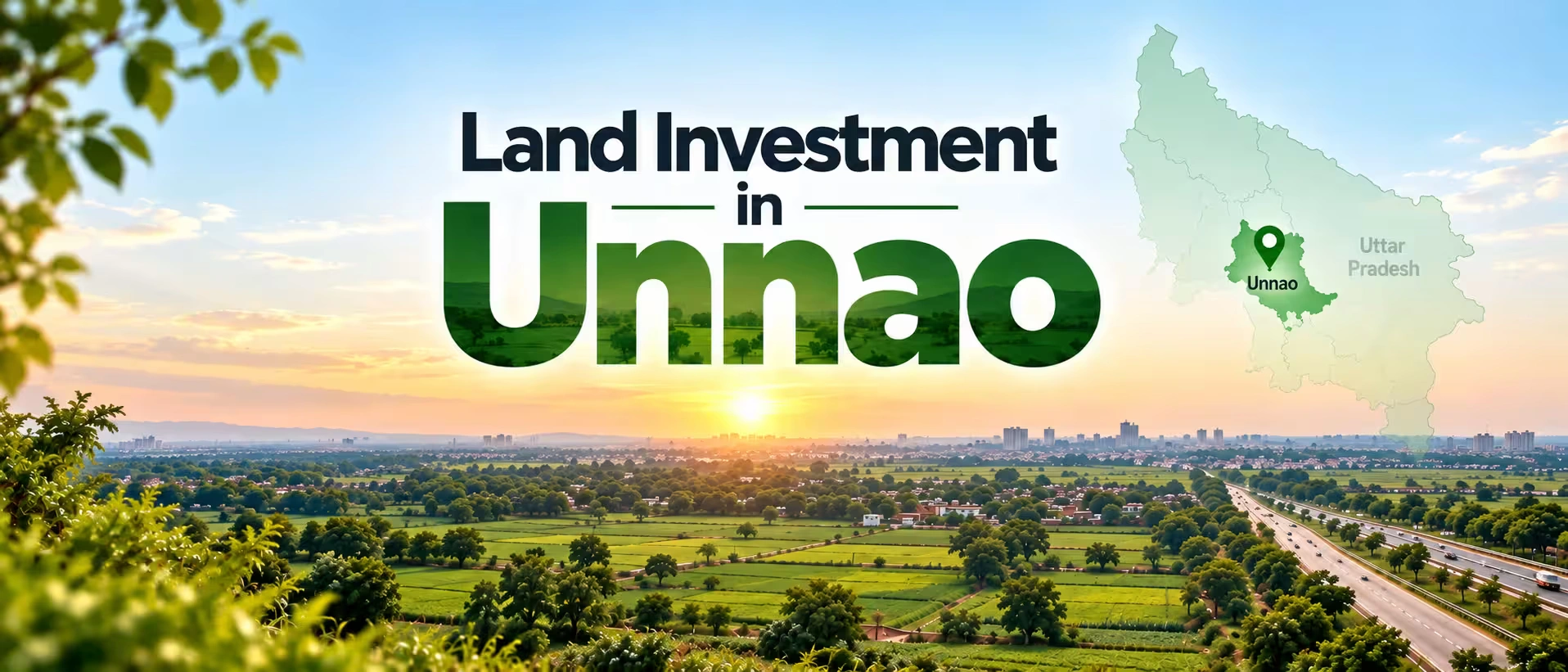
Unnao used to be the district people drove through on their way from Lucknow to Kanpur. Nobody stopped, nobody invested, and land here traded quietly between local families for generations. That picture has changed a lot faster than most outsiders realise. With the UP Integrated Manufacturing and Logistics Cluster taking shape near the Lucknow-Kanpur highway, the Ganga Expressway cutting travel time to a fraction of what it was, and Lucknow's urban sprawl pushing steadily eastward, Unnao has quietly become one of the more interesting land markets in central Uttar Pradesh.
If you're thinking about buying a plot in Unnao, hunting for agricultural land for sale in Unnao, or simply trying to understand whether a farm search in Unnao is worth your time in 2026, this guide walks through everything you actually need to know — not the generic checklist you'll find on ten other websites, but the practical, on-ground reality of buying land in this district.
Key Takeaways
- Unnao's land market is being reshaped by the UPEIDA-led logistics cluster near the Lucknow-Kanpur State Highway, the Ganga Expressway, and Unnao's own railway stations — infrastructure that is already pushing up demand in specific pockets.
- Prices vary sharply by block. Land close to NH-27, the Lucknow-Kanpur highway, and the upcoming industrial cluster commands a real premium over land in the interior blocks.
- Agricultural land and residential plots follow completely different legal pathways in UP — conversion (land use change) is a step many first-time buyers skip and later regret.
- Verified property listing websites have made selling property online in Unnao far more realistic than it was five years ago, cutting out a lot of the guesswork that used to come with local brokers alone.
- Title verification, encumbrance checks, and revenue record matching (Khatauni/Khasra) are non-negotiable before you pay a rupee in advance.
- Whether you're buying or planning to sell land in Unnao, timing your move around infrastructure announcements — not after them — is where the real value sits.
Why Unnao Is Getting a Second Look From Investors
For a long time, Unnao's real estate story was mostly about its leather and textile units around Banthar and the Unnao-Kanpur industrial belt. That's still true, but it's no longer the whole picture. What's changed is connectivity, and connectivity is what actually moves land prices — not sentiment, not marketing brochures.
Three developments are doing the heavy lifting here. First, UPEIDA has been developing an Integrated Manufacturing and Logistics Cluster in Unnao, positioned right along the Lucknow-Kanpur State Highway with access to the Ganga Expressway, the Unnao and Sonik railway stations, and Lucknow's international airport. That's a serious industrial anchor, and industrial anchors pull housing, warehousing, and ancillary commercial demand along with them — this is a pattern you'll recognise if you've watched what happened around the Yamuna Expressway belt over the last five years. Second, the reserved rate the authority has set for industrial land in Unnao is actually higher than in Aligarh, largely because of Unnao's proximity to Lucknow — a signal that the state itself sees this district differently than it did a decade ago. Third, Lucknow's own growth has nowhere to go but outward, and Unnao sits directly in that expansion path.
None of this means every acre in Unnao is suddenly gold. It means the district has stopped being a flat, undifferentiated market. Some blocks are genuinely heating up. Others are still moving at the same slow, seasonal pace they always have. Knowing which is which is the entire game.
Types of Land You'll Encounter in Unnao
Before you go further, it helps to separate the three broad categories buyers usually confuse, because the paperwork, pricing, and purpose are all different.
Residential plots are what most first-time buyers are after — a demarcated piece of land, usually near a town or a developing colony, meant for building a home eventually. If you're searching for a plot in Unnao, chances are you're looking at land in or around areas like Nawabganj, Safipur, Bangarmau, or pockets closer to the district headquarters, where layouts are starting to appear on private colonisers' maps.
Agricultural land is the far larger category by area, and it's where a lot of the real opportunity — and real risk — sits. Genuine agricultural land for sale in Unnao is usually priced per bigha or per acre rather than per square yard, and it comes with restrictions on non-agricultural use unless you apply for conversion. Farmers here still measure land in bigha as a matter of habit, and pricing conversations often happen in that unit even when the paperwork uses acres.
Farmland for lifestyle or long-term holding is a newer trend. Buyers from Lucknow and Kanpur increasingly run a farm search in Unnao not to farm commercially but to hold land as a weekend retreat or a long-term appreciation play, betting that today's agricultural land becomes tomorrow's residential or commercial zone once conversion norms catch up with ground reality.
What's Actually Driving Prices Block by Block
Unnao isn't one market — it's several small ones stitched together under a single district name. A buyer comparing rates without accounting for location within the district is comparing apples to mangoes.
| Location Factor | Effect on Price | Practical Note |
|---|---|---|
| Proximity to Lucknow-Kanpur State Highway / NH-27 | Strong premium | Land within a few kilometres commands the highest rates in the district |
| Near the UPEIDA logistics cluster (Banthar/Unnao node) | Rising steadily | Still catching up to Yamuna Expressway-style jumps, but the trajectory is clear |
| Proximity to Unnao or Sonik railway station | Moderate premium | Useful for buyers eyeing commercial or warehousing potential later |
| Interior blocks (away from highways) | Lower, stable pricing | Better for pure agricultural use or long-term low-cost accumulation |
| Riverbank / Ganga floodplain-adjacent land | Discounted, but check restrictions | Often cheaper for a reason — floodplain norms can limit construction |
This kind of block-by-block variation is exactly why relying on a single average "rate per acre" figure for Unnao is misleading. Two plots ten kilometres apart can differ in price by 40-50% depending on which side of the highway they sit on.
Buying Land in Unnao: What to Check Before You Pay Anything
Land deals in Uttar Pradesh have a reputation, and not always a flattering one — disputed titles, benami holdings, and family partition disputes are common enough that skipping due diligence isn't a risk worth taking, no matter how good the price sounds.
Here's the sequence experienced buyers actually follow, not the theoretical one:
- Match the Khasra and Khatauni records at the local Tehsil office (or through the UP Bhulekh portal) against the seller's claimed area and boundaries. Discrepancies here are more common than people expect, especially on ancestral land that's been informally divided among heirs.
- Run an encumbrance check to confirm the land isn't mortgaged, under litigation, or attached against a loan default.
- Verify land-use classification. Agricultural land can't legally be used for residential or commercial construction until it's formally converted (land use change), and this step gets skipped far too often by buyers in a hurry.
- Confirm the seller's title chain goes back at least 12-13 years without gaps, and check for any pending inheritance claims from co-owners who haven't signed off.
- Visit the site physically, ideally with a local surveyor, rather than relying solely on photos or a broker's word. Boundary markers in rural Unnao aren't always where the paperwork says they are.
- Check the circle rate for that specific area (available on the UP Stamp and Registration Department portal) so your stamp duty calculation and negotiated price are grounded in reality rather than what a broker tells you.
Skipping any one of these steps to save a week or two has cost more than one buyer their entire deposit.
Where Buyers Actually Search: Property Listing Websites and Local Networks
A decade ago, buying land in a district like Unnao meant working almost entirely through local brokers and word of mouth. That's changed. Property listing websites now carry genuine, verified inventory from this belt, and serious buyers typically use a mix of both — online research to shortlist, and local verification to close.
This is where a platform like 2Bigha has carved out a useful role for buyers specifically hunting land, plots, and farms in tier-2 and tier-3 districts like Unnao — categories that the bigger, apartment-heavy portals don't always serve well. Instead of scrolling through a mix of flats, builder projects, and commercial spaces to find one relevant plot listing, land-focused platforms let you filter directly by acreage, land type, and proximity to specific roads or landmarks, which matters a lot more in a district like this than it does in a metro. Pairing that kind of shortlisting with an on-ground visit and a local land consultant gives you the best of both worlds — reach and verification.
Selling Land in Unnao: A Different Set of Priorities
If you're on the other side of the table — looking to sell land in Unnao rather than buy — the priorities shift, but the underlying discipline stays the same.
Get your documents in order first. Buyers today, especially ones sourced online, ask for clean title documents, updated Khatauni copies, and mutation records upfront. Sellers who have these ready close deals noticeably faster than sellers who scramble to arrange paperwork after a buyer shows interest.
Price it against real recent transactions, not old family expectations. It's common for landowning families in Unnao to anchor their asking price to what a neighbour "supposedly" got five years ago. Land near the industrial cluster and highway corridors has moved since then — sometimes up, sometimes not as much as rumour suggests. A quick check against current circle rates and a couple of recent listings keeps expectations realistic.
Selling property online in Unnao has genuinely widened the buyer pool beyond your immediate village or block. Listing on a credible platform puts your land in front of Lucknow- and Kanpur-based buyers who'd never have heard about it through local word of mouth — people specifically hunting for a plot in Unnao or a farm search in Unnao as an investment rather than a local family upgrading their holding. That said, online listings work best when paired with clear photos, accurate boundary details, and a seller who responds quickly — vague or outdated listings tend to get scrolled past.
For owners who'd rather not manage tenant queries, encroachment checks, or seasonal upkeep themselves after a purchase or during a long sale process, engaging a property management service can take a lot of that operational burden off their plate, particularly for larger agricultural holdings where absentee ownership is common.
Legal and Regulatory Points Specific to Uttar Pradesh
A few UP-specific rules matter more than buyers realise:
- Land ceiling laws in UP restrict how much agricultural land a single individual or family can hold; large parcel purchases should be checked against these limits before you commit.
- Stamp duty in UP currently runs around 7% for men and slightly lower for women buyers (with periodic revisions), calculated on the higher of the circle rate or the actual transaction value — always confirm the current rate at the time of registration, since these figures do get revised.
- Conversion of agricultural land for non-agricultural use requires an application to the local Sub-Divisional Magistrate (SDM), and approval isn't automatic — it depends on the zoning and master plan status of that specific area.
- Registration must happen at the Sub-Registrar office covering that Tehsil; deals "settled" only on stamp paper without registration hold no legal weight and are unfortunately still common in rural transactions.
Negotiating and Closing the Deal
Once due diligence is done and you're ready to move ahead, the actual negotiation in a market like Unnao works a little differently than it does in a metro city. Local sellers often expect some back-and-forth, and quoting an unrealistically low first offer can sour the conversation before it starts. A better approach is to walk in with a price range backed by circle rates and two or three comparable recent transactions in that exact block — not the district average, since, as covered earlier, rates swing sharply depending on how close the land sits to the highway or the industrial cluster.
Once a price is agreed, insist on a proper agreement to sell before handing over any advance, spelling out the timeline for registration, the exact area and boundaries, and what happens if either side backs out. For larger parcels, it's worth engaging a local advocate familiar with Tehsil-level records rather than relying only on the broker's assurance — brokers are useful for sourcing and negotiation, but they aren't a substitute for independent legal verification. Registration should follow soon after, at the Sub-Registrar office covering Tehsil, with both parties present along with the required identity and property documents.
Payment structuring matters too. Serious buyers typically pay a token advance to lock the deal, followed by the balance at registration, rather than paying a large sum upfront before the title verification is complete. If a seller pushes hard for full payment before registration, treat that as a reason to slow down, not speed up.
A Realistic Look at Risks
It would be dishonest to present Unnao as a risk-free opportunity. Riverbank areas near the Ganga carry flood-related construction restrictions. Some pockets still have unresolved inheritance disputes going back a generation or more. And infrastructure timelines in India — however well-planned on paper — routinely slip, so buying purely on the promise of "the expressway will reach here soon" is a bet, not a certainty. The sensible approach is to treat infrastructure momentum as one input among several, not the only reason to buy.
Disclaimer: This article is for general informational purposes only and should not be treated as legal, financial, or investment advice. Land prices, government rates, stamp duty figures, and regulatory requirements mentioned here are indicative and subject to change. Please verify current details with local revenue authorities, a qualified legal professional, and official government portals before making any buying or selling decision.