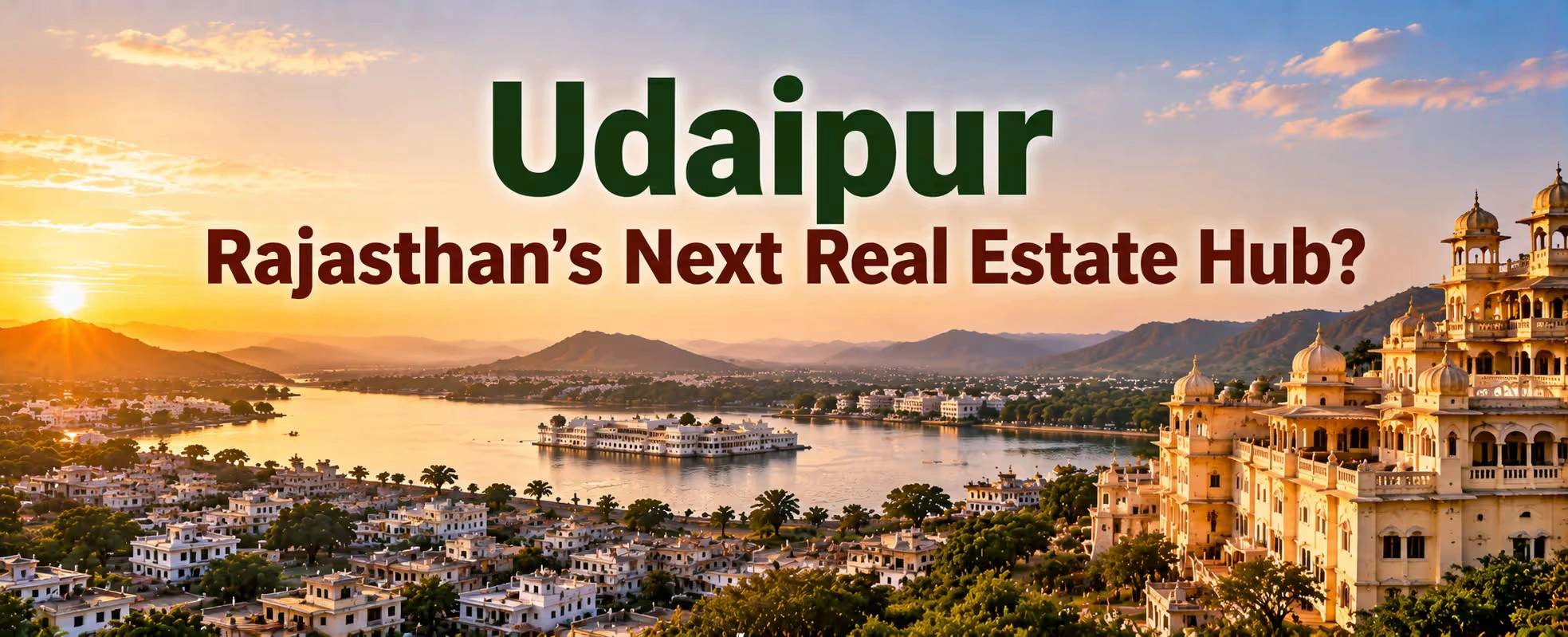
Ask people for the best real estate market in Rajasthan, and the answer will automatically be Jaipur. Why not? The state capital boasts of its metro, its industrial clusters, its IT parks. Well, that’s okay too. But over the past few years, there has been a certain trend developing in the erstwhile Lake City of Udaipur that has started making waves in statistics and not just tourist advertisements. Is Udaipur finally competing, or is this merely a seasonal trend? Let’s take a closer look at what is actually happening city-wise and factor-wise.
How Udaipur Stacks Up Against the Rest of Rajasthan?
| City | Known For | Real Estate Driver | Growth Character |
|---|---|---|---|
| Jaipur | State capital, IT/ITeS sector, and industrial zones | Infrastructure development, GCC expansion, and corporate demand | Established, high-volume growth |
| Jodhpur | Industrial expansion and DMIC corridor influence | Manufacturing and logistics activity | Steady, industry-led growth |
| Udaipur | Tourism, lakes, and heritage appeal | Hospitality demand, land scarcity, and migration | Emerging, appreciation-led growth |
| Ajmer | Religious tourism and regional connectivity | Pilgrimage economy and highway access | Moderate, steady demand |
Jaipur has managed to generate about 65% returns over the past five years in certain areas, which makes it very tough for others to beat it. It also enjoys the privilege of having the necessary policies which other cities can just dream of, such as lower setting-up costs through RIPS 2024, IT and ITeS tax concessions, and zero stamp duties. Udaipur is not doing the same and, in fact, does not have to.
The Land Scarcity Angle Nobody Talks About Enough
That which makes Udaipur different from Jaipur or Jodhpur is as follows. Firstly, the two cities have some land space where there is a possibility of development. Udaipur does not have such land space. The city is surrounded by hills, lakes, and protected land spaces. This may seem trivial, but it has an impact on how much land enters the land market regardless of the level of demand for the land. In situations where the supply is naturally limited, the price of land in the land market tends to rise faster compared to a situation where land supply is not limited. This is one reason why plotted developments are doing better than apartments and flats in Udaipur.
What's Actually Driving Udaipur's Growth Right Now?
A few forces are converging at the same time, which is rarely a coincidence.
1. The Ring Road Is Rewriting the Map
What is interesting about the project is the way that it has covertly converted "far away" into "15 minutes from the center." Places like Umarda, Bedla and Lakhawali, which used to be seen as remote locations, now have easy access not only to the heart of the city but even to the Ahmedabad Highway. The development of such connectivity generally paves the way for appreciation in prices.
2. Tourism Isn't Slowing Down
Udaipur pulled in close to 2 million tourist arrivals in a recent year, and that volume creates year-round demand for rental properties, vacation homes, hospitality-linked real estate, and Farmland in India that can be developed for farm stays, eco-tourism, and wellness retreats. Unlike a one-off spike, this is a durable demand base; weddings, leisure travel, and heritage tourism all feed into it differently, which spreads the demand across the calendar instead of concentrating it in one season.
3. Migration From Smaller Towns
Families hailing from small cities around Rajasthan's south are migrating to Udaipur due to better education, health facilities, and jobs. This migration constitutes real user demand and not speculative demand, and it is a sustainable form of growth as it does not just vanish when the mood changes. In addition, it is a sticky type of demand, and once families migrate for education and/or jobs, they are not planning on migrating anywhere soon.
4. State-Level Push for Infrastructure
Efficient approval processes and investments in infrastructure made by the state government have made real estate development much easier and feasible here than before, resulting in increased developer interest and more choices for buyers.
Where Udaipur Still Falls Behind Jaipur?
To be fair to Jaipur, it's not losing its top spot anytime soon.
- Corporate and IT demand – Jaipur is pulling in GCCs, IT/ITeS firms, and institutional investors at a scale Udaipur simply isn't built for yet.
- Policy incentives – RIPS 2024 and Jaipur-specific data centre incentives don't have an Udaipur equivalent right now.
- Metro and large-scale transit – Jaipur's metro expansion is reshaping entire corridors in a way Udaipur's more modest infrastructure projects can't match at the same scale.
- Absolute market size – Jaipur simply has more transaction volume, more developers, and more inventory across price points.
So if you're comparing raw scale, Jaipur wins comfortably. But real estate investment isn't only about which city is biggest right now; it's often about which city has the most room left to grow.
So, Is Udaipur "The Next Big One"?
Here's the honest answer: Udaipur isn't trying to become the next Jaipur, and that's exactly why it's interesting. Jaipur's growth is broad and diversified: IT, industry, tourism, government policy, all pulling together. Udaipur's growth is narrower but arguably more concentrated: tourism-driven demand meeting a genuinely limited land supply. That combination tends to produce sharper appreciation in specific pockets, even if the overall Udaipur real estate market stays smaller than Jaipur's in absolute size.
For someone looking to purchase land in Udaipur today, the pitch isn't "this will be the next capital city." It's "this is a city with real geographic limits on supply, real tourism-backed demand, and infrastructure catching up fast." That's a genuinely different, and in some ways more defensible, investment case than chasing a market that's already priced in most of its growth.
What This Means for Buyers Right Now?
| If You Want... | Consider |
|---|---|
| Large-scale corporate and IT-driven growth | Jaipur |
| Industrial and logistics exposure | Jodhpur |
| Tourism-backed appreciation with land scarcity | Udaipur |
| Lower entry cost with long-term appreciation potential | Udaipur's emerging corridors (Balicha, Umarda, Debari) |
If your goal is to Buy Land in Udaipur before the ring road and airport-driven appreciation fully plays out, the current window still looks reasonable compared to where things are likely headed over the next five years.
Finding the Right Opportunity with 2Bigha
Whether you've decided Udaipur fits your investment thesis or you're still weighing it against Jaipur and Jodhpur, the next step is finding land you can actually trust. 2Bigha is a marketplace built for buying and selling agricultural land and farmland across India, with strong coverage across Udaipur's growth corridors. Rather than piecing together information from five different local brokers, you get clearer ownership and location details in one place, which makes it far easier to evaluate a plot for sale in Udaipur on its actual merits. And if you already hold land here and are watching the market for the right exit point, the same platform helps you Sell Land in Udaipur to buyers who are genuinely in the market, not just browsing listings.
Conclusion
It is unlikely for Udaipur to surpass Jaipur in terms of being the largest real estate market in Rajasthan any time soon, but that does not matter. Instead, the unique thing that sets Udaipur apart is the fact that it has something special in itself: a place that is indeed constrained geographically, benefiting from stable tourism inflows, and receiving long-awaited connectivity improvements. Investors who have made a profit in Jaipur can see a similarly appealing situation in Udaipur, but slightly delayed and driven by other factors. Whether this makes it "the next big one" is more about scarcity and tourism than about comparing city sizes.
Disclaimer: This article is for informational purposes only and should not be considered investment, legal, financial, or property advice. Real estate regulations, infrastructure plans, market conditions, and government policies may change over time. Readers are advised to verify information with relevant authorities and consult qualified professionals before making any investment or property-related decisions.