Key Takeaways
- Sri Ganganagar is an agriculturally fertile region that uses canal water for irrigation in North Rajasthan, where wheat, cotton, and mustard cultivation takes place, and is ideal for investors looking for productive agriculture lands to generate farm revenue.
- Alwar is a region within the National Capital Region and is favored by the Delhi-Mumbai Expressway and industrial corridors, making it more viable for land appreciation and farmhouse investments.
- Gang Canal, which has recently crossed 100 years of its existence, is undergoing extensive renovation and will be allocated a significant budget by the state of Rajasthan.
- The location of Alwar region in the Delhi-Mumbai Industrial Corridor and the RapidX rail link has increased the rate of land appreciation faster than any other region in Rajasthan.
- Investors must verify the usage category, availability of canal or groundwater, roads, and records of the land before buying, as all these determine the farm produce and future sale of land.
Introduction
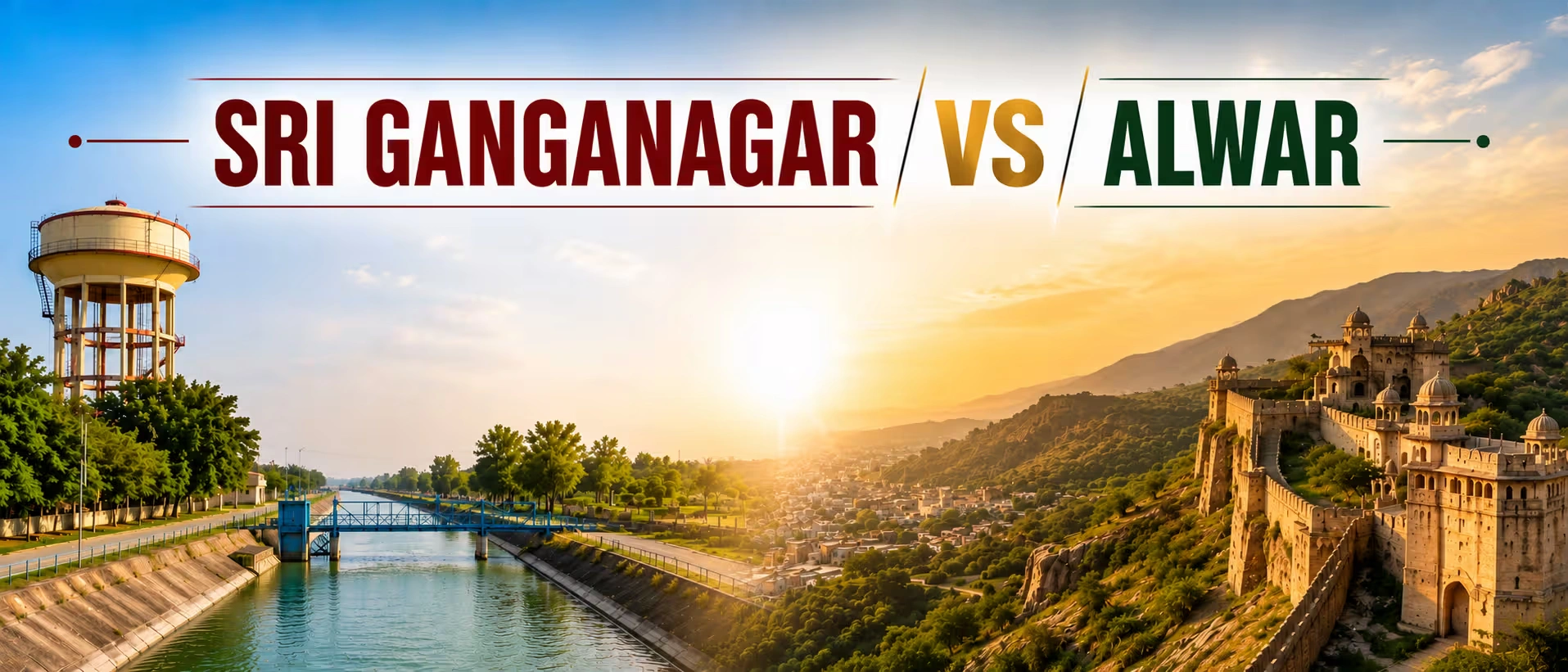
It is always tough to choose between two completely contrasting places, and so is the case of the two agricultural districts, Sri Ganganagar and Alwar. Sri Ganganagar district is considered one of the oldest and most fertile areas in Rajasthan for canal irrigation agriculture and is popularly known as the food basket of the state. Alwar is another name of the Delhi NCR region and is witnessing rapid industrial and infrastructure development. Both these districts are equally good for farmers, buyers of plots, and investors but for different reasons. Let us find out about their soil quality, water supply, connectivity, government assistance, and price of the land.
Understanding the Two Districts
What Makes Sri Ganganagar an Agricultural Hub
Sri Ganganagar is located in the extreme north of the state of Rajasthan, adjacent to the Punjab state boundary. The main source of the prosperity of agricultural land in Sri Ganganagar is irrigation through canals. Due to the Gang Canal constructed by Maharaja Ganga Singh in 1927 and later the Indira Gandhi Main Canal, this desert area has transformed into the richest agricultural belt in the state. Sri Ganganagar is a city in northwest India, which is the administrative headquarters of Sri Ganganagar district, the northernmost district of the state of Rajasthan, bordering Punjab state and Pakistan.
Alluvial soil along with perennial water availability through canals helps produce wheat, mustard, cotton, guar, and citrus fruits (the famous kinnow orchards are grown here). For this reason, the district of Sri Ganganagar has earned the reputation of being the “Food Basket of Rajasthan.”
In a major recent development, Rajasthan's Chief Minister announced Rs 1,717 crore for Gang Canal modernisation, including automation and feeder reconstruction, to boost irrigation and farmer welfare, at the Gang Canal Centenary Celebrations in Sri Ganganagar. This kind of long-term government investment is a strong signal for anyone looking at Sri Ganganagar for serious agricultural use rather than short-term land trading.
What Makes Alwar Attractive for Investors
In the case of Alwar, it is completely different. It is located in the periphery of the National Capital Region (NCR), which makes it a beneficiary of the demand generated by the city of Delhi regarding real estate investments, weekend homes, and industries. The district of Alwar is home to one of the corridors of DMIC, which is known as the Khushkheda-Bhiwadi-Neemrana Investment Region and covers an area of approximately 165 sq. km and includes 42 villages of the district of Alwar, which has already been approved through the development plan.
Apart from industry, there is an increasing trend of farmhouse land and gated farm communities in places like Naugaon. Naugaon is situated in Alwar district and is situated at a distance of only 60-90 km from Delhi and Gurugram through Delhi-Mumbai Expressway and provides good connectivity with respect to Alwar city, Sariska Tiger Reserve, and proposed Bhiwadi-Alwar Airport. There is also improvement in rail connectivity as the Alwar-Delhi RRTS (RapidX) Corridor will make the commute time between Delhi, Gurugram, and Alwar in about 1 hour 44 minutes. These factors have contributed towards making people buy in Alwar, Rajasthan.
Sri Ganganagar vs Alwar: Side-by-Side Comparison
| Factor | Sri Ganganagar | Alwar |
| Primary strength | Canal-irrigated farmland, crop yield | NCR proximity, industrial and farmhouse growth |
| Water source | Gang Canal, Indira Gandhi Main Canal | Mostly groundwater and tube wells, limited canal coverage |
| Main crops | Wheat, mustard, cotton, guar, kinnow | Mustard, bajra, wheat, vegetables (smaller scale) |
| Connectivity | Rail and road links to Punjab and Rajasthan cities | Delhi-Mumbai Expressway, NH-48, upcoming RapidX rail |
| Investment style | Long-term farming income, land banking | Land appreciation, farmhouse living, weekend homes |
| Government focus | Canal modernisation (Rs 1,717 crore project) | DMIC industrial region, RRTS rail corridor |
| Buyer profile | Farmers, agri-investors, family farmland buyers | NCR-based investors, farmhouse buyers, retirees |
Land Prices and Return Potential
Sri Ganganagar Land Pricing Trends
Land prices in Sri Ganganagar tend to move in line with agricultural output and canal reliability rather than speculation. Fertile, canal-fed plots close to towns like Sri Ganganagar city, Sadulshahar, or Padampur usually command a premium over land dependent on tube wells. Because irrigation infrastructure here is old and well-established, price growth is steady rather than explosive. This makes it a reasonably stable option for someone who wants to purchase land in Ganganagar primarily to farm it or rent it out to tenant farmers, and who is not chasing rapid appreciation.
Alwar Land Pricing Trends
Alwar land prices, especially in expressway-facing belts like Naugaon, Bhiwadi, and Neemrana, have been rising quickly because of infrastructure-led demand. For example, farmhouse investment options in areas like Naugaon start from around ₹80 lakh onwards, reflecting how developer interest and NCR demand have pushed values up in what used to be simple farmland. If you plan to buy land in Alwar or later sell land in Alwar, this appreciation potential is one of the biggest draws, though it also means prices are more sensitive to project delays and market sentiment than pure agricultural land in Sri Ganganagar.
Government Initiatives and Regulations to Know
Rajasthan's Canal Modernisation Push
The Gang Canal centenary announcement is not a one-off event. The Chief Minister also highlighted progress under the PM-KUSUM Yojana, noting that Rajasthan ranks first in KUSUM-A and third in KUSUM-C, with farmers in 22 districts already receiving daytime power for agriculture, and Sri Ganganagar farmers set to be added soon. This matters for investors because reliable daytime electricity directly affects irrigation costs and crop cycles.
Land Use Rules for Farmhouses in Alwar
Anyone looking at farmhouse land in Alwar should understand that agricultural land cannot automatically be used for residential-style construction. Rajasthan requires Form 1A clearance for farmhouse construction on agricultural land to ensure compliance with state laws, and the state's land laws aim to balance traditional farming with modern residential needs. Buyers should also confirm Change of Land Use (CLU) approval where developers claim it, and verify NOCs from local authorities and, where relevant, the Forest Department, since parts of Alwar lie near protected zones like Sariska.
Why Due Diligence Matters in Both Districts
Whether you are buying canal-fed farmland in Sri Ganganagar or a gated farm plot in Alwar, the same basic checks apply:
- Title verification – confirm the seller's ownership through Jamabandi (land record) documents.
- Land use category – agricultural, non-agricultural, or CLU-approved.
- Water rights – canal allotment in Sri Ganganagar, groundwater depth and quality in Alwar.
- Road and boundary records – especially important for farmhouse plots sold in phases.
- Local development plan – check if the land falls within an approved investment region or master plan.
This is where using a property management service or a trusted digital platform becomes valuable, since it reduces the risk of disputed titles or unapproved layouts.
Practical Example: Two Investor Profiles
Case 1 – The Farming Family. A family from Punjab wants steady agricultural income and decides to purchase land in Ganganagar near an established canal minor. They lease part of the land to a tenant farmer growing wheat and mustard, earning predictable seasonal income while the land itself appreciates slowly but steadily due to the Gang Canal modernisation project improving water reliability.
Case 2 – The NCR Weekend Investor. A Gurugram-based professional wants farmhouse land for weekend use and future appreciation. They choose a gated plot in Naugaon, Alwar, about 90 minutes from Gurugram via the Delhi-Mumbai Expressway. Within a few years, as the RapidX corridor and DMIC region develop further, the land value rises, and the plot doubles as a lifestyle asset and an investment.
Both are valid strategies. The right one depends on whether you want income from farming or capital appreciation with lifestyle benefits.
Choosing a Subscription Plan or Service for Land Research
Many buyers now prefer using a 2Bigha subscription plan with a property research platform rather than relying only on local brokers. A good platform gives you:
- Historical land price trends by village or tehsil
- Verified listings with clear land-use status
- Access to land records and ownership history
- Alerts on new projects, government announcements, or infrastructure updates
Such platforms as 2Bigha have been created to assist in just this sort of research by providing means to compare districts like Sri Ganganagar and Alwar, study land papers, and make a sound investment decision based on a comparison that is particularly valuable in the case of two such dissimilar alternatives as irrigated lands and farmhouses facing the NCR region.
Which District Should You Choose?
There is no single right answer — it depends on your goal.
Choose Sri Ganganagar if:
- You want farmland primarily for crop production or leasing to farmers.
- You value stable, canal-backed irrigation over speculative growth.
- You are comfortable with slower, more predictable appreciation.
Choose Alwar if:
- You want a farmhouse or weekend property close to Delhi NCR.
- You are looking for faster land appreciation driven by infrastructure.
- You are open to non-farming uses like tourism, weekend rentals, or resale.
Some investors even choose to diversify — holding productive farmland in Sri Ganganagar for income and a farmhouse plot in Alwar for lifestyle and appreciation.
Conclusion
Ultimately, the choice between investing in agriculture in Sri Ganganagar or Alwar boils down to your intentions behind owning agricultural land. Sri Ganganagar provides the true agricultural power by virtue of being endowed with century-old canals which are constantly updated by the Rajasthan government, thus becoming perfect for investors who seek to make money through agriculture. Alwar, with its NCR advantages, expressways, and industrial clusters, becomes a great option for those who seek capital gains and farmhouse life. Regardless of the district you choose, make sure to check land documents, permissions, and utilities beforehand. Using a credible website such as 2Bigha will help you to become a more informed investor when choosing agricultural land.
Disclaimer: This article is for informational purposes only and should not be considered investment, legal, financial, or property advice. Real estate regulations, infrastructure plans, market conditions, and government policies may change over time. Readers are advised to verify information with relevant authorities and consult qualified professionals before making any investment or property-related decisions.