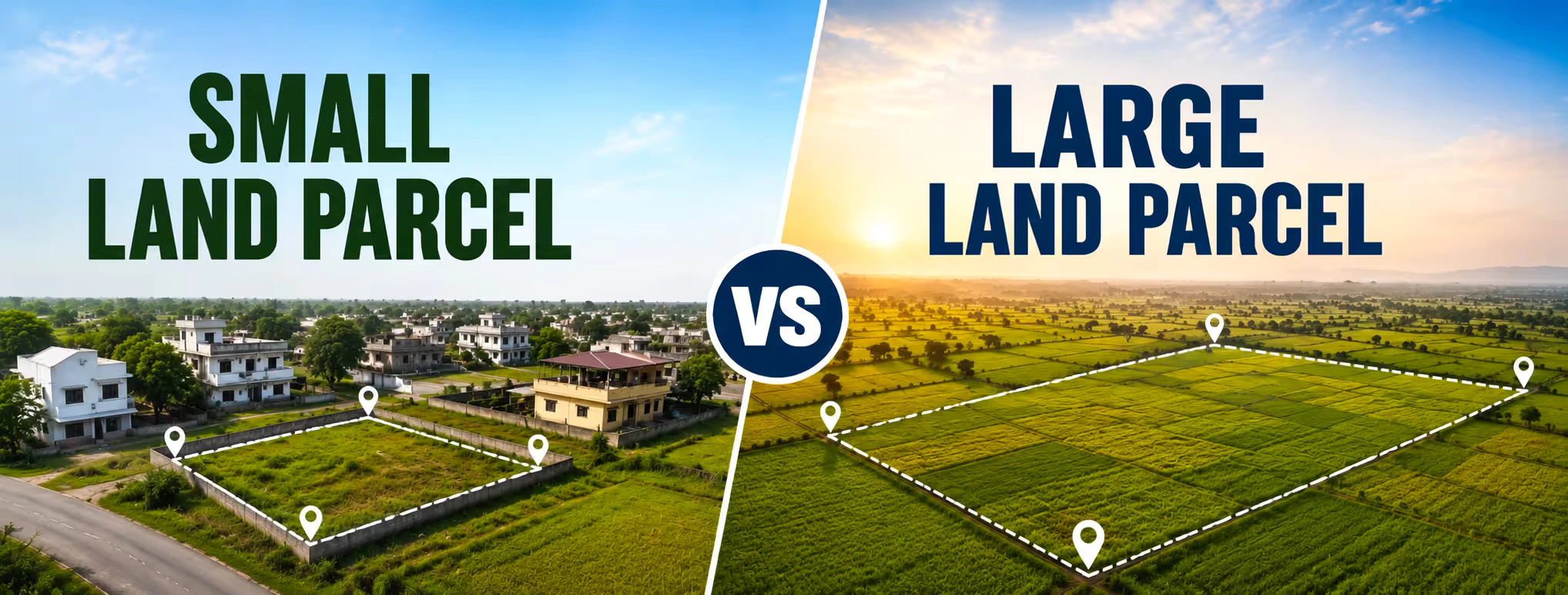
Key Takeaways
- A small land parcel generally suits first-time buyers, limited budgets, weekend farming, farmhouse plans and buyers who want easier maintenance.
- A large land parcel offers better scope for commercial farming, agribusiness, plotted development and long-term land aggregation, but it requires more capital and active management.
- Do not judge land only by acreage. Road access, title clarity, water availability, plot shape, surrounding development and permitted land use can matter more than size.
- Small plots may attract a wider buyer pool, while large parcels can take longer to resell unless they have strategic location advantages.
- A large property is not automatically a better investment. The right parcel is the one that supports your intended use without creating unnecessary financial or operational pressure.
- Buyers should compare the total acquisition cost, not merely the seller’s quoted price.
- Always verify ownership, land classification, access rights, mutation records, survey boundaries and state-specific purchase restrictions before paying a token amount.
Small Land Parcel or Large Land Parcel: The Direct Answer
A small land parcel is usually the better choice when you have a controlled budget, want manageable ownership and plan to use the property personally. A large land parcel makes more sense when you have sufficient capital, a clear commercial plan and the ability to manage fencing, water, labour, security and ongoing maintenance.
In practical terms, size should follow purpose.
Buying 20 acres simply because the per-acre rate looks attractive can become an expensive mistake when you only need two acres for a farmhouse. Similarly, buying one acre may restrict your plans when your real objective is commercial horticulture, warehousing, a solar project or a large managed farm.
The best decision comes from matching four factors:
- Your intended use
- Your available capital
- Your ability to manage the property
- Your future exit strategy
What Is Considered a Small or Large Land Parcel in India?
There is no single real estate definition that classifies every privately marketed property as small or large. The meaning changes by location, land category and intended use.
One acre may feel substantial near Delhi NCR, Bengaluru or Pune, where land prices can be high. The same area may be considered too small for commercial farming in parts of Rajasthan, Madhya Pradesh or Maharashtra.
For agricultural reporting, the Government of India classifies operational holdings as:
- Marginal: Below 1 hectare
- Small: 1 to 2 hectares
- Semi-medium: 2 to 4 hectares
- Medium: 4 to 10 hectares
- Large: 10 hectares and above
These are agricultural census categories, not universal real estate investment categories. They nevertheless provide useful context. The latest official figure cited by the Union government places India’s average operational holding at 1.08 hectares, down from 1.15 hectares in 2010–11.
For an individual buyer, a more practical classification may look like this:
- Small personal-use parcel: Approximately 0.25 to 2 acres
- Mid-sized parcel: Approximately 2 to 10 acres
- Large investment or commercial parcel: More than 10 acres
These ranges should remain flexible. Land value, usability and local regulations matter more than a fixed acreage label.
Small Land Parcel vs Large Land Parcel: Quick Comparison
| Decision Factor | Small Land Parcel | Large Land Parcel |
| Initial investment | Usually lower | Usually substantially higher |
| Buyer suitability | First-time buyers and personal users | Experienced investors and commercial users |
| Maintenance | Easier to manage | Requires regular supervision |
| Fencing cost | Lower overall | Can become a major expense |
| Farming potential | Suitable for intensive or hobby farming | Suitable for broader commercial operations |
| Resale market | Often wider | More specialised |
| Resale timeline | Potentially shorter | May take longer |
| Price negotiation | Limited in high-demand areas | Better scope in some rural markets |
| Infrastructure cost | Lower in absolute terms | Higher for roads, water, power and security |
| Income potential | Limited by scale | Higher when supported by a viable business plan |
| Diversification | Limited use options | Can support multiple activities |
| Risk exposure | Lower capital concentration | Higher capital and legal exposure |
| Management requirement | Moderate | High |
| Subdivision potential | Usually limited | May offer future subdivision, subject to law |
| Best suited for | Farmhouse, weekend use, first investment | Farming, agribusiness, institutional or long-term investment |
Why Buyers Choose Small Land Parcels
Small parcels appeal to buyers because they feel financially and operationally manageable. They allow people to enter the land market without committing their entire investment capacity to one property.
A person living in Gurugram, Noida or Jaipur may want a one-acre or two-acre property for weekend farming, retirement planning or a future farmhouse. Such a buyer may not require the complexity of a 20-acre holding.
Small land parcels can also be suitable for:
- Organic vegetable cultivation
- Nurseries
- Floriculture
- Poultry or small dairy activity
- Personal orchards
- Weekend homes
- Retirement properties
- Long-term appreciation
- Trial agricultural projects
The key advantage is control. You can inspect the complete boundary, monitor activity and improve the property without deploying a large team.
1. Lower Entry Cost
A smaller parcel allows buyers to enter a preferred location without overextending financially.
Suppose a buyer has a total budget of ₹50 lakh. Spending the complete amount on land may leave nothing for registration, legal verification, fencing, site grading, water arrangements or construction.
Buying a smaller parcel for ₹35 lakh and keeping ₹15 lakh for development may create a more usable asset than buying a larger property for the complete ₹50 lakh.
The cheapest land is not always the most affordable land. A low purchase price can be misleading when the property requires major spending after registration.
2. Easier Maintenance and Security
Vacant land does not remain maintenance-free simply because no building stands on it.
Owners may need to manage:
- Boundary marking
- Fencing repairs
- Weed and vegetation growth
- Waterlogging
- Illegal dumping
- Encroachment risk
- Local supervision
- Access-road maintenance
- Agricultural labour
- Periodic document checks
These tasks remain easier on a small parcel. A local caretaker can inspect the full property quickly, and the owner can understand what is happening on the ground.
3. Wider Resale Market
A small property often fits the budget of more buyers. This can improve liquidity, particularly near expanding towns, highways, industrial corridors and weekend destinations.
For example, a two-acre parcel may appeal to:
- A local farmer
- A city-based investor
- A farmhouse buyer
- A small developer
- A hospitality entrepreneur
- A nursery operator
A 50-acre property attracts a much narrower group. The buyer may need institutional capital, agricultural experience or a development strategy.
However, small size alone does not guarantee fast resale. An irregular plot without legal access can remain unsold despite its lower ticket size.
4. Easier Experimentation
First-time land buyers rarely know every practical challenge before ownership.
A small parcel lets you learn about local labour, water conditions, fencing, agricultural cycles, documentation and community relationships without taking excessive exposure.
Consider it a controlled entry rather than a small ambition.
Many buyers begin with one or two acres, understand the local market and purchase adjoining land later. This approach can work, but only when future aggregation is realistic. Neighbouring owners may refuse to sell or demand a premium once they recognise your intention.
Limitations of Buying a Small Land Parcel
A small property can appear convenient at the time of purchase but may restrict long-term use.
Limited Economies of Scale
A borewell, transformer, internal approach, storage shed or security arrangement may cost nearly the same whether the property measures two acres or six acres.
That means infrastructure cost per acre can be significantly higher on a small parcel.
Commercial farming also depends on scale. While high-value crops, nurseries and controlled farming can work on limited acreage, conventional crops may not generate sufficient returns after labour, irrigation and transportation expenses.
Restricted Future Expansion
A one-acre plot may be enough for a basic weekend retreat but not for a larger farmhouse, orchard, livestock area, rainwater pond and staff accommodation.
Buyers frequently underestimate how much area setbacks, internal roads, landscaping and utility zones consume.
You should therefore prepare a simple land-use sketch before finalising the property. Mark the proposed building, setbacks, entrance, parking, plantation, water system and open area. This exercise quickly reveals whether the plot is genuinely adequate.
Higher Price Per Unit
Small plots in popular locations may command a higher per-acre or per-bigha rate because they are affordable to a larger audience.
A seller may quote ₹40 lakh for one acre while offering ten acres in the same region at ₹30 lakh per acre. The larger parcel appears cheaper per acre, but the buyer must still deploy ₹3 crore.
The unit rate matters, but total capital exposure matters more.
Why Buyers Choose Large Land Parcels
Large land parcels can create opportunities that small holdings cannot support. They offer operational flexibility, stronger negotiating power and the possibility of combining multiple land uses.
A 20-acre property may accommodate cultivation, an orchard, storage, livestock, water harvesting and future expansion. The owner does not need to compromise every time the project grows.
Large parcels are generally considered for:
- Commercial cultivation
- Horticulture
- Dairy or livestock projects
- Agroforestry
- Warehousing, where legally permitted
- Solar or renewable-energy projects
- Resorts or farm stays, subject to approvals
- Institutional development
- Long-term land banking
- Future subdivision, where permitted
- Large family estates
1. Better Scale for Commercial Use
A commercial agricultural project usually requires more than fertile soil. It may need internal roads, irrigation networks, worker facilities, machinery access, storage and buffer space.
A large parcel provides room for these supporting functions.
However, acreage does not create profitability by itself. A 50-acre dry property without dependable water can be less productive than a well-irrigated five-acre farm near a reliable market.
Commercial buyers should evaluate the complete operating model:
- What will the land produce?
- Who will manage it?
- Where will the produce be sold?
- What is the expected annual cost?
- How much water will the activity consume?
- How long will the project take to break even?
- Can the land support an alternative use if the first plan fails?
2. Lower Per-Acre Pricing in Some Markets
Sellers of large properties may offer a lower unit rate because fewer buyers can afford the complete holding.
This can create an attractive acquisition opportunity for a financially prepared buyer. It can also create a value trap.
A parcel available at a 20% discount is not a bargain when half of it is rocky, inaccessible, disputed or affected by a high-tension line.
Always compare the usable land rate, not merely the advertised land rate.
For example, assume a 20-acre parcel costs ₹20 lakh per acre. The quoted value is ₹4 crore. If five acres are unusable because of steep terrain, drainage channels or access constraints, the effective rate on the 15 usable acres becomes much higher.
3. Greater Flexibility
Large parcels allow buyers to divide activity into zones. One portion may support cultivation, while another remains available for a farmhouse, orchard or future project.
This flexibility can protect the investment when market conditions change.
A buyer who initially plans agricultural use may later consider a farm stay or institutional activity. That change remains subject to land-use rules, permissions and local development controls. Ownership does not give an automatic right to convert or develop land.
4. Potential for Value Addition
A large parcel may gain value when the owner improves access, completes fencing, resolves record discrepancies, installs irrigation or organises the property into functional sections.
Value addition should remain lawful and commercially justified. Buyers should not assume that every large agricultural holding can be divided and sold as residential plots.
Unauthorised plotting can create registration problems, penalties and future litigation.
Limitations of Buying a Large Land Parcel
Large land ownership can look impressive on paper while quietly consuming capital.
1. Higher Total Acquisition Cost
The purchase value is only the first layer.
A large parcel may require substantial spending on:
- Stamp duty and registration
- Legal due diligence
- Professional measurement
- Boundary pillars
- Fencing
- Gates and access control
- Internal roads
- Water infrastructure
- Electricity connection
- Soil improvement
- Labour accommodation
- Security
- Insurance, where applicable
- Ongoing supervision
A buyer who spends the complete budget on acquisition may struggle to protect or use the property.
2. Complex Title Verification
Large properties may include several khasra numbers, survey numbers, co-owners or inherited shares. They may have been assembled over time from different sellers.
Each component requires verification.
A clean title for one survey number does not automatically prove clean ownership of the complete parcel. You must confirm that the sale deed, revenue record, mutation, cadastral map and physical possession align for every section.
India’s Digital India Land Records Modernization Programme aims to improve transparency and modernise records, and the Department of Land Resources provides links to state and Union Territory Record of Rights portals. Digital records are useful, but they do not eliminate the need for physical verification and professional legal review.
3. Higher Encroachment and Supervision Risk
An owner may not notice activity occurring at the far end of a large holding, particularly when the property lacks a clear boundary.
Seasonal cultivation by neighbours, movement of boundary markers, informal pathways and dumping can gradually create disputes.
Regular site inspection matters. Large absentee-owned properties require a reliable local system, not occasional visits during holidays.
4. Slower Exit
Finding a buyer for a high-value property can take time. Buyers may ask for:
- Partial purchase
- Extended payment schedules
- Development partnerships
- Price reductions
- Joint ventures
- Seller financing
- Conditional agreements
These arrangements can increase legal and financial complexity.
A large parcel should therefore be purchased with a longer holding horizon unless the location already has strong institutional demand.
Parcel Size Is Not the Most Important Factor
Buyers often begin their farmland search by filtering acreage and budget. That approach is convenient, but it can hide the factors that determine whether the property is actually useful.
A smaller, rectangular plot with direct road access can be more valuable than a much larger property reached through an uncertain village track.
Before comparing size, evaluate the following.
Location
Location affects access, labour availability, agricultural inputs, emergency services, buyer demand and resale potential.
Do not rely only on the distance from a major city. A property advertised as “90 minutes from Delhi” may require three hours during peak traffic or the monsoon.
Check actual travel time at different hours.
Legal Access
A road visible on a satellite image does not automatically establish a legal right of access.
Confirm whether the approach road is:
- Public
- Recorded in the revenue map
- Privately owned
- Shared through a registered right
- Merely used informally by local residents
A property without legally enforceable access can become difficult to finance, develop and resell.
Plot Shape
Rectangular and square plots generally support easier planning, fencing and cultivation.
A narrow strip may contain the promised acreage but offer limited practical use. Irregular boundaries can increase fencing cost and create unused pockets.
Measure frontage and depth rather than checking area alone.
Water Availability
Water needs differ by project.
A farmhouse may need modest domestic supply. An orchard, dairy or commercial crop operation may require consistent water throughout the year.
Do not treat a neighbouring borewell as evidence that your land will receive the same yield. Groundwater conditions can change within a short distance.
Check existing water sources, local depth, electricity availability, seasonal changes and extraction restrictions.
Soil and Topography
A visually green property during the monsoon may become dry for the rest of the year.
Study:
- Soil type
- Natural drainage
- Slope
- Flood history
- Waterlogging
- Erosion
- Rock content
- Existing crops
- Nearby farming patterns
A soil test costs little compared with the investment and can prevent a serious mismatch.
Surrounding Activity
Visit the surrounding area, not only the plot.
A peaceful parcel can lose appeal when located near a proposed dumping site, polluting industry, stone crusher, high-tension corridor or flood-prone channel.
Speak with local farmers, not only the broker or seller. Local conversations often reveal seasonal conditions and boundary history that documents do not show clearly.
Which Parcel Size Works for Different Buyer Goals?
For a Weekend Farmhouse
A small or mid-sized parcel will usually meet the requirement.
The buyer needs enough land for the building, landscaping, parking, plantation, utilities and privacy. Purchasing excessive acreage can increase maintenance without improving the experience.
Focus on connectivity, security, road quality and year-round accessibility.
For Retirement Planning
A manageable parcel near healthcare, markets and a functioning town is generally more practical than a remote large estate.
Retirement buyers should think about the property at age 65 or 70, not only at the time of purchase. A large farm may feel attractive today but become physically and financially difficult to maintain later.
For Commercial Farming
A larger parcel may support a better scale, but the correct size depends on the crop.
High-value horticulture, protected cultivation and nurseries can work on relatively limited acreage. Grain cultivation and mechanised operations generally need larger areas to achieve meaningful scale.
The business plan should determine acreage—not the other way around.
For Long-Term Appreciation
Location quality matters more than owning the maximum area.
A three-acre plot near a credible growth corridor may outperform 30 acres in a stagnant region. Buyers should examine actual infrastructure execution, not rumours about future highways, airports or industrial projects.
Check notifications, development plans and government records wherever possible.
For Future Subdivision
Large properties may create subdivision opportunities, but buyers must confirm whether local laws permit the intended activity.
Minimum plot-size rules, road-width requirements, land-use restrictions, agricultural conversion procedures and development permissions vary significantly.
Land and land records fall primarily under state administration, and purchase, ceiling, transfer and land-use rules can differ across India.
Do not buy agricultural land on the assumption that you can automatically convert it into residential plots.
How Budget Changes the Decision
Consider two hypothetical options.
Option A: Small Parcel
- Area: 2 acres
- Purchase price: ₹60 lakh
- Legal, registration and measurement: ₹6 lakh
- Fencing and gate: ₹5 lakh
- Basic water and site work: ₹7 lakh
- Contingency: ₹4 lakh
- Approximate total deployment: ₹82 lakh
Option B: Large Parcel
- Area: 10 acres
- Purchase price: ₹2.2 crore
- Legal, registration and measurement: ₹20 lakh
- Fencing and access work: ₹18 lakh
- Water and power setup: ₹15 lakh
- Security and initial maintenance: ₹7 lakh
- Contingency: ₹15 lakh
- Approximate total deployment: ₹2.95 crore
The large parcel may offer a lower per-acre rate, but it demands far more total capital.
The correct comparison is not ₹30 lakh per acre versus ₹22 lakh per acre. It is ₹82 lakh of total exposure versus nearly ₹3 crore.
A buyer should also consider the opportunity cost. Capital locked in unused land cannot support other investments, emergencies or business needs.
Small vs Large Agricultural Land: Income Expectations
Buyers sometimes expect agricultural income to cover ownership expenses immediately. This rarely happens without planning and active management.
Income depends on:
- Crop selection
- Soil suitability
- Water reliability
- Labour availability
- Market distance
- Input costs
- Yield
- Storage
- Transportation
- Weather
- Management quality
A larger agricultural farmland holding may generate more gross revenue, but it also creates higher operating expenses.
Small parcels can work through intensive use. A nursery, floriculture project or premium vegetable operation may earn more per acre than a large low-input farm. However, these activities require knowledge, labour and market access.
Passive ownership and profitable farming are not the same thing.
How Resale Value Differs
Small Parcel Resale
Small parcels generally attract more individual buyers because the total price remains accessible.
They may sell well near:
- Growing towns
- Tourist destinations
- Industrial clusters
- Major highways
- Second-home markets
- Established agricultural communities
However, excessive fragmentation can reduce usefulness. A half-acre plot may attract buyers near an urban edge but have limited agricultural value in a remote village.
Large Parcel Resale
Large parcels appeal to fewer but potentially stronger buyers.
The buyer may be:
- A farmer expanding operations
- An agribusiness company
- A developer
- An institution
- A hospitality operator
- A renewable-energy company
- A long-term investor
The sale can take longer because due diligence, financing and internal approvals become more detailed.
When reviewing farm listings, check how long comparable properties have remained available. A market with hundreds of repeated listings but few completed transactions may lack genuine liquidity.
Common Mistakes Buyers Make
Buying More Land Than They Can Manage
A large property can become a burden when the owner lacks a local manager, operating plan or maintenance budget.
The emotional satisfaction of owning 25 acres fades quickly when fencing breaks, weeds spread and disputes begin.
Buying Too Little for the Intended Use
The opposite mistake also occurs.
A buyer purchases a small plot and later realises that setbacks, internal access and utilities leave insufficient usable space.
Prepare a basic site plan before committing.
Focusing Only on Price Per Acre
A low rate can reflect:
- Poor access
- Weak title
- Water scarcity
- Difficult terrain
- Remote location
- Disputed boundaries
- Restricted land category
- Lack of demand
Price should be viewed as a result of property quality, not as an independent bargain.
Trusting Online Information Without Ground Verification
Searching plots for sale near me can help identify nearby opportunities quickly. It cannot confirm physical boundaries, possession, soil condition or legal access.
Treat online information as the beginning of due diligence, not the end.
Assuming Every Large Parcel Can Be Divided
Subdivision depends on state laws, planning regulations, land classification and local approvals.
An informal promise from a broker does not create legal development rights.
Ignoring Family and Co-Ownership Issues
Inherited rural properties frequently involve multiple family members. One person may show the property even though several legal heirs hold rights.
Ensure every required owner participates in the transaction and verify powers of attorney carefully.
Legal Checks Before Buying Any Land Parcel
The legal process should become more detailed as parcel size and transaction value increase.
1. Verify the Current Owner
Match the seller’s identity with the sale deed, Record of Rights, mutation entries and tax or revenue records.
Check whether the seller holds full ownership or only an undivided share.
2. Review the Ownership Chain
A lawyer should inspect previous title documents for the legally relevant period and identify missing links, inheritance issues, mortgages, court matters or unregistered transfers.
3. Confirm Mutation and Revenue Entries
Mutation supports the updating of revenue records after transfer. It does not replace the registered title deed, but inconsistencies should not be ignored.
The Department of Land Resources maintains links to state-level Record of Rights systems and citizen land-record services.
4. Match the Documents with the Ground
Engage an authorised surveyor or qualified local professional to confirm:
- Survey or khasra numbers
- Total area
- Boundary points
- Encroachments
- Access
- Physical possession
The Unique Land Parcel Identification Number initiative seeks to link parcels with geo-referenced cadastral information, but implementation and record completeness can vary.
5. Check Land Classification
Confirm whether the property is classified as agricultural, residential, industrial, forest, grazing, government, tribal or another category.
Do not rely on the appearance of nearby construction as proof that development is permitted.
6. Check Buyer Eligibility
Several states place conditions on agricultural land ownership, ceilings, transfers or purchases by non-agriculturists.
NRIs and OCIs should take particular care. RBI guidance generally does not permit them to purchase agricultural land, plantation property or farmhouses under the usual permission available for residential and commercial property.
7. Search for Charges and Litigation
Check registered mortgages, bank charges, acquisition notices, court disputes, revenue cases and pending family claims.
8. Confirm Access Rights
The legal documents and revenue map should support the access route visible at the site.
9. Verify Local Dues
Ensure that applicable land revenue, electricity charges, irrigation dues and other property-related liabilities have been cleared.
10. Use a Written Agreement
The agreement should clearly define:
- Total area
- Survey numbers
- Sale consideration
- Payment stages
- Document obligations
- Possession
- Default consequences
- Refund conditions
- Registration timeline
Never depend only on WhatsApp messages or verbal assurances for a high-value land transaction.
Practical Site-Visit Checklist
Use this checklist before selecting either a small or large parcel.
Property and Boundary
- Are all boundary points visible?
- Does the physical area match the documents?
- Is the shape suitable for your plan?
- Is any neighbouring owner using part of the land?
- Does a public path cross the property?
Access and Connectivity
- Is the road public and legally recorded?
- Can a car, tractor or commercial vehicle enter?
- Does the road remain usable during the monsoon?
- How far is the nearest paved road?
- Is mobile connectivity available?
Water and Utilities
- Is a borewell, canal, pond or pipeline available?
- What is the seasonal water position?
- Is electricity available nearby?
- What will a new connection cost?
- Does the property face flooding or waterlogging?
Location
- How far is the nearest town?
- Where are the nearest hospital and market?
- Are labour and agricultural inputs available?
- What projects are actually under construction nearby?
- Are there polluting or disruptive activities in the area?
Legal and Commercial
- Does the seller’s identity match the records?
- Are all co-owners participating?
- Is the land transferable to you?
- Is the quoted price consistent with recent local transactions?
- Can you resell the property without depending on the same broker?
How to Compare Land Online More Effectively
Online discovery has improved access to rural property information, but buyers still need a disciplined comparison process.
Instead of opening random advertisements, shortlist properties using:
- Exact location
- Total area
- Unit of measurement
- Quoted total price
- Effective per-acre price
- Road frontage
- Land category
- Water source
- Distance from the nearest town
- Seller type
- Available documents
- Site photographs
- Map location
A dedicated land marketplace can make this initial comparison more organised than scattered broker messages and unstructured social media posts.
2Bigha allows users to explore verified agricultural land, rural plots and farmland through an interactive map while comparing location, price and plot size. This location-first approach helps buyers eliminate unsuitable options before arranging site visits.
Still, a listing should never replace legal review. Platform verification, seller statements and uploaded documents must be independently checked before payment.
How 2Bigha Helps Buyers and Sellers
Land discovery has traditionally depended on local brokers, roadside boards, personal contacts and incomplete WhatsApp information. That system often makes comparison difficult because every seller describes location, measurements and prices differently.
2Bigha brings agricultural land, farmland, farmhouses and rural plots into a more organised, map-based environment.
Buyers can compare relevant options instead of repeatedly searching for agricultural land on sale across unrelated property categories. The map view also provides useful location context before a physical visit.
For owners interested in selling property online, better location details, realistic pricing, clear photographs and accurate measurements can improve the quality of buyer enquiries.
2Bigha also supports users through its subscription plan and property management service.
The platform should be used as a structured discovery and connection tool. Buyers must still complete title verification, measurement and site inspection through appropriate professionals.
A Simple Decision Framework
Answer the following ten questions before deciding between a small and large parcel.
1. What Will You Do with the Land?
Write down one primary use. Avoid vague answers such as “investment and maybe something later.”
2. How Much Land Does That Use Actually Require?
Prepare a basic area allocation for buildings, cultivation, access, parking, utilities and open space.
3. What Is Your Total Budget?
Include development, registration, fencing, legal work and contingency.
4. Can You Hold the Property for Seven to Ten Years?
Land transactions can move slowly. Do not depend on an immediate resale.
5. Who Will Manage the Property?
Identify the person responsible for site visits, maintenance, labour and local coordination.
6. What Is Your Maximum Acceptable Annual Expense?
Estimate recurring costs before purchase.
7. Is Income Necessary?
A property purchased for appreciation can remain unproductive. A property expected to generate income requires an operating plan.
8. How Will You Exit?
Identify likely future buyers. “Someone will buy it” is not an exit strategy.
9. Can You Handle a Legal Delay?
Larger acquisitions can involve more documents, owners and survey numbers.
10. Would a Smaller, Better-Located Parcel Serve You More Effectively?
This question prevents buyers from choosing acreage over quality.
When a Small Land Parcel Is the Better Choice
Choose a smaller property when:
- You are buying land for the first time.
- You have a limited but stable budget.
- You want a weekend home or personal farm.
- You cannot supervise a large property regularly.
- You prefer a wider resale audience.
- You need land near a major city.
- Your planned activity does not require commercial scale.
- You want to learn before expanding.
- You value location over acreage.
- You need to preserve capital for development.
Small parcels are particularly suitable when the buyer wants personal enjoyment and long-term value rather than a full agricultural business.
When a Large Land Parcel Is the Better Choice
Choose a larger property when:
- You have a clear commercial or institutional plan.
- Your project requires scale.
- You can fund the complete acquisition and development.
- You have reliable local management.
- Water and access have been independently verified.
- The title structure is clean.
- You can hold the investment for the long term.
- The parcel has a strategic location or operational advantage.
- You understand applicable land-ceiling and transfer rules.
- You are comfortable with a narrower resale market.
A large property should solve a real requirement. Buying extra acres without a purpose merely converts available capital into maintenance responsibility.
What About Buyers Searching for “Farmground for Sale”?
The phrase farmground for sale is sometimes used by buyers searching for agricultural or rural land, although “farmland for sale” and “agricultural land for sale” are more commonly used in India.
Regardless of the search wording, buyers should confirm whether the advertised property is genuinely agricultural land, a farmhouse plot, converted land or an unapproved subdivision.
Similar-sounding listings can represent very different legal categories.
Final Verdict: Small or Large Land Parcel?
There is no universally better parcel size.
A small land parcel usually wins on affordability, manageability and resale flexibility. A large parcel wins on scale, diversification and long-term commercial potential.
The strongest purchase is not necessarily the largest property you can afford. It is the parcel that:
- Has a clear and transferable title
- Offers legal and practical access
- Supports your intended use
- Fits your complete budget
- Can be maintained properly
- Has realistic resale demand
- Does not depend on speculative promises
For most first-time buyers, a smaller, well-located, and legally clear parcel is safer than a large remote holding purchased only because the per-acre price appears cheap.
For experienced investors and commercial operators, a larger parcel can create substantial value—but only when water, access, title, management and market demand support the plan.
Use 2Bigha to compare relevant land opportunities by location, size and price before investing time in site visits. Then move from online shortlisting to physical inspection, professional measurement, and independent legal due diligence.
Acreage attracts attention. Usability creates value.
Editorial Note: Agricultural land laws, ownership eligibility, land ceilings, conversion procedures and registration requirements vary by state. Buyers should obtain independent legal and technical advice for the specific property before completing a transaction.