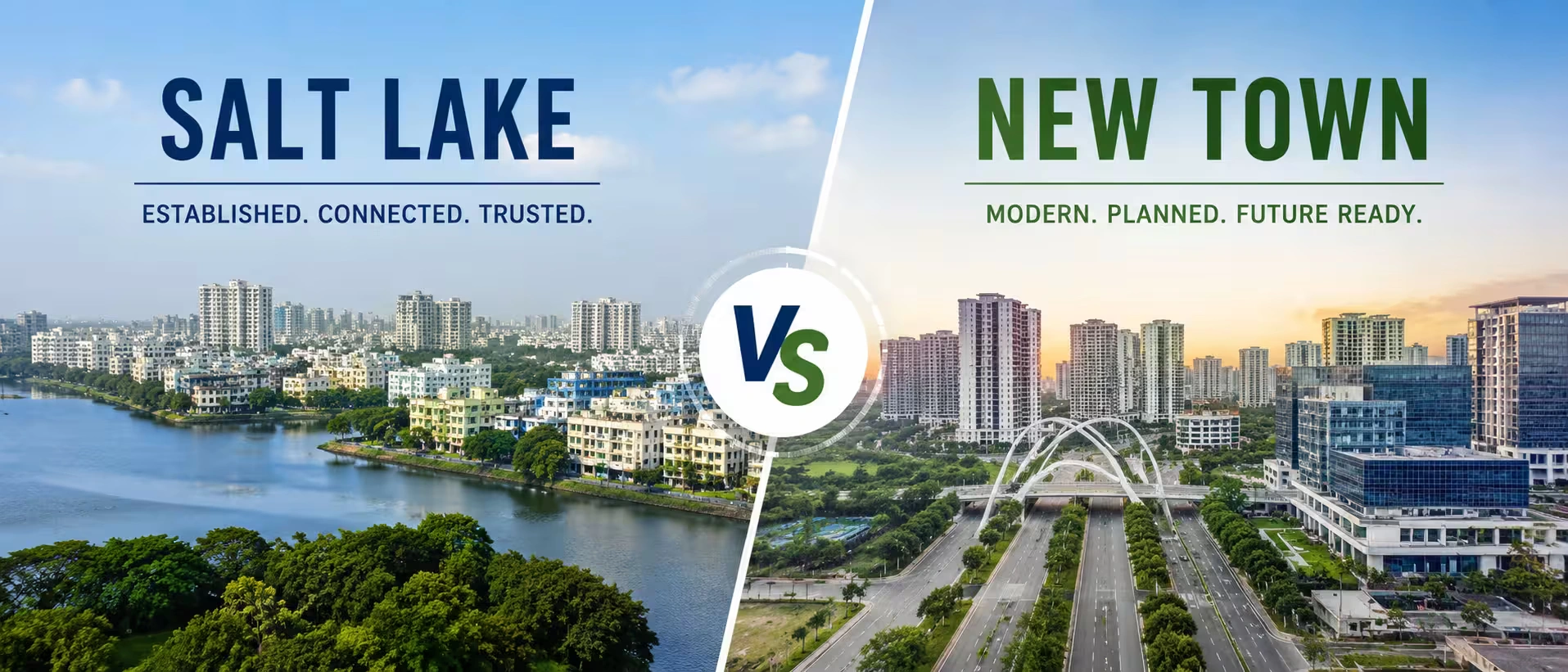
Kolkata’s eastern growth corridor offers two very different land investment opportunities. Salt Lake, also known as Bidhannagar, is an established planned township with mature neighbourhoods, offices, schools, hospitals and dependable connectivity. New Town is a newer planned city that continues to add residential, commercial and social infrastructure.
Both locations attract property investors, but they do not offer the same entry cost, risk level or growth potential.
Salt Lake may suit buyers who value scarcity, an established address and lower development uncertainty. New Town may be better for investors seeking a longer growth runway, more property choices and the possibility of stronger appreciation. However, the final decision should depend on the title, permitted land use, road access, holding period and exact location, not only the area name.
Salt Lake and New Town Are Different Investment Markets
Many buyers compare Salt Lake and New Town only by looking at property prices. That approach can lead to a poor investment decision because their land markets work differently.
Salt Lake is already substantially developed, and vacant lands are limited. When land for sale becomes available, it may be connected to an existing house, a redevelopment opportunity or the transfer of leasehold rights. This scarcity can help support property value, but it also increases the entry cost and makes legal verification essential.
New Town was developed in phases as a greenfield township. It includes residential developments, office districts, educational institutions, recreation zones and major roads. Investors may find more variety here, including officially allotted lands, resale properties and land in the wider Rajarhat–New Town corridor.
This wider selection creates opportunities, but the quality of land can vary sharply between locations. Two lands marketed under the New Town name may have completely different road access, approvals, infrastructure and appreciation potential.
Why Land Investors Consider Salt Lake
Salt Lake’s biggest advantage is that buyers do not have to wait for the neighbourhood to become liveable. It already has established residential blocks, Sector V’s employment base, healthcare facilities, local markets and road links to central Kolkata and the airport side.
For a land investor, this maturity reduces location-related uncertainty. A well-positioned land may attract families, professionals, builders, clinics or offices, depending on its approved use. Limited fresh land supply can also help a legally clear property maintain its value over time.
Salt Lake generally suits investors looking for:
- A recognised and established Kolkata address
- Limited land supply and scarcity value
- Redevelopment or self-use opportunities
- Existing residential and commercial demand
- Lower dependence on future infrastructure promises
The main limitation is affordability. Investors may need to commit a large amount for a relatively small parcel. Undeveloped land also produces no rental income unless it already has a usable structure or the investor develops it.
Salt Lake therefore makes more sense for capital preservation, self-use or redevelopment than for low-budget speculative investment.
Understand Salt Lake’s Leasehold Structure
A buyer should not assume that every Salt Lake property is a straightforward freehold sale. Many land were originally allotted on a leasehold basis. A transaction may involve government permission, applicable transfer charges and compliance with conditions mentioned in the lease.
Before paying a token amount, verify the original allotment letter or lease deed, transfer permissions, mutation records, property tax receipts, sanctioned building plan and approved land use.
Buyers should also check whether the property has an active mortgage, legal dispute, unauthorised construction or ownership claim. A premium location cannot protect an investor from a defective property transfer.
Why New Town Attracts Growth-Focused Investors
New Town’s investment potential comes from continuing urban expansion. It has arterial roads, planned residential districts, commercial zones, educational campuses, recreation spaces and growing public infrastructure.
Unlike Salt Lake, several parts of New Town and its adjoining corridors still have development potential. New residential projects, workplaces and public facilities can gradually increase demand for nearby land.
For investors searching for land for sale with a seven-to-ten-year investment horizon, New Town may offer stronger appreciation potential. Buyers can focus on lands near occupied housing projects, employment districts, major roads, educational institutions and public transport.
New Town may suit investors seeking:
- A longer urban growth cycle
- More residential and commercial land options
- Newer infrastructure and planned development
- Access to employment and business districts
- Potential appreciation from future population growth
However, higher potential also brings greater location risk.
Do Not Trust the “Near New Town” Label Blindly
The name “New Town” is frequently used loosely in property advertisements. A land promoted as being near New Town may actually be located several kilometres outside the planned township.
It could be situated in a village or peripheral mouza with different road conditions, municipal services and land-use controls. Some projects use the New Town name mainly for marketing, even when they fall outside the area managed by the relevant development authority.
Always verify the land number, mouza, khatian, administrative jurisdiction and distance from recognised landmarks. Do not depend only on a project name, brochure or map shared by a broker.
Micro-Location Matters More Than the New Town Name
New Town is not one uniform property market. A land’s investment potential depends on its Action Area or surrounding locality, distance from occupied developments, road width, drainage, electricity, water supply and nearby commercial activity.
A higher-priced land in an established pocket may carry lower development risk. A cheaper land on the fringe may provide greater upside, but investors may have to wait longer for roads, utilities, shops and public transport.
Visit the location personally before making a decision. Confirm that the access road shown in the documents exists physically. Where possible, inspect the area during the monsoon to understand drainage and waterlogging conditions.
Check whether homes, shops, schools and transport facilities are already operating nearby. Real activity on the ground is more valuable than proposed infrastructure shown in a sales presentation.
What About Agriculture Farmland Near New Town?
Buyers often see agriculture farmland advertised around Rajarhat, Bhangar and other peripheral locations at prices below residential lands. The lower entry cost can appear attractive, but agricultural and residential land are not interchangeable assets.
Agricultural farmland may make sense when the buyer genuinely wants cultivation, farm leasing, agroforestry or a long-term landholding. It becomes risky when the investment depends entirely on the hope that the land will soon be converted into residential property.
Before purchasing agricultural farmland, confirm:
- Its recorded land classification
- The complete ownership chain
- Mutation and tax records
- Physical possession and boundaries
- Legal access from a recognised road
- Whether land conversion is required
- Wetland, waterbody or environmental restrictions
- Acquisition, tenancy or legal disputes
Never pay the price of a residential land for agricultural land simply because an agent promises that conversion or urban development will happen later.
Salt Lake vs New Town: Investment Comparison
| Investment Factor | Salt Lake | New Town |
|---|---|---|
| Market Stage | Mature and established | Developing and expanding |
| Land Availability | Very limited | More options across different pockets |
| Entry Cost | Usually higher | Wider price range |
| Main Value Driver | Scarcity and established demand | Infrastructure, employment and urban growth |
| Legal Concern | Leasehold transfer and approved use | Title, jurisdiction and land classification |
| Best Suited For | Stability, self-use and redevelopment | Long-term appreciation |
| Main Investment Risk | High acquisition cost | Selecting the wrong peripheral location |
Which Location Should You Choose?
Choose Salt Lake when your priority is a proven neighbourhood, established demand and limited land supply. It is more suitable for investors with a higher budget who are prepared to complete detailed lease and transfer verification.
Returns may be steadier rather than dramatic, but a well-located and legally clear land can remain desirable because new land supply is extremely limited.
Choose New Town when your priority is future growth. It may work well for investors who can hold the property patiently and select land near functioning infrastructure, occupied residential projects and employment areas.
New Town offers more upside opportunities, but an isolated parcel in an undeveloped peripheral location can lock up an investor’s money for several years.
Choose agricultural farmland only when the title is clear and the investment remains practical in its current agricultural use. Future conversion should be treated as a possibility, not a guarantee.
Due Diligence Before Buying Land
A land purchase should begin with documents, not with a sales brochure. Ask an independent property lawyer and licensed surveyor to verify the title chain, leasehold or freehold status, mutation, tax payments, encumbrances, land measurements, land classification, access road and permitted use.
Buyers should also check for acquisition notices, litigation, mortgages, tenancy rights, wetland restrictions and unauthorised land subdivision.
Calculate the complete acquisition cost instead of focusing only on the advertised land rate. Registration expenses, transfer fees, legal charges, brokerage, boundary work, land filling and drainage requirements can materially increase the actual investment.
Final Verdict: Salt Lake or New Town?
Salt Lake is the stronger choice for investors seeking stability, scarcity and an established urban address. New Town is generally more suitable for buyers seeking greater choice and higher long-term growth potential.
Agricultural farmland on the outskirts may offer a lower entry point, but it carries a different legal and investment profile. It should not be evaluated like an approved residential land.
Do not invest based on the headline location alone. In Kolkata’s eastern corridor, a legally clear land with proper access and approved use will usually be safer than a cheaper parcel supported only by future promises.
The best investment is not simply Salt Lake or New Town. It is the right parcel, purchased at a reasonable price after complete legal and physical verification.
Disclaimer: This article is for informational purposes only and should not be considered investment, legal, financial, or property advice. Real estate regulations, infrastructure plans, market conditions, and government policies may change over time. Readers are advised to verify information with relevant authorities and consult qualified professionals before making any investment or property-related decisions.