Here's a story that plays out more often than you'd think. Someone buys a piece of rural land, everything looks fine on paper, and then two years later a neighbor shows up claiming the fence line is off by fifteen feet and has always been off by fifteen feet, going back generations. Suddenly you're in a dispute over land you thought was fully yours, sorting out boundaries that were never quite clear to begin with.
Rural land is especially prone to this. Unlike a flat in a city building with clean, documented walls, farmland boundaries often rely on old records, informal markers, sometimes literally a tree or a stone that's moved over the years. If you're planning to buy, the boundary is honestly one of the first things you should be paranoid about, right up there with ownership itself.
Why Rural Boundaries Get Messy in the First Place?
A few reasons this keeps happening, over and over:
- Old survey records don't always match what's physically on the ground anymore, especially in villages where land has been divided among family members multiple times over decades.
- Natural boundary markers, like a canal, a tree line, or a stone marker, shift or disappear entirely, and nobody updates the paperwork.
- Informal family partitions happen without proper legal documentation, so what "everyone knows" about who owns what doesn't actually match the revenue records.
- Adjoining owners sometimes encroach gradually; a few feet of fencing moved every year, until it's suddenly a real dispute.
None of this is necessarily anyone being dishonest. A lot of it is just decades of informal practice catching up with formal paperwork.
What to Check Before You Even Make an Offer?
If you're seriously looking at a plot, whether you found it browsing plots for sale near me or through a broker, there's a specific set of things worth checking before money changes hands.
| Check | Why It Matters |
|---|---|
| Survey/khasra number on the sale deed | Confirms the exact parcel being sold, not just a general description |
| Village map or cadastral map | Shows the recorded boundary shape and dimensions officially |
| Physical measurement vs. recorded area | Mismatches between the two are one of the earliest red flags |
| Encumbrance Certificate (EC) | Reveals pending litigation, court attachments, or ownership disputes |
| Adjoining owner details | Worth knowing who you'll be sharing a boundary with, and whether they've had disputes before |
The survey number is really the anchor for everything else. Every document connected to the land — the sale deed, the EC, the revenue record, the mutation entry — should show the same survey number and the same boundary description. If even one of them doesn't line up, that's worth pausing on before you go further.
Talk to the Neighbors. Seriously.
This sounds almost too simple to matter, but it's one of the most useful things you can do. Documents tell you what's recorded. Neighbors tell you what actually happens on the ground. A short conversation with the people farming or living next to the plot can surface things no paperwork will show you:
- Whether there's been a past dispute over the exact boundary line, even one that got "settled" informally.
- Whether the current fencing or marker actually matches what's on the map, or whether it's shifted over the years.
- Whether the seller has a reputation for honest dealing in the area, which matters more in villages than you'd expect.
If a neighbor hesitates or gets vague when you ask about the boundary, take that seriously. People are usually pretty direct about this stuff unless there's something they're avoiding.
Also Read: Bhu Naksha Gujarat: Spot Boundary Issues Before They Become Legal Problems
Get a Proper Demarcation Done
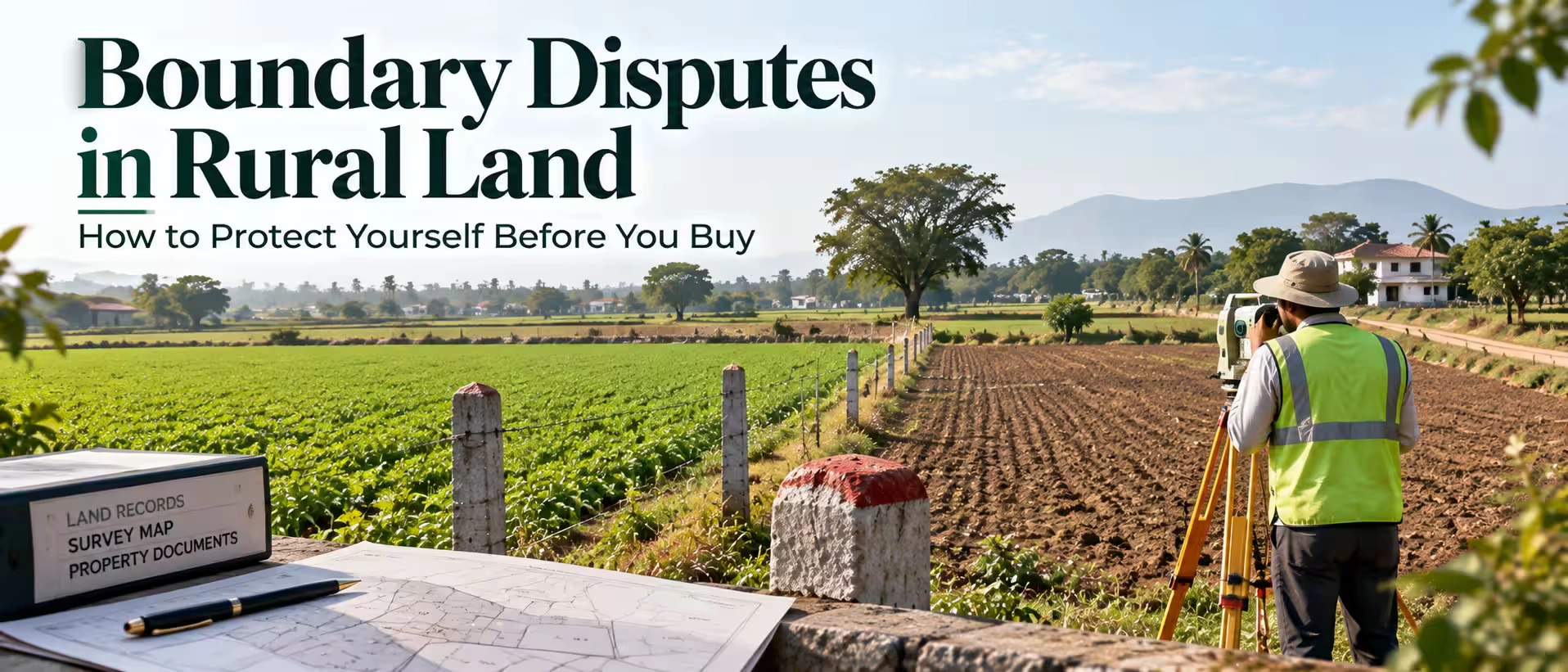
Here's the step a lot of buyers skip, mostly because it takes a bit of effort and a bit of money. A formal demarcation means applying to your local revenue or survey office, usually the Tehsildar or a survey and settlement officer depending on the state, to have the exact boundary physically measured and marked against the official record.
This matters because a boundary dispute, if it ever comes to that, gets decided based on recorded measurement, not on who's been using the land longer or who shouts loudest. A proper demarcation, ideally done jointly with the adjoining landowners present, gives you documented proof of where your land actually starts and ends. It's a bit of a process:
- File an application with the relevant survey office, referencing your survey number.
- Request a joint measurement, meaning adjoining owners get notified and are present.
- Get a certified demarcation report once it's done, and keep it with your other property documents.
Yes, it takes time. But it's a lot cheaper and faster than fighting a dispute after construction has already started, or after you've already paid full price.
Red Flags Worth Walking Away From
Some signs are serious enough that they should make you reconsider the deal entirely, or at least insist on resolving them before you proceed:
- The seller is reluctant to let you get an independent survey done.
- The area on the ground is noticeably different from what's on the deed, and nobody can explain why.
- There's an ongoing court case or lis pendens flagged on the Encumbrance Certificate.
- Multiple family members claim ownership, and only one of them is signing the sale documents.
- The village map hasn't been updated in a long time, and local officials seem unsure of the current boundary themselves.
Any one of these alone might have a reasonable explanation. Two or more together, and it's usually worth stepping back.
If You're Selling, This Cuts Both Ways
If you're the one selling agricultural land, being upfront about boundary status actually works in your favor, not against you. Buyers browsing land for sale near me or farm land for sale near me are increasingly cautious, and for good reason. A listing that clearly states the boundary has been verified and demarcated tends to move faster and attract more serious buyers, since it removes one of the biggest hesitations people have.
This is also part of why a lot of sellers have shifted toward selling property online through platforms with verified listings, rather than relying purely on word of mouth or a local broker's assurance. When you're trying to move farmland for sell, being able to show clean, matched documentation — survey number, EC, demarcation report — does more to close a deal than almost anything else you can offer.
The Honest Bottom Line
Boundary issues rarely show up as a dramatic legal battle on day one. They tend to surface quietly, years later, usually right when you're trying to sell, build, or pass the land on to family. Doing the boundary verification properly before you buy costs some time and a bit of money upfront. Skipping it can cost a lot more later, in legal fees, in stress, and sometimes in losing part of the land entirely.
Verified Boundaries, Verified Land
Whether you're checking out plots for sale near me for the first time or you've been searching land for sale near me for months without finding something you trust, boundary clarity should be non-negotiable before you commit. At 2Bigha, every listing comes with background verification and clear ownership records, so you're not gambling on whether the boundary lines actually match what's on paper. And if you're on the other side of the table, ready to list farmland for sell or explore selling property online, 2Bigha gives you a platform where verified documentation does the heavy lifting for you.
Disclaimer: This article is for informational purposes only and should not be considered investment, legal, financial, or property advice. Real estate regulations, infrastructure plans, market conditions, and government policies may change over time. Readers are advised to verify information with relevant authorities and consult qualified professionals before making any investment or property-related decisions.