Key Takeaways
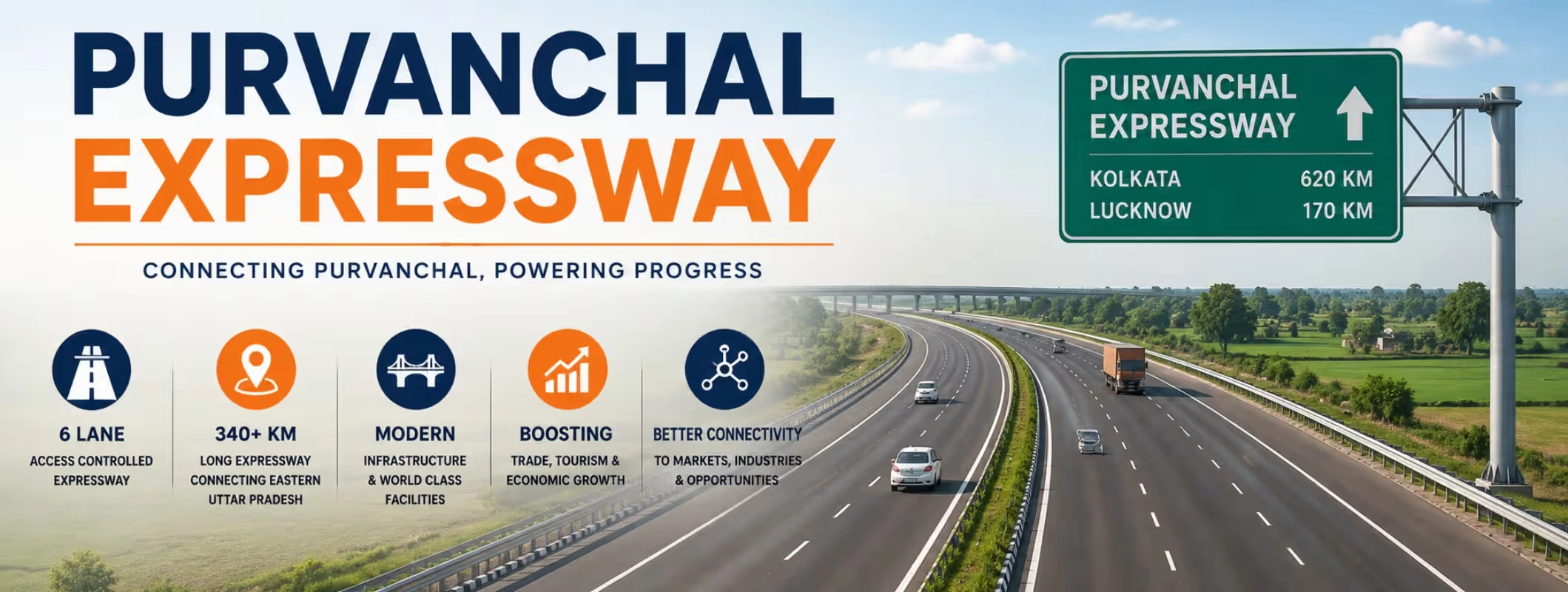
Purvanchal Expressway is one of the most significant road infrastructure projects in Uttar Pradesh, connecting Lucknow with Ghazipur and improving access across Eastern UP.
The expressway is around 340.824 km long and starts near Chand Sarai village in Lucknow district, ending near Haidaria in Ghazipur district, close to the UP-Bihar side.
It passes through or serves major districts such as Lucknow, Barabanki, Amethi, Sultanpur, Ayodhya, Ambedkar Nagar, Azamgarh, Mau, and Ghazipur.
The road is a 6-lane access-controlled expressway, built with future expansion scope up to 8 lanes, and has a design speed of 120 km/h. Drivers should still follow the posted speed signs on the route.
The Purvanchal Expressway toll for a full single journey is charged according to vehicle category. For cars and light motor vehicles, the full-route toll is around ₹700 as per the latest publicly reported 2026 rates.
For property buyers, the expressway has increased interest in land near authorized entry-exit areas, district nodes, commercial pockets, and logistics-friendly locations. Still, land price movement is never guaranteed, and legal due diligence matters more than hype.
What is Purvanchal Expressway?
The Purvanchal Expressway is one of the most important infrastructure developments in Uttar Pradesh, designed to improve connectivity between the state capital, Lucknow, and the eastern region of the state. The expressway enhances transportation and accessibility across key districts such as Sultanpur, Azamgarh, Mau, and Ghazipur, while also strengthening links toward Bihar through the Ghazipur corridor.
For travellers and drivers, the Purvanchal Expressway offers faster, smoother, and more efficient travel across eastern Uttar Pradesh. For local businesses, it supports easier movement of goods and services, helping reduce logistics time and transportation costs.
From a real estate and land investment perspective, the expressway has created rising demand for land near interchanges, access roads, township zones, and upcoming industrial corridors. Improved connectivity often encourages commercial activity and infrastructure development, making nearby locations attractive for future growth.
The growing interest has also increased the demand for land listing online, as buyers and investors actively search for verified plots and agricultural land near major infrastructure projects. Digital land platforms make it easier to compare locations, check connectivity advantages, and explore available opportunities.
However, investors should remember that not all land near an expressway automatically gains high value. Factors such as legal status, road access, surrounding development, zoning regulations, and long-term infrastructure plans play an important role before making any land purchase decision.
Purvanchal Expressway at a Glance
| Feature | Details |
| Expressway Name | Purvanchal Expressway |
| State | Uttar Pradesh |
| Managed By | Uttar Pradesh Expressways Industrial Development Authority |
| Total Length | Around 340.824 km |
| Start Point | Chand Sarai village, Lucknow district, near Lucknow-Sultanpur Road |
| End Point | Near Haidaria village, Ghazipur district |
| Main Route | Lucknow to Ghazipur |
| Districts Covered | Lucknow, Barabanki, Amethi, Sultanpur, Ayodhya, Ambedkar Nagar, Azamgarh, Mau, Ghazipur |
| Lanes | 6 lanes, expandable to 8 lanes |
| Design Speed | 120 km/h |
| Opening Date | 16 November 2021 |
| Project Cost | Around ₹22,494.66 crore including land cost |
| Toll Status | Toll is applicable and revised from time to time |
| Key Use | Passenger travel, logistics, regional trade, district connectivity, land and commercial activity |
Purvanchal Expressway Route: Start Point, End Point, and Districts
The Purvanchal Expressway route starts from Chand Sarai village in Lucknow district, near the Lucknow-Sultanpur Road. From there, it moves eastwards through several districts of Uttar Pradesh and ends near Haidaria in Ghazipur district.
The broad route follows this pattern:
Lucknow → Barabanki → Amethi → Sultanpur → Ayodhya region access → Ambedkar Nagar → Azamgarh → Mau → Ghazipur
This route is valuable because it does not only connect two end points. It brings multiple district-level markets closer to Lucknow and gives Eastern UP better access to the state capital, major highways, and onward regional movement.
Districts Covered by Purvanchal Expressway
The expressway serves nine districts:
- Lucknow
- Barabanki
- Amethi
- Sultanpur
- Ayodhya
- Ambedkar Nagar
- Azamgarh
- Mau
- Ghazipur
These districts are not all equally priced from a property point of view. Land near Lucknow or established town access points generally commands stronger buyer attention. Deeper rural stretches can look affordable, but buyers need to check approach roads, legal documents, land category, and future usability before making any decision.
Purvanchal Expressway Map: How to Understand the Route
When you look at the Purvanchal Expressway map, do not read it only as a straight line from Lucknow to Ghazipur. Read it as a chain of access points, district connections, and market zones.
The western side begins around Lucknow, where the route connects with the capital region. This side attracts attention because Lucknow already has stronger residential, administrative, educational, and commercial activity.
The middle stretch, including Amethi, Sultanpur, Ayodhya-side access, and Ambedkar Nagar, is more mixed. Here, buyer interest often depends on town proximity, agricultural use, institutional movement, and local road connectivity.
The eastern stretch through Azamgarh, Mau, and Ghazipur connects large population belts and trade movement. For Ghazipur and nearby areas, the expressway also improves movement towards the Bihar side.
For land buyers, the map should answer three practical questions:
- How far is the land from an authorized entry or exit?
- Is there a proper approach road from the expressway access point to the plot?
- Is the location close to an existing village, mandi, town, industrial node, petrol pump, school, hospital, or transport activity?
A plot touching a highway boundary is not automatically better. On access-controlled expressways, direct entry from random roadside land is usually restricted. Buyers should focus on legal access, not only distance from the main carriageway.
Major Entry and Exit Areas on Purvanchal Expressway
Purvanchal Expressway entry and exit points are designed through interchanges, slip roads, and toll plazas. For daily travellers and property buyers, these access points matter more than the road line itself.
| Access Area | Why It Matters |
| Lucknow / Chand Sarai side | Main western entry, better connection to the capital region |
| Barabanki / Haidergarh side | Useful for local movement and rural market access |
| Inhauna / Rudauli side | Helps connect nearby towns and the Ayodhya-side belt |
| Amethi / Jagdishpur belt | Relevant for local industry, education, and district movement |
| Sultanpur / Kurebhar area | Central stretch, also known for the airstrip zone |
| Ambedkar Nagar / Akbarpur side | Useful district-level access and local trade movement |
| Azamgarh side | Strong population belt and regional connectivity |
| Mau side | Helps connect eastern UP towns and surrounding rural areas |
| Ghazipur / Haidaria side | Eastern terminal near the UP-Bihar movement zone |
Before planning a journey, drivers should check the latest navigation route because entry and exit movement depends on direction, toll plaza access, and local road conditions.
Purvanchal Expressway Distance and Travel Time
The distance of Purvanchal Expressway is estimated to be 340.824 km. In case of travel from Lucknow to Ghazipur, it is generally assumed that time taken for the journey would be in the region of 3.5 to 4.5 hours.
It is essential for drivers not to mistake the maximum speed limit as the right to go over-speeding. Long-distance driving requires proper lane management, adequate rest, tire condition check, and sufficient breaking distance. Presence of foggy conditions, heavy rainfall, stray cattle near the approach road, unforeseen break-down of vehicles, and parked cars could pose danger, particularly early mornings in winter and at night times.
Travelers could make things simpler by starting with a full tank of fuel and ensuring that FASTag works well. Halting unnecessarily near the shoulders should better be avoided, and proper rest areas could be utilized by travelers.
Purvanchal Expressway Toll: Latest Full-Route Rates
The Purvanchal Expressway toll charges vary according to the class of the vehicle as well as the distance traveled. These rates vary from time to time, and travelers need to look out for the latest information on these.
The current rate for traveling the full stretch from one end to another is:
| Vehicle Category | Full-Route Single Journey Toll |
| Two/Three Wheelers and Tractors | Around ₹350 |
| Car, Jeep, Van, Light Motor Vehicle | Around ₹700 |
| Light Commercial Vehicle / Mini Bus | Around ₹1,105 |
| Bus / Truck | Around ₹2,240 |
| Heavy Construction Machinery / Multi-Axle Vehicle | Around ₹3,430 |
| Oversized Vehicle | Around ₹4,400 |
For most private travellers, the key figure is the car/LMV toll. For transporters, toll cost should be calculated along with fuel, driver time, delivery schedule, vehicle load, and destination access after exiting the expressway.
Also Read: Uttar Pradesh Mega Projects 2026: Airports, Expressways & Metro
Purvanchal Expressway Speed Limit
Purvanchal Expressway has a 120 km/h design speed, but actual driving speed depends on posted speed limits, vehicle type, weather, and traffic control rules. Heavy vehicles, buses, and private cars do not always follow the same safe operating conditions.
A better rule for drivers is: follow signage, keep lane discipline, avoid sudden lane changes, and reduce speed during fog, rain, night driving, or low visibility.
Speed saves time only when it remains controlled. Overspeeding on long expressways increases accident risk, tyre heating, braking distance, and driver fatigue.
Main Features of Purvanchal Expressway
Purvanchal Expressway was designed as a high-speed, access-controlled road. Its features make it different from a regular highway.
1. Access-Controlled Movement
The expressway does not function like a normal road where vehicles enter from every village or roadside. Entry and exit are managed through selected points. This improves speed and safety, but it also means nearby land does not automatically get direct expressway access.
2. Six-Lane Road with Expansion Scope
The road has 6 lanes and is planned with expansion scope up to 8 lanes. This gives the project long-term capacity for rising traffic.
3. Strong District Connectivity
The expressway links major districts of Eastern Uttar Pradesh with Lucknow. This supports passenger movement, logistics, agricultural trade, and regional services.
4. Emergency Airstrip in Sultanpur District
One of the most discussed features is the airstrip on the expressway in Sultanpur district. This gives the road strategic value beyond regular passenger travel.
5. Toll Plazas and FASTag Use
Toll collection is part of the expressway system. Travellers should keep FASTag active and maintain balance before starting the journey.
6. Rest Areas, Fuel, and Utility Facilities
The route includes planned facilities such as rest areas, petrol pumps, service stations, and food options. Still, drivers should not wait until the last moment for fuel or rest. On long expressways, practical planning always helps.
7. Logistics and Industrial Activity
Government-backed industrial and logistics nodes around expressways create attention for commercial land and warehousing. Along Purvanchal Expressway, official IMLC locations have been listed in districts such as Sultanpur, Ambedkar Nagar, Ghazipur, and Amethi.
Purvanchal Expressway Latest Status
Purvanchal Expressway is operational and open for public movement. Toll is applicable, and the route is already part of Uttar Pradesh’s wider expressway network.
The bigger story now is not only the existing road. The next phase of attention is around link projects, industrial nodes, logistics planning, and district-level development along the route. A proposed link between the Agra-Lucknow Expressway and Purvanchal Expressway has also seen tender activity, which shows the state’s focus on improving expressway-to-expressway movement.
For travellers, this means smoother regional movement. For businesses, it improves goods movement. For land buyers, it creates location-based interest, but the final decision should still depend on documents, access, and actual usability.
Local Market Insight: Why Land Near Purvanchal Expressway is Getting Attention
Land near Purvanchal Expressway attracts three types of buyers.
The first group is made of local buyers who want agricultural land, farm plots, or family-owned expansion near their native district. Their focus is usually affordability, road access, and clean title.
The second group includes investors from nearby cities who are looking at long-term land holding near expressway access points. They usually compare areas near Lucknow, Sultanpur, Azamgarh, Mau, and Ghazipur.
The third group includes commercial buyers who look for land suitable for warehouses, petrol pumps, dhabas, repair workshops, small logistics yards, or highway-side services. For them, the most useful locations are near legal access points, not random roadside plots.
This is where many buyers make mistakes. They hear “land near Purvanchal Expressway” and assume every plot will rise in price. That is not how land markets work. A land parcel 2 km from an entry point with a clear road, clean title, and nearby settlement can be more practical than a plot right beside the expressway but without legal access.
Best Locations to Watch Near Purvanchal Expressway
Lucknow and Chand Sarai Side
The Lucknow side has better urban influence because it connects with the capital region. Land is usually more expensive, but demand is also more organized. Buyers looking for plots near Lucknow should carefully check zoning, conversion rules, approach road width, and future road widening plans.
Barabanki and Haidergarh Belt
This belt is useful for those who want relatively calmer locations while staying connected to Lucknow and nearby towns. Agricultural land buyers often look at such areas, but documentation must be checked properly.
Amethi and Jagdishpur Belt
This zone has district-level relevance and some industrial and institutional movement. Land buyers should study local demand instead of buying only because the expressway passes nearby.
Sultanpur and Kurebhar Area
Sultanpur sits around the middle of the route and has strong visibility because of the expressway airstrip. Land around access points can attract attention, but buyers should separate genuine access-based value from inflated asking prices.
Ambedkar Nagar and Akbarpur Side
This area is useful for local trade and district connectivity. Buyers should look for plots close to existing roads, markets, schools, and transport points.
Azamgarh and Mau Belt
Azamgarh and Mau are large population zones in Eastern UP. Demand can come from local families, business owners, and long-term land holders. The key is to check land category and approach road quality.
Ghazipur and Haidaria Side
The Ghazipur end improves movement towards the UP-Bihar side. This can support logistics and trade-related land interest, but buyers should study local land records and flood/drainage conditions carefully.
Buying Land Near Purvanchal Expressway: Practical Checklist
Use this checklist before buying land near the expressway:
- Check distance from the nearest authorized entry or exit, not only the expressway boundary.
- Confirm whether the approach road is legal, usable, and wide enough.
- Check khasra, khatauni, mutation, title chain, and seller ownership.
- Confirm whether the land is agricultural, residential, commercial, or industrial.
- Ask whether land conversion is required for your intended use.
- Check if the land falls near restricted zones, road widening areas, or acquisition-affected pockets.
- Visit the site physically in daytime and evening.
- Check drainage, flood history, soil condition, and nearby water bodies.
- Compare the asking price with recent local sale deeds and circle rates.
- Avoid cash-heavy or unclear transactions.
- Do not buy based only on a broker’s verbal promise.
- Speak to a local lawyer before paying token money.
For buyers exploring land near Purvanchal Expressway, 2Bigha helps users compare map-based listings, review location details, and shortlist farmland, agricultural land, plots, and commercial land options through a cleaner discovery process with a subscription pricing plan for structured support.
Real Buyer Concerns Near Purvanchal Expressway
“Is the land too far from the exit?”
This is one of the most practical questions. A plot 10 km away from an entry point might still be useful if the local road is good and the town nearby is active. A plot only 500 metres from the expressway may be weak if it has no legal access.
“Will land prices rise?”
No one can guarantee land appreciation. Prices depend on demand, local development, infrastructure delivery, buyer interest, land use, and overall market sentiment. Expressways improve connectivity, but they do not remove market risk.
“Can I build a farmhouse?”
That depends on local rules, land category, gram panchayat norms, conversion requirements, and district-level permissions. Buyers should not assume that every agricultural parcel can be used for farmhouse construction.
“Is commercial land better than farmland?”
Commercial land near a legal access point can be useful for highway services, warehousing, or shops, but it is also costlier and more rule-sensitive. Farmland can be more affordable, but conversion and access become key concerns if the buyer wants non-agricultural use.
“Should I buy close to the toll plaza?”
Toll plazas and interchanges can attract service demand, but the best land is not always the closest land. Traffic flow, road access, parking possibility, local permissions, and visibility from service roads matter more.
Risks of Buying Property Near Purvanchal Expressway
Buying land near a major expressway can look attractive, but risks are real.
Some sellers quote inflated prices using the expressway name. Some plots do not have clean access. Some agricultural parcels are sold as future commercial land without proper conversion. Some buyers ignore drainage and later face waterlogging. Some land parcels have family disputes, unclear mutation, or pending legal issues.
There is also a common misunderstanding around access-controlled roads. Just because land is near the expressway does not mean vehicles can directly enter from that plot. Entry happens through approved ramps and interchanges.
A safe buyer should check documents first, location second, and price third. Never reverse this order.
Travel Tips for Purvanchal Expressway
Keep FASTag active and maintain enough balance before starting.
Start with enough fuel, especially for long-distance night travel.
Do not stop on the shoulder unless there is an emergency.
Use proper rest areas for food, washroom breaks, and vehicle checks.
Avoid overspeeding in fog, rain, or low visibility.
Keep emergency numbers, vehicle papers, insurance, and driving license ready.
If travelling with family, plan one proper stop instead of multiple random halts.
For commercial vehicles, calculate toll, fuel, delivery timing, and city entry restrictions before choosing the route.
Why Purvanchal Expressway Matters for Eastern Uttar Pradesh
Purvanchal Expressway gives Eastern UP a stronger road connection with Lucknow and the larger expressway network of Uttar Pradesh. It supports passenger mobility, district-to-district trade, agricultural movement, logistics planning, and access to future industrial zones.
For local people, the biggest benefit is time saving and smoother travel. For businesses, it improves movement of goods. For landowners, it improves visibility of nearby areas. For buyers, it opens more location choices beyond traditional city limits.
Still, smart buying requires patience. The best land decision is not based on excitement. It is based on documents, access, local demand, and realistic use.
Conclusion
Purvanchal Expressway is more than a Lucknow to Ghazipur road. It is a major infrastructure route that connects Eastern Uttar Pradesh with the state capital and strengthens the wider UP expressway network. With a length of around 340.824 km, 6-lane access-controlled design, major district coverage, toll-based travel, and future industrial activity, it has become an important route for travellers, transporters, businesses, and land buyers.
For travel, the expressway offers faster and smoother movement. For property, it has created attention around land near entry-exit points, district nodes, and logistics-friendly areas. But appreciation is not guaranteed. Buyers should avoid hype, inspect the site, check title documents, understand land use, and compare local prices before making a decision.
If you are exploring land near Purvanchal Expressway, focus on practical value: clean papers, proper road access, useful location, and realistic long-term demand.