Uttar Pradesh is not just building roads and stations. It is building a new growth map. In 2026, the real story is how airports, expressways, metro rail, regional transit, inland waterways, and industrial clusters are starting to connect cities, logistics hubs, manufacturing zones, and emerging real estate belts across the state. As of March 12, 2026, this infrastructure push is already changing how investors, businesses, developers, and land buyers are evaluating Uttar Pradesh.
Key Takeaways
- Noida International Airport at Jewar has secured its aerodrome licence, major operational infrastructure is complete, and Phase 1 is designed for 12 million passengers annually, making western UP one of the most closely watched growth belts in India.
- The 594 km Ganga Expressway remains UP’s flagship under-construction road project, while the 91.352 km Gorakhpur Link Expressway strengthens eastern connectivity and links into the wider expressway grid.
- Urban mobility is expanding beyond Lucknow and Noida. Kanpur Metro has already extended operations up to Kanpur Central, Agra Metro is running on its priority stretch, and the Delhi-Ghaziabad-Meerut Namo Bharat corridor is improving regional access into western UP.
- The next big shift is not only transport. UPEIDA has invited development around 27 Integrated Manufacturing & Logistic Clusters and 6 Defence Industrial Corridor nodes, which means infrastructure-led land demand may increasingly move beyond the usual city-core locations.
Why Uttar Pradesh Infrastructure Projects matter in 2026
When people search for Uttar Pradesh mega projects 2026, they usually think of one large project. That is the wrong lens. The bigger opportunity is the network effect. An airport alone changes aviation access. An expressway alone reduces travel time. But when an airport, expressways, metro systems, freight hubs, and industrial nodes grow together, entire micro-markets get re-rated. That is what Uttar Pradesh is moving toward now.
The state’s official investment and infrastructure pages already show the scale of this shift: existing metro operations in Lucknow and Noida, ongoing metro development in Kanpur and Agra, upcoming metro projects in more cities, and a broad road and highway base that supports freight, industrial growth, and regional mobility.
1. Noida International Airport is the biggest immediate trigger for western UP
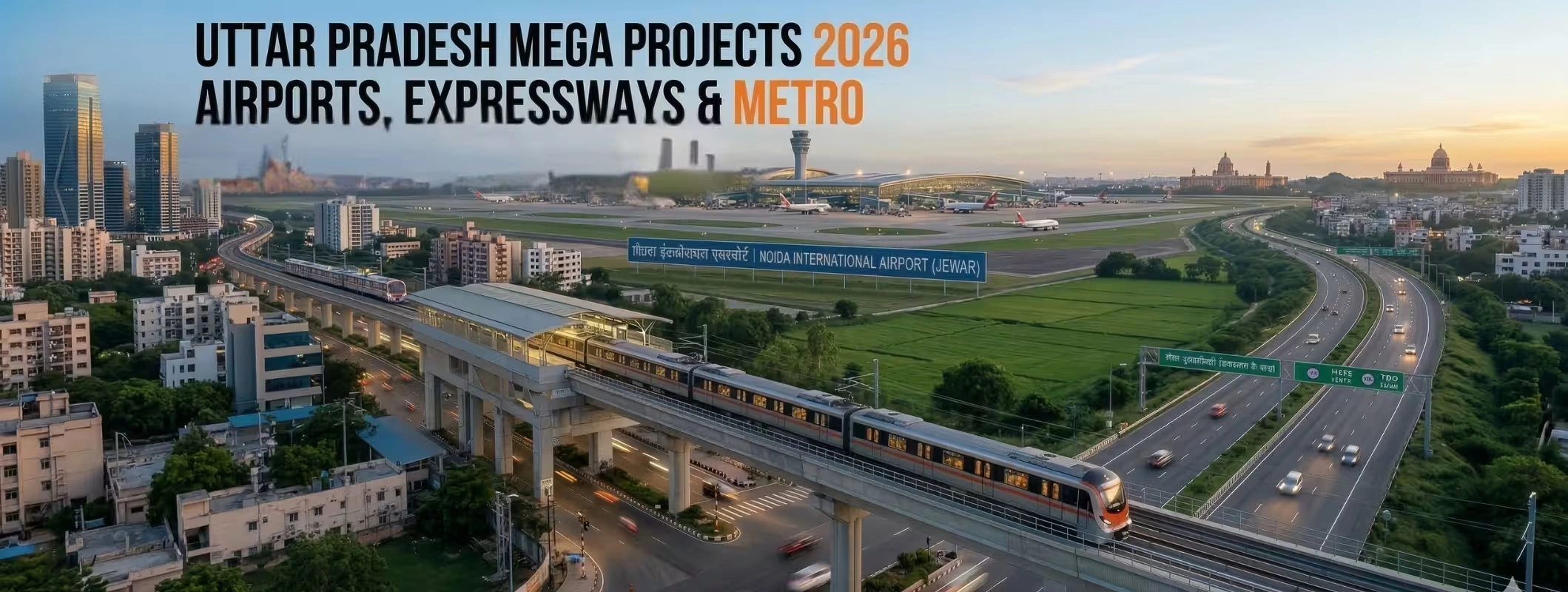
If one project is changing sentiment fastest, it is the Noida International Airport at Jewar. According to the airport’s official March 2026 update, it has received its aerodrome licence from DGCA, major infrastructure needed for operations is complete, BCAS security vetting has already moved forward for domestic passenger and cargo operations, and the airport is now in the final readiness phase before commercial launch formalities are completed. The airport says Phase 1 will operate with one runway and one terminal handling 12 million passengers annually, with long-term development planned up to 70 million passengers a year.
This matters far beyond aviation. Jewar changed the conversation for Greater Noida, Yamuna Expressway, logistics, warehousing, hospitality, industrial parks, and land markets across western UP. The airport’s own update also highlights direct connectivity via the six-lane Yamuna Expressway and its expected role as a catalyst for regional economic growth. That is why real estate around airport-linked infrastructure is no longer just a speculative theme. It is becoming a planning theme.
2. Ganga Expressway is still the flagship road project to watch
The Ganga Expressway remains one of the most important UP infrastructure projects because of its sheer scale and geography. UPEIDA’s official project page lists it at about 594 km, connecting Meerut to Prayagraj and benefiting districts including Meerut, Hapur, Bulandshahr, Amroha, Sambhal, Badaun, Shahjahanpur, Hardoi, Unnao, Rae Bareli, Pratapgarh, and Prayagraj. It is planned as a six-lane access-controlled expressway, expandable to eight lanes.
From a real estate and land perspective, this is important for two reasons. First, long linear infrastructure expands the map of investable locations beyond big-city centres. Second, expressway-linked districts often start attracting warehousing, roadside commercial development, logistics services, agro-processing, and plotted growth in phases rather than all at once. Buyers who only focus on the headline city usually enter late. Buyers who study corridor-level demand often enter smarter. That is the real lesson from the Ganga Expressway story.
3. Eastern UP connectivity is getting stronger through Gorakhpur Link and Purvanchal corridors
The Gorakhpur Link Expressway is not as talked about as the Ganga Expressway, but it matters strategically. UPEIDA lists it at 91.352 km, running from Jaitpur in Gorakhpur district to Salarpur in Azamgarh at the Purvanchal Expressway, covering Gorakhpur, Azamgarh, Ambedkar Nagar, and Sant Kabir Nagar.
The Purvanchal Expressway already serves as a wider east-west development backbone. UPEIDA describes it as a major industrial and socio-economic catalyst connecting the eastern boundary of the state to the capital region through the expressway network, with benefits expected for agriculture, commerce, tourism, educational institutions, townships, and employment.
That means eastern UP is not only about mobility anymore. It is increasingly about corridor-led development, where improved access can support new logistics, service businesses, warehousing, local manufacturing, and township activity over time. For land buyers, this is where patience matters. Not every parcel near an expressway becomes valuable. But the right parcel with legal clarity, access, and nearby economic activity can move much faster than the broader market.
4. Bundelkhand Expressway is more than a road. It is a regional development tool
The Bundelkhand Expressway already links the Bundelkhand region to the national capital through the Agra-Lucknow and Yamuna expressway systems. UPEIDA lists it at 296.070 km, covering Chitrakoot, Banda, Mahoba, Hamirpur, Jalaun, Auraiya, and Etawah. The authority also explicitly connects this corridor with agriculture, commerce, tourism, industry, and the boost it gives to the Defence Industrial Corridor vision.
This is why Bundelkhand should not be viewed only through an affordability lens. Infrastructure changes the value equation in regions that were previously dismissed as too slow or too remote. If industrial, defence, agro-processing, storage, and training ecosystems deepen around the corridor, real estate demand can broaden from purely local need to strategic regional demand.
5. Kanpur Metro and Agra Metro show that UP’s urban transit story is widening
UP’s metro story is no longer limited to Lucknow and Noida. According to UPMRC’s 2024–25 annual report summary, Kanpur Metro has two corridors totalling 32.4 km, and services were extended from Motijheel to Kanpur Central on 30 May 2025, taking operations to 14 stations from IIT Kanpur to Kanpur Central. The remaining sections of Corridor 1 and Corridor 2 are still progressing.
The same annual report summary shows that Agra Metro is operational on its 6 km priority stretch from Taj East Gate to Mankameshwar Metro Station, while the full project covers 29.4 km across two corridors.
This matters for property markets because urban transport does three things at once: it improves commuter convenience, reduces friction between residential and commercial zones, and changes which localities feel “central.” In cities like Kanpur and Agra, that can slowly reshape office demand, mixed-use development, rental pockets, and land attractiveness near future stations and interchanges.
6. Namo Bharat is giving western UP a new regional mobility layer
The Delhi-Ghaziabad-Meerut Namo Bharat corridor adds another layer to the western UP story. NCRTC lists the full corridor at 82 km, with 16 Namo Bharat stations and 9 additional Meerut MRTS stations. NCRTC also states that after inauguration of an additional 13 km section, the operational stretch reached 55 km with 11 stations.
That is a major signal for cities and micro-markets linked to the NCR. Faster, more reliable regional transit can influence residential decisions, workforce movement, warehousing attractiveness, and transit-led development patterns. For western UP, the story is no longer “Delhi spillover” alone. It is increasingly about integrated regional mobility.
7. Varanasi’s ropeway and inland waterways add a different kind of infrastructure value
Varanasi is not only benefiting from roads and tourism. It is also seeing multimodal infrastructure expansion. PIB states that the Varanasi Urban Ropeway, described as India’s first urban ropeway project, is under construction from Varanasi Cantt and is designed with 148 gondola cabins capable of carrying up to 96,000 passengers per day.
On the logistics side, PIB says UP already has the Varanasi Multimodal Terminal, and also notes ongoing inland water transport projects including a ₹200 crore river cruise terminal, a ₹150 crore regional centre of excellence, and a ship repair facility. It further states that IWAI has acquired 75 acres in Chandauli for a freight village adjacent to the Varanasi multimodal terminal.
That combination matters. Passenger mobility, tourism infrastructure, river logistics, and freight support do not just improve movement; they broaden the city’s economic profile. In practical terms, that can support demand for hospitality, support services, warehousing, river-linked commerce, and nearby land with legitimate development potential.
8. The real opportunity may be in industrial and logistics ecosystems along the corridors
This is where many buyers still miss the bigger picture. UPEIDA has formally invited investors and developers for Industrial Parks on PPP mode at 27 Integrated Manufacturing & Logistic Clusters and 6 Defence Industrial Corridors. The listing even maps IMLC node locations along expressways including the Ganga Expressway.
Separately, UPEIDA’s Defence Corridor page states that the UP Defence Industrial Corridor spans six nodes: Lucknow, Kanpur, Jhansi, Agra, Aligarh, and Chitrakoot, supported by major expressways such as Yamuna, Agra-Lucknow, Purvanchal, Bundelkhand, Gorakhpur Link, and Ganga Expressway.
This is the infrastructure-led land story that matters most. Roads create access. But industrial clusters create recurring demand. Once manufacturing, warehousing, defence production, processing, and logistics ecosystems take shape, land values around the right nodes can move on stronger fundamentals, not only on hype.
9. PM MITRA Park adds another layer to UP’s industrial infrastructure story
The industrial build-out is not limited to logistics and defence. Invest UP documents show that the PM MITRA Mega Textile and Apparel Park in Uttar Pradesh is being tendered as a 1,000-acre greenfield project. Another Invest UP document notes that PM MITRA parks are expected to attract major investment and large-scale direct and indirect employment once completed.
For real estate watchers, this matters because industrial infrastructure creates secondary land demand in housing, rental accommodation, worker services, transport support, storage, and local commerce. In other words, infrastructure-led growth is rarely limited to the project site itself.
What these Uttar Pradesh mega projects mean for property and land buyers
The cleanest takeaway is this: UP’s infrastructure boom is creating new real estate logic. The old model was simple city-centre appreciation. The new model is more location-specific. Buyers now need to study airport influence zones, expressway access points, metro catchments, industrial corridors, logistics nodes, and future township belts.
That also means blind buying is a bad idea. Prices around major projects often move before utilities, zoning clarity, or service roads fully catch up. So the right question is not, “Is this near an expressway?” The right question is, “Does this parcel have legal clarity, practical access, nearby demand drivers, and a believable use case over the next three to seven years?” That is where serious buyers separate themselves from speculative noise.
How 2Bigha helps Buyers act on these trends
This is exactly where 2Bigha becomes useful. Most buyers know the headline project, but they struggle with the micro-location decision. 2Bigha helps readers move from hype to actual research by making it easier to discover land opportunities around growth corridors, compare locations, study surrounding access on a map, and shortlist more credible options instead of chasing random offline leads.
For someone tracking land near expressways, airport-linked growth belts, industrial areas, or future development corridors in Uttar Pradesh, that matters a lot. A platform like 2Bigha can help you save time, compare better, and focus on locations where infrastructure and usability actually meet. That is far more valuable than buying or selling land only because a broker says “project is coming.”
Quick checklist before buying land near UP infrastructure projects
Before investing near a mega project, check these points:
- Verify title, mutation, and ownership trail.
- Confirm land use, zoning, and whether conversion is required.
- Check actual road access, not just map proximity.
- Study whether the location is near an interchange, node, terminal, or only somewhere on the long corridor.
- Review flood risk, utility access, and surrounding development.
- Understand whether the demand driver is residential, industrial, logistics, tourism, or mixed use.
- Compare at least three nearby parcels before committing.
Final Word
The biggest mistake in 2026 is to think Uttar Pradesh’s infrastructure growth is just a news topic. It is a location story, an industrial story, a logistics story, and a land story. Jewar airport, the Ganga Expressway, Gorakhpur Link, Bundelkhand connectivity, expanding metro systems, Namo Bharat, Varanasi’s multimodal upgrades, and corridor-based industrial planning are together reshaping how value gets created across the state.
For buyers, investors, and developers, the opportunity is real, but only when research is sharper than the market noise. That is where smart location filtering and on-ground verification matter. And that is also why using a platform like 2Bigha can give you an edge before the crowd fully catches up.
FAQs - Uttar Pradesh Mega Projects 2026
1. Which is the most important Uttar Pradesh infrastructure project in 2026?
There is no single answer. For western UP, Noida International Airport is the biggest trigger. For state-wide corridor growth, the Ganga Expressway is the flagship road project. For NCR-linked mobility, the Delhi-Ghaziabad-Meerut Namo Bharat corridor is highly important.
2. Will the Ganga Expressway increase land values?
It can improve demand in the right micro-markets, especially where access, industrial activity, and service infrastructure come together. But not every parcel near the corridor will benefit equally. Corridor access, legal clarity, and local economic activity matter more than simple distance.
3. Which UP cities and regions may benefit the most from current infrastructure development?
Greater Noida–Jewar, Meerut, Kanpur, Agra, Varanasi, Prayagraj, and several corridor-linked districts in Bundelkhand and eastern UP are all positioned to benefit from different types of infrastructure-led growth.
4. How should buyers use 2Bigha while exploring land near mega projects?
Use 2Bigha to compare locations, narrow down corridor-linked areas, review map context, and shortlist options more intelligently. Then verify title, access, zoning, and local development potential before making a final decision.