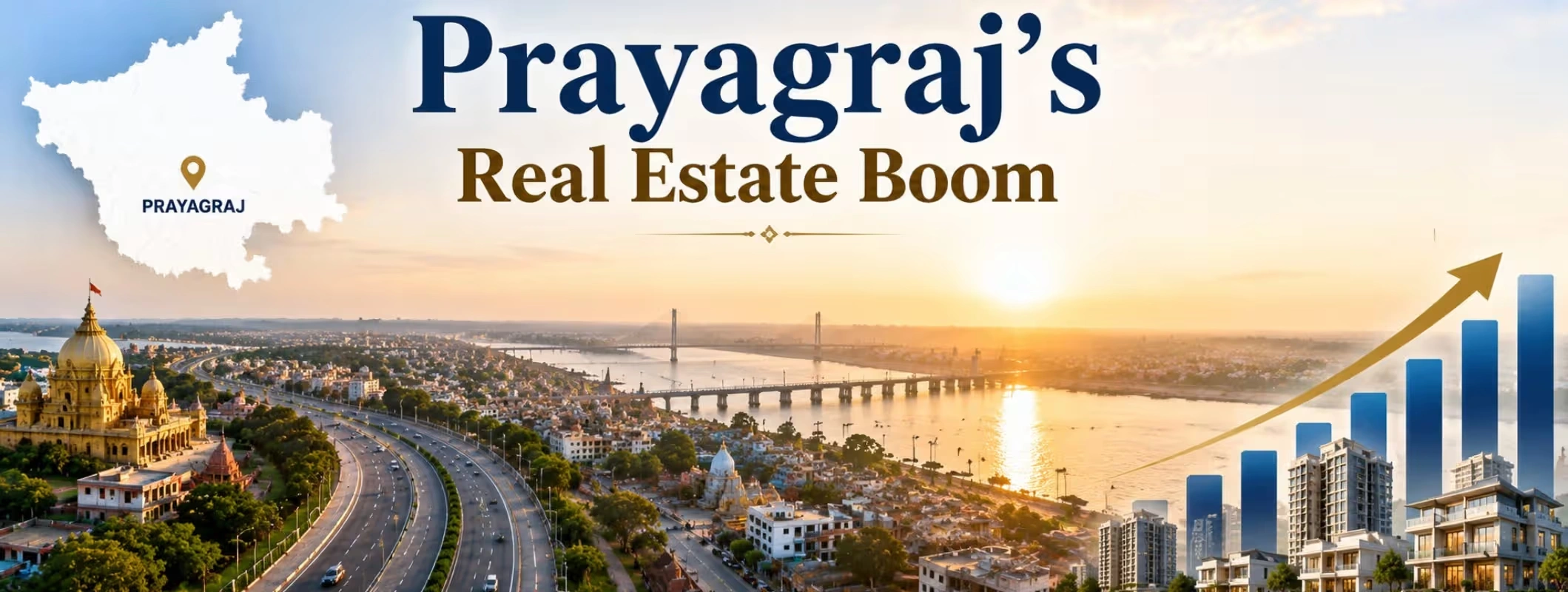
The city of Prayagraj has been famous for its temples, ghats, and spiritual significance. There has been a lot of activity happening silently in Prayagraj, which includes widening of roads, expansion of the airport and construction of an expressway that has reduced journey time to Delhi/NCR by half. Anyone looking for land in eastern Uttar Pradesh needs to seriously consider Prayagraj.
From Pilgrimage City to Growth Corridor
Prayagraj, for most of its existence, has been a city defined by religion, education, and tradition. This is slowly but steadily changing, and in a rather rapid manner as well. The government's efforts to develop the city via infrastructure, improved connectivity, and development programs are slowly moving Prayagraj away from being solely a religious city and making it an economic city.
Such trends are helping create many new opportunities in various types of residential, plotted, mixed-use, and hospitality real estate. According to Square Yards, real estate in Tier-2 and Tier-3 growth corridors, located close to airports and logistics centers and connected via expressways, can appreciate by anywhere between 25% and 100% over the coming 2 to 4 years. That's a wide range, but even the lower end puts Prayagraj on the radar for anyone doing serious Agricultural Land for Sale or plotted-land research in UP right now.
The Infrastructure Driving It All
A handful of projects are doing most of the heavy lifting here, and it's worth breaking them down individually rather than lumping them together.
| Infrastructure Project | What It Does |
| Ganga Expressway | Connects Meerut to Prayagraj, improving links to western UP and NCR |
| Ring Road & Bypass | Cuts city traffic, opens up peripheral land for development |
| Prayagraj Airport modernisation | Boosts business travel and connectivity |
| Railway & multimodal upgrades | Strengthens overall transport network |
| Temple-town development (₹5,000 crore) | Improves ghats, roads, and visitor infrastructure |
The Ganga Expressway alone changes the equation for a lot of buyers. Once it's fully functional, Prayagraj stops being a standalone city and starts behaving like an extension of the NCR growth belt, at least in terms of accessibility. The Ring Road and Bypass work in a similar way, except they're solving a more local problem, reducing congestion inside the city while quietly making peripheral land more usable for residential and plotted projects. Then there's the airport. Modernisation work here matters less for tourists, and more for business travellers, and a more business-friendly airport tends to attract exactly the kind of commercial interest that pushes surrounding land prices upward over time.
Why the Temple Economy Still Matters?
Separating the spiritual essence of Prayagraj from its property-related narrative could be an error because they are strongly intertwined, and perhaps, now even more than ever before. In total, over the course of five years, the Indian government has invested around ₹5,000 crore in infrastructure development aimed at supporting the development of pilgrim townships and tourism facilities, including ghats and other infrastructure.
Such investments are not only important for pilgrims but also create a ripple effect on hotels, serviced apartments, holiday homes, and shopping areas, all of which are doing good business in the pilgrimage cities due to an increase in visitors. The representatives of the industry have stated that the long-term infrastructure development in Prayagraj has opened many more opportunities in the city's urban infrastructure, moving far beyond the mere roads and mobility issues. As a result of the growing importance of Prayagraj as a spiritual center, along with the improved connectivity of the area, this city is viewed as a strong driving force for the growth in value of residential real estate over the medium term. Currently, residential prices in Prayagraj stand at ₹7,900-8,000 per square foot, and there is an expected growth of 20-30% over the next three to five years.
The Mahakumbh Effect Hasn't Faded
It's easy to think of Mahakumbh 2025 as a one-time event that's already come and gone, but its impact on the city's infrastructure is still very much active. Over ₹7,000 crore was spent on roads, flyovers, beautification, and sewerage systems in preparation for the event, and more than 450 million pilgrims passed through the city during that period.
That scale of footfall proved something developers had suspected for a while: Prayagraj can handle, and attract, tourism numbers that most Indian cities never see. The infrastructure built for Mahakumbh doesn't disappear once the event ends. Roads stay widened, facilities stay upgraded, and the city keeps the benefit long after the crowds have gone home. Analysts covering the region have described this as a legacy effect, where connectivity and quality-of-life improvements built around a single religious event end up supporting a much longer, more sustainable growth story for the city's real estate ecosystem.
What This Means for Land and Plot Buyers?
If you're specifically looking at land rather than built-up property, the peripheral zones around Prayagraj, areas benefiting from the Ring Road, Bypass, and expressway access, are worth tracking closely over the next couple of years. These are typically the pockets where Farmland for Sale and plotted land see the earliest price movement, well before residential towers or commercial complexes start going up.
Rural land buyers who've had success in similar growth corridors elsewhere in India, think Neemrana near Delhi, or parts of the Jaipur periphery, will likely recognise the pattern here. Infrastructure lands first, land prices move next, and built-up real estate follows a step behind. Getting in during that first window is usually where the bigger gains come from.
A Word on Diversifying Beyond Prayagraj
Prayagraj is one growth story, but it's part of a much larger pattern playing out across India's Tier-2 corridors right now, expressways and airport upgrades consistently pulling land values up in their wake. If this kind of infrastructure-led growth interests you, it's worth widening the search beyond just one city. This is where verified land listings become genuinely useful. Instead of chasing tips from local brokers in every new city that starts trending, a platform that already tracks and verifies agricultural land across multiple growth corridors saves a lot of time and reduces risk considerably.
Where 2Bigha Comes In?
2Bigha is built exactly for buyers trying to navigate this kind of opportunity. It's a dedicated marketplace for buying and selling agricultural land and farmland across India, and every listing goes through a documentation and ownership check before it reaches buyers. Whether you're tracking emerging belts near Prayagraj, or you already know you want to buy land in an infrastructure-driven corridor elsewhere in UP or Rajasthan, 2Bigha's listings make it easier to compare options without relying purely on local word-of-mouth. And for landowners in these growth zones who'd rather Sell Agricultural Land Online than go through multiple middlemen, listing with verified documentation tends to attract far more serious buyers, faster.
Conclusion
The evolution of Prayagraj from a city of pilgrimage to a genuine real estate development corridor was no quick fix, nor is it complete yet. The Ganga Expressway, the airport redevelopment, the development of the Ring Road, and the consistent development of the temple town will come together to transform the economy of the city, and the lands lying in its surrounding belt could become the first to benefit from this. For those who have been keeping an eye on developments in NCR and Rajasthan, Prayagraj could turn out to be the next destination for you to mark on your radar.
Disclaimer: This article is for informational purposes only and should not be considered investment, legal, financial, or property advice. Real estate regulations, infrastructure plans, market conditions, and government policies may change over time. Readers are advised to verify information with relevant authorities and consult qualified professionals before making any investment or property-related decisions.