More people are asking where to find organic farmland, and the honest answer is that there's no single website with a neat "organic" tag on every plot. Some land has been chemical-free for years. Other land was sprayed last season and is now being sold as "natural". If you're going through agriculture land for sale and you want soil you can actually certify later, you need a method. This guide gives you one, in the order you'd really do things.
What Counts as Organic Farmland?
Organic farmland is land where crops are grown without synthetic fertiliser, pesticides or weedkillers, and where the soil and water are clean enough to pass a certifying body's checks. In India, there are two main routes. NPOP is mostly used for export and runs through accredited agencies. PGS-India is a group-based system meant for the domestic market. When you look at listings, the land usually falls into one of three groups:
| Type | What it means | What to expect |
|---|---|---|
| Certified organic | Already has a valid certificate | Higher price. Check whose name the certificate is in. |
| In conversion | Chemical-free now, waiting out the conversion period | Usually two to three years. Mid-range price. |
| Regular land with a clean history | Never heavily sprayed, no certificate yet | Cheapest. You start the clock yourself. |
8 Steps to Find the Right Organic Farmland
Step 1: Decide what you want from the land
Before you open a single listing, write down why you want the land. Food for your family is one goal. Growing vegetables to sell in a nearby city is another. A weekend farm is a third. Each one needs a different size, so half an acre and five acres are not the same search.
Then work out the full budget, not just the price of the land. Add fencing, a bore well, labour, certification fees, and the registration cost. Also be honest about time. If you can only visit twice a year, you'll need a manager you trust.
Step 2: Pick a region that suits your crop
Climate and water decide what you can grow, so choose the region first. Sikkim has been declared an organic state, Madhya Pradesh has one of the largest organic areas in the country, and hill states like Uttarakhand suit certain crops well.
Many buyers start with a search for plots for sale near me. That's fine, because land close to home is easier to visit. Just know that good organic farmland is often a little further out, where fewer farms use heavy chemicals. One more thing to check early: some states limit who can buy agricultural land. Himachal Pradesh and Maharashtra are two examples. Find out the rule for your state before you fall for a plot.
Step 3: Search in more than one place
Don't rely on a single source. Use online marketplaces, but also talk to people on the ground:
- Local farmers and village elders
- The nearest Krishi Vigyan Kendra
- Organic farmer groups and PGS local groups
- Farmer producer organisations in the area
A map search for farmlands near me gives you a quick starting list. It won't tell you anything about soil or water, so treat it as a list of names and nothing more. Keep a simple sheet with survey number, price per acre, water source, road access, and your notes. After ten plots you'll forget which was which.
Step 4: Visit the land more than once
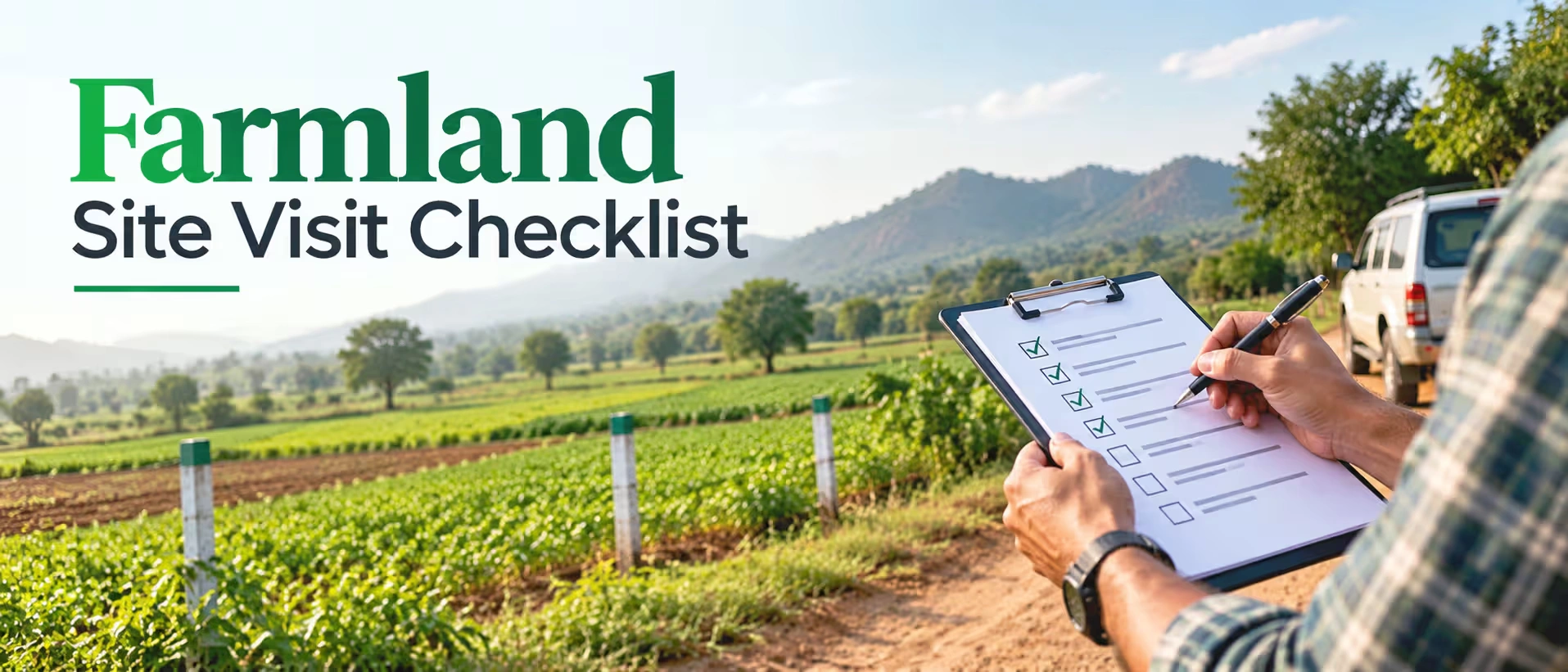
One visit isn't enough. Go once in dry weather and once after rain if you can. Look at the colour of the soil, dig a handful and check for earthworms. Healthy soil usually has them. Look at the crops standing there, and at the neighbouring fields too.
Walk the edges. Empty pesticide packets, sprayer marks, or burnt crop residue tell you a lot. Talk to the neighbours and ask who farmed it in the last three years and what they put on it. If a neighbour uphill sprays heavily, runoff can reach your plot. Take photos and note the GPS location each time.
Step 5: Test the soil and the water
Don't guess. Take soil from four or five spots across the plot, dig about six inches down, mix it together, and send it to a lab. State agriculture labs, agricultural universities, and KVKs all do basic tests. Ask for pH, organic carbon, and the main nutrients. If you can, also ask for a pesticide residue and heavy metal test from an accredited lab.
Test the water too. Take samples from the bore well, open well, or canal and check for salinity, total dissolved solids, and contamination. Also ask what industry or drains sit upstream. The tests cost very little next to the land price, and they give you real numbers to bargain with.
Step 6: Verify the papers
Get the land record extract for that state. It's called Jamabandi, Khatauni, or 7/12 extract depending on where you are. Then check these points:
- The survey or khasra number matches the plot you visited
- The seller's name matches the record, and all co-owners agree to sell
- Mutation entries are up to date
- No loan, mortgage, or court case is attached
- The land is recorded as agricultural
Ask for the earlier sale deeds too, so you can trace the ownership back. Hire a local lawyer for this step. Paying a small fee now is much easier than fighting a title dispute later.
Step 7: Check the organic status
If the seller says the land is certified, ask for the certificate. Note the agency, the validity dates, the plots and crops it covers, and the name of the operator. Then confirm it with the agency directly instead of trusting a photocopy.
Certificates are usually issued to a farmer for a particular piece of land. When the land changes hands, ask the agency whether the status carries over or whether you have to apply again. Don't assume. If the land is in conversion, ask for records such as field history, what inputs were bought, and the dates. If there's no certificate at all, plan for the full conversion period and put it in your budget.
Step 8: Negotiate, agree in writing, and register
It will be useful for you to compare the asking price with that of previous sales. In your case, the soil and water tests will definitely help, as a negative test will provide you with a valid reason to demand a reduced price. You will have to sign the sales agreement with the advance amount, the period of time, and other terms and conditions, including the provision of help in getting the certificate. Payment will be made through bank transfer, and a receipt will be obtained. After that, you will get the sale deed registered with the Sub-Registrar and pay the stamp and registration duty.
Red Flags When Buying Organic Farmland
Back off or at least take your time if you come across these scenarios:
- The property is priced significantly below the going rate in the locality
- The seller insists on fast payment of an advance
- The term "organic" has been mentioned without a certification document
- There is heavy spraying in the neighbourhood and no buffer strip between the properties
- The seller does not allow a test of the soil/water on the property
- The property is registered under the name of a deceased owner, and his or her heirs have not signed the deal
- There is subdivision of a big piece of land into small parcels without proper road laying
Find Organic Farmland on 2Bigha
2Bigha is a marketplace for agricultural land and farmland in India. You can browse agriculture land for sale across states, read Background Verification Reports before you commit, and use Book a Visit to see a plot in person. That covers the steps where most buyers get stuck, the search and the first check. If you're on the other side, 2Bigha also helps owners with selling property online. You list the land, buyers reach you, and you don't need to depend on a single local broker.
Disclaimer: This article is for informational purposes only and should not be considered investment, legal, financial, or property advice. Real estate regulations, infrastructure plans, market conditions, and government policies may change over time. Readers are advised to verify information with relevant authorities and consult qualified professionals before making any investment or property-related decisions.