Noida International Airport at Jewar began handling commercial flights on 15 June 2026, a few months after Phase 1 was formally inaugurated in March. Land searches across Gautam Buddh Nagar have changed since then. Buyers who used to type plots for sale near me from Delhi or Gurugram are now looking specifically at the Jewar belt, and sellers have raised their asking prices to match. The airport is real and operating, but that doesn't make every piece of land sold in its name clean, approved, or fairly priced. This guide covers what a buyer should verify in 2026 before any money changes hands.
What Has Actually Changed Around Jewar?
The airport is run by Yamuna International Airport Private Limited, a subsidiary of Zurich Airport International, on land that stretches across around 1,334 hectares. Phase I serves around 12 million passengers annually, and in due course of time, this number will rise to 70 million through 4 phases. The first airline services available at the airport include IndiGo and Akasa Air. It was suggested that international flights can begin in late 2026. Nevertheless, it would be prudent if you consider the schedule from the official website of the airport.
This simply means that, on the ground level, it is very clear-cut; the demand side is led by the end users, the long-term investors, and even some of the speculators, and those who pay the price are the last. Most of the lands that are being sold as agricultural lands are still considered as such in revenue records.
Why Price Should Not Be Your First Question?
Most buyers start by asking what the rate per square yard or per bigha is. A better first question is whether the land can legally be used for what you plan to do with it. Two plots next to each other can differ hugely in value because one falls inside an approved YEIDA sector and the other sits in a zone with no development permission at all. Once you know the legal position, the price discussion becomes much more grounded.
Step 1: Confirm the Land Use and Master Plan Status
Start with the Yamuna Expressway Industrial Development Authority (YEIDA) master plan and find out what category your plot falls in. The usual categories are residential, industrial, institutional, commercial, green, or agricultural. Someone searching farmlands near me and picking a listing purely because it is close to the airport may find that the parcel is marked as green belt or reserved for a road or utility corridor.
Ask the seller for the number of khasra and cross-check with the land-use map issued by the concerned authority. In case you want to construct a building on any agricultural land, make sure whether there is a change in the use of that land or if a change in land use is permissible. This process takes place under the UP Revenue Code, and the latest effort to enable the development authorities to sanction the change of land use in small parcels has made it easier. Do not assume that the change in land use will be allowed later at whatever price the seller charges.
Step 2: Understand the Land Category
Not all land near the airport is freely tradable. The status of the land decides who can sell it and what you can do with it.
| Land Type | Who Can Sell | Main Risk to Check |
|---|---|---|
| Freehold farmer-owned land | The recorded owner (bhumidhar) | Land use category, encumbrances, joint owners |
| Land acquired by YEIDA or the airport company | Not the farmer anymore | Seller may be selling land already acquired |
| YEIDA allotted plot | Original allottee, with authority transfer rules | Lease terms, pending dues, transfer permission |
| Land inside a private plotted project | Developer or earlier buyer | RERA registration and approved layout |
| Land owned by a Scheduled Caste landholder | Needs district magistrate permission to sell to certain buyers | Sale without permission can be voided |
A lot of disputes around Jewar in the past involved land that had already been acquired and compensated but was sold again by the same family to an unaware buyer. When exploring emerging real estate hotspots in Uttar Pradesh, ask for proof that the land lies outside the acquired area and verify it against the relevant authority's notifications.
Step 3: Verify Ownership and the Record Trail
The title clearance process goes beyond just the copy of the sale deed. Follow this sequence:
- Check the information on the khatauni and khasra details on the UP Bhulekh portal and ensure that the name of the seller is identical, including the spelling.
- Examine the number of names listed. In the case of joint owners and inheritors, all need to be present to sign the sale deed.
- Procure an encumbrance certificate from the office of the sub-registrar for at least the past 30 years where there have been any mortgages or previous transactions.
- Backtrack the chain of ownership. For instance, a property transferred four times in the past two years should be a cause for concern.
- Go to the location along with the revenue plan and verify the physical boundaries to match the recorded boundaries.
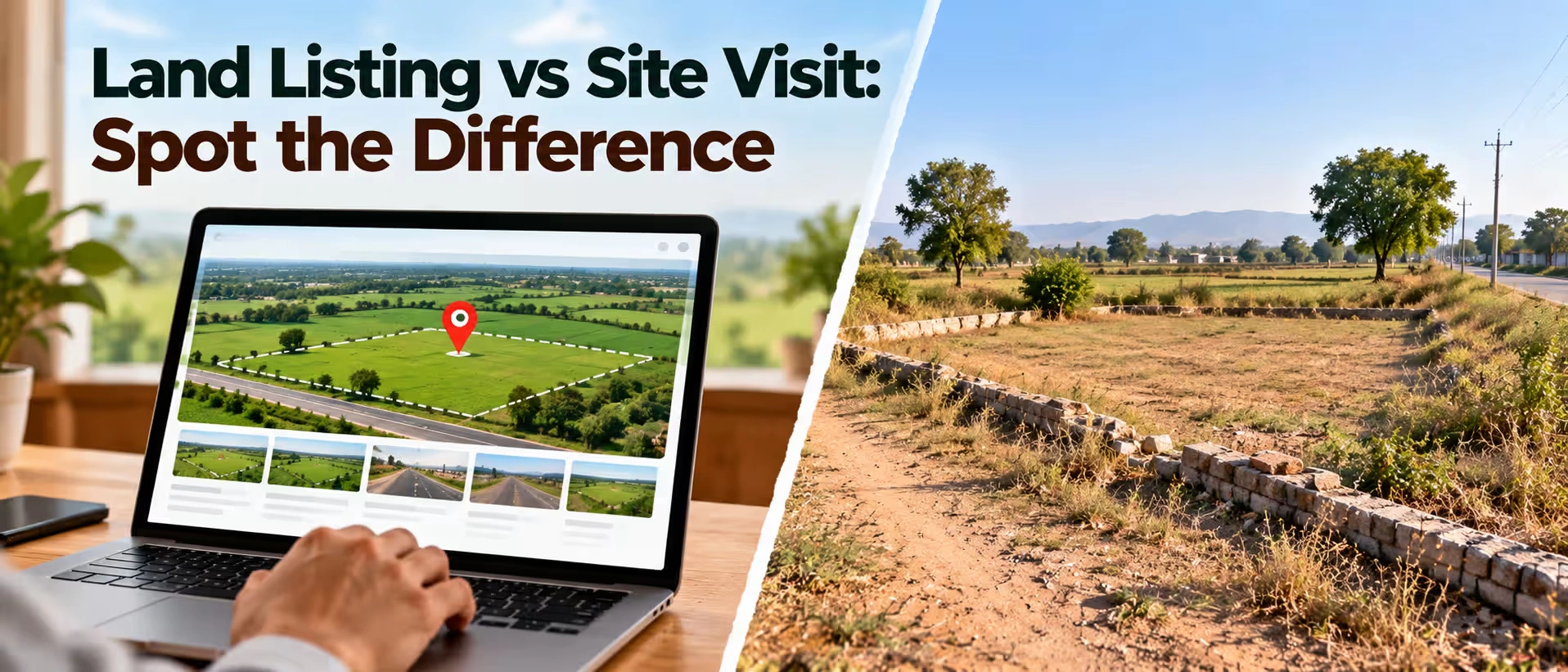
There are several who conduct a farm search on an online portal and choose a plot based on the photographs. Photographs do not prove anything in terms of the ownership of the property. The records do.
Step 4: Check Airport Height and Zoning Limits
This is a frequent mistake which is made more often than it needs to be. The land around a functioning airport is regulated by height regulations that are set by the Airports Authority of India through their zoning maps. Should you plan on constructing a multi-storey building, a warehouse with high racks, or a telecommunication tower, then you will have to obtain a height clearance NOC. Some plots lie under approach/departure paths and can be used only for low-rise buildings, while some are bound by noise and obstacle regulations.
Don’t forget to ask the seller about height clearance and whether your plot lies within the restricted zone. If the seller does not give you a clear answer, consider it a warning sign.
Step 5: Compare Circle Rate, Market Rate and Real Demand
Circle rate is the minimum rate used by the government for calculating stamp duty, which is generally out of date compared to the actual values of the transactions in the area near the newly constructed airport. Get the current circle rate of the area and compare it with the last registered transaction, not only with the quotes provided by the broker. The land sold in the area near the airport comes with a future airport premium.
| Check | What to Compare | Why It Matters |
| Circle rate | Current government rate for the village | Sets your stamp duty base |
| Recent registered sales | Last 6 to 12 months nearby | Shows what buyers actually paid |
| Seller asking price | Quote versus registered deals | Reveals the speculative markup |
| Road width and access | Approach road type | Affects both resale and approvals |
If the asking price is far above registered deals nearby, ask what specific advantage the plot has. A reasonable answer might be a wider road frontage, a corner position or approved layout status. "It's near the airport" alone is not an answer, since almost everything in the area can say that.
Red Flags That Should Slow You Down
- The seller wants immediate payment in the form of token money and does not share documents.
- Khasra number in the brochure doesn’t tally with the revenue record.
- The property is sold through a power of attorney rather than a sale deed.
- There is no road connection, or a road link can be obtained only through the field of your neighbor.
- The rate is clearly low as compared to all other transactions around it, with no reason. The seller either wants an unregistered transaction or splits payment in a non-registered way.
- An agent says "Conversion is guaranteed," but there is no order at all.".
Sellers who are used to selling property online usually have documents ready and respond to verification requests quickly. Hesitation around documents is rarely a good sign.
Documents to Collect Before You Pay
| Document | Where to Get It | What to Look For |
| Sale deed and previous deeds | Seller, sub-registrar | Unbroken ownership chain |
| Khatauni and khasra extract | UP Bhulekh | Seller's name, area, land type |
| Encumbrance certificate | Sub-registrar office | No loans or disputes |
| Land use or conversion order | YEIDA or revenue office | Valid, in the owner's name |
| Height clearance NOC | AAI / relevant authority | Allowed building height |
| RERA registration (if a project) | UP RERA portal | Approved layout, project status |
| Tax and dues receipts | Authority / revenue office | No pending payments |
Verifying Land Near Jewar With 2Bigha
This consumes time when done alone, particularly if one comes from outside this region. 2Bigha is an Indian-based market for land and farmland. They ensure verification prior to publishing listings and offer a buyer to seek out a Land Report that ensures no problems will be encountered in any records. One can browse the listings, select those he or she is interested in, and even use the Book a Visit feature to view the lands with the right guidance. When you own land near Jewar and are planning to sell your plot, you can make the listing through the platform and connect directly with prospective buyers without relying solely on the services of agents.
Disclaimer: This article is for informational purposes only and should not be considered investment, legal, financial, or property advice. Real estate regulations, infrastructure plans, market conditions, and government policies may change over time. Readers are advised to verify information with relevant authorities and consult qualified professionals before making any investment or property-related decisions.