List Your Land
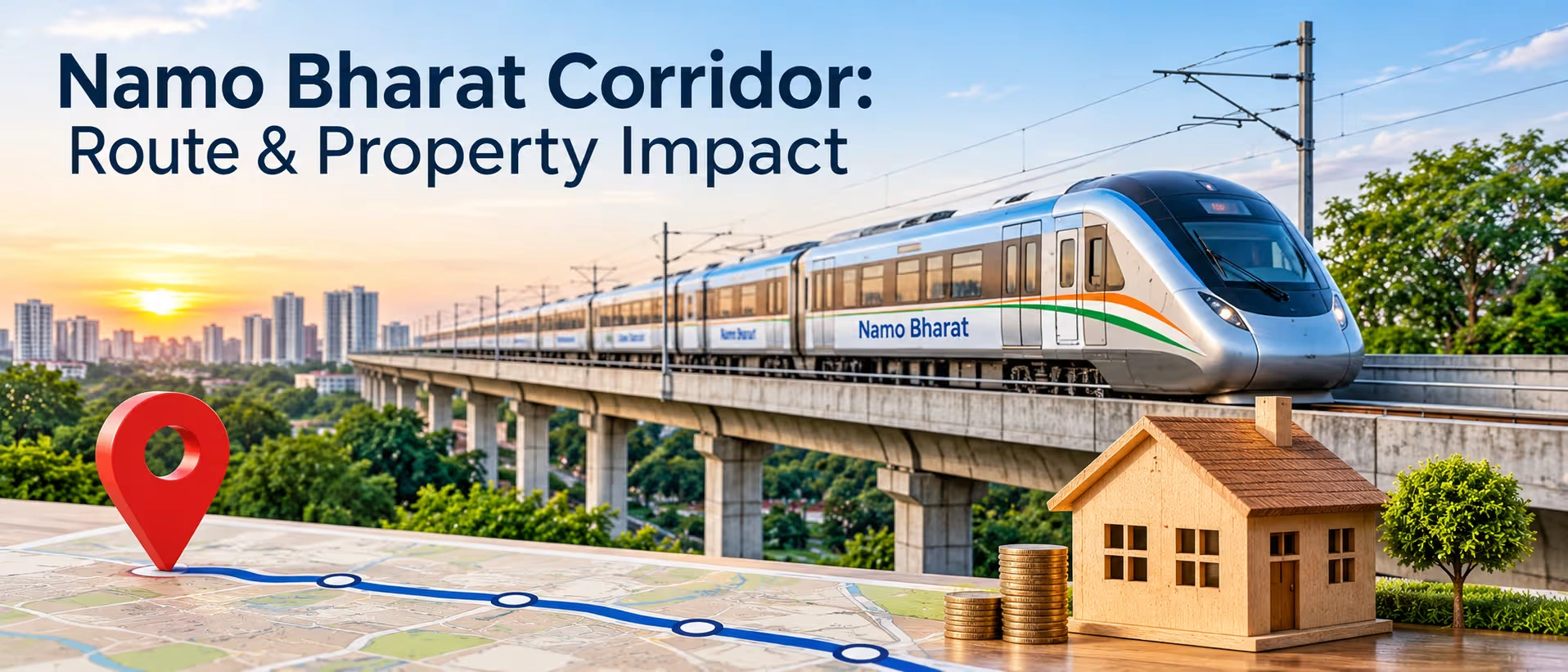
The Namo Bharat Corridor linking Delhi with Panipat and Karnal has received approval from the National Highways Authority of India, which adds to the clearances already given by the Centre and the Haryana government. The line is meant to carry commuters along the Delhi–Ambala highway belt in a fraction of the time they spend on the road today, and it also changes how people look at land in towns like Sonipat, Panipat and Karnal. Here is what has actually been announced, followed by what it could mean for buyers and sellers.
Namo Bharat Corridor: What Has Been Announced and Who Approved It?
NHAI has now cleared the project after the Centre and the Haryana government gave their go-ahead. The National Capital Region Transport Corporation (NCRTC) will build it. NHAI has also given land-use permission for pier construction, station development and the shifting of high-tension power lines along the route, since the corridor runs next to NH-44.
Preliminary work has already started on a stretch of about 22 km between Narela and Murthal. Trains will have a design speed of 180 km/h, an operating speed of 160 km/h, and will run every 5 to 10 minutes.
Namo Bharat Corridor Route: Alignment, Distance and Cities
The corridor is 136.3 km long and runs parallel to the Delhi–Ambala highway (NH-44). It starts in Delhi, passes through Sonipat district, then reaches Panipat and ends in Karnal. Most of the line will be elevated. The exceptions are Kashmere Gate in Delhi and the stations in Panipat.
Anyone looking at a plot in Delhi for the long term should note that the Delhi end of the line has six stops and the biggest interchange of the whole project, which is covered in the next section.
Namo Bharat Corridor Stations and Interchange Points
Twenty-two stations are proposed in total. The report lists them district by district.
| Area | Stations |
| Delhi (6) | Sarai Kale Khan, Kashmere Gate, Jharoda Majra, Burari Crossing, Bhalswa, Mukarba Chowk |
| Sonipat (7) | Kundli, KMP Expressway interchange, Bahalgarh Chowk, Rajiv Gandhi Education City, Murthal, Bari Industrial, Ganaur |
| Panipat (4) | Samalkha, Panipat ISBT (Siwah bus stand), Panipat City (Gohana Crossing), Sector-18 |
| Karnal (5) | Ganjbar-Badauli-Kohand, Gharaunda, Karnal Bypass (Madhuban), Sector-7, New Bus Stand (ISBT) |
Sarai Kale Khan will be the largest interchange hub. It connects to the Delhi–Meerut corridor, Hazrat Nizamuddin railway station, the ISBT and the Metro's Pink and Blue lines. Kashmere Gate links to the Red, Yellow, and Violet lines, while other Delhi stations connect to the Pink and Magenta lines. In Sonipat, Kundli will link to the proposed Rithala–Kundli Metro line, the KMP stop connects to the Orbital Rail network, and Ganaur connects to the international fruit and vegetable market.
Namo Bharat Corridor Cost, Funding and Timeline
The estimated cost is about ₹33,051 crore, and the target for completion is 2030. The project could also influence interest in nearby property markets, including farm land for sale in Delhi. The source report does not break down how the money will be shared, so this article does not guess at a funding split.
Item | Status |
Approvals | NHAI, Centre and Haryana government |
Builder | NCRTC |
Early work | About 22 km, Narela to Murthal |
Target completion | 2030 |
Early works around Narela and Murthal also matter to anyone searching for farm land for sale in Delhi, because the outer north Delhi belt is where the first visible construction is happening.
How Much Travel Time Will the Namo Bharat Corridor Save?
Today a trip from Delhi to Panipat takes two to two and a half hours by road or regular train. On the new line, it should take around one hour. The Delhi to Karnal journey, which can run three and a half to four hours at the moment, is expected to drop to about an hour and a half.
Daily commuters such as salaried workers, business owners and students are the obvious winners. For families who have been weighing a plot in Panipat but worried about the daily distance, a one-hour ride to Delhi changes the maths quite a bit. Murthal, Samalkha and Sonipat are also expected to get a push from the better access.
Real Estate Impact Around Namo Bharat Corridor Stations
Haryana has included the corridor in its Transit-Oriented Development (TOD) policy. The report expects high-rise housing, offices, retail space and commercial complexes to expand around the stations, giving people a chance to live close to where they work.
Two developers quoted in the report see it the same way. Abhay Kumar Mishra of Jindal Realty said areas that never reached their potential because of poor connectivity could now see more growth. Vinod Kumar of Sky Byte Developers pointed to Kundli, Bahalgarh Chowk and Rajiv Gandhi Education City as stations that will make commuting easier for people living around them. These are views from industry players, not guarantees. Actual demand will depend on how fast construction moves and what each station area is zoned for.
Namo Bharat Corridor and Agricultural Land Near Panipat and Karnal
Better connectivity usually makes buyers look further out, and that includes land buyers. Farmland near Panipat, Samalkha, Gharaunda and Karnal may draw more enquiries once stations start operating, mainly from people who want a farmhouse or a long-term holding within reach of Delhi. Anyone searching for a plot in Karnal is likely to ask how far it sits from the Madhuban bypass station or the ISBT station.
Still, no one can promise that prices will go up. Land near a station may become more expensive, but land a few kilometres away might see little change, and timelines can slip. Treat the corridor as one factor among several, next to road access, water, soil, and clear title.
What to Verify Before Buying or Selling Land Near the Corridor?
- Check the land use in the Jamabandi and confirm that the plot is not under any acquisition or alignment notice.
- Match the khasra number on the ground with the one on the record.
- Ask whether the plot falls inside a TOD zone or a restricted green belt area.
- Confirm the actual distance to the nearest station and the approach road.
- Get a lawyer to review the title and any past mutation entries.
2Bigha is an agricultural land marketplace where owners and buyers can list and search verified land across India, including Haryana, and the team can help you compare options before you commit.
Conclusion
The Namo Bharat Corridor is moving from approval into early construction, with a 2030 target, 136.3 km of track and 22 stations across Delhi, Sonipat, Panipat and Karnal. For the region, it means shorter commutes and more development around stations. For landowners, it is a reason to look at paperwork and timing carefully. If you own farmland in the belt and are thinking of selling, a clean record helps you sell land in Karnal or elsewhere along the route with fewer delays.
Disclaimer: This article is for informational purposes only and should not be considered investment, legal, financial, or property advice. Real estate regulations, infrastructure plans, market conditions, and government policies may change over time. Readers are advised to verify information with relevant authorities and consult qualified professionals before making any investment or property-related decisions.