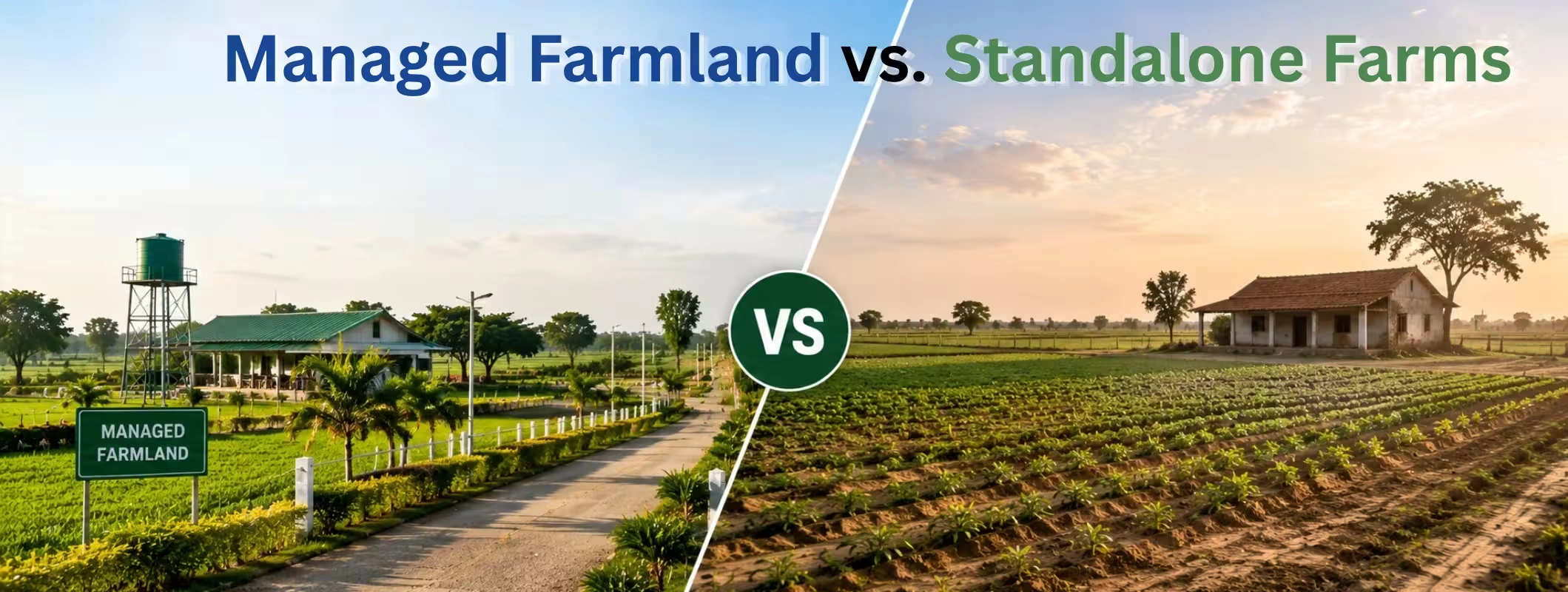
Purchasing farmland does not solely hinge on the purchase of a parcel of farming land anymore. Modern buyers consider farmland to be a valuable asset that may serve as a source of income, weekend place of residence, and potential money maker in the future. However, there is one important point to discuss prior to making a final decision – Managed Farms vs standalone agriculture farmland?
Each of the variants has its own advantages. Managed farmland will provide a buyer with professional services, constant maintenance, and low participation in farming processes. In turn, standalone farm gives all the power to the owner, provides flexibility, and makes him fully responsible for his property.
In this blog, we will compare Managed Farms vs. standalone farms based on cost, management, maintenance, risk, and ROI.
What Are Managed Farms?
Managed farms are farming ventures where the land is often subdivided into small units and is facilitated by an expert management group. Here the buyer will purchase farmland and the farm management firm will help with activities such as fencing, irrigation, plantation, soil upkeep, security, caretaker assistance, and possibly even crop planning.
Nowadays managed farms are gaining more popularity among urban buyers, NRIs, professionals, and even first-time farmland buyers because managed farms are a good source of second income like lease, getaway, rental, and etc.
The key factor for its increasing popularity is convenience. You will get a more streamlined approach towards land ownership, where the basic aspects of development and maintenance have been thought about in advance.
What Are Standalone Farms?
Standalone farms are independent agricultural land parcels bought directly by an individual buyer. These may be small, medium, or large land parcels located near villages, highways, rural belts, farm zones, or developing outskirts.
When you buy standalone agriculture farmland, you get more control. You can decide what to grow, how to fence the land, whether to build a farmhouse as per local rules, how to use the land, and when to sell it. There is no shared management structure unless you hire your own caretaker, farmer, surveyor, or local team.
Standalone farms are often preferred by experienced investors, local buyers, farmers, developers, or people who already understand land documentation, soil quality, village access, water availability, and legal checks. With 2Bigha, you can buy standalone farmland in India, we provide verified land and have an experienced team that helps buyers purchase land.
Managed Farms vs. Standalone Farms: Quick Comparison
| Factor | Managed Farms | Standalone Farms |
|---|---|---|
| Ownership | Individual plot ownership, often within a professionally managed farm project | Direct ownership of an independent agricultural land parcel |
| Management | Managed by a dedicated farm management team | Owner manages the farm personally or hires local support |
| Initial Cost | Usually higher due to development, infrastructure, and management services | Often lower, depending on location and the condition of the raw land |
| Maintenance | Easier, with structured and regular maintenance | Entirely the owner's responsibility |
| Control | Moderate control, depending on the project's operating rules | Full control, subject to applicable local land laws |
| Risk | Lower operational risk when the project is genuine and professionally managed | Higher risk if title, boundaries, access, and legal documents are not properly verified |
| ROI Potential | Generally stable, driven by convenience, project quality, and location | Can be higher when purchased at the right location and managed effectively |
| Best For | NRIs, urban buyers, passive investors, and first-time farmland buyers | Experienced investors, local buyers, and hands-on farm owners |
Cost Comparison: Which One Is More Affordable?
Cost is one of the first things buyers compare when looking for managed or standalone farmland for sale. At first glance, standalone farms may look cheaper because you are often buying raw farm land. With standalone farmland, you may need to spend separately on fencing, borewell or water access, road approach improvement, land leveling, soil testing, plantation, caretaker salary, security, electricity connection, and legal verification. These costs can increase your total investment over time.
Managed farms usually come at a higher cost as compare with standalone because the project may already include basic infrastructure, fencing, plantation planning, internal roads, irrigation setup, or ongoing maintenance support. The price is not only for land; it also includes convenience and management. Sometime managed farms are known as Farmhouse (if rooms are available).
So, if you compare only the land price, standalone farms may seem more affordable. But if you compare the total cost of ownership, managed farms can be more predictable for buyers who want to invest in agricultural land for sale without worrying about unexpected development and maintenance expenses.
Management Comparison: Time, Effort, and Responsibility
In Managed Farms, the service provider usually takes care of regular farm-level activities. This may include site supervision, plantation care, irrigation, cleaning, security, and buyer updates. For someone living in another city or country, this support can make farmland ownership much easier.
Standalone farms need active involvement. You must either visit the land regularly or appoint a trusted local caretaker. If you are not familiar with the area, you may struggle with labour availability, seasonal maintenance, document follow-ups, or local coordination.
This is one of the biggest problems 2Bigha aims to solve. Many buyers like the idea of owning farmland but feel unsure because they do not know whom to trust, how to verify the land, or how to manage it after purchase. 2Bigha helps by making farmland discovery more transparent, organized, and buyer-friendly.
ROI Comparison: Which Gives Better Returns?
ROI in farmland depends on multiple factors: location, road access, nearby development, soil quality, water availability, legal clarity, land use potential, holding period, and demand in the area.
Managed Farms can offer steady value appreciation if the project is located in a growing belt and maintained well. Since the land is usually better presented and easier to manage, it may attract buyers who want a ready and hassle-free farm ownership experience. The ROI may be stable, but the entry cost can be higher.
Standalone farms can offer higher ROI if buyers buy at the right price in an emerging location. For example, raw agricultural farmland near upcoming highways, tourism zones, industrial corridors, second-home destinations, or expanding city outskirts may appreciate well over time. But the risk is also higher if the land has unclear documents, poor access, water problems, disputed boundaries, or low resale demand.
2Bigha has also covered useful insights on top locations for buying farmland in India 2026 to help buyers understand where farmland demand may grow in the coming years.
How 2Bigha Helps You Solve These Farmland Buying Problems
2Bigha is built to make farmland discovery simpler, more transparent, and more practical for buyers. Whether you are searching for Managed Farms, standalone agriculture farmland, or verified land for sale, 2Bigha helps you make a more informed decision.
2Bigha also supports buyers with better listing details, location clarity, and practical farmland insights. The goal is not only to show land but to help users understand whether that land fits their purpose. A buyer looking for weekend farming may need a different location than someone looking for long-term appreciation. A buyer interested in managed farmland may need convenience, while a standalone farm buyer may need more control and flexibility.
For sellers, agents, and landowners, 2Bigha also creates a better way to present farmland to genuine buyers. Clean listings, location-focused discovery, and a farmland-specific audience help improve trust between buyers and sellers. Also our team helps sellers’ listing land, manage farms, and farmhouses.
Final Thoughts
Managed Farms and standalone farms both have strong potential in India’s growing farmland market. Managed Farms offer ease, structure, and professional support. Standalone agriculture farmland offers flexibility, control, and possible higher upside if chosen wisely.
However, in both cases, real success depends on informed decision-making. You should not buy farmland simply because the price looks attractive or the photos look appealing. It is important to verify the location, road access, land records, water availability, maintenance requirements, and future growth potential.
2Bigha helps buyers and sellers bridge this gap. Whether you are looking for Managed Farms, agriculture farmland, farmland for sale, or verified land for sale in India, the platform provides a focused and transparent way to explore opportunities. For landowners and real estate professionals, the 2Bigha Subscription Plan also offers enhanced listing visibility, lead generation, and tools to connect with genuine buyers, making it easier to market farmland effectively.
With the right platform, right location, and right due diligence, farmland can become more than just land. It can become a long-term asset, a lifestyle choice, and a smart investment for the future.
Disclaimer: This article is for informational purposes only and does not constitute legal, financial, investment, tax, or real estate advice. Information, including market trends, property prices, infrastructure developments, and government policies, may change over time. Readers should verify all details through official sources and consult qualified professionals before making any property-related decision.