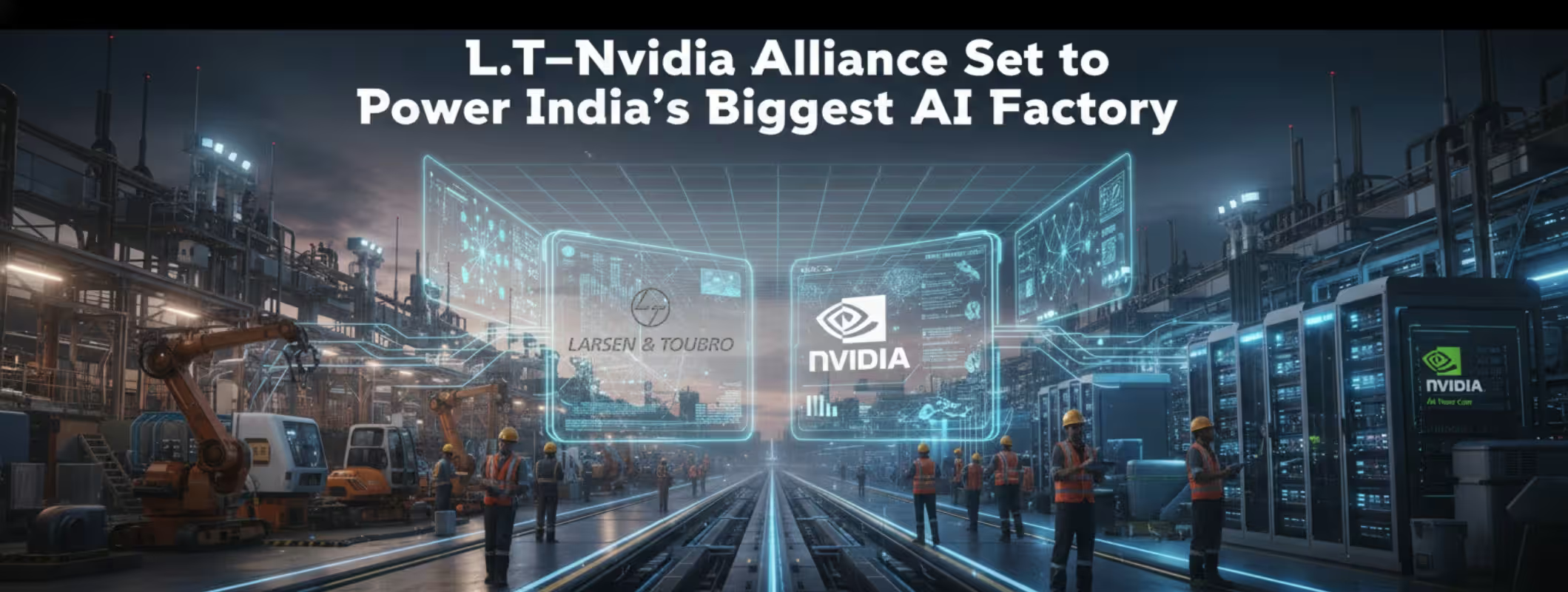
When people hear “AI,” they usually picture apps and chatbots. But the real AI race is being won on the ground — through power capacity, data centres, fibre routes, and land that can handle heavy infrastructure.
That’s why the recent move by Larsen & Toubro and NVIDIA is a big deal. The two have announced a proposed venture to build sovereign, scalable, gigawatt-scale AI factory infrastructure in India, aligned with the IndiaAI Mission.
Let’s break down what’s actually being built, why “gigawatt-scale” truly matters, and how this development could quietly reshape the land conversation — especially for industrial parcels, logistics zones, and even those looking to purchase agricultural land near future infrastructure corridors that may transform into high-value infrastructure clusters.
What Exactly did L&T and NVIDIA Announce?
This isn’t just a “partnership” headline. The plan is to combine L&T’s engineering and execution capabilities with NVIDIA’s AI infrastructure stack—GPUs, CPUs, networking, accelerated storage, and enterprise software, to deliver production-grade AI capacity anchored in India.
Two concrete rollout points have been reported repeatedly across primary and secondary sources:
- Expansion in Chennai: Scale an NVIDIA GPU cluster deployment to up to 30 MW, within a 300-acre campus.
- New facility in Mumbai: A 40 MW data centre is under execution.
And this is happening in a broader national “AI infrastructure sprint,” where multiple large players announced big AI/data-centre commitments at India’s AI summit events in February 2026.
“AI factory” sounds Fancy. What does it mean in plain terms?
Think of an AI factory as a purpose-built compute plant.
Traditional data centres are designed for general computing (web hosting, enterprise applications, storage). An AI factory is tuned for AI training and inference, which means:
- very high-density GPU racks
- extremely fast networking between GPUs
- heavy cooling requirements
- stable, large-scale power
- strong security and governance (especially for “sovereign” workloads)
That’s why the announcement keeps leaning on “AI-ready data centre infrastructure” and “advanced computing platforms.”
Why “gigawatt-scale” is the headline that matters
- 1 gigawatt (GW) = 1,000 megawatts (MW)
When a project is designed to be “gigawatt-scale,” it signals a campus mindset, not a single building mindset, something that can grow modularly over time as demand rises.
And when campuses scale, the conversation shifts from “IT project” to land + power + approvals + water + grid planning.
The land and infrastructure side nobody should ignore
AI factories don’t go where it’s “nice.” They go where it’s possible.
If you’re looking at land signals (or advising investors/owners), these are the real drivers:
1) Power availability is the first filter
AI computers need consistent power at industrial scale. This is why many AI-ready data centre projects cluster near strong grid nodes, substations, and planned capacity expansions.
2) Cooling + water planning becomes a site-selection factor
AI workloads produce heat. Cooling strategy can influence where sites work, what permissions are needed, and what operating costs look like.
3) Fibre connectivity and latency matter
Sites need reliable fibre routes and redundancy.
4) Approvals and zoning decide timelines
A “perfect” parcel is useless if the zoning, land use category, or local permissions slow it down by years.
This is also why you’ll see feasibility studies mentioned around “land suitability” in large new campuses.
Gujarat’s Dholera Signal: AI-ready campuses are becoming “city-scale” projects
Separate from the L&T–NVIDIA announcement, L&T’s data centre arm Vyoma signed an MoU with the Gujarat government to explore a 250 MW green, AI-ready hyperscale data centre campus at Dholera Special Investment Region with a proposed investment of ₹25,000 crore.
Even if this is not the same site as the NVIDIA-linked buildout, it confirms the direction: AI infrastructure is moving into planned industrial regions and large campuses, not just city-edge facilities.
What to watch if you’re tracking “AI corridor” potential
If you’re listing or evaluating land for sale, here’s the honest take:
Most random plots won’t benefit from AI/data-centre growth. The parcels that gain strategic value tend to be:
- industrial-zoned or realistically convertible
- near high-capacity power infrastructure
- close to fibre routes and highways
- inside or near approved industrial parks/SIRs/SEZ-like ecosystems
- not tangled in title / access / right-of-way issues
A Simple Due-Diligence Checklist (practical and non-negotiable)
Before someone sells you the “AI hub is coming here” story, check:
- Current land use + permitted change of land use (CLU) feasibility
- Distance to nearest substation / grid expansion plans (where publicly available)
- Water availability rules and sustainability constraints
- Road access for heavy equipment movement
- Litigation / encroachment history
- Local authority stance on data centres / industrial campuses
If any of these fail, the “AI boom” narrative won’t help that parcel.
Agricultural land: opportunity, but don’t get carried away
Let’s talk about agricultural land specifically, because this is where people often jump too fast.
Yes—large infrastructure growth can increase demand for nearby services: staff housing, logistics, ancillary warehousing, small commercial nodes, and renewable energy support in some regions.
But converting agricultural land into something industrial is not automatic, and it comes with:
- land-use conversion constraints
- environmental and water scrutiny
- local planning rules
- political/community factors
So if someone is pitching agricultural land purely as “future data centre land,” treat it as speculation unless they can show credible planning alignment and conversion feasibility.
A smarter angle for agricultural land owners is often adjacent demand (access roads, warehousing support, agri-logistics, staff ecosystem), not assuming the core campus will land on farmland.
Why This Alliance matters Beyond Tech Headlines?
The L&T–NVIDIA venture sits inside a larger wave where major groups and tech firms are committing serious capital to AI and data infrastructure in India.
This matters because:
- AI capacity becomes an economic infrastructure layer (like roads and ports)
- “Sovereign AI” pushes more data + compute to stay within national boundaries
- High-density compute creates new demand clusters for power and industrial real estate
FAQs
Is this “AI factory” already live?
It’s been announced as a proposed venture with a roadmap that includes Chennai expansion and a Mumbai facility under execution, but it’s not described as fully operational today.
Why are megawatts (MW) mentioned in AI announcements?
Because AI infrastructure is constrained by power and cooling. MW is a practical indicator of how much compute a facility can realistically host.
Will AI factories increase land prices?
Sometimes, in specific pockets where zoning, power, and connectivity line up. But broad “everything will go up” claims are usually marketing, not reality.
Should I buy land near proposed data centre regions?
Only if you can validate fundamentals (zoning, access, power feasibility, title clarity). Otherwise you’re buying a story, not an asset.