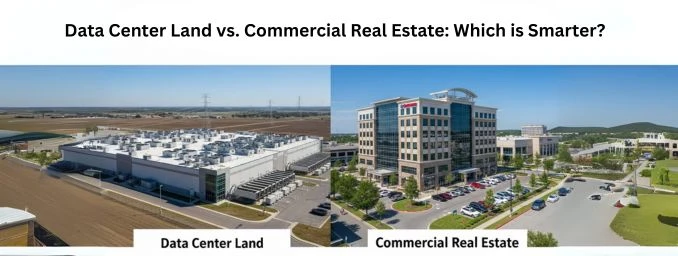
Real estate investing in India is evolving quickly. For decades, investors put their money into offices, retail shops, warehouses, and other traditional commercial assets. But times are changing. With cloud technology, artificial intelligence, and data-driven businesses growing at lightning speed, a fresh opportunity is rising—data centre land.
If you're looking to purchase commercial property or consider buying commercial land as an investment option, you might wonder whether conventional commercial property continues to offer the best return or whether it's more intelligent to invest in capital in land for data centers. This blog will walk you through the differences, benefits, hurdles, and prospects of both to enable you to make an informed choice.
Understanding Commercial Real Estate
Commercial Real Estate is real property that is utilized solely for business. Some examples include:
- Office complexes
- Shopping centers and retail stores
- Logistics centers and warehouses
- Hotels, restaurants, and properties based on services
Investors have traditionally opted for CRE due to its providing rental income, long-term appreciation, and the ability to diversify over residential property.
When you purchase commercial land, you're investing in a piece of land that can be leased, developed, or held for appreciation in value. It is often the entry point for most into large-scale real estate investment.
What Is Data Center Land?
Data Center land is plain land that is specifically bought or developed to build data centers. Unlike typical real estate used for offices, retail, or warehouses, this land is chosen and prepared to support massive digital infrastructure like cloud computing, 5G, and AI-based applications. Large tech firms and cloud providers are fueling unprecedented demand for land that accommodates:
- High power capacity
- Robust fiber optic connectivity
- Cooling and sustainability infrastructure
- Secure, disaster-resistant environments
Not all areas are suitable, of course, but the right piece of data center land can be extremely valuable, particularly in markets where digital infrastructure is on fire.
Key Differences: Data Center Land vs. Commercial Real Estate
To see which one is wiser, let's compare them along several dimensions:
Demand Drivers
- Commercial Real Estate demand is driven by population growth, consumer spending, and business expansion. For example, as urban areas expand, demand for retail and office space typically increases.
- Data Center land demand is fueled by global digitalization. Every time businesses adopt cloud computing or AI tools, the need for storage and processing grows.
- If your focus is on future technology, data centers are leading the race.
Investment Accessibility
- Common Real Estate (CRE) is open to many different types of investors. Commercial land in an expanding city is something anyone can buy and either develop or rent out.
- Data center Land has more technical expertise required, such as location, power infrastructure, and regulatory requirements are significantly more important than in conventional CRE.
Risk & Stability
- Commercial Real Estate has regular risks of vacancy levels, shifting tenant needs, and economic cycles.
- Data Center land has greater up-front due diligence. When selected properly, it frequently results in long-term leases with tech giants, giving stability.
Return on Investment (ROI)
- Commercial Real Estate can provide stable rental returns and value growth.
- Data centers, once established, tend to generate more ROI due to the high demand from tech firms.
- Both return profits, but data centers can perform better in the digital age.
Benefits of Investing in Commercial Real Estate
- Use Flexibility: When you purchase commercial land, you have various alternatives such as develop offices, retail, or even lease the land itself.
- Constant Cash Flow: Leasing commercial property guarantees a consistent income.
- Appreciation: Property in prime city areas keeps appreciating.
- Diversification: Commercial Real Estate may be less risky than stocks and other investments.
Benefits of Data Center Land Investment
- High Growth in Demand: The international digital economy guarantees increasing demand.
- Long-Term Tenants: Technology firms like long-term leases for stability.
- Premium Valuation: Data center land tends to be sold at premium prices compared to traditional Commercial Real Estate.
- Future-Proof Investment: As technology growth comes from AI, IoT, and digital services, data centers don't go out of fashion.
For investors looking ahead, data center land is in line with technology growth.
Challenges of Commercial Real Estate vs Data Center Land
Both are solid investment choices, but there are some challenges.
For Commercial Real Estate:
- Market cycles have the potential to impact rental demand.
- Remote work trends are lowering office space needs.
- Retail properties are competitive with e-commerce.
For Data Center Land:
- Needs substantial capital if development is planned.
- Requires diligent location choice (power, connectivity, climate).
- Regulatory approvals can be complicated.
Global & Indian Marketing Trends
Across global markets like the U.S., Singapore, and India, demand for data center land is skyrocketing day by day. In India, cities such as Hyderabad, Chennai, UP, Rajasthan, and Mumbai are emerging as hotspots for hyperscale data centers, powered by government support and rapid digital adoption.
At the same time, Commercial Real Estate continues to hold strong in Tier-1 and Tier-2 cities, especially in warehousing, logistics, and retail. For investors looking to buy commercial land in these markets, opportunities remain promising and highly rewarding.
Final Thoughts
In the current times, the question isn't whether to purchase commercial land or data center land, but how to split the two in half. Traditional Commercial Real Estate provides tried and tested stability, whereas data centers offer a future in line with the accelerating growth of technology.
Whether you are venturing into first time land purchase transaction or growing an existing portfolio, making thoughtful consideration of the opportunities in both markets will optimize returns while remaining strong in a shifting economy.