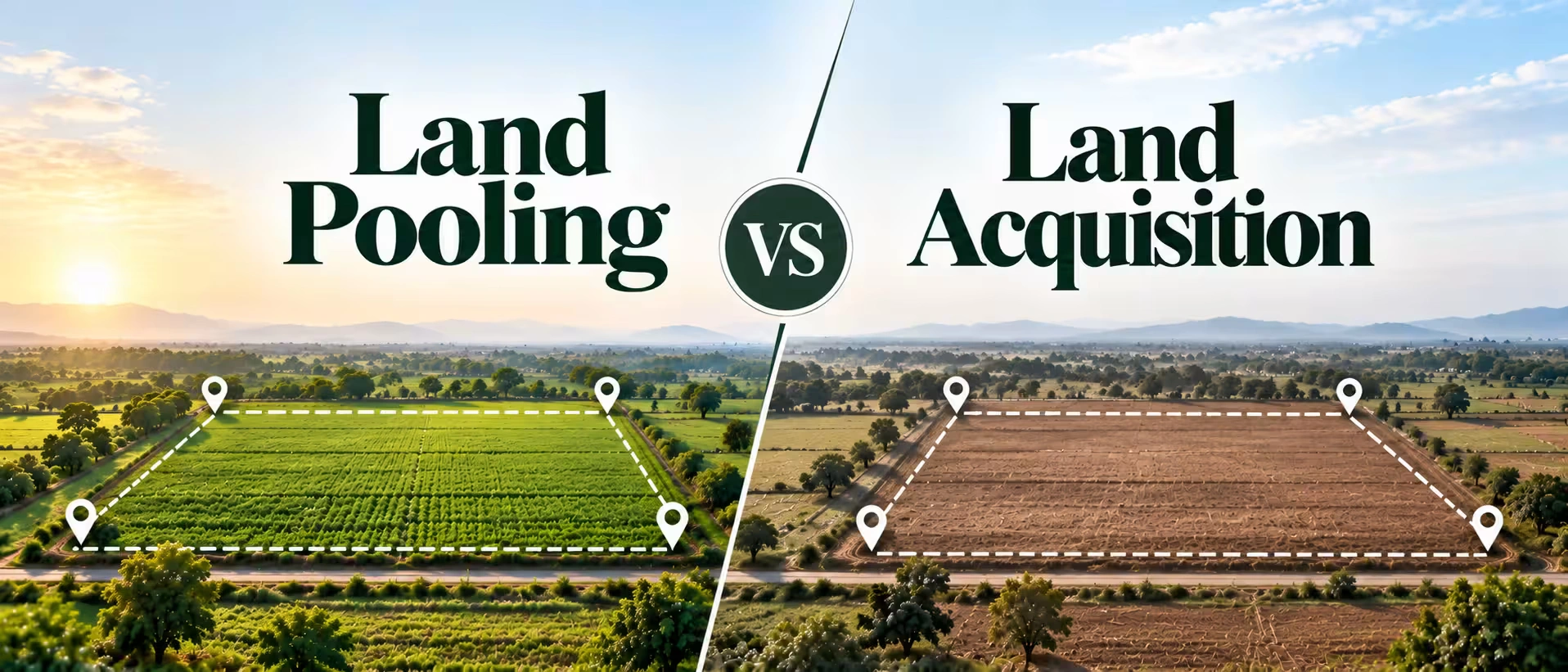
In the case where a government project requires a piece of land, it will be notified to the owners of such land through two major processes – pooling or acquisition. Most times, when people hear about either of the two terms, they think something like “the government is taking my land.” Honestly, such fear is justified because the process will definitely take the land. However, there is a big difference between the two approaches because the way you benefit from the land will totally depend on which approach is being taken. It is, therefore, important to understand the two different processes if you have land in the notified area.
The Core Difference, in Plain Terms
Land acquisition refers to the compulsory acquisition of land by the government or a government-backed agency in exchange for compensation due to a purposeful activity. The landowner gets rid of the land completely. Land pooling refers to the process where owners give away their land for temporary possession by a development body that develops the entire area, including roads, drainage, utility lines, and then gives back to the landowner a smaller area with much greater value. In simpler terms, land acquisition is an exit strategy. Land pooling, however, involves a trade-up in theory. The success of that theory is largely dependent on the way the particular system works.
Side-by-Side Comparison
| Factor | Land Acquisition | Land Pooling |
|---|---|---|
| Ownership outcome | Landowner loses the land entirely | Landowner gets back a smaller developed plot |
| Compensation type | Monetary compensation, often market value plus statutory additions | Developed land in return, sometimes with partial monetary component |
| Owner's consent | Often mandatory/compulsory, with legal exceptions | Generally requires majority landowner consent to proceed |
| Long-term value potential | Fixed at time of payout | Can appreciate significantly as the area develops |
| Legal process | Governed by land acquisition laws, notification and award process | Governed by state-specific pooling policies |
| Typical use case | Highways, railways, defense projects, public infrastructure | Planned urban expansion, new townships, integrated development zones |
| Owner's risk | Risk of undervaluation if compensation isn't market-aligned | Risk tied to how well and how fast the authority actually develops the area |
Reading this table, the appeal of pooling is obvious; you keep a stake in the upside. But that upside is only real if the developing authority actually delivers on infrastructure and timelines, which isn't always guaranteed.
How Land Acquisition Actually Works?
Acquisition in India is generally governed under the Right to Fair Compensation and Transparency in Land Acquisition, Rehabilitation and Resettlement Act, 2013, along with relevant state-level rules. The process typically involves a preliminary notification, a social impact assessment for larger acquisitions, an award of compensation, and eventually possession being taken by the authority. A few things matter a lot here for the affected landowner.
- Compensation is meant to reflect market value, but disputes over what counts as "market value" are extremely common, especially for agriculture land where recorded transaction values often lag behind actual market rates
- Landowners have a right to object during the objection period after preliminary notification, though the window for this is often narrower than people expect
- Rehabilitation and resettlement provisions apply in larger acquisitions, but the compensation offered for crop land for sale value versus its potential future non-agricultural value is a frequent point of dispute
- Legal recourse exists if compensation is contested, but it can take years to resolve through the courts
The practical reality is that acquisition compensation, even when calculated fairly at the time, often looks low in hindsight once the project drives up surrounding land values, which the original owner no longer has any claim to. This distinction is particularly relevant when comparing acquisition with the Haryana Land Pooling Policy 2026, where landowners may receive a reconstituted plot under the applicable scheme rather than only monetary compensation.
How Land Pooling Actually Works?
Land pooling schemes, sometimes called Town Planning Schemes or Land Readjustment Schemes depending on the state, work differently. Landowners in a notified area typically pool their individual plots into one larger area. The development authority then plans and builds the infrastructure, roads, sewage, electricity, sometimes parks and civic amenities, across the whole pooled area, and reallocates smaller, developed plots back to each original owner in proportion to what they contributed.
A landowner might hand over, say, an acre of undeveloped agricultural land and receive back a smaller but fully serviced plot, maybe 50-60% of the original area, depending on the scheme's deduction ratio for infrastructure. The trade is less land, but land that's now connected, serviced, and typically worth significantly more per unit area than it was before.
- Consent thresholds vary by state, but most schemes require majority landowner agreement before proceeding
- The deduction percentage (how much land is retained by the authority for infrastructure) is one of the most negotiated aspects of any pooling scheme
- Timelines for actual development can stretch much longer than initially promised, which is the single biggest practical risk for participating landowners
- Some schemes allow a partial monetary component alongside the returned developed plot, particularly for smaller landholdings that wouldn't yield a viable plot size otherwise
Which One Actually Benefits the Landowner More?
There's no universal answer, and anyone claiming otherwise is oversimplifying. It depends heavily on the specific project, the state's track record with similar schemes, and the landowner's own priorities. Acquisition tends to make more sense for owners who want a clean, immediate exit, no ongoing involvement, no waiting years for development to materialize, just compensation and closure. This suits someone who's already looking to move on, perhaps reinvesting into plots for sale near me in a different, already-developed area rather than staying tied to a project's uncertain timeline.
Pooling tends to favor owners who are comfortable waiting, believe in the specific authority's execution track record, and want to participate in the area's long-term appreciation rather than cashing out early. It's a bet on the project actually happening on schedule, which, depending on the state and the authority involved, is not something to take for granted.
The Documentation Landowners Should Insist On
Regardless of which process you're facing, a few documents and clarifications matter enormously and are worth demanding before agreeing to anything.
- Written confirmation of the compensation or reallocation formula, not a verbal assurance from a field official
- A clear project timeline, with penalty or recourse clauses if the authority misses its own deadlines
- Independent valuation of the land, rather than relying solely on the authority's assessment, particularly for acquisition cases
- Legal review of the notification and consent documents before signing, since consent once given is often difficult to withdraw
- Clarity on tax implications, since compensation and returned developed plots can be treated differently for tax purposes depending on the state and the nature of the scheme
Skipping this step, especially the independent valuation, is one of the most common regrets landowners report after the fact.
What Happens to Land Currently Under Cultivation?
A recurring concern for owners running active agricultural operations, including those experimenting with organic farmland conversion, is what happens to standing crops and land-in-use during either process. Compensation frameworks generally account for standing crop value separately from land value in acquisition cases, but the timeline mismatch — losing access to farmland mid-season — is a genuine practical disruption that documentation alone doesn't fully solve. It's worth raising this specifically during any consultation process rather than assuming it's automatically factored in.
If You're Considering Selling Instead
For some landowners facing either scenario, the more attractive option ends up being exiting the market altogether before the notification process even begins, particularly if the land sits in an area only recently rumored for a pooling or acquisition scheme. Selling property online through a verified platform gives owners more control over timing and price than waiting to see how a government process unfolds. It's also often a faster route than navigating years of acquisition compensation disputes or pooling development delays.
This is where a platform like 2Bigha becomes genuinely useful. For owners actively engaged in land selling ahead of a notified project, or simply looking to reach a wider, verified pool of buyers searching for farmlands near me listings, listing through a platform with built-in documentation and background verification tends to move faster and attract more serious buyers than informal broker networks. It's worth exploring as an option well before any formal notification locks a landowner into either acquisition or pooling terms.
Disclaimer: This article is for informational purposes only and should not be considered investment, legal, financial, or property advice. Real estate regulations, infrastructure plans, market conditions, and government policies may change over time. Readers are advised to verify information with relevant authorities and consult qualified professionals before making any investment or property-related decisions.