Key Takeaways
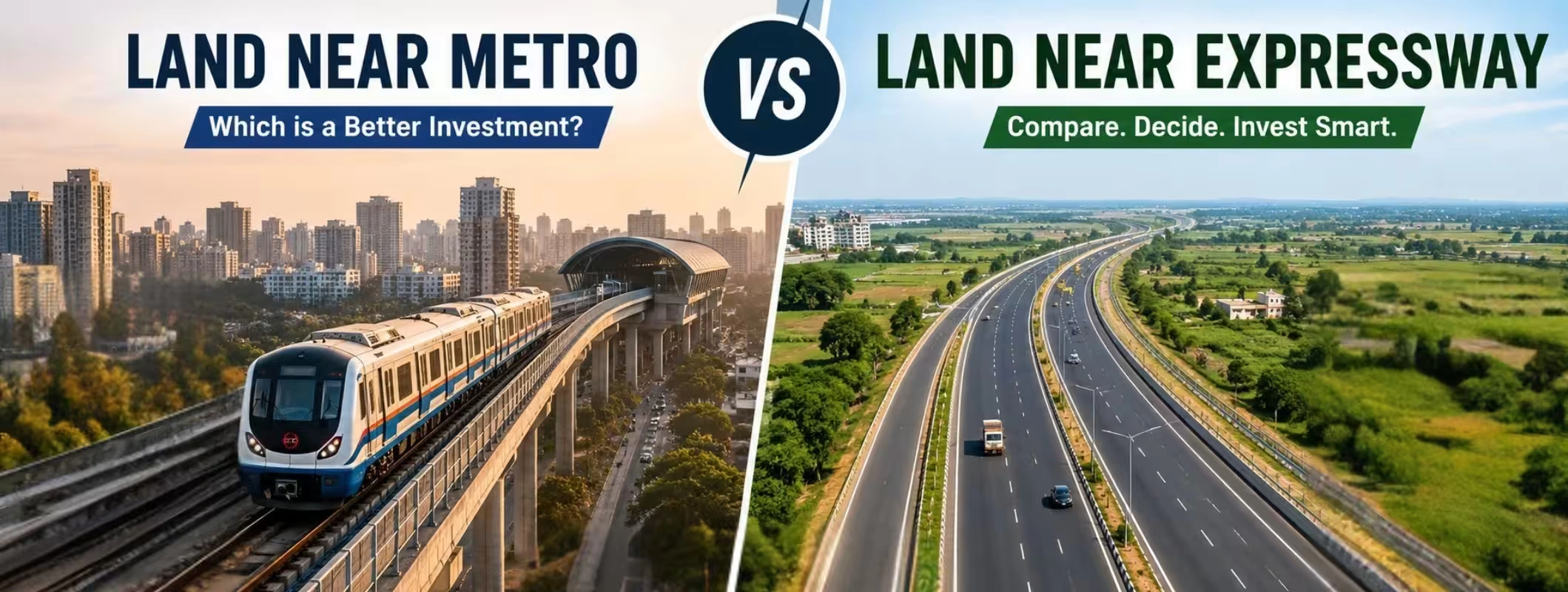
- Land near metro stations appreciates relatively fast in urban settings because of the constant demand for commuters and scarcity of land.
- Land near expressway corridors is suitable for industry, logistics, and housing township projects that ensure long-term appreciation of value.
- Metro corridor land is relatively expensive per square yard but appreciates fast during resale.
- Expressway corridor land is relatively cheap and suited for farmland, warehousing, or large land investments.
- It is always advisable to check the land records and clearances when purchasing such lands adjacent to any infrastructure project.
- The decision must be based on investment period and purpose.
Introduction
Location is the most significant determining factor in whether the land investment becomes profitable or remains inactive for many years. One of the major concerns that Indian investors often struggle with nowadays is whether one should opt for a land investment near metro stations or an investment near expressway corridors. Both the options have completely changed the way of investing in property over the past ten years in many cities such as Delhi NCR, Pune, Bengaluru, and Hyderabad. This write-up will help you understand both the options in detail with examples from the market trends.
Understanding the Two Investment Options
Before comparing returns, it helps to understand what each type of location actually offers to a property buyer.
What Does "Land Near Metro" Mean?
Land near a metro consists of parcels that are within the walking or driving distance (usually 0.5 to 3 km) of an existing or future metro station. Since metro rail projects are typically planned within or around busy urban areas, the land is mostly within city boundaries or fast-urbanizing outskirts.
What Does "Land Near Expressway" Mean?
Land near the expressway consists of plots that are located adjacent to the controlled access highways connecting two or more cities/regions like Delhi-Mumbai Expressway, Yamuna Expressway, or Mumbai-Pune Expressway. The land is usually on the periphery of cities, in semi-urban or rural zones undergoing development.
Why Location Near Infrastructure Matters for Real Estate
Infrastructure projects like metro lines and expressways are widely recognized as price catalysts in real estate. Government spending on connectivity directly increases demand in the surrounding belt.
- The metro corridors increase intra-city transport speed, thereby making land near such transport more valuable.
- The expressways save inter-city transport time and open up land for industries, logistics centers, warehousing, and township development.
- Such projects normally lead to an increase in land prices even before their completion – which is known as the “announcement effect.”
This is why serious investors track upcoming infrastructure announcements closely before buying land, and platforms such as 2Bigha are useful here, as they allow users to explore property insights and track how nearby infrastructure developments may influence land values.
Land Near Metro: Advantages and Limitations
Advantages of Investing Near Metro Stations
- High Rental Returns – Young working professionals seek houses close to the metro stations for assured rental returns.
- Fast Appreciation – Research into metro corridors of Delhi, Noida, and Bangalore reveals that prices of land increase by 15%-40% within 2-3 years after the announcement of the metro lines.
- Higher Liquidity – The smaller size plots near metros can be sold faster than larger plots located at the entrance of an expressway.
- Developed Infrastructure – Areas near metros usually have schools, hospitals, and markets nearby.
Limitations of Metro-Adjacent Land
- Higher Entry Cost – Prime metro-facing land can be significantly more expensive per square yard.
- Limited Plot Sizes – Urban land near metro stations is often smaller and less suited for farmhouse-style or large-scale development.
- Regulatory Restrictions – Transit-oriented development (TOD) zones may have restrictions on land use, height, or purpose.
Land Near Expressway: Advantages and Limitations
Advantages of Investing Near Expressways
- Lower Entry Price – Land along upcoming expressway stretches is usually more affordable, allowing investors to acquire larger parcels.
- Long-Term Growth Potential – As logistics parks, industrial corridors, and new townships develop, land values can multiply over 5–10 years.
- Ideal for Farmhouse Land – Investors looking for farmhouse land or weekend retreats often prefer expressway-adjacent plots due to larger sizes and lower density.
- Government-Backed Corridors – Many expressways are part of larger regional development plans, which bring roads, water, and electricity infrastructure over time.
Limitations of Expressway-Facing Land
- Slower Initial Growth – Appreciation can take longer since surrounding infrastructure (schools, hospitals, markets) develops gradually.
- Zoning Uncertainty – Not all expressway-adjacent land is approved for residential or commercial use; some remains agricultural until reclassified.
- Lower Liquidity in Early Years – Reselling large rural plots can take longer than smaller urban parcels.
Land Near Metro vs Land Near Expressway: Comparison Table
Factor | Land Near Metro | Land Near Expressway |
| Entry Cost | Higher per sq. yard | Comparatively lower |
| Appreciation Speed | Faster in short term (2–3 years) | Slower but steady over 5–10 years |
| Ideal Investment Type | Residential, rental income | Farmhouse land, industrial, large townships |
| Plot Size Availability | Smaller, urban plots | Larger, semi-rural plots |
| Liquidity | Higher, easier resale | Lower initially, improves with development |
| Infrastructure Maturity | Usually established | Develops gradually |
| Best Suited For | Salaried buyers, short-term investors | Long-term investors, large landholders |
Key Factors to Check Before Buying Land Near Metro or Expressway
Regardless of which option you choose, certain due-diligence steps remain essential when buying land in India.
1. Verify Land Records and Ownership
Always check land records, mutation entries, and encumbrance certificates before finalizing a purchase. Disputed or unclear titles are among the most common reasons investors lose money in Indian real estate.
2. Confirm Zoning and Land Use Approval
Land near an expressway may still be classified as agricultural. Converting it to residential or commercial use requires approval from local development authorities. Similarly, land near metro corridors may fall under TOD zoning with specific usage rules.
3. Check RERA Registration (For Developed Projects)
If you're buying a plot within an approved layout or township, confirm that the project is registered under the Real Estate (Regulation and Development) Act, RERA. This protects buyers from delayed possession and misleading advertising.
4. Assess Connectivity Beyond the Headline Project
A metro station or expressway alone doesn't guarantee growth. Check last-mile connectivity, availability of water and electricity, and proximity to employment hubs.
5. Compare Multiple Listings Before Deciding
Whether you're buying near a metro corridor or an expressway, it helps to compare several plots before committing. With more people now selling property online, buyers have easier access to price trends, plot dimensions, and seller details across regions, making it simpler to shortlist the right investment without depending entirely on local agents.
6. Study Government Master Plans
Most Indian states publish master plans (like the Delhi Master Plan 2041 or UP's regional development plans) that outline where future infrastructure, industrial zones, and residential sectors are proposed. These documents are extremely useful for identifying land with genuine long-term potential.
Government Initiatives Influencing Land Value Near Metro and Expressways
Several government programs continue to shape demand in these corridors:
- PM Gati Shakti National Master Plan – An integrated infrastructure plan which takes care of all road, rail, and metro plans, leading to an increase in the value of land around these infrastructures.
- Metro Network Extension Plans – Cities such as Delhi, Bangalore, Pune, and Kanpur are continuously adding to their metro network plans, creating investment avenues.
- Expressways Projects – Plans such as Delhi Mumbai Expressways and Ganga Expressways are expected to increase the value of the land across various states by enhancing connectivity between cities.
- Land Record Digitization – Digitization of land records by the states under Digital India Land Records Modernization Programme makes it easier for investors to verify land ownership.
Staying updated on such initiatives is easier through dedicated real estate research platforms. 2Bigha, for instance, is designed to help users explore property insights, investment opportunities, and land record information relevant to specific regions, which can save significant research time for new investors.
Real-World Example: Comparing Two Investor Journeys
Case 1 – Metro Investment: An investor purchased a small plot near an upcoming metro station in a Tier-1 city in 2019. Within four years, as the metro line became operational and rental demand increased, the plot's value nearly doubled, and it was resold with strong liquidity.
Case 2 – Expressway Investment: Another investor purchased a larger parcel of farmhouse land near a developing expressway stretch in the same period. Initial appreciation was slow, but as logistics parks and residential townships began coming up nearby, the land value grew significantly over six to seven years, ultimately outperforming smaller urban plots on a percentage basis.
This illustrates that both strategies can work — the right choice depends on your investment timeline and risk appetite. Interestingly, both investors later found it easier to plan their exit by selling property online, as digital listings helped them reach genuine buyers faster than relying only on local brokers.
Which One Should You Choose? A Quick Decision Guide
- Choose land near metro if you want faster appreciation, rental income potential, and easier resale within 3–5 years.
- Choose land near expressway if you have a longer investment horizon, want larger plot sizes, or are interested in farmhouse land or industrial-use property.
- Diversify if possible — many experienced investors hold a mix of both to balance short-term liquidity with long-term growth.
How Technology Is Making Land Investment Easier
Earlier, land investment in India depended a lot on local brokers and information passed through word of mouth, which resulted in incomplete or biased suggestions. With the introduction of online platforms, things have started to change. People can now find out online about selling their property, compare lands from different locations, check documents, and even subscribe to get information about a particular plot of land or locality. Subscription of a particular platform for property research will enable investors to keep track of the prices, approvals of new projects, and infrastructure developments independently of any broker. The online platform such as 2Bigha is a great example of this trend
Conclusion
There is no one answer to the issue of whether one should invest in land near the metro or near the expressway; it all depends upon what you expect from your investment. Metro land usually makes sense for people looking to see faster results on their investment. Expressway land, on the other hand, works well when you have more time on your hands for investments and look for larger pieces of property. The most important thing in any of these situations is doing your homework thoroughly, as far as researching land records and RERA requirements is concerned. As the infrastructure in India develops through metrolinks and expressways, investors who do their homework wisely, using platforms like 2Bigha, will succeed
Disclaimer: This article is for informational purposes only and should not be considered investment, legal, financial, or property advice. Real estate regulations, infrastructure plans, market conditions, and government policies may change over time. Readers are advised to verify information with relevant authorities and consult qualified professionals before making any investment or property-related decisions.