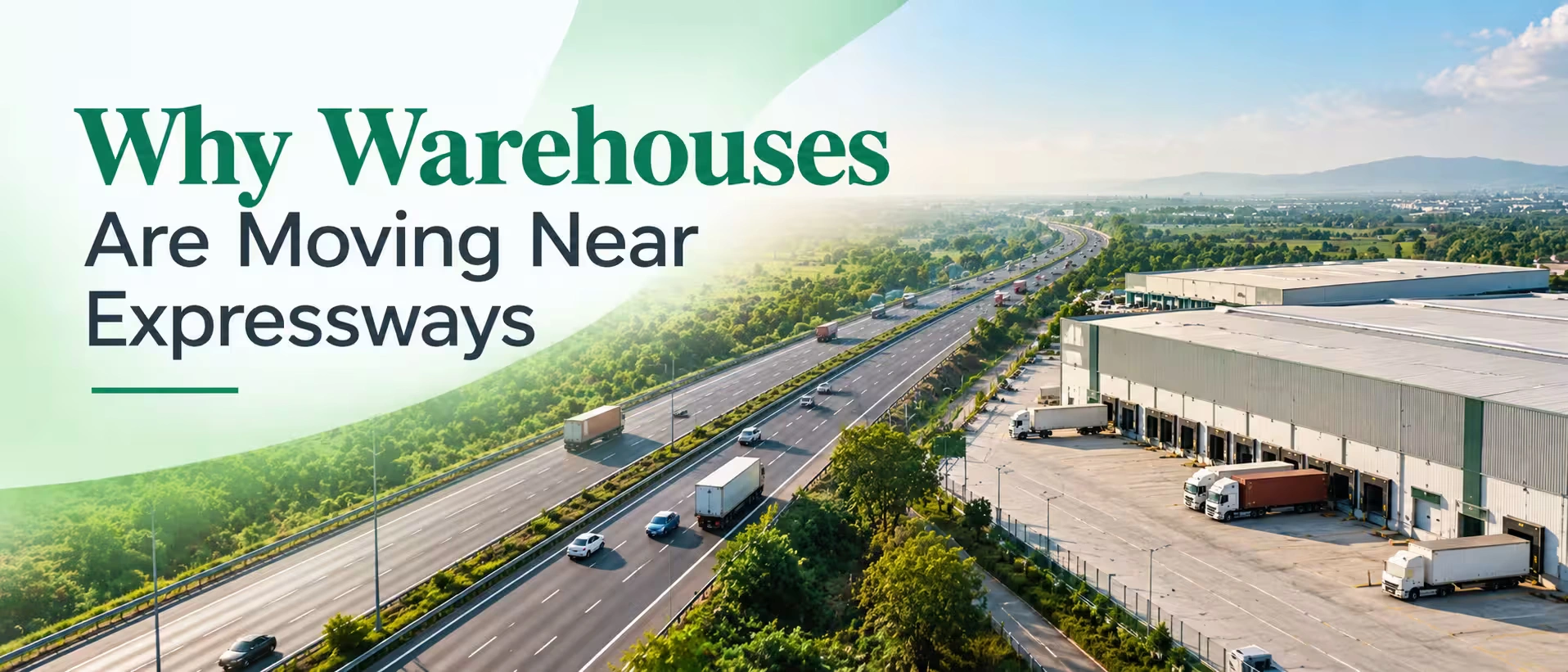
Warehouse and logistics companies are leasing and buying farmland near new expressways, and the speed of it has surprised a lot of landowners. The reason is simple. A truck on an expressway arrives on time, and on the old highway it often didn't. Once a company can trust the travel time, it needs fewer godowns, but bigger ones, and bigger ones need flat, cheap land in large pieces. Farmland matches that. If you plan to buy agricultural land near one of these roads, know what is pushing the demand before you pay extra for it.
What changed in the last few years?
- GST was introduced in 2017, and there were no longer any border posts at the state borders. Companies did not store inventory in every state but in regional distribution centers.
- E-commerce continued to rise. Now consumers demand next-day deliveries, which require inventory to be closer to the consumer than the factory.
- The National Logistics Policy (2022) and the freight corridors project have proved that the government wants to reduce logistics costs.
- Rents in sheds close to Mumbai and Delhi had risen so high that relocating 30 to 50 kilometers away to a larger shed became a better solution.
- Expressways have reduced this distance.
What do logistics developers look for?
- Proximity to an interchange. The trucks will not benefit from the advantage when they have to creep at a snail’s pace on the road through the village to get to the highway.
- Land that is contiguous. Generally, 5 acres and above, and usually much more.
- Land that is flat and drains easily. Waterlogged land is expensive to develop.
- Land use classification. In most states, agricultural land must be converted first before construction of a warehouse.
- Availability of power and water. Cold storage requires lots of electricity.
- Presence of people nearby. Loading, packing, and driving require labor.
Where is this already happening?
- The old clusters include Bhiwandi (Mumbai), Manesar and Bawal (Gurugram), Sanand (Ahmedabad), Hoskote and Nelamangala (Bengaluru), and Oragadam (Chennai).
- The other early projects include the Delhi-Mumbai Expressway, which is over 1,300 km long, and a few state expressways in Uttar Pradesh.
- This sequence includes: Land agents begin to make appearances, there are rumours, and then a few large players secretly acquire pieces, followed by an announcement of a logistics park and price rises for all others.
- If you buy after the announcement, you end up paying for a story that has been monetized by others.
Is every plot near an expressway a good buy?
No. Some of them are a trap.
- Expressways are access-controlled. You can't open a gate onto the road like you could on an old highway.
- You get on and off only at interchanges, and they can be far apart.
- A plot right beside the road but far from an exit can be worth less than one that is 3 km from an exit and a little off the road.
- People searching for a plot near me for sale along a new corridor often think frontage means access. It doesn't, and it has cost buyers a lot.
- Look at service roads, link roads that are actually sanctioned, and the master plan. They say more about the plot than the highway does.
Does plot Size Matter?
- One or two bighas is fine for farming or a farmhouse, but not for a warehouse.
- Developers want one big piece. Farmland plots of this size only work when the neighbours agree to sell together.
- That is why agents walk around pooling parcels from several owners.
- If you want a farm on sale near me where you'll really grow crops, the expressway still helps, because your produce reaches the mandi faster. You will just pay more than for the same soil a few villages inland.
What Should Buyers check before paying?
| Check | What to confirm |
| Land use | Is it agricultural, converted, or inside a zone that allows warehouses? Check the development plan, not the broker. |
| Access | Distance to the nearest interchange, and whether the service or link road is sanctioned or only proposed. |
| Acquisition | Any widening or new alignment that could take a strip of the plot. |
| Title | Owner is clear, all heirs have signed, no loan or case on the land. |
| Flooding | Past waterlogging, any nullah nearby. |
| Price | Recent registered deeds in the area, not agent quotes. |
- If the whole pitch is "warehouse coming soon", ask which company, which survey number, and what approval exists.
- If nobody can answer, the warehouse probably exists only in the sales talk.
Mistakes buyers make near expressways
- Buying on rumour before any approval is on paper.
- Paying for frontage without checking where the nearest exit is.
- Forgetting that conversion costs money and time.
- Skipping the title check because the agent says another buyer is waiting.
- Visiting only in dry months and missing what the plot looks like in the rains.
If you own land near an expressway
- Plot size and distance from the interchange decide most of the price. Think about these two first.
- For land selling, talk to your neighbours before you list. Joined-up plots with clean papers get better offers than one small piece.
- Some owners lease to a developer for rent. You keep the land, but it is tied up for a long time, often ten years or more, so read the terms carefully.
- When you sell land, sort out the land use status early. Pending conversion is the most common reason a deal gets stuck.
- Keep revenue records, mutation entries, and tax receipts ready.
- Get two or three offers before you sign anything.
Will every expressway fill up with warehouses?
- No. Some stretches stay empty for years.
- Too many warehouses can get built, and land use rules can change.
- Value the land as land first. Treat the logistics angle as a bonus.
Find and Check Land with 2Bigha
2Bigha is a marketplace for agricultural land and farmland in India, built around verified listings.
- Browse listings in growing corridors.
- Run a land report to check key details before you commit.
- Book a visit once you have narrowed down your list.
- Own land near an expressway? List it on the platform and reach people who are searching for that kind of plot.
Disclaimer: This article is for informational purposes only and should not be considered investment, legal, financial, or property advice. Real estate regulations, infrastructure plans, market conditions, and government policies may change over time. Readers are advised to verify information with relevant authorities and consult qualified professionals before making any investment or property-related decisions.