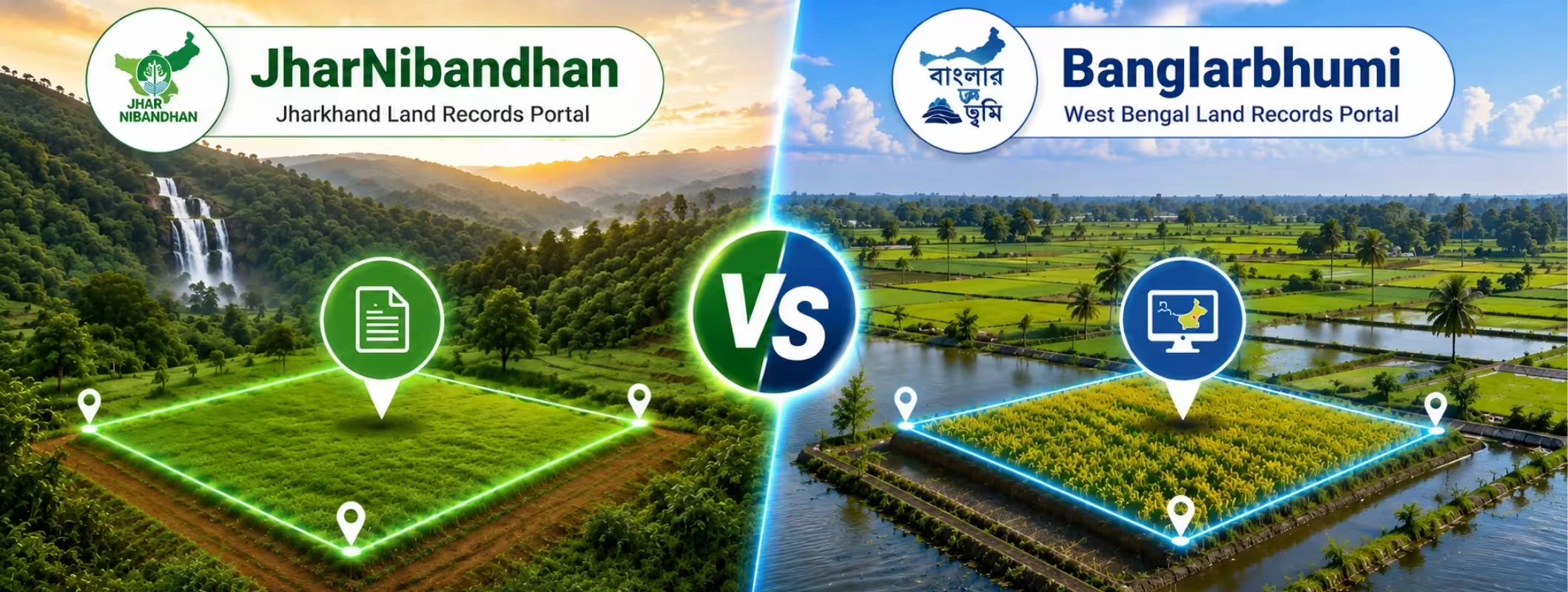
If you are someone who has already tried to check land ownership papers in eastern India, you already know the difficulty level. Every state has its own website, its own terminology, and its own steps. Two portals that people usually talk about are JharNibandhan in Jharkhand and Banglarbhumi in West Bengal. Both portals provide the same thing in different locations: digital access to land records, but they work quite differently once you actually start using them. This article will help you understand what each portal does, how they compare, and what it means if you're planning to buy or sell land in either state.
What Is JharNibandhan?
JharNibandhan is Jharkhand's official platform for property registration, owned by the Department of Revenue, Registration and Land Reforms. It was mainly created to make document registration and stamp duty calculation easier for citizens and sub-registrars alike, reducing the extra time spent on travel. If you're dealing with land in Jharkhand, JharNibandhan is usually where the registration part of your transaction happens, while a related portal called Jharbhoomi handles the record-viewing side, things like Khata, Khesra, mutation status, and land maps.
What You Can Do on JharNibandhan?
- Calculate the stamp duty and registration charges before registering a deed.
- Monitor the progress of document registration
- View digital registration of property deeds
- Use the fee calculator to calculate total charges in advance
Due to the different functions that registration and documentation have on JharNibandhan and Jharbhoomi, new users may find it difficult to understand their role. One should always remember that JharNibandhan is the “registration counter” and Jharbhoomi is the “documentation room.”
What Is Banglarbhumi?
While Banglarbhumi, which began operations way back in 2010, is the response of West Bengal to the same problem, the approach followed here is that of consolidation. This initiative of West Bengal has been developed and maintained by the Land & Land Reforms Department of West Bengal, and it combines all four components in a single website.
What You Can Do on Banglarbhumi?
- Search Khatian and plot details using the "Know Your Property" feature
- Check RS-LR (Revisional Survey-Land Records) plot information
- Apply for mutation, conversion, and Warish (inheritance) applications online
- Download mouza and plot maps
- Pay Khajna (land revenue) online
A recent update is worth noting: digitally signed Khatian and plot information copies are now available for free through Banglarbhumi land records services, following an amendment to the state's records manual. That's a meaningful shift for anyone who used to pay repeatedly just to get a certified copy of their own land document.
JharNibandhan vs Banglarbhumi: Side-by-Side Comparison
Feature | JharNibandhan (Jharkhand) | Banglarbhumi (West Bengal) |
| Primary purpose | Document registration & stamp duty | Land records, mutation & citizen services |
| Record viewing | Handled via linked Jharbhoomi portal | Built into the same portal |
| Ownership document | Register-II (Panji 2), Khatian | Khatian, RS-LR plot info |
| Mutation status | Trackable via Jharbhoomi | Trackable via Banglarbhumi directly |
| Maps | BhuNaksha for land maps | Mouza maps, plot maps |
| Language support | Primarily Hindi and English | Bengali, English, and Hindi |
| Certified copies | Available via registration records | Now free for Khatian/plot info |
| Mobile access | App support available | Mobile browser compatible |
Why the Difference in Structure Matters?
Jharkhand splits registration and record-keeping across two connected systems, which mirrors how many north Indian states organize their land data. West Bengal, on the other hand, has leaned toward putting everything under one roof. Neither approach is wrong, but it changes what you should expect as a buyer. If you're looking at land in Jharkhand, be ready to check two portals, JharNibandhan for the registration and fee side, and Jharbhoomi for ownership history and maps. If you're comparing options to buy agricultural land in West Bengal, Banglarbhumi alone usually covers most of what you need to verify before moving ahead.
Jharkhand Property Regularisation: A Complication Worth Knowing
One of the factors that make it a bit tougher in Jharkhand at present is a kind of land called "Gair Majarua Khas". It refers to certain categories of government or community land where, for some time, there was a notification that prohibited the registration of that land.
However, this notification was quashed by the Jharkhand High Court, which allowed for the registration of such plots of land. However, the process of property regularisation in Jharkhand entails additional verification procedures as opposed to the registration of ordinary raiyati (privately owned) land. If you are going to sell any land plot of this type in Jharkhand, then it would be useful for you to check the land classification on Jharbhoomi in advance because the buyers will definitely want to know it. There is no analogous restriction in the case of Banglarbhumi in West Bengal.
What This Means for Buyers and Sellers?
- Anyone searching for farm land near Jharkhand should confirm land classification (raiyati vs Gair Majarua Khas) before finalizing a deal.
- Buyers looking to buy agricultural land in West Bengal can lean on Banglarbhumi's single-portal system to check Khatian, RS-LR details, and mutation status together.
- Sellers interested in selling land online in West Bengal benefit from the portal's free digitally signed documents, which speed up buyer trust.
- For those planning to sell agricultural land in Jharkhand, cross-checking both JharNibandhan and Jharbhoomi avoids last-minute registration delays.
- If you're browsing farm land for sale in West Bengal, always match the Dag (plot) number on the listing against the RS-LR record before paying any advance.
Where 2Bigha Fits In?
Checking two government portals, understanding Khatian versus Register-II, and figuring out whether a plot is Gair Majarua Khas isn't something every buyer wants to do alone. This is exactly where 2Bigha: Buy and Sell Agriculture Land & Farmlands in India becomes useful.
Instead of leaving buyers to navigate JharNibandhan, Jharbhoomi, and Banglarbhumi separately, 2Bigha brings verified agricultural land listings from states like Jharkhand and West Bengal into one searchable platform. Whether you're looking for land in Jharkhand with a clean registration history or want to buy agricultural land in West Bengal backed by verified Khatian and RS-LR details, the platform aims to remove the guesswork that usually comes with cross-referencing multiple state portals. For sellers, it also offers a simpler way to sell land online in West Bengal or list farmland in Jharkhand without depending entirely on local brokers.
Conclusion
JharNibandhan and Banglarbhumi are solving the same basic problem, replacing paper-heavy land offices with digital access, but they've taken different roads to get there. Jharkhand's system splits registration and record-viewing across connected portals and still carries some complexity around Jharkhand property regularisation for certain land categories. West Bengal's Banglarbhumi, by contrast, offers a more unified experience with free certified copies now built in. Whichever state you're dealing with, the underlying advice stays the same: verify ownership, mutation status, and classification before you commit to any land deal, whether you're buying, selling, or simply comparing options across both states.
Disclaimer: This article is for informational purposes only and should not be considered investment, legal, financial, or property advice. Real estate regulations, infrastructure plans, market conditions, and government policies may change over time. Readers are advised to verify information with relevant authorities and consult qualified professionals before making any investment or property-related decisions.