Key Takeaways
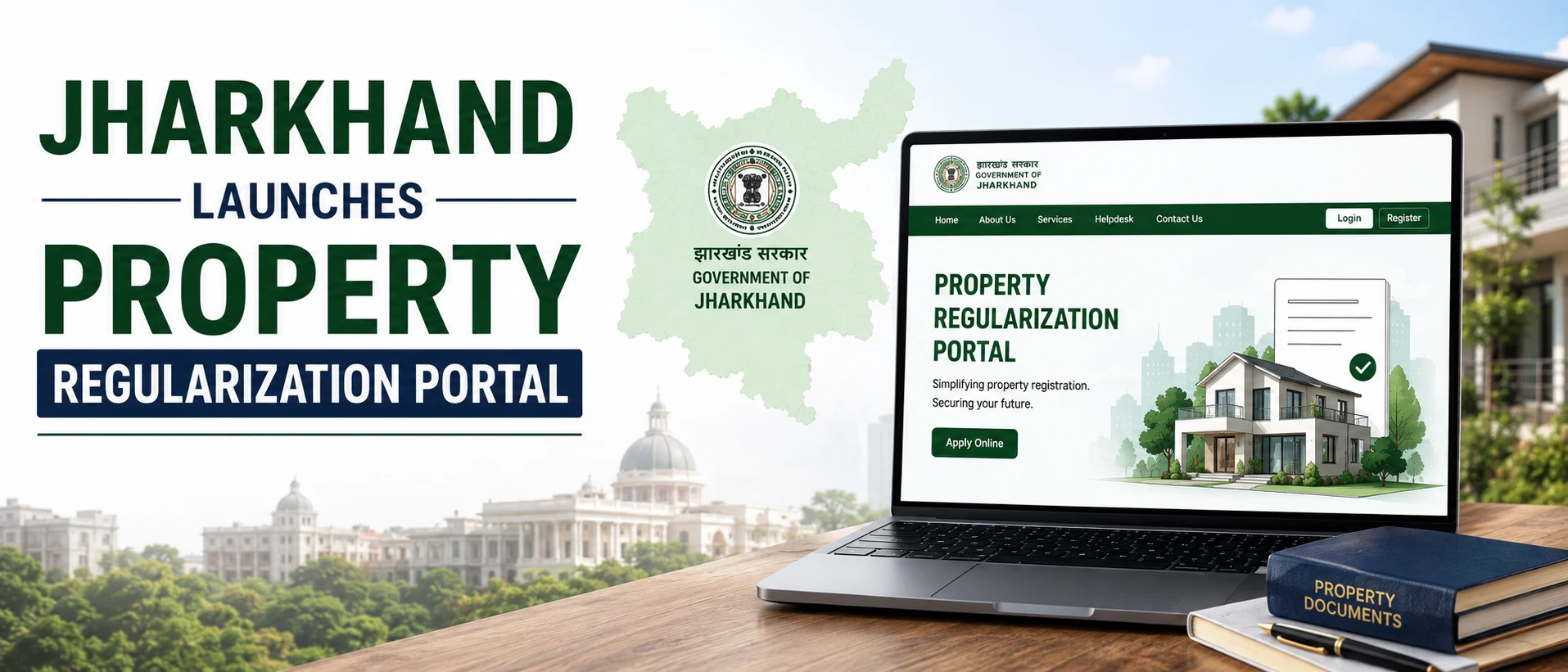
Jharkhand has launched an online portal to regularise eligible unauthorised residential buildings under the Jharkhand Regularisation of Unauthorisedly Constructed Building Rules, 2026. The portal is meant to help homeowners bring certain existing constructions into the legal framework, not to encourage new violations.
The process mainly applies to eligible residential buildings, especially homes built without sanctioned maps or with deviations from approved plans. Reports state that buildings up to G+2 height and plots below 300 sq. metres are covered under the scheme, but owners should verify the latest eligibility on the official portal before applying.
Property legalisation is not the same as property registration, mutation, or land record correction. For complete ownership safety, owners must also check Jharkhand land records, mutation status, sale deed, building approval, tax records, and encumbrance details.
For buying or selling land in Jharkhand, platforms like 2Bigha can help property owners and buyers focus on verified listings, cleaner documentation, and more transparent property discovery.
Quick Answer: How Can You Legalize Property in Jharkhand Online?
To legalize property in Jharkhand, eligible homeowners can apply through the new online building regularisation portal, fill in property details, upload ownership and building documents, pay the applicable regularisation fee, and track the application digitally. The process is mainly for existing unauthorised residential constructions that meet the government’s eligibility conditions.
However, legalising a building does not automatically fix every title issue. You should also verify land ownership records, mutation status, sale deed registration, property tax records, and land map details through official Jharkhand property portals.
What Does “Legalize Property in Jharkhand” Actually Mean?
Many property owners use the word “legalize” for every property-related issue, but in real estate, it can mean different things.
In Jharkhand, the new online portal is mainly about regularising unauthorised residential buildings. This means the government is giving eligible homeowners a digital route to bring certain existing houses into the legal framework if they were built without sanctioned building plans or with deviations from approved plans.
It does not mean every disputed land, encroached land, forest land, government land, or unclear ownership property will become legal automatically. This difference is very important.
For example, if your house was built on privately owned land but the building plan was not approved, the new portal may help if the property meets the rules. But if the land ownership itself is disputed, the mutation is missing, the sale deed is defective, or the land falls under prohibited/restricted category, you may need separate correction, verification, or legal action.
That is why every owner should understand three layers of property legality:
- Land ownership legality – Who owns the land?
- Revenue record legality – Is the land record updated in the owner’s name?
- Building approval legality – Was the construction approved or regularised?
A property becomes safer for sale, loan, inheritance, and future development only when these layers are aligned.
Why Jharkhand’s New Property Legalisation Portal Matters
There are many urban and semi-urban areas within Jharkhand that are filled with structures constructed by their owners without getting any formal approvals from authorities or making minor changes to the approved design during construction. There is increasing demand in urban cities like Ranchi, Dhanbad, Jamshedpur, Bokaro, Deoghar, Hazaribagh, and its neighboring areas for plots and constructions like small residential structures and individual houses.
Introduction of this new portal is significant as it eliminates the need for offline filing, going to municipal authorities, and uncertainty regarding progress or status and involvement of middlemen. This will enable people to use online methods for applying, document submission, making payments, and monitoring the status of their process online. Some building-related online facilities offered by the Urban Development & Housing Department include Building Plan Approval Management System (BPAMS).
For genuine homeowners, this is a practical relief. A regularised property can become easier to sell, transfer, finance, insure, or pass on to the next generation. For buyers, it also adds one more checkpoint before investing in a house or plot.
Who Can Apply for Property Legalisation in Jharkhand?
The new process is aimed at owners of eligible unauthorised residential buildings. Based on current reports, the scheme covers residential buildings up to G+2 height and within the notified plot/area limits. The cabinet-approved rules mention buildings up to 10 metres or G+2 and up to 300 square metres, with regularisation fees and penalties.
You may consider applying if:
- Your house was built without a sanctioned map.
- Your construction has deviations from the approved building plan.
- Your building is residential and within the permitted height/area limits.
- Your property is not on government land, public land, road land, water body, forest land, or restricted land.
- You have ownership documents such as sale deed, gift deed, partition deed, inheritance papers, or other valid title documents.
- You can provide a site plan or structure map prepared by a registered architect, engineer, or approved professional.
- You can submit an affidavit confirming that the property is not violating key restrictions.
Owners should not assume eligibility only because the portal is live. The final decision will depend on documents, local body verification, building status, land category, municipal rules, and applicable penalties.
Also Read: Jharbhoomi 2026: How to Check Jharkhand Land Records Online
Step-by-Step Process to Apply Online for Property Legalisation in Jharkhand
Step 1: Visit the Official Portal
You may begin by logging into the website of the Jharkhand Urban Development & Housing Department or even the building regularisation portal provided by the government of Jharkhand.
Please refrain from accessing websites through third parties, as there is no guarantee of success when doing so.
Step 2: Create Your User Login
Use your mobile number, email address, and other identity details for registration. Ensure that you have your Aadhaar number, PAN, mobile number, and email address. You should use your own mobile number as some things can depend on it.
Step 3: Select Your Urban Local Body
Choose the correct municipal corporation, nagar parishad, nagar panchayat, or local urban body. This is important because property verification will be linked to your local jurisdiction.
For example, a property in Ranchi must not be filed under the wrong local body. Wrong selection can delay or reject the application.
Step 4: Fill Property Details Carefully
Enter the property location, plot number, khata number, ward number, road details, plot area, built-up area, building height, floors, and type of construction.
Do not guess these details. Match them with your deed, municipal tax receipt, approved map, land records, and site measurements.
Step 5: Upload Ownership and Building Documents
Submit the scanned copies of the above documents. The above documents include sale deed, proof of land ownership, tax receipt, building picture, site plan, structural details, affidavit, ID proof, etc.
Low-quality scans might hamper the approval process. High-resolution PDF or images where names, plot number, signature, and stamp are clearly visible should be submitted.
Step 6: Pay the Applicable Fee
The system may calculate regularisation charges, penalty, or compounding fee based on property details. Reports also mention that fees may be allowed in instalments to reduce the burden on applicants.
Step 7: Submit and Track Your Application
Once your payment and submission is done, note down the acknowledgment number. Check for the status of your application online. It has been observed through various government documents that there is a fixed timeframe in which applications will be processed; however, one needs to keep track of this portal.
Documents Required for Property Legalisation in Jharkhand
Document | Why It Is Needed |
| Aadhaar, PAN, or voter ID | To verify applicant identity |
| Registered sale deed / gift deed / partition deed | To prove ownership |
| Latest land record / khata / Register-II details | To match revenue records with ownership |
| Property tax receipt | To show municipal record and tax compliance |
| Site plan or structure map | To verify actual construction |
| Building photographs | To document current physical condition |
| Affidavit | To declare that the property is not on public/restricted land |
| Mutation record | To prove revenue record update |
| Encumbrance details | To check loan, lien, or transfer history |
| NOC, if applicable | For special cases such as society, apartment, or restricted property |
This checklist may change depending on the local body and property type, so always check the live portal before submission.
Property Legalisation vs Registration vs Mutation vs Record Correction
Many owners confuse these terms. This table will help.
Process | What It Means | Where It Usually Applies | Why It Matters |
| Property legalisation / building regularisation | Bringing eligible unauthorised construction into the legal framework | Existing buildings with approval issues | Helps reduce future demolition, penalty, loan, and resale risks |
| Property registration | Registering a sale deed or transfer deed | Sale, gift, partition, lease, transfer | Creates registered transaction proof |
| Mutation | Updating revenue records after ownership transfer | After sale, inheritance, gift, partition | Helps update government land records in the new owner’s name |
| Land record correction | Fixing errors in khata, plot, owner name, area, or classification | Wrong or outdated land records | Prevents dispute during sale, loan, or inheritance |
| Encumbrance verification | Checking whether property has loan, lien, charge, or legal burden | Before buying or financing property | Protects buyer from hidden liabilities |
The Department of Revenue, Registration and Land Reforms lists online facilities such as digitised revenue and registry records, online mutation, online lagan payment, and links to land records and registration portals.
How to Check Jharkhand Land Records Online Before Applying
Before you apply for legalisation, check whether your land details match your documents.
Jharkhand’s official land records portal provides access to services such as Apna Khata, Register-II, khata and Register-II details, khesra-wise details, online application, application status, and Bhu-Naksha.
Check these details:
- Owner name
- Khata number
- Khesra or plot number
- Land area
- Land type
- Mutation status
- Register-II details
- Revenue payment status
- Bhu-Naksha map
- Any mismatch between deed and land record
If the land record shows an old owner’s name, wrong plot number, incorrect area, or missing mutation, fix that before you sell or apply for major approvals.
Jharkhand Property Registration Online: What Owners Should Know
For sale, gift, mortgage, partition, lease, or other deed-based property transfer, registration is handled through Jharkhand’s registration system. The state uses the National Generic Document Registration System for citizen services, including citizen registration/login, fee calculator, prohibited property search, appointment viewing, grievance submission, and document-related downloads.
Before buying land in Jharkhand, check:
- Whether the seller has a registered deed
- Whether the deed chain is complete
- Whether the property falls under prohibited or restricted land
- Whether stamp duty and registration fee were paid correctly
- Whether mutation was completed after registration
- Whether land use allows the intended purpose
- Whether the property has any court case or encumbrance
Registration alone does not always complete ownership safety. After registration, mutation and land record update are equally important.
How to Update Land Records in Jharkhand
If your land record is outdated or incorrect, you may need to apply for correction through the relevant revenue system or local office. Common issues include:
- Name spelling error
- Old owner name still visible
- Wrong khata or plot number
- Area mismatch
- Land category mismatch
- Missing mutation entry
- Incorrect inheritance update
- Map mismatch
- Boundary dispute
For Jharkhand land mutation online application, use the official land record portal’s online application and application status features. Keep the registered deed, identity proof, tax receipt, affidavit, and supporting documents ready. The Revenue Department’s official page confirms online mutation and digitised revenue records as part of Jharkhand’s online facilities.
Common Mistakes to Avoid While Applying
- Do not apply without checking land ownership records.
- Do not hide construction deviations.
- Do not upload unclear documents.
- Do not use a random agent’s mobile number for OTP-based login.
- Do not assume every unauthorised property is eligible.
- Do not ignore mutation after registration.
- Do not buy land only because the seller says “regularisation ho jayega.”
- Do not invest in property without checking restricted land status.
- Do not treat property tax receipt as ownership proof.
- Do not skip legal verification before buying or selling.
In Indian real estate, the biggest property risk is not always price. It is documentation. A cheap property with unclear title can become expensive later.
What This Means for Buyers and Sellers in Jharkhand
For sellers, legalisation can increase buyer confidence. If your building is eligible and regularised, it becomes easier to present the property as a cleaner asset. Buyers ask fewer questions when your sale deed, mutation, tax receipt, building approval, and land record all match.
For buyers, this portal gives one more layer of due diligence. Before buying a house or plot, ask whether the building has sanctioned approval or regularisation proof. Also check mutation, land records, encumbrance, and property tax status.
For investors searching to buy land Jharkhand verified plots, Jharkhand farmland for sale verified, or land for sale Jharkhand documents clear, documentation should be your first filter, not the last.
This is where 2Bigha can support smarter property discovery. On a property marketplace like 2Bigha, buyers and sellers can focus on clearer listings, document-first property evaluation, and better transparency while exploring land, farmland, plots, and rural real estate opportunities. For owners, agents, and local property professionals, 2Bigha can also support visibility through its subscription plan.
Buyer’s Checklist Before Purchasing Property in Jharkhand
Use this checklist before paying token money:| Checkpoint | What to Verify |
| Seller identity | Aadhaar, PAN, and legal ownership |
| Sale deed | Registered deed and complete title chain |
| Mutation | Owner name updated in revenue records |
| Jharkhand land records | Khata, Register-II, khesra, and area details |
| Bhu-Naksha | Plot location and boundary reference |
| Encumbrance | Loan, lien, charge, or legal burden |
| Land category | Agricultural, residential, commercial, restricted, forest, government, CNT/SPT-related risk |
| Building approval | Sanctioned map or regularisation certificate |
| Property tax | Latest paid receipt |
| Possession | Physical access, boundary, road, and dispute check |
If any one of these is missing, pause the deal and verify before moving ahead.
Why Legal Property Is Easier to Sell
A buyer does not only buy land or walls. A buyer buys confidence.
A legal property with updated documents gives confidence to:
- Homebuyers
- Banks
- Housing finance companies
- Investors
- Builders
- Tenants
- Family members during inheritance
- Future buyers
A property with unclear ownership, missing mutation, or unauthorised construction may still get local buyers, but it can face lower valuation, slow resale, bank loan rejection, and future disputes.
That is why property documentation in Jharkhand is becoming more important as digital systems improve.
Final Thoughts
Jharkhand’s new online property legalisation portal is a positive step for homeowners who built houses without proper approvals but now want to bring their property into the legal framework. It can reduce uncertainty, improve transparency, and make property transactions safer.
But owners should not treat this as a shortcut for every property issue. A legally safer property needs clear ownership, proper registration, updated mutation, correct land records, valid building approval or regularisation, and clean encumbrance status.
For buyers and sellers in Jharkhand, the smart move is simple: verify first, transact later. Platforms like 2Bigha can help bring more transparency into the property discovery journey by encouraging document-focused land and property listings.