Key Takeaways
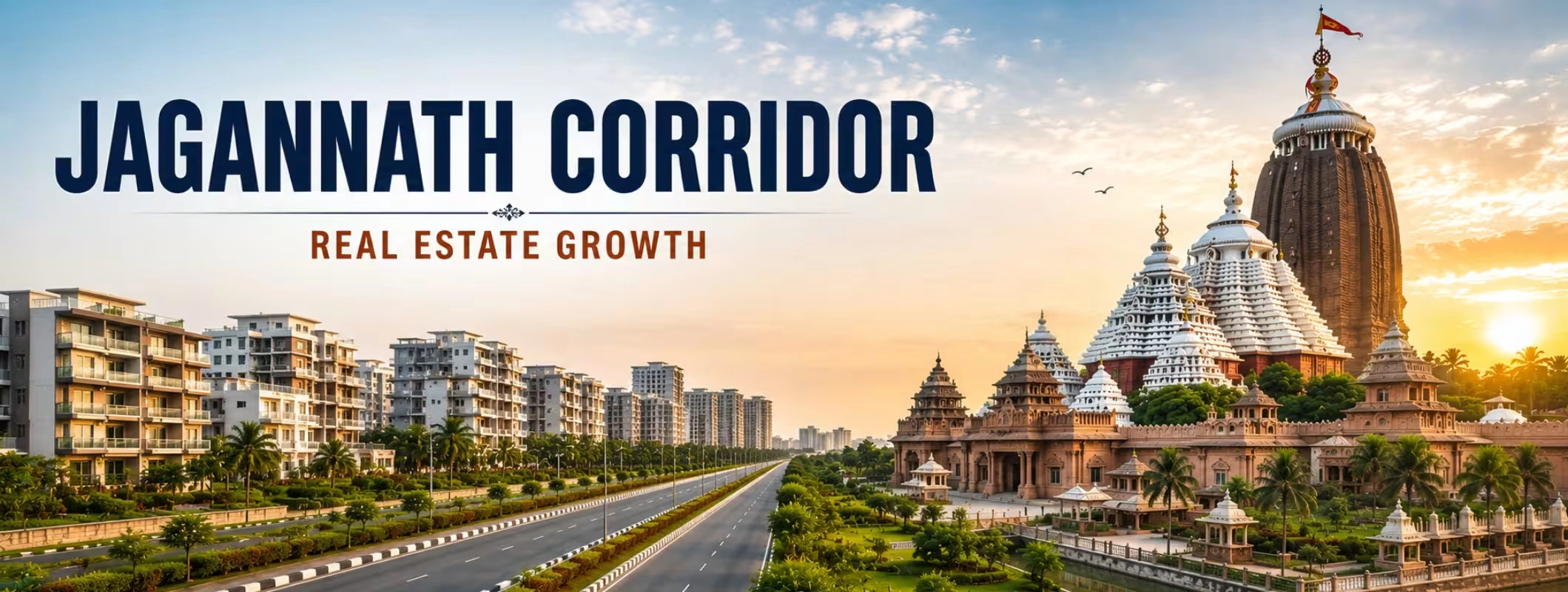
- The Jagannath Corridor Puri has changed the way investors, pilgrims, hotel owners, and land buyers look at Puri. It is no longer seen only as a temple town; it is becoming a stronger mix of spiritual tourism, coastal real estate, hospitality demand, and heritage-led infrastructure growth.
- The biggest real estate opportunity is not blindly buying any plot near the temple. The smarter move is to study access roads, legal title, land-use permission, tourism movement, parking zones, municipal limits, resale demand, and long-term civic development.
- For buyers planning Jagannath Corridor Puri real estate investment, 2026 can be an important year because Puri is seeing temple-area redevelopment, tourism infrastructure upgrades, civic expansion, and stronger interest in coastal land investment in Odisha.
- Current online property platforms show Puri property rates moving in a wide range depending on locality, project quality, and proximity. Housing.com lists Puri properties from around ₹2,500 per sq ft, with an average around ₹6,619 per sq ft and higher listings around ₹12,000 per sq ft. These are indicative portal trends, not final transaction values.
- Puri’s land market is also being affected by municipal expansion. Sources reported in March 2026 that 34 revenue villages were brought into the expanded municipal boundary and benchmark land rates may be revised upward because actual market values are far higher than government benchmark values in several pockets.
Introduction: Why Puri Real Estate Is Getting Serious Investor Attention
Puri has always been one of India’s most powerful spiritual destinations. For generations, families have travelled to the city for darshan at the Shree Jagannath Temple, Rath Yatra, Mahaprasad, sea beach visits, and religious rituals. But after the Jagannath Temple corridor project, Puri is now being discussed in a new way by real estate investors.
The conversation has shifted from “Puri is a pilgrimage place” to “Puri is a tourism-led real estate growth market.” That is a big shift.
The Jagannath Corridor Puri has improved the visibility of the temple precinct and strengthened the city’s identity as a heritage destination. Along with this, road upgrades, parking plans, coastal tourism projects, civic expansion, and hospitality demand are creating stronger property interest in and around Puri.
For investors, this matters because real estate does not grow only because of emotion. It grows when there is repeated footfall, better access, limited premium land, infrastructure spending, and strong buyer confidence. Puri has all these factors in motion.
But there is one caution. Not every land parcel near the temple will become a jackpot. Some areas may have legal restrictions, narrow access, title issues, high entry prices, tourism congestion, or limited future usability. So, before you buy land in Puri near Jagannath Temple, you need a clear investment lens.
This blog explains the Jagannath Temple development impact, the tourism effect on property prices, which locations may benefit, what buyers should check, and how platforms like 2Bigha can help investors discover verified land opportunities with better transparency.
What Is the Jagannath Corridor Puri Project?
The Jagannath Corridor, also known as the Shree Mandir Parikrama Prakalpa, is a major heritage and pilgrim infrastructure project around the Shree Jagannath Temple in Puri. The project was inaugurated in January 2024 and was widely reported as an ₹800 crore heritage corridor aimed at improving amenities and access for devotees.
The project is part of a larger vision to make Puri cleaner, more organized, and more comfortable for pilgrims and tourists. It focuses on improving the area around the temple through better movement space, pilgrim facilities, parking, connectivity, and heritage-sensitive development.
According to Indian Express reporting, related Puri development works include the Shree Setu link, connectivity from Bada Danda to the national highway, a link road from Puri bypass to Jagannath Ballav Pilgrim Centre, a multi-modal hub, multi-level parking, commercial space, and meditation space.
This is why investors are not looking only at the temple boundary. They are looking at the wider Puri development map.
When a temple corridor improves access and visitor experience, nearby real estate usually starts seeing three types of demand:
- Religious tourism demand from pilgrims and repeat visitors
- Hospitality demand from hotels, guest houses, homestays, and serviced stays
- Land investment demand from buyers expecting future appreciation
This is the foundation of the Puri tourism property boom.
Why the Jagannath Temple Development Impact Matters for Real Estate
Real estate grows when infrastructure changes daily behaviour. The corridor is important because it does not only beautify an area; it changes how people move, stay, spend, and invest in the city. Puri already had spiritual demand. The corridor adds organized infrastructure. That combination is powerful.
Odisha Tourism describes the Jagannath Temple as one of India’s Char Dham pilgrimage sites and highlights major rituals such as the Chariot Festival, where devotees gather in large numbers. This gives Puri a long-term demand base that is not seasonal in the normal tourism sense. Even if hotel demand peaks during Rath Yatra and festivals, temple-linked footfall remains active across the year.
For real estate, that means:
- Residential demand may grow from local families, second-home buyers, and retirees.
- Commercial demand may grow near pilgrim routes, transport nodes, and market areas.
- Hospitality demand may grow around beach roads, temple access points, and new tourism zones.
- Land demand may grow in outer areas where prices are still relatively more accessible.
This is why Puri real estate growth is being driven by both faith and infrastructure.
Tourism Is the Real Demand Engine Behind Puri Property Growth
The strongest reason to study Puri tourism impact on property rates is simple: tourists create income opportunities.
A temple town with millions of visitors needs hotels, lodges, dharamshalas, restaurants, parking, local transport, shops, guided services, homestays, and rental homes. As these services grow, land and property demand follow.
Odisha’s tourism numbers also support this direction. Reports citing the Deputy Chief Minister stated that Odisha received 1,13,83,556 tourists in 2024–25, up from 1,00,14,175 in 2023–24.
Puri has a natural advantage within Odisha because it combines:
- Jagannath Temple
- Puri Beach
- Rath Yatra
- Coastal tourism
- Religious rituals
- Weekend travel
- Family pilgrimage
- Proximity to Konark and Bhubaneswar
That is why pilgrimage tourism India and coastal real estate Odisha meet strongly in Puri. The city attracts both emotional buyers and practical investors. Some buyers want a small home near the temple for family visits. Some want land for long-term appreciation. Some want to build guest accommodation. Some sellers want to exit at better valuations as demand rises. This creates an active buy-sell movement.
Puri Property Price Near Jagannath Temple: What Buyers Should Understand
Many buyers search for Puri property price near Jagannath Temple expecting a simple answer. But in reality, prices vary sharply based on distance from the temple, access road width, property type, land-use status, title clarity, frontage, commercial potential, and whether the land falls inside high-demand tourism routes.
Online portals can give a broad idea, but they cannot replace local due diligence. Housing.com lists Puri property rates with a starting price around ₹2,500 per sq ft, an average around ₹6,619 per sq ft, and premium listings around ₹12,000 per sq ft. These numbers are useful for market direction, but final prices near the temple corridor can differ because micro-location matters heavily.
A plot very close to the temple may be expensive but may also face redevelopment rules, crowd pressure, parking limitations, or usage restrictions. A slightly outer plot near a future access road or tourism corridor may offer better long-term appreciation at a more practical entry price.
So, do not ask only, “What is the rate near Jagannath Temple?”
Ask:
- Is the land legally clear?
- Is the access road wide enough?
- Is the land residential, commercial, agricultural, or converted?
- Is it inside municipal limits or newly added areas?
- Is the area suitable for resale, rental, or development?
- Is there waterlogging or coastal regulation impact?
- What is the official benchmark value?
- What are recent registered sale values?
This is how smart investors evaluate real estate near Jagannath Temple.
How Municipal Expansion Can Affect Puri Land Rates in 2026
One of the biggest 2026 signals for Puri land rates is municipal expansion.
Magicbricks reported that Puri’s move toward Municipal Corporation status includes 34 revenue villages from nine neighbouring panchayats being brought into the expanded municipal boundary, increasing the total wards from 31 to 39. The report also noted that benchmark land valuations may be revised because market prices in several pockets are already much higher than official benchmark values.
This matters because benchmark revision can affect:
- Stamp duty
- Registration cost
- Seller expectations
- Loan valuation
- Property tax
- Investor entry cost
- Future resale pricing
For existing landowners, higher benchmark values may improve perceived asset value. For new buyers, it may increase the cost of entry. For investors, it creates urgency but also risk. Buying only because “rates will rise” is not enough. You still need location quality and legal safety.
The best opportunity often lies in areas where infrastructure is improving but prices have not already absorbed the full future premium.
Comparison Table: Which Puri Property Zones May Benefit From the Corridor?
| Property Zone | Why It May Benefit | Best Suited For | Main Risk to Check |
| Near Jagannath Temple / Bada Danda | Strong pilgrim movement, religious value, commercial visibility | Shops, lodges, small hospitality, legacy property holders | High prices, congestion, restrictions, title complexity |
| Jagannath Ballav Pilgrim Centre side | Improved pilgrim movement, parking and access support | Hospitality, food outlets, rental stays, commercial use | Zoning and road-access clarity |
| Atharanala and city entry pockets | Better connectivity and investor attention | Long-term land investment, residential plots | Benchmark revision and rising entry cost |
| Baliapanda / beach-side zones | Coastal tourism, hotels, leisure demand | Second homes, rentals, hospitality | Coastal regulation, cyclone risk, maintenance |
| Sipasarubali / new marine drive influence area | Tourism-led future growth, beach development interest | Larger land investment, resort/hospitality planning | Project timeline, approval, infrastructure delivery |
| Outer municipal expansion villages | Lower entry compared to core areas, future urbanization potential | Long-term investors and developers | Conversion, title, civic service timeline |
This table should not be treated as a buying recommendation. It is a decision framework. Always verify the land records, zoning, approvals, access, and actual transaction history before buying.
Why Jagannath Corridor Puri Real Estate Investment Is Different From Normal City Investment
A normal city property market depends mainly on jobs, offices, schools, metro routes, and residential migration.
Puri is different.
Here, the demand drivers are:
- Faith
- Tourism
- Heritage value
- Coastal lifestyle
- Cultural identity
- Government-backed infrastructure
- Hospitality income potential
- Second-home emotional buying
That makes Jagannath Corridor Puri real estate investment a niche opportunity. The buyer psychology is also different. A family buying in Puri may not compare it with Bhubaneswar purely on rental yield. They may value temple access, emotional attachment, retirement use, festival visits, or long-term heritage-city appreciation.
This emotional demand can support prices, especially in limited-supply pockets. But emotional demand can also create overpricing. That is why disciplined due diligence is important.
In simple words, Puri is not just a square-foot market. It is a location-confidence market.
Puri Tourism Property Boom: What Is Driving Buyer Interest?
The Puri tourism property boom is not based on one project only. It is coming from multiple layers of development.
1. Temple Corridor Visibility
The corridor has improved the identity of Puri as a more organized heritage destination. When a city becomes more visually attractive and easier to navigate, investor confidence improves.
2. Better Pilgrim Infrastructure
Parking, roads, pilgrim centres, commercial spaces, and crowd-management infrastructure support longer stays and better visitor experience. This indirectly supports hospitality and retail property.
3. Coastal Tourism Growth
Puri is not only a temple city. It is also a beach city. Reports have highlighted the growth of newer coastal zones such as Sipasarubali and the new marine drive side, with wider roads, hotels, restaurants, and tourist activity.
4. Future Tourism Projects
The 2026–27 Odisha budget placed Puri strongly in the tourism vision, including plans such as a Shree Jagannath Interpretation Centre, an international cruise terminal, and coastal tourism development.
5. Civic Expansion
As Puri’s municipal limits expand, more areas may come under structured urban planning, civic services, and benchmark rate revision. This can influence land prices, tax planning, and long-term development. Together, these factors create a stronger case for investment in Odisha coastal cities, especially Puri.
Also Read: Odisha Gets ₹769 Crore for Roads & Flyovers in 7 Districts
Should You Buy Land in Puri Near Jagannath Corridor?
You can consider buying land near the Jagannath Corridor if your goal is long-term appreciation, tourism-linked income, second-home use, or commercial development. But the decision should depend on the property’s legal status, road access, land-use permission, price realism, and resale demand.
A plot near the temple corridor may look attractive, but the highest-return opportunity is not always the closest plot. Sometimes, the better investment is in a nearby growth pocket where infrastructure is improving, entry cost is reasonable, and future use is flexible.
For example:
- A small commercial property near pilgrim movement may suit rental income.
- A residential plot near a developing road may suit long-term appreciation.
- A larger parcel near a tourism zone may suit hospitality development.
- A resale plot in a clear-title municipal area may suit conservative buyers.
So, when you purchase plots near Jagannath Temple Puri, do not buy only on emotion. Buy on documents, access, and future use.
Buyer Checklist Before Investing in Puri Real Estate
Use this checklist before making any decision.
| Due Diligence Point | What to Check | Why It Matters |
| Title clarity | Ownership chain, sale deed, mutation, encumbrance | Prevents legal disputes |
| Land category | Residential, commercial, agricultural, converted | Decides future usability |
| Benchmark value | Govt valuation and expected revision | Affects registration and taxes |
| Road access | Width, ownership, approach route | Impacts resale and development |
| Municipal status | Existing or newly added civic area | Affects approvals and services |
| Temple proximity | Actual travel time, not just distance | Crowd and access matter |
| Tourism potential | Near beach, corridor, parking, roads, markets | Supports rental/commercial demand |
| CRZ/coastal rules | Coastal distance and restrictions | Critical for beach-side land |
| Waterlogging risk | Monsoon condition and drainage | Protects long-term value |
| Seller verification | Identity, authority, unpaid dues | Prevents fraud |
| Local price check | Recent registered values, not only asking price | Avoids overpaying |
This checklist is especially important for buyers looking for verified land for sale in Odisha or resale plots in Puri temple area.
What Type of Properties May See Demand in Puri?
Puri’s real estate growth can support different property types, but each has a different investment logic.
Residential Plots
Residential plots may attract local families, second-home buyers, and long-term investors. These are usually safer than speculative commercial land if documents are clear and the area has basic civic access.
Commercial Properties
Commercial units near pilgrim movement, temple access roads, parking zones, and market streets can perform well because tourism creates repeat footfall. However, these properties often come at premium prices.
Guest Houses and Homestays
As tourism grows, guest accommodation can become attractive. But buyers must check licenses, building norms, parking, safety rules, and local permissions.
Coastal Land
Coastal land investment Odisha is attractive because beach tourism has strong appeal. But it also requires careful checking of CRZ rules, cyclone exposure, soil conditions, and construction restrictions.
Agricultural or Outer-Area Land
Outer land may offer lower entry pricing but higher due diligence risk. Buyers must check conversion possibility, access, title, and whether the area is likely to receive future infrastructure.
Puri Land Appreciation Near Temple Corridor: What Can Push Prices Higher?
The phrase Puri land appreciation near the temple corridor is popular because investors expect the corridor to push prices upward. That can happen, but only where demand is backed by usability.
Here are the main appreciation triggers:
Better Access
If a location becomes easier to reach from highways, parking hubs, railway station, or tourism routes, land value can rise.
Tourism Spending
More pilgrims and tourists create demand for rooms, food, retail, transport, and services. Property near these demand points can benefit.
Civic Upgrade
Municipal expansion can improve roads, drainage, lighting, waste management, and planning. Over time, this can support higher property values.
Limited Supply
Premium land near the temple and beach is naturally limited. When demand rises and supply is fixed, prices can strengthen.
Commercial Conversion Potential
Land that can legally support shops, guest houses, hotels, or mixed-use development may command a premium.
Verified Listings and Digital Discovery
Platforms that organize land discovery can make the market more transparent. This is where 2Bigha can support buyers and sellers by helping them explore land opportunities with better listing clarity, verified property details, and a smoother discovery process. Sellers, agents, and landowners can also use a subscription plan pricing to improve visibility and reach serious buyers.
How 2Bigha Helps Buyers and Sellers in Temple-Led Land Markets
Temple-led real estate markets are emotional, fast-moving, and often confusing for first-time buyers. Many people hear that prices are rising and rush into deals without checking documents properly. That is risky.
2Bigha can help bring more structure to this type of land search.
For buyers, 2Bigha can support:
- Easier discovery of land opportunities
- Better property visibility
- Location-based comparison
- Verified land listing approach
- More informed buyer decisions
- Reduced dependence on random local leads
For sellers, 2Bigha can support:
- Better reach for land listings
- Stronger visibility among serious buyers
- Easier presentation of property details
- Faster buyer discovery
- Cleaner communication
For a market like Puri, where land investment near Jagannath Temple and coastal land demand are both growing, transparency can become a major advantage. Buyers do not only need listings. They need confidence.
Investment Strategy for Puri Real Estate in 2026
If you want to invest in Puri real estate 2026, do not treat the whole city as one market. Divide it into investment zones.
Strategy 1: Core Temple-Area Investment
This is for buyers with higher budgets and clear commercial goals. The focus should be on footfall, frontage, legal use, and rental demand.
Best for: shops, lodges, guest houses, small commercial assets
Risk: high entry price and strict regulation
Strategy 2: Corridor-Influence Residential Investment
This is for buyers who want long-term appreciation but do not need to be exactly beside the temple.
Best for: residential plots, small homes, second homes
Risk: overpaying based on hype
Strategy 3: Coastal Tourism Investment
This is for buyers looking at beach-side tourism, hospitality, or lifestyle demand.
Best for: serviced stays, boutique hospitality, second homes
Risk: CRZ rules and maintenance cost
Strategy 4: Outer Growth Pocket Investment
This is for patient investors who can wait for civic expansion and road development to mature.
Best for: long-term land banking
Risk: uncertain timeline and conversion issues
The safest approach is to match your budget with your holding period. If you want quick resale, buy only in highly liquid areas. If you can hold for 7–10 years, outer growth pockets may offer better upside.
What Sellers in Puri Should Know
If you want to sell property in Puri, the current market interest can work in your favour. But pricing must be realistic.
Many sellers make one mistake: they price their property based on the highest rumour in the market. Serious buyers do not pay just because a location is “near a corridor.” They check title, access, benchmark value, development potential, and recent sale evidence.
To sell better:
- Keep land documents ready.
- Get mutation and tax records updated.
- Mention exact road width and access.
- Share distance from temple, beach, railway station, and main roads.
- Clarify whether land is residential, commercial, agricultural, or converted.
- Use verified listing platforms instead of only local word-of-mouth.
- Price based on realistic comparable sales.
A clean property with clear documents will always attract better buyers than a hyped property with confusion.
Risks of Investing Near Jagannath Corridor Puri
Every growth market has risk. Puri is no exception.
1. Overpricing
Some sellers may demand future prices today. Avoid paying a premium only because the word “corridor” is attached.
2. Legal Issues
Old temple-town properties may have complex ownership, inheritance claims, lease issues, or unclear boundaries.
3. Land-Use Restrictions
Not every plot can be used for hotels, shops, or commercial activity. Check zoning before buying.
4. Coastal Regulation
Beach-side land may face construction limits. This is especially important for buyers looking at coastal land investment in Odisha.
5. Congestion
Temple proximity brings footfall but also traffic, noise, crowding, and parking problems.
6. Infrastructure Timeline
Some future projects may take longer than expected. Do not build your investment only on announcements.
7. Liquidity Risk
High-value land may not sell quickly unless priced correctly. The best investors stay optimistic but not blind.
Future Outlook: Is Puri Real Estate Still Worth Watching?
Yes, Puri is worth watching closely in 2026 and beyond.
The city has a rare mix of religious demand, coastal appeal, government-backed tourism investment, and limited premium land. The corridor has improved Puri’s brand value, and future infrastructure can strengthen its position as one of India’s most important spiritual tourism cities.
The Odisha government’s 2026–27 plans also signal continued focus on Puri, including tourism infrastructure, cultural projects, cruise terminal plans, and the Shamuka coastal tourism hub vision.
But investors should avoid hype buying.
The best opportunities will be in properties that have:
- Clear legal title
- Strong access
- Practical land use
- Nearby infrastructure
- Real buyer demand
- Reasonable entry price
- Long-term holding potential
For most buyers, the winning formula is simple: choose verified land, check documents deeply, compare micro-locations, and invest with patience.
Conclusion
The Jagannath Corridor Puri has given new energy to Puri’s real estate market. It has strengthened the city’s image as a heritage destination and made investors look seriously at temple-led property growth, tourism-linked rentals, coastal land, farmland for sale, and long-term appreciation.
But the real opportunity is not just “buy anything near the temple.” The real opportunity is to understand how the Jagannath Temple development impact connects with tourism, infrastructure, municipal expansion, coastal growth, and verified land demand.
For buyers, Puri can be a strong long-term market if the property is legally clean and strategically located. For sellers, this is a good time to present land professionally and reach serious buyers. For investors, 2026 is not about chasing rumours. It is about making informed, document-backed decisions.
Platforms like 2Bigha can play an important role in this journey by making land discovery more transparent for buyers, sellers, agents, and investors looking at Puri, Odisha, and other high-growth land markets in India.