Key Takeaways
- Khatu Shyam Ji is not just a devotional landmark. Rajasthan Tourism identifies it as one of the state’s important pilgrimage destinations in Sikar, around 55 km from Sikar city, and highlights the annual fair season and Reengus padyatra connection.
- The investment story here is being shaped by public spending as well as faith-driven demand. Rajasthan’s 2024-25 modified budget announced ₹100 crore for Khatushyamji temple development, and the Government of India has separately listed ₹87.87 crore of development works for Shri Khatu Shyam Ji Temple under Swadesh Darshan 2.0.
- Connectivity is also improving on paper and in policy. Parliament records show the Ringus–Khatushyamji rail line was sanctioned, and India Investment Grid lists the project timeline from March 2024 to March 2028.
- This does not mean every plot near the temple is a smart buy. In temple-town markets, legal title, road access, zoning, drainage, crowd movement impact, and resale usability matter more than hype. Official DLC and registration tools are available on Rajasthan’s ePanjiyan system, and Sikar/Reengus master plan entries are available on the state planning portal.
- The best opportunities usually come from disciplined land selection: regulated plots, clear-entry parcels, approach-road visibility, or clean-title agricultural land with a realistic holding plan, not from blindly chasing “temple corridor” rumours. The temple story creates demand, but paperwork and use-case decide returns.
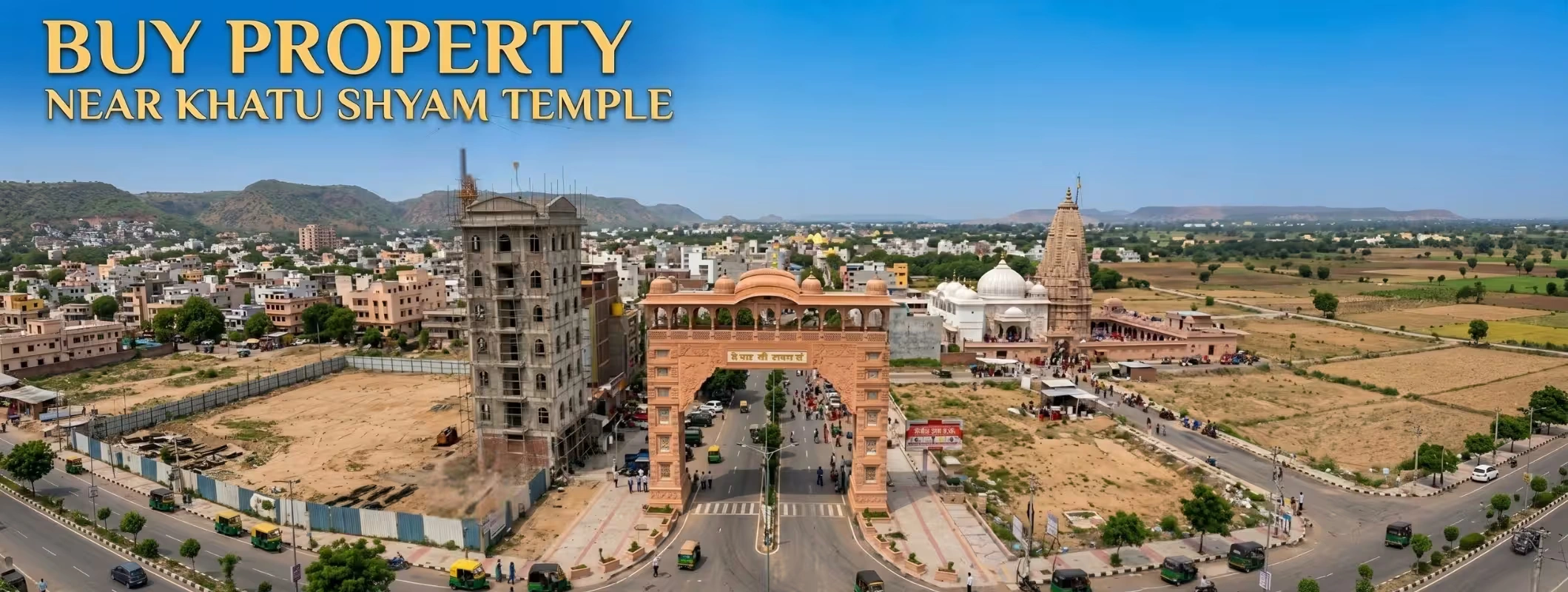
Khatu Shyam Ji has moved far beyond being only a spiritual destination. In real estate terms, it has become part pilgrimage hub, part local commerce driver, and part long-term infrastructure story. That is exactly why many buyers are now searching for land near khatu shyam temple, looking at Sikar land investment, or evaluating whether Khatoo Shyam Ji temple real estate can deliver better upside than a normal semi-urban plot purchase. The answer is yes in some cases, but not automatically.
If you want the blunt truth, Khatu is not a “buy anything and wait” market. It is a selective market. The right parcel can benefit from devotional footfall, religious tourism, better access, and spillover demand for parking, stay, retail, services, and plotted development. The wrong parcel can stay stuck for years because it has weak access, poor documentation, wrong land use, or only festival-season excitement. That difference is where most buyers lose money.
Why Khatu Shyam Ji Matters for Real Estate
Rajasthan Tourism describes Khatu Shyamji Temple as one of the state’s most revered pilgrimage destinations and notes that the 10-day fair is held in February/March, with many devotees beginning their padyatra from Bhairuji Temple in Reengus. The official temple ecosystem also publishes Google map access and Ringas station train information, which shows how central regional connectivity is to the pilgrimage experience.
That matters for property because real estate around religious destinations usually grows through repeated human movement, not just one-time tourism. Devotees need roads, parking, accommodation, food, services, crowd management, sanitation, shops, temporary logistics, and sometimes long-stay or second-home support infrastructure. In other words, temple demand does not act like a holiday market. It acts like a recurring, event-backed, service-heavy economy.
Rajasthan’s own budget language supports this broader logic. The state says tourism contributes a 5.6% direct and indirect share to GSDP and supports around 20 lakh families, while also announcing a tourism policy push and infrastructure spending for heritage, religious, rural, and eco-tourism. So when you look at property investment in Sikar, Rajasthan, you should not view Khatu in isolation. It sits inside a larger state strategy that values tourism-led local economies.
The Big Investment Trigger: Public Spending Around Khatoo Shyam Ji
A lot of real estate hype floats around temple towns, but Khatu has one advantage many speculative locations do not: there are actual public investment signals behind the story. Rajasthan’s 2024-25 modified budget announced a provision of ₹100 crore for development of Khatushyamji temple. Separately, PIB listed “Development works at Shri Khatu Shyam Ji Temple (Sikar)” under Swadesh Darshan 2.0 with an outlay of ₹87.87 crore.
Why should a land buyer care about that? Because once government money starts targeting a pilgrimage destination, the market begins to think differently about approach roads, sanitation, parking, crowd flow, façade improvement, visitor handling, and commercial spillover. That does not guarantee immediate appreciation, but it can shift the usability and perception of nearby land. For investors, this is the point where Khatu Shyam Ji property guide thinking becomes more practical than emotional.
The second trigger is connectivity. Parliament records show the new rail line between Ringus and Khatushyamji, measuring 17.49 km, has been sanctioned. India Investment Grid now lists the Ringus Khatushyamji new line project with a start date of 05 March 2024 and a completion target of 31 March 2028. That is the kind of infrastructure signal smart investors watch closely. Better access does not make every parcel premium, but it strengthens the case for plots and land parcels tied to lawful frontage, movement corridors, or support-use demand.
Is Khatu Shyam Ji Temple Real Estate a Good Investment
Yes, but only under the right strategy. If your goal is short-term flipping purely on rumours, this market can punish you. If your goal is disciplined land selection based on access, title, use-case, and holding horizon, the Khatu-Sikar belt has a stronger case than many random plotted locations in Rajasthan. That is because the demand here is backed by faith, movement, and policy attention, not just brochure marketing.
The better question is not “Should I buy land near Khatu Shyam Ji temple?” The better question is: What kind of land should I buy, and for what end use?
Also Read: Sikar Bypass Approved: New Routes to Fatehpur, Nawalgarh & Dhod
Best Real Estate Plays Near Khatu Shyam Ji Temple
1. Temple-Access Commercial or Mixed-Use Plots
This is the obvious play, but also the most overhyped. Land close to the temple zone can work well for shops, guest-oriented retail, small hospitality, storage, service use, or future mixed-use demand. But only plots with clear access, usable frontage, and proper compliance deserve a premium. If a broker sells you only the phrase buy plot near Khatu Shyam Ji temple without showing title chain, road width, setback reality, and local restrictions, walk away.
2. Ringas/Reengus Connectivity Belt
Rajasthan Tourism itself ties the Khatu pilgrimage movement to Reengus, and rail planning strengthens that belt further. So land along sensible access corridors between Ringas/Reengus and Khatu can be interesting for logistics, stay formats, service activity, and secondary housing demand. This is often a smarter play than blindly chasing the innermost temple radius because the entry cost may be more rational while connectivity upside remains alive.
3. Sikar City and Sikar Fringe Plots
Many investors ignore the supporting city and only chase the shrine. That is a mistake. Rajasthan Tourism places Khatu about 55 km from Sikar, which means Sikar remains a practical anchor for residents, traders, service providers, and families who want exposure to the Khatu growth story without being inside the religious-core zone. The state planning portal also shows master plan entries for both Sikar and Reengus, which reinforces the importance of checking planned land use before buying. For buyers interested in invest in sikar real estate, this city-fringe strategy can be more balanced than a high-emotion temple-core purchase.
4. Farmland and Agricultural Land in the Sikar Belt
This is where many buyers get trapped. Yes, farmland for sale Sikar and buy agricultural land in Sikar are high-intent search themes. But agricultural land should only be bought when the title is clean, access is physically usable, measurements are verified, and your exit plan is realistic. Do not assume every agricultural parcel near a religious town will one day become a plotted goldmine. Some land stays agricultural for a reason. Some parcels are legally messy. Some have no practical buyer pool except another speculator.
What Type of Investment Fits Which Buyer?
| Investment Type | Best For | Why it Can Work | Main Risk |
| Temple-core plot | High-risk investors, small commercial buyers | Footfall-led demand, visibility, service economy | Overpricing, congestion, compliance issues |
| Ringas/Reengus corridor land | Medium-term investors | Connectivity story plus movement spillover | Delayed execution of infra |
| Sikar city/fringe plot | End users, conservative investors | Better livability, broader resale base | Slower upside than temple-core hype |
| Agricultural land near Sikar/Khatu belt | Long-horizon investors only | Lower entry in some cases, land banking potential | Title, access, conversion assumptions, illiquidity |
This table is not a promise chart. It is the practical way to think about Sikar real estate investment in 2026: match the asset to the use-case, not the emotion.
What Smart Buyers Must Check Before Buying Land Near Khatoo Shyam Ji Temple
Before you buy, verify these points:
- DLC benchmark and registration cost: Rajasthan’s official ePanjiyan and DLC portals let buyers check area-wise DLC rates, major document rates, and fee-related information. Never negotiate blindly without first understanding the official valuation framework.
- Land use and planning context: The state planning portal lists master plan entries for Sikar and Reengus. That means zoning and planning context are not optional—they are part of the due diligence.
- Road access in real life, not just on paper: In temple-led markets, crowd days change ground reality. A parcel that looks excellent on a quiet weekday may become difficult to access during peak pilgrim periods.
- Title chain and mutation history: Do not depend only on the seller’s word. Match registry, khasra details, mutation trail, possession reality, and local record consistency.
- Flooding, drainage, and crowd-management impact: Devotional towns can face seasonal pressure. Check whether your parcel benefits from movement or gets trapped by it.
- Exit buyer profile: Ask yourself who will buy from you later: a retailer, family, small developer, religious-economy operator, or another land speculator? If you cannot answer that, the purchase is weak.
The Real Opportunity: Temple Economy + Supporting Geography
The strongest way to understand real estate opportunities in Sikar is to see Khatu and Sikar as a linked ecosystem.
Khatu creates devotional pull. Ringas/Reengus creates access logic. Sikar creates urban support. Public investment creates confidence. But only regulated, usable, legally clean land turns that story into returns.
That is why the best investment areas in the broader belt are usually not chosen only by distance to the temple. They are chosen by a combination of:
- movement flow,
- lawful land use,
- practical road connection,
- future resale audience,
- and documented ownership.
This is also why temple land investment India should never be treated like blind sentimental buying. Religious towns can outperform, but they can also trap money when investors buy unusable parcels.
How 2Bigha Can Help in This Market
If you are exploring buy land, sell land in sikar, or compare plots around Khatu, using a map-first platform is simply smarter than depending only on scattered broker calls. That is where 2Bigha fits naturally into this market.
With 2Bigha, buyers can explore map-based land listings, understand location context more clearly, and assess the land area visually before moving forward. That matters a lot in a market like Sikar where frontage, approach roads, nearby activity, and ground context change the investment logic. For active investors, local agents, and repeat sellers, 2Bigha’s subscription plans also make the process more structured. Instead of casually listing and waiting, a subscription-led workflow supports better visibility, stronger discovery, and a more serious buying-selling environment.
So if someone is seriously evaluating land for sale near Khatu Shyam Ji temple or nearby plotted and agricultural opportunities, 2Bigha can act as a more practical starting point than relying only on WhatsApp forwards and verbal rate claims.
Final Word
Khatu Shyam Ji temple real estate is real, but it is not magic.
Yes, Khatu has a strong long-term story because it combines faith-led demand, tourism relevance, public investment, and improving connectivity. Rajasthan Tourism clearly positions it as a major pilgrimage destination, the state budget has already committed serious money, the centre has sanctioned development under Swadesh Darshan 2.0, and the Ringus–Khatushyamji rail line adds another meaningful signal.
But smart investing here does not mean buying the closest plot to a temple gate. It means choosing the right asset in the right belt with the right paperwork and the right exit logic.
If you do that, Sikar land investment near the Khatu Shyam Ji ecosystem can be far more than an emotional purchase. It can become a measured real estate decision with actual long-term logic behind it.
FAQs - Buy Land Near Khatu Shyam Temple
1. Is it a good idea to buy land near Khatu Shyam Ji temple?
It can be a good idea, but only when the parcel has clear title, real road access, usable land use, and a defined end purpose. Khatu has genuine demand drivers because it is a major pilgrimage destination and has public investment support, but not every nearby parcel is automatically valuable.
2. Why is Khatoo Shyam Ji becoming important for property investors?
Because the area combines religious footfall, tourism relevance, state-backed development, and improved connectivity planning. These factors can strengthen demand for plots, support services, retail-facing land, and select residential or mixed-use opportunities.
3. Is there any official development announced for Khatu Shyam Ji?
Yes. Rajasthan’s 2024-25 modified budget announced ₹100 crore for Khatushyamji temple development, and PIB has listed ₹87.87 crore of development works for Shri Khatu Shyam Ji Temple in Sikar under Swadesh Darshan 2.0.
4. Is the Ringas–Khatushyamji rail line officially sanctioned?
Yes. Parliament records state that the new line between Ringus and Khatushyamji has been sanctioned, and India Investment Grid lists the project timeline through March 2028.
5. Should I buy inside the temple zone or in the Sikar/Reengus belt?
That depends on your budget and strategy. Temple-zone plots may offer stronger commercial potential but higher risk and higher pricing pressure. Sikar and Ringas/Reengus belt locations can offer a more balanced entry if connectivity and resale usability are better.
6. How do I verify land value and registration-related details in Rajasthan?
Start with Rajasthan’s official ePanjiyan and DLC systems. They provide access to DLC information, document-wise fees, and major article rate references. Do not rely only on broker quotes or portal asking prices.
7. Is agricultural land near Sikar a better investment than a plotted site?
Not always. Agricultural land can work for long-horizon investors, but it carries more due diligence burden around title, access, and future usability. A regulated plotted site may be safer for buyers who want easier resale or future construction options.
8. How can 2Bigha help in buying or selling land near Khatu Shyam Ji?
2Bigha helps by offering a map-based way to explore land listings and understand area context better. That is especially useful in places like Sikar and Khatoo where location quality is not just about distance, but also about access, surroundings, and visibility. Its subscription plans can also help serious users manage listings and discovery in a more organised way.