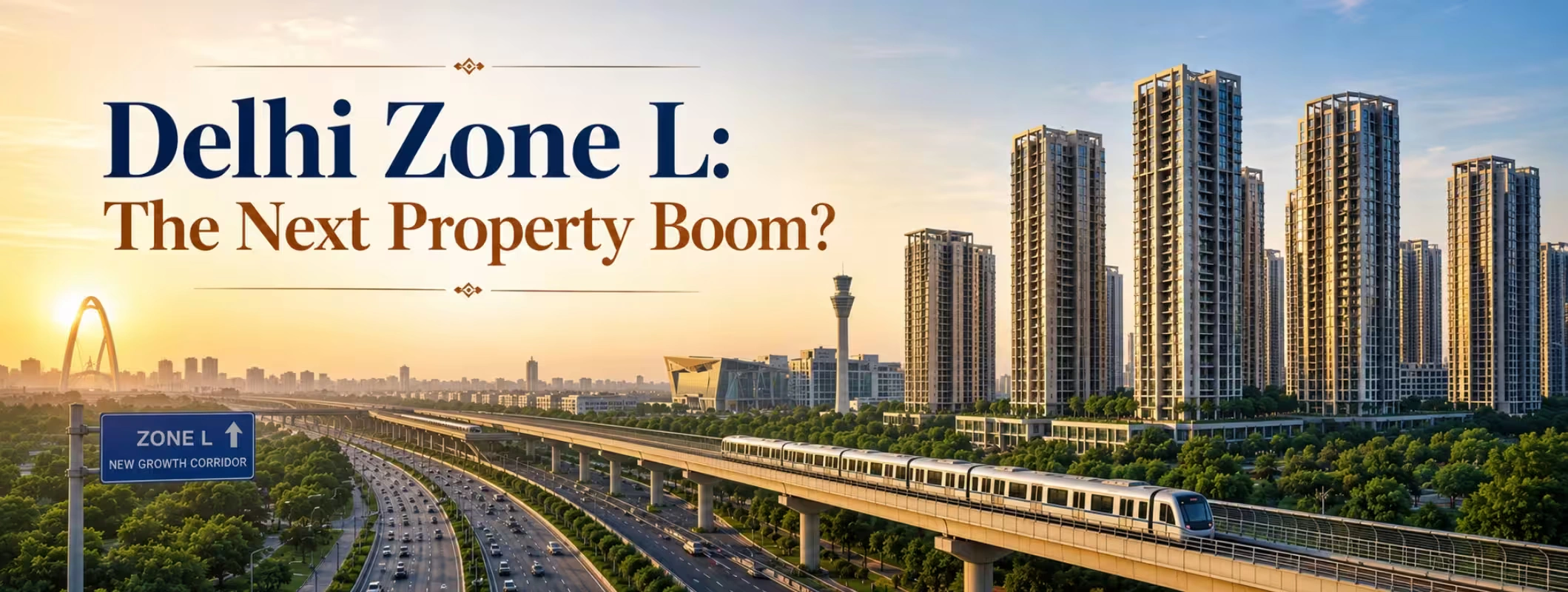
There are various parts of Delhi that most people drive past without a even looking at them. Villages that get stucked between flyovers, farmland sitting quietly on the city's western edge, settlements that look untouched while the rest of the capital races ahead. For many years, these araes were simply overlooked, neither fully urban nor truly rural. That is about to change.
If you are thinking of ways to Buy Land in Dwarka or looking at a plot for sale in Zone L, Delhi, the timing could not be more interesting. Master Plan Delhi 2041 has placed these forgotten villages squarely in the middle of Delhi's next big urban push. And the investors who are giving attention right now are positioning themselves well ahead of the crowd.
Zone L, spread across South West Delhi, covers roughly 46 villages, from Najafgarh and Dhansa to Tikri Kalan, Jharoda Kalan, and Jasfarpur Kalan. These are places with real history and real people, but for years, they sat outside the city's formal planning framework. No paved roads to speak of, no proper drainage, no metro connection. Just land, acres and acres of it, right on Delhi's doorstep. Under the DDA's Land Pooling Policy and the larger vision of Master Plan Delhi 2041, that story is being rewritten.
What Is Zone L and Why Does It Matter?
Zone L is not a new concept. Delhi Development Authority first introduced it under the Master Plan Delhi 2021, recognising that the city needed a substantial new residential zone to house its increasing population. South West Delhi, the stretch between Dwarka Sub-City and the Haryana border, was considered as the most logical candidate.
The numbers back this up. Zone L holds the largest land bank of any zone included in the DDA's Land Pooling Policy. We are talking about approximately 22,979 hectares of land, a scale that small most other planned urban extensions in the NCR. Its location is a big part of why people are excited about it:
| Location Advantage | Detail |
| Proximity to IGI Airport | Just a few kilometres away |
| Connection to Dwarka Sub-City | Directly adjacent in the east |
| Highway access | NH-10 / Rohtak Road on the north |
| Link to South Delhi and Gurgaon | Within easy reach via existing roads |
| Upcoming UER-II (Urban Expressway) | An 80-metre-wide extended corridor connecting Zone L to the airport, Dwarka, and South Delhi |
What Master Plan Delhi 2041 Actually Says About These Villages?
The draft Master Plan Delhi 2041, prepared by the DDA, is far beeter then the previous plans in how it treats urban villages. Earlier approaches either ignored them or were so limited in scope that they made little practical difference.
The 2041 plan takes a different line. It acknowledges that many of Delhi's 54 urban villages are of heritage and cultural importance, and it calls for a mix of regeneration and conservation, not just demolition and redevelopment. The DDA is expected to formulate specific development regulations for these villages within two years of the plan being officially notified.
With this 48 villages in various parts of Delhi are earmarked for full urbanisation. That means proper civic infrastructure, paved roads, clean water supply, drainage systems, healthcare access, schools, and street lighting. These are the basics that have been missing for years.
The Lal Dora Fix That Nobody Expected
One of the more significant moves under the Master Plan 2041 is what the government has announced for Lal Dora properties. Lal Dora refers to the residential land within village boundaries that has historically been exempt from standard municipal building regulations. The flip side of that exemption has always been legal uncertainty, unclear ownership, no proper title documents, and difficulty in getting bank loans.
The Delhi government has now announced free first-time property registration for Lal Dora residents. This is not a small administrative update. For the families that have lived on this land for generations without any formal papers, it means legal recognition. For buyers, it means the supply of clear-title land in these areas could increase meaningfully over the next few years.
Minister Parvesh Verma, addressing residents, summed up the intent: this is about dignity, stability, and giving people a real stake in the city's future. That framing matters because it signals a political commitment that goes beyond just updating zoning maps.
Zone L Villages: The Ones to Watch
With roughly 46 villages falling under Zone L, not all of them are equally positioned for appreciation. Geography matters. Connectivity matters even more.
Najafgarh
The largest urban agglomeration in Zone L, Najafgarh, already has a market, decent road connectivity, and a long-established commercial character. As urbanisation picks up pace, Najafgarh is expected to function as a neighbourhood centre, the kind of place that gets new retail and healthcare facilities, and eventually metro access. Land for Sale in Najafgarh is attracting interest from both residential buyers and small commercial investors.
Dhansa and Tikri Kalan
These villages sit on the northern end of Zone L, closer to NH-10 and the Rohtak Road corridor. The highway access makes them relevant for logistics and last-mile commercial use, not just residential. Once UER-II is fully operational, the travel time from these villages to the airport and central Delhi will drop sharply.
Jharoda Kalan and Jasfarpur Kalan
These are quieter villages in the southern part of the zone, closer to the Haryana boundary. Agricultural land here has historically been priced lower than the northern villages, but the green belt designation on Delhi's periphery means that land use in these pockets will be carefully controlled, which can actually protect long-term value.
Why Are Investors Starting to Take Notice?
Anyone tracking Delhi real estate in 2026 will notice that Zone L Dwarka real estate has been slowly gaining traction in conversations that a couple of years ago were entirely dominated by Noida and Gurgaon. There are a few reasons for this.
First, pricing. Land rates in Dwarka proper have increased from INR 37,000 to INR 62,000 per sq ft. That is well beyond the reach of most individual buyers or small investors. Zone L, sitting just next to Dwarka, still has far more accessible price points, making it one of the last entry-level opportunities in western Delhi.
Second, the 2041 plan's explicit focus on transit-oriented development (TOD) means that any metro extension or bus corridor improvement near Zone L will unlock appreciation very soon. The city is being designed around transit nodes, and Zone L's proximity to Dwarka Sector 21 Metro Station and the planned metro extensions gives it natural TOD potential.
Third, and this is important, Zone L is inside Delhi. Not Greater Noida. Not Faridabad. Not Bhiwadi. This is National Capital Territory land, governed by the DDA, backed by central government planning. For buyers concerned about legal clarity and infrastructure commitment, that distinction matters. Those looking to sell land in South West Delhi are increasingly finding a more active buyer base than even two years ago. That shift in market interest reflects the growing confidence that the 2041 vision is moving towards implementation.
2Bigha: The Smarter Way to Find Verified Land in Delhi
Looking for agricultural or rural land in or around Delhi's Zone L villages is not as simple as browsing a general property portal. Much of this land comes with legacy ownership structures, village revenue records, and documentation that requires careful verification. Getting this wrong is costly. That is exactly the gap that 2Bigha is built to close.
2Bigha is a land marketplace platform specifically designed for buying and selling agricultural land and farmland across India. Whether you are trying to Purchase Land in Delhi, explore farmland for sale in Delhi, or find a verified plot for sale in Zone L Delhi, the platform brings together listings that have been checked for authenticity before they go live.
What sets 2Bigha apart is the combination of technology and local expertise. The AI-powered search tools help match buyers to properties based on location, land use, and budget — while the expert advisory team understands how to navigate state revenue records, Lal Dora classifications, and DDA land pooling documentation.
For landowners sitting on DDA Zone L villages' land who are thinking about selling, 2Bigha offers a transparent process to connect with serious buyers across India. This is particularly useful for families who have inherited agricultural plots and want to convert them into liquid assets without getting tangled in informal markets. In a region where the difference between a good deal and a legal mess comes down to documentation, having a verified listing platform is not just convenient; it is essential.
What the Master Plan 2041 Still Needs to Resolve?
It would be dishonest to write about this opportunity without flagging the real uncertainties. As of April 2026, the draft MPD-2041 is still waiting final notification from the Ministry of Housing and Urban Affairs. It received approximately 33,000 public objections after its June 2021 release. The operative law for Delhi land transactions remains MPD-2021, notified back in 2007. Any broker or agent presenting the 2041 zone map as current enforceable law is technically describing a draft document, not a settled regulation.
That said, the direction is clear. Political announcements, DDA surveys, community consultations, and infrastructure planning in Zone L are all moving in one direction. The question for buyers is not if this zone develops, but about timing and entry price.
A Practical Checklist Before You Buy
- Check whether the specific village falls under the DDA Land Pooling Policy's notified area.
- Verify land use classification under MPD-2021 (the current operative plan)
- Confirm that the seller has clear title or Lal Dora registration
- Understand possession timelines and whether infrastructure is confirmed or only planned
- Avoid any deal that relies solely on the 2041 draft documents for legal standing
- Use platforms like 2Bigha to access listings that have already been document-verified
Conclusion
Delhi's Zone L villages have spent years on the margins, neither city nor countryside, neither developed nor completely untouched. But the Master Plan Delhi 2041, combined with the DDA Land Pooling Policy and the recent Lal Dora registration announcement, is drawing these villages into the centre of Delhi's next growth chapter.
The infrastructure triggers, UER-II, proximity to IGI Airport, the planned Diplomatic Enclave, and metro extensions are not speculation. They are on maps and in government budgets. Zone L is positioned to absorb a wave of residential and commercial development as Delhi's western edge gets integrated into the formal city.
For anyone seriously exploring land for sale in Dwarka or nearby Zone L villages, the right time to research and act is before this story becomes mainstream. Once MPD-2041 gets formally notified and infrastructure announcements start coming in incresaing succession, the entry price will show that momentum quickly.
Do your due diligence, work with verified platforms, and understand the legal landscape before committing. The opportunity in Zone L is real, but so is the need to tread carefully.