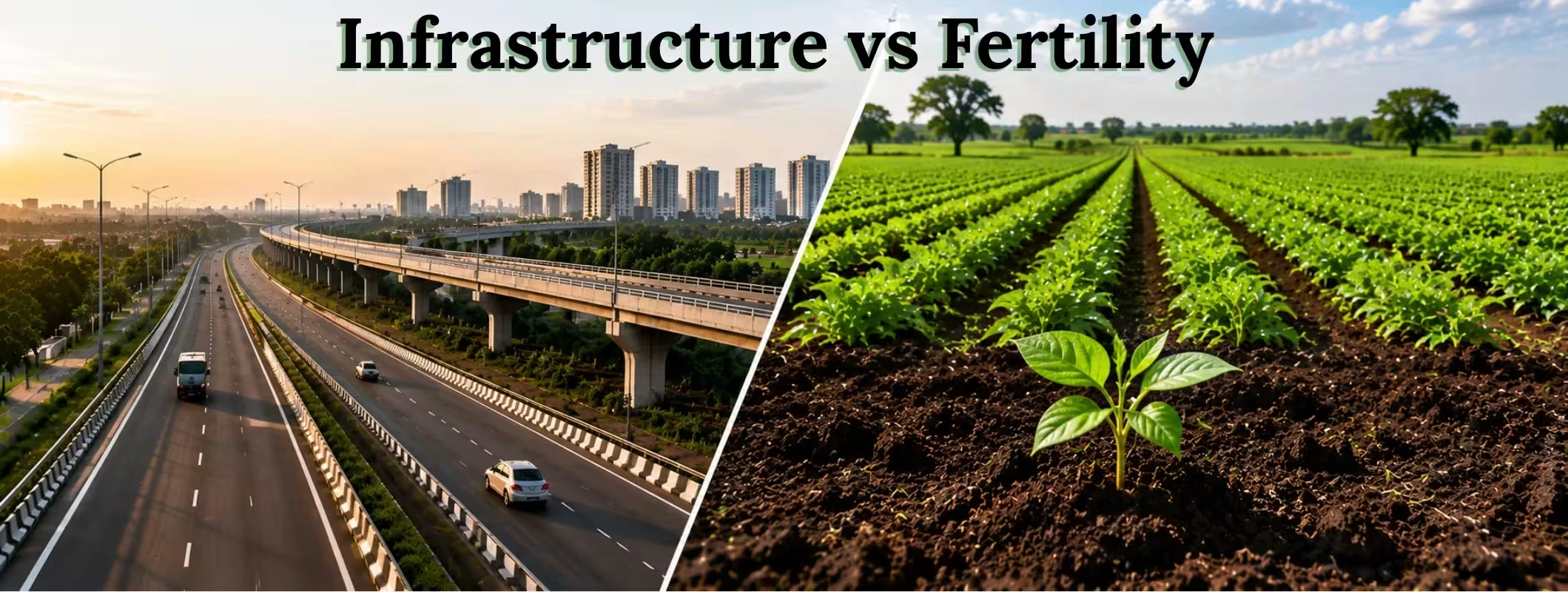
Two pieces of land. The same district. The same amount of rainfall. While one costs ₹2 lakh per acre, the other fetches ₹15 lakh. Why such a disparity? 9 out of 10 times, it’s not because of fertility levels. Rather, the key factors here are the presence of a canal, a road, or a market nearby. This realization often catches many new buyers off-guard, who have always heard about fertility in discussions on agricultural land.
The Fertility Argument
Nobody's saying soil doesn't matter. Alluvial and loam soils support better yields, require fewer chemical inputs, and allow farmers to grow a wider variety of crops season after season. That's real value, and buyers should always consider soil quality before investing. Land with genuinely fertile soil tends to retain its value and often appreciates over time. In parts of Punjab, decades of rich alluvial soil combined with consistently high yields have kept farmland in demand regardless of surrounding development. The same principle applies to plots for sale in Haryana, where fertile agricultural land continues to attract buyers. However, here's the catch: soil fertility alone rarely explains the biggest price differences in the market. Two fields with nearly identical soil test reports can have vastly different values if one is located next to a highway while the other is in a less accessible area.
The Infrastructure Argument, With Numbers
This is where the data gets hard to argue with. Irrigated land consistently sells for two to five times more than rain-fed land in the very same district, even when the underlying soil is comparable. That's not a small premium. That's the difference between an affordable plot and one that's priced out of reach.
Rajasthan makes the point almost too clearly. Canal-irrigated land near the Indira Gandhi Canal trades at ₹15–25 lakh per acre. Barren land just 50 kilometers away, sitting in the same desert climate with similar soil, goes for ₹50,000 to ₹2 lakh. Same state, same weather pattern, wildly different price, because one plot has water access and the other doesn't. Broader infrastructure tells a similar story. Roads, market access, and irrigation facilities are estimated to lift land value by 10–20% on their own, independent of soil quality. Add proximity to an industrial corridor or a mandi town, and that number climbs further.
Punjab and Haryana are the clearest real-world example of infrastructure and fertility working together. Both states combine naturally fertile soil with dense canal networks and strong market connectivity, and both consistently rank among India's highest-value farmland regions, often crossing ₹8–10 lakh per acre.
A Side-by-Side Comparison
| Factor | Fertility-Driven Value | Infrastructure-Driven Value |
| Price impact | Moderate, gradual | Often 2–5× within the same district |
| Example | Rich alluvial soil in parts of Punjab | Canal-irrigated land near Indira Gandhi Canal, Rajasthan |
| Speed of change | Slow — soil quality shifts over years | Fast — a new road or canal can double prices in seasons |
| Investor relevance | Long-term productivity, resale to farmers | Short-to-mid-term appreciation, resale to developers or investors |
| Risk | Low, but limited upside | Higher upside, tied to project execution timelines |
Where Does This Play Out Across States?
Madhya Pradesh offers a useful contrast. Land here remains among the cheapest in the country, often ₹2–8 lakh per acre, largely because infrastructure and irrigation coverage still lag behind states like Punjab. Yet MP land prices rose about 12% in a single year recently, reaching close to ₹1 lakh per acre on average in several districts, almost entirely on the back of expanding road and irrigation projects. If you're evaluating a plot to buy land in Madhya Pradesh, ask about the irrigation source before you ask about the soil report.
Rajasthan shows the same pattern at an extreme. Buyers considering land to purchase in Rajasthan often assume desert soil caps the value everywhere. It doesn't. Canal-fed districts near the Indira Gandhi Canal defy that assumption completely.
Haryana blends both factors well. A plot for sale in Haryana near NCR's expanding road network typically commands a premium over an equally fertile plot further from any highway, because access to Delhi's markets matters as much as what's growing in the field.
Maharashtra is more fragmented. Western Maharashtra benefits from strong irrigation and market access, while parts of Vidarbha remain rain-fed and cheaper despite decent soil. Anyone planning to sell land in Maharashtra should benchmark against nearby infrastructure projects, not just past crop yields.
Punjab, as mentioned, is the rare state where fertility and infrastructure reinforce each other instead of competing, which is exactly why farmland for sale in Punjab rarely drops in value even during weak agricultural years.
So, Which One Should Guide Your Decision?
Put differently, fertility is a measure of the agricultural potential of the land. On the other hand, the presence or absence of infrastructure facilities reflects whether or not the land can be considered an investment opportunity. While buying the land for agriculture, pay attention to its soil quality, distance to groundwater, and past crops. In case you consider resale or a rise in value, then accessibility to infrastructure facilities will weigh more than a slight improvement in soil quality of another land parcel.
- Some useful checks before purchase of either kind of land include:
- Distance to nearest all-weather roads and mandi
- Presence of canal, expressway, or industrial corridor projects in the district announced by the government
- Soil quality and the yield of recent crops as per the seller’s information
- Groundwater depth and irrigation facilities
- Price of sale deeds within the village for the last 12-24 months
How 2Bigha Helps You Weigh Both Factors?
The comparison of fertility and infrastructure cannot be done based on the listing photo. This requires real data – soil information, irrigation source, distance to the nearest road, and proven transaction history. This is what 2Bigha aims to provide you with. As an India-based platform for the purchase and sale of agricultural land and farmland, 2Bigha provides you with verified listings of farmlands with proven information on soil type, access to water, and proven legal ownership, so you don't have to choose between fertility and infrastructure blindly.
Be it the choice between two plots where one lies in Madhya Pradesh while the other in Rajasthan, or whether a field located adjacent to a canal in Haryana is a good option, with 2Bigha, you will have the chance to compare the numbers, rather than taking the decision based on your broker's suggestion. Sellers also benefit. If your land is highly fertile due to good access to irrigation or if your land lies near some new infrastructure, 2Bigha ensures that you reach out to buyers looking for such lands.
Conclusion
Fertility creates productivity for farms. Infrastructure creates value for them. Both of these are important, but when the numbers are put up against one another, it is the latter which seems to have more impact, and sometimes even doubles or triples the figures in just one district. The most informed decisions that can be made regarding land purchase today in India are those that no longer ask the false dichotomy of choosing between these two aspects.
Disclaimer: This article is for informational purposes only and should not be considered investment, legal, financial, or property advice. Real estate regulations, infrastructure plans, market conditions, and government policies may change over time. Readers are advised to verify information with relevant authorities and consult qualified professionals before making any investment or property-related decisions.