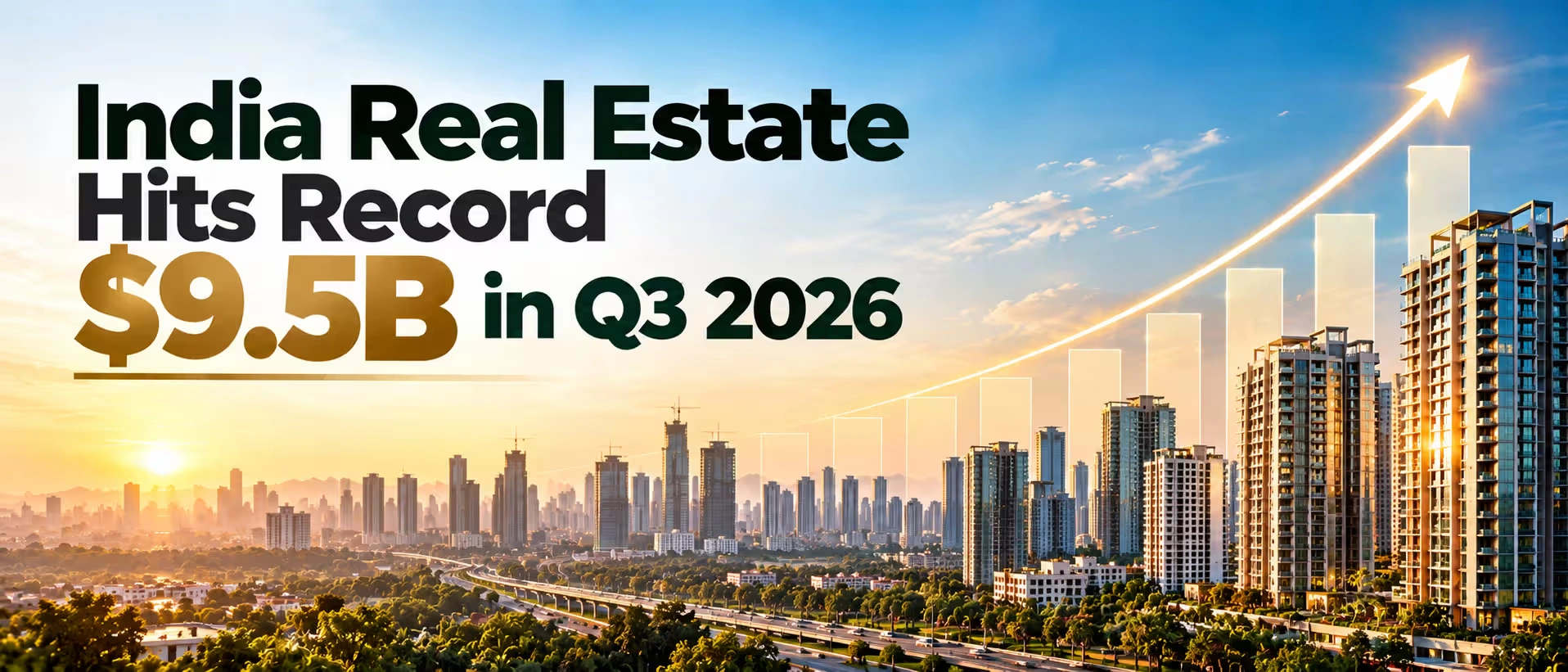
On 28 September 2026, a CBRE report put a big number in front of the market. India's real estate sector pulled in $9.5 billion in just three months. That is the highest quarterly figure ever recorded. Headlines like this can feel far from your own plot. Big funds, data centres and office towers do not sound like a two-acre field. But money at this scale changes how people look at land, and it is worth understanding before you buy or sell anything. This guide keeps it simple. First the numbers, then what they mean, then the steps you can follow.
Quick Pointers
- Q3 2026 (July to September) saw a record $9.5 billion in real estate inflows.
- That is more than double the same quarter last year.
- Foreign investors came back in a big way.
- Most of the money went to big commercial assets, not farmland.
- The effect on farmland is indirect. It will not be the same in every district.
What the Report Says?
The numbers come from CBRE's India Market Monitor for Investments, Q3 2026. Here they are in one place.
| Point | Figure |
| Inflows in Q3 2026 | $9.5 billion (record) |
| Same quarter in 2025 | $4.4 billion |
| Previous quarter (Q2 2026) | $3.8 billion |
| Total for first nine months of 2026 | $18.6 billion |
| Full year 2025 | $14.2 billion |
| Share from foreign investors | About 59% |
Look at the last two rows together. Nine months of 2026 have already crossed the whole of 2025. The year still has three months left.
Who is Putting the Money In?
The mix of investors matters as much as the total.
Investor type | What the report shows |
Foreign investors | About 59% of all inflows |
US investors | Around 90% of the foreign money |
Other foreign sources | Canada, Singapore and Japan |
Institutional investors | About 79% of inflows, up from about 28% in Q2 |
Developers | Around 13% of investments |
So this is not small retail buyers rushing in. It is large funds with long plans. They move slowly, they check everything, and they tend to stay for years. That kind of buyer usually says something about how they see India's future.
Where the Money Went?
Three asset types took almost all of it.
- Data centres
- Built-up office buildings
- Land and development sites
Together they made up nearly 91% of the money put to work in the quarter. Data centres grew several times over compared to both the last quarter and last year. By city, Mumbai, Delhi NCR and Chennai together took about 53% of the inflows. Around 15% came from deals that covered more than one city. Notice the third item on that list. Land and development sites are part of the story. But these are mostly parcels that are close to cities and meant for building. Ordinary farmland in a far district is a different thing.
Why This Matters If You Are Looking for Land?
You might be someone who types land for sale near me into your phone once a week and never thinks about CBRE reports. Fair enough. Still, this trend touches you in a few small ways.
- More demand near big cities. When funds and developers want sites around Mumbai, Delhi NCR, and Chennai, land on the edges of these cities gets more attention.
- Better sentiment. Foreign money coming back tells local buyers that the market is healthy. People feel safer buying.
- More talk about prices. Sellers hear about record numbers and often raise their asking price. That does not mean the market has moved that much.
Be careful with that last point. A record national number does not make your village plot worth more overnight. Prices are local. Roads, water, court cases, and buyers nearby decide the real rate.
Does This Push Farmland Prices Up?
Honest answer: not directly, and not everywhere. The report is about equity capital in the real estate sector. That means offices, data centres and building sites. It does not track fields sold for farming. Still, there are a few indirect links.
| Link | How it can affect farmland |
| City growth | Farm belts near expanding cities can see more buyers |
| New data centre and office hubs | Nearby villages may see better roads and power |
| Investor confidence | More people look at land as a safe asset |
| Talk in the media | More first-time buyers start their search |
Now think about crop land for sale in your area. Its price will depend on water, soil, road access, and clear papers. A bullish national report helps the mood. It does not replace those basics.
Steps for Buyers Right Now
If you plan to buy in this market, follow these steps in order.
- Set your purpose first. Do you want farming income, a weekend farm, or a long-term hold? The answer decides your budget and location.
- Look at the ground, not the headline. Visit the plot. Talk to farmers next door. Ask about water and last year's crop.
- Check the papers. Get the land record, sale deed history, and any loan or dispute details. Never skip this.
- Compare prices. Look at at least three recent sales nearby. Do not go by the seller's story alone.
- Check the growth plan. Ask if any road, industrial zone, or city plan is coming near the land. Confirm it on official sources, not on hearsay.
- Pay safely. Use bank transfer, get receipts and sign a registered agreement.
Remember that hype makes people rush. If a seller says the price will double next month because of some big news, be careful. That is a sales line, not a fact.
Steps for Sellers Right Now
The strong mood in the market can help you if you are ready. Here is how to use it.
- Get your papers in order. Scan the sale deed, land record, tax receipts, and survey map.
- Clear dues and disputes. A clean plot sells faster and at a better rate.
- Find your real price. Check the circle rate and what nearby plots sold for in the last year.
- Highlight what buyers value. Road access, water source, soil type, and distance from the nearest town.
- Take good photos. Clear pictures of the land, the boundary, and the approach road help a lot.
- List it in the right places. Use platforms that verify listings so serious buyers find you.
If you want to sell land in a year like this, timing helps, but preparation helps more. A buyer with money will still walk away from a plot with messy papers.
Mistakes to Avoid in a Hot News Cycle
| Mistake | Why it hurts |
| Raising the price only because of the news | Serious buyers go elsewhere, and the plot sits unsold |
| Buying in a hurry out of fear of missing out | You may skip checks and end up with a dispute |
| Trusting social media posts about "upcoming projects" | Many are false or years away |
| Ignoring local factors | Water, access and title still matter most |
| Dealing with too many middlemen | Price rises and the real owner gets hard to find |
For anyone in land selling, the smartest move is to stay calm. Let the papers and the location do the talking.
Find Verified Land on 2Bigha
If you want to act on this trend, start with a place that shows land you can trust. 2Bigha is a marketplace for agricultural land and farmland in India. You can browse farm listings, check location details, and book a visit at 2Bigha. Here is how it works for you.
- Buyers: Search by state, district, and budget. Shortlist plots and book a visit.
- Sellers: List your land with clear details so real buyers can reach you.
- Both: Use the 2Bigha Land Report to understand a plot before you commit.
Plenty of owners search for a phrase like farm for sell and land up on pages with old or copied posts. A verified platform saves you that time. It does not replace a lawyer or a site visit, but it gives you a cleaner starting point.
What to Watch Over the Next Few Months?
- The Q4 2026 investment numbers, to see if the pace holds
- New data centre and office projects in your region
- Road, rail and airport announcements near your target area
- State-level changes in stamp duty and land rules
CBRE says it expects the strong pace to carry through the rest of the year. If that happens, interest in land near growing cities should stay warm. Still, no one can promise a price. Treat forecasts as a guide, not a guarantee.
Disclaimer: This article is for informational purposes only and should not be considered investment, legal, financial, or property advice. Real estate regulations, infrastructure plans, market conditions, and government policies may change over time. Readers are advised to verify information with relevant authorities and consult qualified professionals before making any investment or property-related decisions.