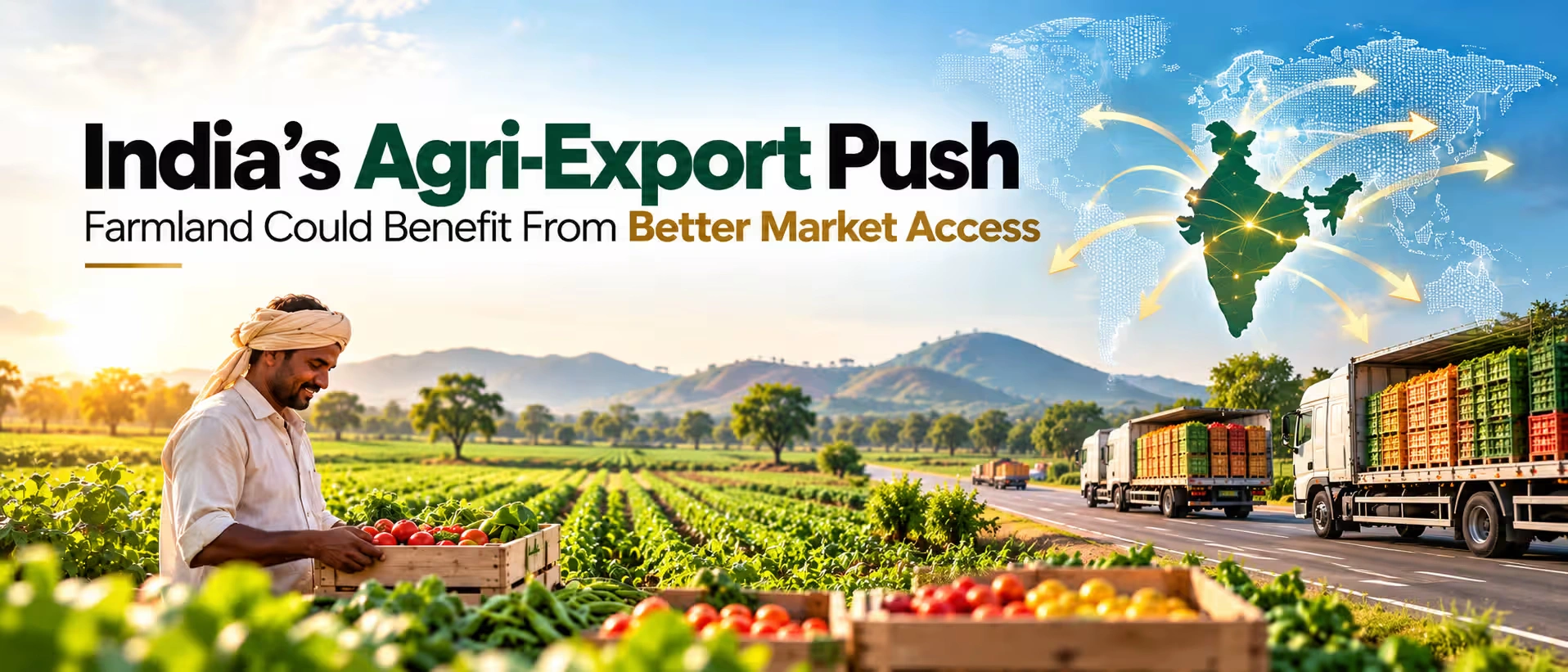
India's agricultural exports crossed some major milestones over the last few years, and honestly, most land buyers haven't caught on to what that means for them yet. Rice, spices, fruits, marine products — they're all moving out of the country in bigger volumes than before. But here's the part that doesn't get talked about enough: this export growth isn't spread evenly across the map. Some regions are set up to gain a lot from it. Others, not so much.
If you own farming land or you're eyeing agricultural land on sale as an investment, understanding this pattern could genuinely change where you look, and what you're willing to pay for it.
Why Exports Change the Value Equation for Land?
Traditionally, farmland value in India came down to soil quality, water access, and whether there was a decent local market nearby. Exports add a completely different variable: how fast and how cheaply can this produce reach a port, an airport, or a processing unit before it spoils or loses value?
That single question ends up mattering a lot. A plot with average soil but excellent road access to a container freight station can outperform a plot with rich soil stuck three hours from the nearest highway. It sounds counterintuitive at first, but exporters care less about raw yield and more about consistency, quality control, and how quickly they can move product.
A few things that suddenly matter a lot more under an export lens:
- Distance to ports, airports, or dry ports (ICDs)
- Access to cold storage and pack-house facilities
- Whether the region falls under an Agri Export Zone or similar cluster
- Road quality for last-mile transport of perishables
- Presence of Farmer Producer Organisations (FPOs) that aggregate produce for export
Regions Riding the Export Wave
Certain belts across India have become genuine export hotspots, and land in these zones has seen real interest from both farmers and investors. Here's a rough picture of how things stack up:
| Region | Export Strength | Key Produce |
|---|---|---|
| Maharashtra (Nashik, Solapur) | Strong grape and pomegranate exports | Grapes, onions, pomegranates |
| Gujarat (Kutch, Junagadh) | Growing marine and mango exports | Mangoes, groundnut, seafood |
| Andhra Pradesh (coastal belt) | Rising seafood and chilli exports | Shrimp, chilli, mango |
| Punjab and Haryana | Basmati rice export hub | Basmati rice |
| Karnataka (Chikkaballapur, Kolar) | Vegetable and floriculture exports | Grapes, flowers, vegetables |
This table isn't exhaustive by any means, but it gives a sense of why location within a state can matter just as much as the state itself when you're scanning crop land for sale with export potential in mind.
What Buyers Should Actually Look For?
If you're searching for farmland for sell listings with an export angle in mind, don't just look at the soil report. Ask a few sharper questions first.
- Is there an existing export cluster nearby? Land inside or close to a notified Agri Export Zone tends to attract better infrastructure support over time.
- What's the cold chain situation? Even good produce loses value fast without nearby cold storage or pack-house access.
- How far is the nearest logistics hub? A container freight station or airport within a couple of hours can be a genuine game changer.
- Are FPOs active in the area? Farmer collectives often have existing tie-ups with exporters, which can mean easier market access from day one.
- What's the crop history of the region? Areas with an established track record of a particular export crop usually have better local expertise and support infrastructure.
The Seller's Side of the Story
If you're currently exploring land selling and your property happens to sit within or near an export-active region, that's worth highlighting clearly. A lot of sellers underprice land simply because they're valuing it the old way, purely on soil and water, without factoring in the logistics advantage that export-focused buyers are actually paying for.
This is also where selling property online through a proper platform helps. Local word-of-mouth sales rarely reach the kind of buyer who understands export economics. An investor or agri-business looking for land near a processing cluster is far more likely to search online than to hear about your plot through a village broker.
A Quick Reality Check
Not every piece of farmland benefits equally from India's export push, and it's worth being honest about that. Land far from any transport corridor, with no cold chain access and no crop history tied to export demand, won't suddenly become valuable just because national export numbers are rising. The gains are concentrated, not universal.
That said, government momentum is real. Schemes under the Agriculture Export Policy, along with state-level cluster development programs, are actively working to widen this benefit beyond the usual hotspots. Over the next few years, more districts are likely to get pulled into this network as infrastructure catches up.
| Factor | Boosts Export Potential | Limits Export Potential |
|---|---|---|
| Proximity to port/airport | Yes | No |
| Cold storage nearby | Yes | No |
| Existing FPO or exporter tie-up | Yes | No |
| Isolated location, poor roads | No | Yes |
| No established crop cluster | No | Yes |
Finding the Right Farmland With 2Bigha
Whether you're looking to buy farming land with future export potential or you're planning to sell land that sits in a promising logistics corridor, having accurate, verified information makes all the difference. 2Bigha lets buyers explore agricultural land on sale across India with clear details on location, connectivity, and background verification, so you can judge export potential with real facts instead of guesswork.
And if you're a landowner considering selling property online, 2Bigha gives your listing visibility among buyers who are actually looking for land with genuine growth angles, not just casual browsers.
Disclaimer: This article is for informational purposes only and should not be considered investment, legal, financial, or property advice. Real estate regulations, infrastructure plans, market conditions, and government policies may change over time. Readers are advised to verify information with relevant authorities and consult qualified professionals before making any investment or property-related decisions.