Key Takeaways
- Ahmedabad's land market is driven by infrastructure growth — the GIFT City corridor, the metro network, and the SP Ring Road have all pushed demand for plots in Ahmedabad in the last few years.
- Before you buy land in Ahmedabad, always verify the 7/12 extract, title deed, and zoning classification (residential, commercial, industrial, or agricultural).
- Areas like Shela, South Bopal, Sanand, and Vaishnodevi Circle are currently seeing strong appreciation for both residential and commercial land for sale in Ahmedabad.
- If you're looking at industrial land in Ahmedabad, GIDC-approved zones near Sanand, Vithal Udyognagar, and Changodar are worth shortlisting first.
- Anyone planning to sell land in Ahmedabad should get an updated valuation and title clearance done before listing, not after a buyer asks for it.
Buying land in Ahmedabad isn't quite like buying a flat. There's no builder handing you a ready sale agreement, no RERA number pasted on a brochure, and often, no clear signage telling you where one owner's boundary ends and the next one begins. It's a slower, more hands-on process — and honestly, that's exactly why so many buyers either overpay or get stuck in disputes that drag on for years.
I've spoken to enough first-time land buyers in Ahmedabad to notice a pattern. Most people aren't confused about why they want land — they know they want to build a home eventually, or park their savings somewhere that beats inflation, or start a small manufacturing unit near Sanand. What trips them up is the how. Which documents actually matter? Which localities are genuinely growing versus just "hyped"? And how do you avoid the classic mistake of paying token money before the title is even clear?
This guide walks through all of that — step by step, in plain language, with the kind of detail you'd want from someone who's actually been through the process rather than someone summarising a government website.
Why Ahmedabad's Land Market Deserves Your Attention Right Now
Ahmedabad has quietly become one of western India's more interesting land markets. It's not Mumbai-expensive, but it's also not the sleepy tier-2 city it was a decade ago.
A few things are pushing this shift. The Ahmedabad Metro's Phase 2 extension has opened up connectivity along corridors that were considered "too far" just five years back. GIFT City, sitting right on the Ahmedabad-Gandhinagar border, has pulled in finance and tech companies, and that demand naturally spills into residential and commercial plot for sale in Ahmedabad listings nearby. And the Dedicated Freight Corridor, along with GIDC industrial belts around Sanand and Changodar, has made industrial land in Ahmedabad a genuinely active category — not just for large manufacturers, but for smaller warehousing and logistics players too.
Add to this the fact that Gujarat, as a state, has one of the more transparent land record systems in the country through the AnyROR portal, and you get a market that's growing but still verifiable if you know where to look. That last part matters more than most buyers realise — land in Gujarat is easier to research on paper than in several other states, but "easier" doesn't mean "effortless."
Understanding the Types of Land Available in Ahmedabad
Understanding the type of land you are searching for is essential before venturing into your plot hunt in Ahmedabad, as each type of land has its own specific terms, permissions, and buyer requirements.
The most common land type to search for would be residential plots; they are zoned for housing by the Town Planning Scheme and are usually the general plots that one hears about when speaking casually about plots/lands.
Commercial lands for sale in Ahmedabad are the lands which are zoned for shops/offices/showrooms and/or mixed zoning use. Commercial lands are usually located near major roads and/or are in commercial zones and cost more per square yard than any other type of lands.
Industrial land in Ahmedabad falls under GIDC (Gujarat Industrial Development Corporation) jurisdiction in most cases, especially in belts like Sanand, Vatva, Naroda, and Odhav. Buying here involves a different approval process, often requiring an allotment or NOC from GIDC itself if it's within an estate.
Agricultural or farm land is its own category entirely. If you're running a farm search in Ahmedabad for weekend farmhouses or actual cultivation, remember that agricultural land in Gujarat has restrictions on who can buy it — in most cases, only farmers (or those who meet specific state criteria) can purchase agricultural land, unless it's been converted to non-agricultural (NA) use.
Getting this classification wrong at the start is one of the most common — and expensive — mistakes buyers make.
Step-by-Step Guide to Buying Land in Ahmedabad
Step 1: Define Your Purpose and Budget First
This sounds obvious, but it's skipped more often than you'd think. Are you buying to build a home in the next two years? Parking money for long-term appreciation? Are you planning to set up a warehouse? Every function guides you to a different area, a different price range, and a different list of things to check out for.
Have an accurate budget that factors in the land cost, along with stamp duty (which is around 4.9% in Gujarat), registration charges, and the fees of lawyers and brokers (if you purchase your plot from a broker). Many buyers ignore such additional costs that leave them short by 6-8% of the total cost of the transaction.
Step 2: Shortlist Locations Based on Actual Growth Indicators, Not Just Hype
It is not a secret that there are some growth corridors in Ahmedabad. However, the distinction between real growth of the city due to its infrastructural development and aggressive marketing should be made.
Residential land plots in Ahmedabad, such as South Bopal, Shela, Sanathal, as well as the land plot along SP Ring Road, attract buyers since they are close to educational institutions, hospitals, and the ring road. Vaishnodevi Circle and Tragad gain momentum due to metro connectivity.
The commercial land plots in Ahmedabad, such as SG Highway or those close to GIFT City, are usually more expensive but offer high rent potential.
For industrial land in Ahmedabad, Sanand (especially post the Tata Nano and now EV manufacturing push), Changodar, and Vithal Udyognagar remain the go-to belts, largely because of GIDC infrastructure and highway access.
Step 3: Verify the Land Title Thoroughly
This is where most disputes originate, and it's the step buyers most often rush through because they're excited about the location.
At minimum, check:
- 7/12 Extract (Satbara Utara) — confirms current ownership and land classification.
- Title Deed / Sale Deed history — trace ownership back at least 30 years if possible, to rule out disputed claims.
- Encumbrance Certificate — confirms the land is free of loans, mortgages, or legal claims.
- Village Form 6 and 7/12 — for agricultural land specifically, to check for tenancy rights under the Gujarat Tenancy Act.
- Jantri Rate — the government-published guideline value, useful to sense-check whether the asking price is inflated.
I'd genuinely recommend hiring a local property lawyer for this step rather than relying solely on the seller's paperwork. It costs a fraction of what a bad title dispute would cost you later.
Step 4: Check Zoning and Development Plan (TP Scheme) Status
Ahmedabad's land falls under various Town Planning schemes managed by AUDA (Ahmedabad Urban Development Authority) or AMC (Ahmedabad Municipal Corporation), depending on location. Before you finalise a plot in Ahmedabad, confirm:
- Whether the plot is inside a finalised TP scheme (final plots are safer than "draft" or "preliminary" stage plots, which can still be reallocated).
- The Final Plot (FP) number and original Original Plot (OP) number — these should match across all documents.
- Whether the land use permission matches your intended purpose (residential, commercial, or industrial).
A plot still in the draft TP stage can look like a bargain, but it comes with real uncertainty — the final boundaries and even the exact area can change during finalisation.
Step 5: Physically Visit the Site — More Than Once
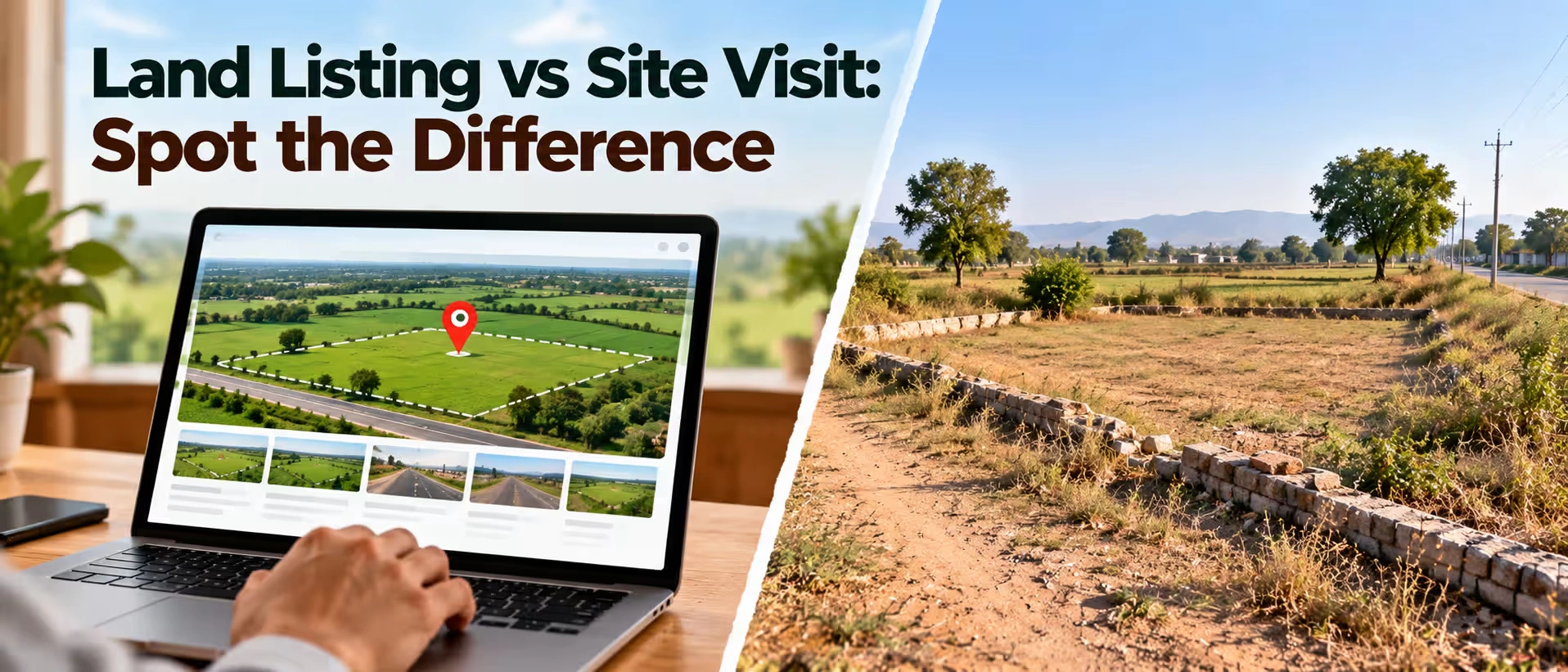
Photos and floor plans lie by omission. A site visit tells you what no document can: is there waterlogging in monsoon, is the approach road actually motorable, is there a nullah or drainage line cutting through the plot, and what does the neighbourhood actually feel like at different times of day.
Visit at least twice — once on a weekday and once on a weekend — and if possible, once during or right after monsoon. Ahmedabad's low-lying pockets near riverbeds and old lake beds (locally called "talao" areas) can have serious drainage issues that only show up in the rains.
Step 6: Get a Fresh Land Survey and Boundary Demarcation
Ask for a fresh measurement through a licensed surveyor (or the Ahmedabad DILR — District Inspector of Land Records office) before finalising the deal. Boundary disputes with neighbouring landowners are common, especially in areas where agricultural land has been subdivided over generations without formal re-measurement.
Step 7: Negotiate and Draft the Agreement to Sell
Once you're satisfied with the title and physical condition, move to a formal Agreement to Sell that specifies the sale price, payment schedule, possession timeline, and penalty clauses for delays on either side. Never pay a substantial token amount before this agreement is signed and the preliminary title check is done.
Step 8: Complete Stamp Duty Payment and Registration
In Gujarat, land sale deeds must be registered at the sub-registrar office within whose jurisdiction the land falls. You'll need:
- PAN cards and Aadhaar of both buyer and seller
- Two witnesses
- Payment of stamp duty and registration fee (calculated on either the sale value or Jantri rate, whichever is higher)
Once registered, the sale deed becomes the primary legal proof of ownership.
Step 9: Apply for Mutation (Name Transfer in Revenue Records)
Registration alone doesn't complete the process — you still need mutation (entry of your name in the village revenue records / 7/12 extract) to be fully recognised as the owner for future transactions, loans, or NA conversion. This is often overlooked and can create complications years later when you try to resell.
Step 10: Plan for Ongoing Land Management
If you're not building immediately, think about basic upkeep — boundary walls, fencing, periodic site visits to prevent encroachment, and property tax payments. For buyers who purchase land as an investment and don't live nearby, opting for a property management service can take care of these recurring responsibilities without you having to visit every few months.
Document Checklist at a Glance
Document | Why It Matters | Applies To |
|---|---|---|
| 7/12 Extract | Confirms ownership and land classification | All land types |
| Title Deed (30-year chain) | Rules out disputed ownership | All land types |
| Encumbrance Certificate | Confirms no pending loans/liens | All land types |
| TP Scheme / FP-OP Numbers | Confirms zoning and finalisation status | Residential & commercial |
| GIDC Allotment Letter / NOC | Confirms legal industrial use | Industrial land |
| NA (Non-Agricultural) Order | Required if converting farm land for building | Agricultural land |
| Jantri Valuation | Sense-checks the asking price | All land types |
| Mutation Entry | Updates revenue records post-purchase | All land types |
Where to Search: Choosing the Right Real Estate Platform
A lot of buyers still rely on word-of-mouth or a single local broker, and while that's not necessarily wrong, it does limit how much of the market you actually see. This is where real estate websites genuinely add value — a good platform lets you compare plot for sale in Ahmedabad listings across multiple localities, filter by budget, land type, and even check basic legal status before you contact anyone.
Platforms such as 2Bigha focus specifically on land and plot transactions rather than treating them as an afterthought to apartment listings, which matters because land deals need different filters — zoning, TP scheme status, road width, and NA status — that most generic property portals don't handle well. Using a dedicated land-focused platform alongside your own legal due diligence gives you a far more realistic shortlist before you even step out for a site visit.
Selling Land in Ahmedabad: A Quick Note for Owners
If you're on the other side of this transaction and plan to sell land in Ahmedabad, the same due-diligence logic applies in reverse. Buyers today are more informed than they were even five years ago, and a clean, ready title package speeds up your sale considerably. Get your 7/12 extract updated, clear any pending mutation entries, and have your Jantri valuation and recent comparable sale prices ready before you list. Sellers who show up with organised paperwork routinely close deals faster and at better prices than those who make buyers chase for documents mid-negotiation.
Common Mistakes Buyers Make (And How to Avoid Them)
- Paying token money before title verification — always verify first, pay later.
- Ignoring TP scheme status — draft-stage plots can still change in area and boundary.
- Skipping a physical monsoon visit — drainage issues rarely show up in a dry-season photo.
- Assuming agricultural land can be built on immediately — NA conversion is a separate legal process.
- Not budgeting for stamp duty and registration — these can add 6-8% to your total cost.
- Relying on a single source of listings — cross-checking prices across a couple of real estate websites helps you avoid overpaying.
Final Thoughts
Buying land in Ahmedabad rewards patience more than speed. The city's growth story is real — GIFT City, the metro expansion, and the industrial belts around Sanand aren't going anywhere — but the buyers who do well here are the ones who verify before they sign, not after. Take the time to check the title, walk the site more than once, and use a reliable platform to compare your options properly. Get those basics right, and land in Ahmedabad remains one of the more grounded, genuinely promising investments in Gujarat's real estate market today.
Disclaimer: This article is for general informational purposes only and does not constitute legal, financial, or investment advice. Land laws, stamp duty rates, and TP scheme statuses are subject to change; readers should consult a qualified property lawyer and verify current regulations with relevant government authorities (AUDA, AMC, GIDC, or the sub-registrar office) before making any land purchase or sale decision.