List Your Land
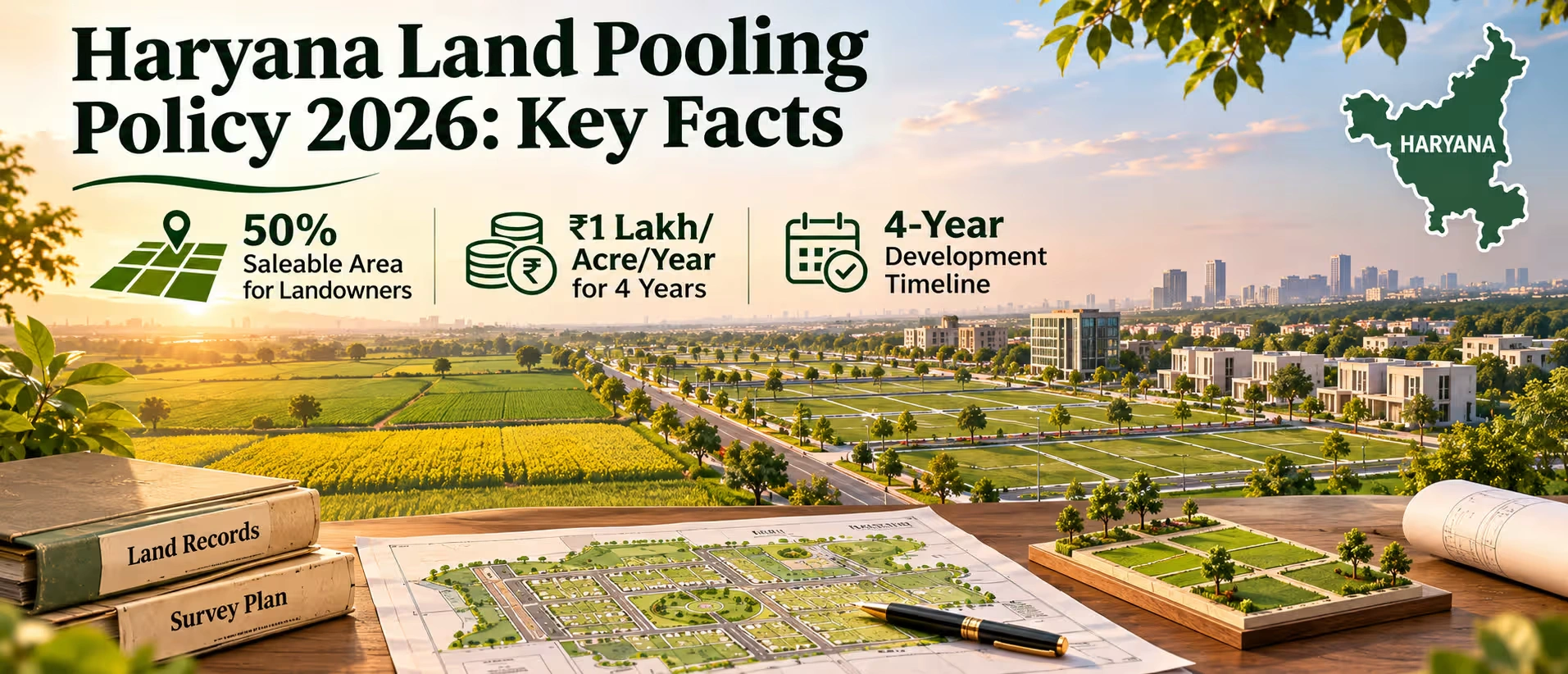
Anyone who owns a plot in Haryana, or a few killas of farm land near a growing town like Gurugram, Sonipat or Hisar, has probably seen the headlines from 3 November, when the state cabinet under Chief Minister Nayab Singh Saini approved the Land Pooling Policy-2026 and replaced the 2022 policy. Under pooling, owners hand their land to a development agency, which lays roads, drains, and plots and then returns part of the developed area to them, so the new numbers decide whether pooling is a better deal than an outright sale. This blog goes through what changed, what the news reports leave unclear, and how a seller or a buyer should think about it.
What the Cabinet Approved on 3 November?
The cabinet met on Tuesday and cleared the policy as a framework for taking land for urban and industrial projects through the voluntary participation of landowners. The main change is that landowners will be offered 50% of the total saleable area of a project as per the approved layout plan, while the other 50% stays with the development agency. Commercial sites come out of the owner's half according to a set entitlement, and the rest is given as residential, industrial, or institutional plots depending on what the project is meant for.
Key Numbers in the New Policy
People tracking agricultural land for sale in Haryana near upcoming projects should also check Digital Land Records in Haryana to understand ownership details and land status. The figures below come from the cabinet announcement, as reported by The Hindustan Times and The Tribune.
| Item | What the 2026 policy says |
| Landowner's share | 50% of the project's saleable area |
| Yearly support | ₹1 lakh per acre for four years, in proportion to land given, counted from the day the sale deed is registered |
| Delay in payment | 9% simple interest if the amount is not paid within 15 days of the sale deed |
| Project completion | Four years from final approval, down from five, and the land goes back to the owners if infrastructure is not ready |
| Smallest plots | 100 sq m residential, 250 sq m industrial, 500 sq m institutional |
| Commercial kiosks or booths | For owners who contribute more than 2,000 sq m |
| Holdings under 999 sq m | Cash instead of plots |
| Buyback of allotted plots | Three years, up from one |
| Aggregator's fee | 0.5% of the agricultural collector rate of that revenue estate, paid by the development agency |
How It Differs From the 2022 Policy?
The 2022 policy linked what an owner received to the market value of the undeveloped land, which meant two owners with the same area could be offered different amounts depending on where the land sat, while the new policy drops that link and uses a plain half share. Project timelines are tighter, since the completion period was cut from five years to four, and the window in which the agency can buy back an allotted plot has been stretched from one year to three. Land pooling through e-Bhoomi has been kept out of the new policy, according to the government spokesperson.
What Small Landowners Get?
Owners who put in less than 999 square metres, which is roughly a quarter of an acre or about two kanals, will not get a plot. They receive money instead, either under the 2013 land acquisition law or at the reserve price of the plot, whichever is higher, and no commercial space is offered for holdings below that size. That matters for a family with a small bit of agricultural land: Haryana villages often split among brothers over the years, because a share that looks fine on paper may fall under the cutoff once the Jamabandi is divided. Owners who hold land entitlement certificates can club them to apply for a bigger developed plot, and the minimum sizes listed in the table apply in proportion to how much land each person contributed.
Pooling or Selling: What to Weigh?
This is a 4-year support at ₹1 lakh per acre. Since the plots will be available only after completion of the project (which may take up to 4 years after final approval), this would mean getting regular but small income and plots at a later date. Whereas you will get a lump sum amount on selling the plots. The value of a pooled plot could be higher than raw land if there are roads and sectors nearby. But this will completely depend on the location and timely completion by the agency. The main safeguard is the provision of handing back the land to owners if they fail to meet the deadline. If there are multiple heirs in the family, then it is important to note that all the co-owners must agree to hand over the land to the project. The final notification & related rules might have extra details not mentioned in the news.
What Buyers Should Keep in Mind?
A buyer looking at farm land in Haryana close to a town should first check whether the village falls in an area where pooling is open, because the Haryana Shahari Vikas Pradhikaran has published advertisements that list villages and acreage and invite landowners and land aggregators to come forward. Land that has already been pooled belongs to the project, and land in a notified area can be tied up in a scheme for years, so the same plot that looks like a bargain may not be freely sellable. Since the aggregator's fee is linked to the collector rate and paid by the development agency, owners are not expected to pay it, but a buyer should still ask the seller whether any agreement with an aggregator exists.
Checks Before You Sell or Pool
Check the latest Jamabandi and Fard from the Haryana land records portal. Ensure that your name, khewat number, khasra number, and area details match. Also ensure that all the Intkals after any death or previous sale have been recorded. Check the development plan of the nearest town to ensure that your property lies in a sector, green belt, or rural area. Get an encumbrance certificate for any loans. Finally, check with a lawyer that you understand the final notified policy before signing any option forms or sale deeds.
How to Sell Land in Haryana Outright?
Owners who prefer to sell land in Haryana for a lump sum can do it without waiting for any project, and the order is the same as in most states: fix the records first, set a price using recent registered sales near your khasra and the collector rate for your area, list the land with clear photos and the village and tehsil, sign an agreement to sell with a token amount, and register the sale deed at the Sub-Registrar office. After registration, the Intkal has to be done so that the buyer's name appears in the Jamabandi, and the sale amount should come by bank transfer so that a record exists.
How 2Bigha Helps?
Sellers on 2Bigha can list their land absolutely free of cost under the Silver plan. They can also message their details via WhatsApp. Buyers can browse through the plots and agricultural lands available in Haryana and directly contact the sellers. In case you're still confused about whether you want to pool or sell, then this feature will help you know what your buyers in your area like.
Conclusion
The policy conditions are much clearer for owners to understand in 2026. The 2026 policy offers a fixed 50% share plus ₹1 lakh annual support per acre. It has a shorter time to complete, plus a clause to return the land. However, small plots will receive only cash payments, and the plots will only be provided once the project has been completed. If you sell, you will receive instant cash; however, if you pool, you will receive developed plots at a later date. The right option for you depends on your land size, when you need the cash, and how close your land is to a real project.
Disclaimer: This article is for informational purposes only and should not be considered investment, legal, financial, or property advice. Real estate regulations, infrastructure plans, market conditions, and government policies may change over time. Readers are advised to verify information with relevant authorities and consult qualified professionals before making any investment or property-related decisions.