Key Takeaways
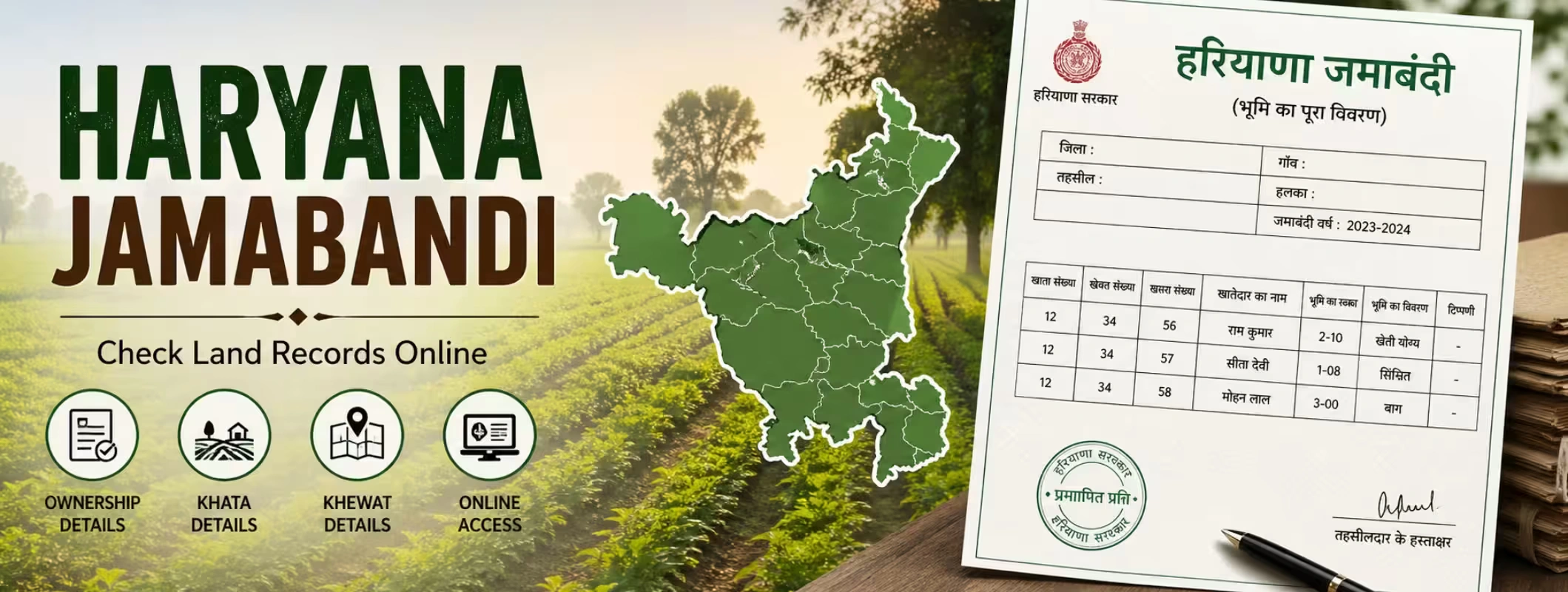
- Haryana Jamabandi is the official land record document that helps buyers, sellers, investors, farmers, and legal advisors verify ownership, khasra details, khatauni information, mutation status, and revenue record history before a land transaction.
- The Haryana Jamabandi online portal allows citizens to check Jamabandi Nakal, mutation status, property registration details, cadastral maps, deed-related information, and other land record services digitally. The official portal states that people can view sanctioned mutations and Jamabandi records using owner name, khewat number, and khasra number.
- Before buying land in Haryana, never rely only on verbal ownership claims, broker screenshots, or old registry papers. Always verify the latest Jamabandi copy, mutation entry, khasra number, ownership chain, and land-use status.
- For safer buying and selling, platforms like 2Bigha can help users explore land opportunities with better transparency, map-based listings, verified property information, and subscription-based listing plans for property owners, agents, and buyers.
Introduction: Why Haryana Jamabandi Verification Matters
Buying land in Haryana can be a smart investment, especially in fast-growing regions near Gurgaon, Faridabad, Sonipat, Panipat, Karnal, Rohtak, Rewari, Ambala, Hisar, and other developing belts. Haryana has strong demand for agricultural land, farmhouse land, industrial plots, highway-side land, residential plots, and resale properties.
But here is the real issue: land investment is only safe when the documents are clean.
Many buyers make the mistake of checking only the registry copy. That is not enough. A registry shows that a sale deed was executed, but it does not always prove that the seller’s current ownership position is clear. For that, you need to check the latest Jamabandi Nakal, mutation status, khasra details, and revenue record history.
That is where the Haryana Jamabandi online check becomes important.
The Haryana Jamabandi portal, managed for land record access in Haryana, helps users view official land records such as Jamabandi, mutation, registration, and related property details. The official portal includes services like Jamabandi Nakal for checking, verifiable copy of Nakal, mutation status, mutation orders, deed registration appointment, and cadastral maps.
This guide explains how to verify land records Haryana online, how to download Jamabandi Nakal Haryana, what details to check, and how buyers and sellers can use land records before making a property decision.
What is Jamabandi in Haryana
Jamabandi is a Record of Rights document used in many North Indian states, including Haryana. In simple words, it records important land ownership and revenue details.
A Haryana Jamabandi document usually includes:
Detail | Meaning |
| Owner name | Person or persons recorded as landowners |
| Khewat number | Account number of landowners |
| Khatauni number | Details linked with cultivators or possession |
| Khasra number | Plot/parcel number assigned in revenue records |
| Land area | Size of land recorded in official units |
| Type of land | Agricultural, gair mumkin, residential-related, etc. depending on record |
| Mutation details | Changes due to sale, inheritance, gift, partition, etc. |
| Revenue details | Land revenue and related entries |
For a buyer, Jamabandi is one of the most important documents because it helps answer a basic question: Who is recorded as the landowner in the revenue records?
Why is Jamabandi Nakal Important Before Buying Land in Haryana
A Jamabandi copy Haryana online is important because it helps reduce document-related risks. It gives buyers a clear starting point before paying token money, signing an agreement, or applying for a loan.
You should check Haryana land records online before buying land because it helps you verify:
- Whether the seller’s name appears in the current land record
- Whether the khasra number matches the land being shown physically
- Whether the land area matches the seller’s claim
- Whether mutation has been updated after previous sale or inheritance
- Whether there are multiple owners or co-sharers
- Whether there is any mismatch between registry and revenue records
- Whether the land is suitable for the buyer’s intended use
For example, a seller may show you a sale deed, but the mutation may still be pending. In such cases, the seller’s ownership may not be fully reflected in the latest revenue records. That can create problems during resale, loan approval, partition, conversion, or legal verification.
Haryana Jamabandi Online Portal: What Can You Check
The Haryana Jamabandi portal provides access to several land and property record services. The official portal lists services related to Jamabandi Nakal, verifiable copy of Nakal, mutation, property registration, mutation status, mutation orders, court cases, revenue court status, and cadastral maps.
Here are the major services useful for buyers and sellers:
| Portal Service | Why it Matters |
| Jamabandi Nakal for checking | Helps verify ownership, khasra, khatauni, and land record details |
| Get verifiable copy of Nakal | Useful when you need a more formal copy for verification |
| Check mutation status | Helps confirm whether ownership transfer has been updated |
| View mutation orders | Helps review mutation approval details |
| Mutation status of deeds | Useful after property registration |
| Deed registration appointment | Helps with property registration process |
| Cadastral maps | Helps understand plot location and boundaries |
| Revenue court status | Helps identify certain dispute-related records |
How to Verify Land Records Haryana Online
Here is a simple step-by-step Haryana Jamabandi guide for checking land records online.
Step 1: Visit the Official Haryana Jamabandi Portal
Go to the official Haryana Jamabandi portal. Make sure you are using the official government land record website and not a random third-party page.
The official Haryana Jamabandi portal is built to provide access to land record services such as registration, mutation, and Jamabandi.
Step 2: Select “Jamabandi Nakal for Checking”
On the portal, look for the Jamabandi section and choose the option for checking Jamabandi Nakal.
This option is generally used when you want to view land ownership and record details online.
Step 3: Choose District, Tehsil, Village, and Jamabandi Year
You will usually need to select:
- District
- Tehsil/Sub-tehsil
- Village
- Jamabandi year
Choose the correct village carefully. Many villages may have similar names, especially in Haryana’s rural belts.
Step 4: Search by Owner Name, Khewat Number, Khasra Number, or Khatauni
The Haryana Jamabandi portal allows users to view sanctioned mutation and Jamabandi details using owner name, khewat number, and khasra number.
You can search using:
| Search Method | Best Used When |
| Owner name | You know the landowner’s exact name |
| Khewat number | You have the revenue account number |
| Khasra number | You know the specific land parcel number |
| Khatauni number | You want cultivator/possession-linked details |
For buyers, the safest approach is to cross-check through more than one method. For example, search by khasra number and then match the owner name.
Step 5: Review Ownership Details Carefully
Once the record appears, check whether the seller’s name matches the Jamabandi record.
Do not ignore spelling variations, father’s name, family name, co-owner details, or share percentage. In many land parcels, multiple family members or co-sharers may be recorded. If all owners have not agreed to sell, the transaction can become risky.
Step 6: Match Khasra Number With Physical Land
The khasra number is one of the most important details in Haryana land records online. It identifies a specific parcel of land in revenue records.
Check whether the khasra number mentioned in the Jamabandi matches:
- Sale deed
- Old registry papers
- Site shown by seller
- Cadastral map
- Mutation entry
- Agreement to sell
- Local patwari verification
A mismatch in khasra number can lead to serious ownership and boundary disputes.
Step 7: Check Mutation Details Haryana Online
Mutation records show whether ownership changes have been updated after events such as sale, inheritance, gift, partition, or court order.
The Haryana Jamabandi portal provides mutation-related services including checking mutation status, mutation status of deeds, and viewing mutation orders.
Before buying land, check:
- Whether mutation is sanctioned
- Whether mutation is pending
- Whether mutation was objected to
- Whether the mutation order matches the claimed ownership
- Whether all previous transfers are properly reflected
Step 8: Download or Save the Jamabandi Nakal
After checking the record, save or download the Jamabandi Nakal if available. For a more formal record, use the verifiable copy option where applicable.
Keep a copy for:
- Buyer due diligence
- Legal review
- Loan discussion
- Agreement drafting
- Seller verification
- Future resale records
Haryana Jamabandi Nakal Meaning: Simple Explanation
A Jamabandi Nakal means a copy of the Jamabandi record. It is not just a normal document. It reflects key land ownership and revenue details available in the state’s land record system.
For buyers, the Jamabandi Nakal helps verify whether the land being offered for sale has a clear ownership record. For sellers, it helps prove that the property details are properly recorded before listing or negotiating.
In simple terms:
- Jamabandi = Original land revenue record
- Jamabandi Nakal = Copy of that land record
Details You Must Check in Haryana Jamabandi Before Buying Land
When you open the Jamabandi record, do not just check the owner’s name and close the page. A serious buyer must read the document properly.
1. Owner Name and Father’s Name
Check the full name of the owner. If the seller’s name is different from the record, ask why.
Common reasons may include:
- Mutation pending
- Inherited land not updated
- Family partition not recorded
- Power of attorney sale
- Old registry not reflected
- Joint ownership issue
2. Khewat Number
Khewat number identifies the account of landowners. If multiple people are listed under the same khewat, understand each person’s share before moving forward.
3. Khatauni Number
Khatauni details are important in agricultural land records because they may show possession or cultivation-related details.
4. Khasra Number
This is the parcel number. Always match the khasra number with the land location and map.
5. Land Area
Check whether the area shown in Jamabandi matches the seller’s claim. If the seller says 2 acres but the record reflects less land or shared ownership, investigate before paying.
6. Mutation Entry
Mutation confirms whether revenue records were updated after ownership transfer. A registered sale deed without updated mutation can create future complications.
7. Land Type
Check whether the land is agricultural, residential, commercial, gair mumkin, or another category as per record. Land use matters for construction, conversion, resale, and loan eligibility.
Comparison: Registry vs Jamabandi vs Mutation
Many buyers confuse registry, Jamabandi, and mutation. These documents are connected but not the same.
| Document | What it Shows | Why it Matters |
| Registry/Sale Deed | Legal sale transaction between buyer and seller | Proves sale deed execution |
| Jamabandi | Revenue record showing ownership and land details | Helps verify current land record status |
| Mutation | Revenue record update after sale/inheritance/transfer | Confirms ownership change in land records |
| Khasra Map/Cadastral Map | Parcel location and boundary reference | Helps verify land location and boundaries |
A safe buyer checks all of them together.
How to Check Ownership of Land in Haryana
To check ownership of land in Haryana, use the Jamabandi Nakal option on the official portal and search through owner name, khewat number, khasra number, or khatauni details.
The ownership record should be checked along with:
- Registry chain
- Mutation status
- Khasra number
- Cadastral map
- Encumbrance or charge, where applicable
- Local revenue office verification
- Legal opinion from property lawyer
For high-value land purchases, especially agricultural land, farmhouse land, highway-side land, and development land, online checking should be the first step, not the final step.
How to Download Jamabandi Haryana
The exact portal interface may change from time to time, but the basic Haryana Jamabandi Nakal process usually follows this flow:
- Visit the official Haryana Jamabandi portal
- Go to the Jamabandi section
- Select Jamabandi Nakal for checking or verifiable copy option
- Choose district, tehsil, village, and year
- Search by owner name, khewat, khasra, or khatauni
- Open the land record
- Review ownership and parcel details
- Download, print, or save the copy where available
For legal use, always confirm whether you need a certified or verifiable copy instead of only a screenshot.
What is Khasra Khatauni in Haryana
Khasra and Khatauni are two common terms used in Haryana land records.
Khasra
Khasra is a plot or survey number assigned to a specific land parcel. It helps identify the exact land in revenue records.
Khatauni
Khatauni records details connected with landholding, cultivation, or possession. It helps understand how land is associated with owners or cultivators.
Together, khasra khatauni Haryana records help buyers verify the land parcel and ownership-linked details more accurately.
What is Mutation in Haryana Land Records
Mutation is the process of updating revenue records after a transfer of ownership. This transfer may happen through:
- Sale
- Gift deed
- Inheritance
- Partition
- Court order
- Family settlement
- Will-related transfer
A buyer should not ignore mutation details Haryana online. If the mutation is not updated, the land record may still show the previous owner.
For example, if Mr. A sold land to Mr. B, but mutation was not completed, the latest Jamabandi may still create confusion. That can affect resale, loan processing, title verification, and buyer confidence.
Common Problems Found During Haryana Land Record Verification
Land verification often exposes issues that buyers do not notice during site visits.
1. Seller Name Not Updated
The seller may have a sale deed but mutation may still be pending.
2. Joint Ownership
The land may be owned by several family members. If only one person wants to sell, the buyer must check whether that person has legal authority to sell the full share.
3. Khasra Mismatch
The land shown physically may not match the khasra number in the record.
4. Area Difference
The seller may claim a larger area than what is recorded.
5. Pending Mutation
A pending mutation can delay ownership clarity.
6. Dispute or Objection
There may be objections, court cases, or family disputes linked with the land.
7. Land Use Restriction
Agricultural land may not be freely usable for residential, commercial, or farmhouse development without required approvals.
Buyer’s Checklist: Verify Land Records Haryana Online Before Payment
Use this checklist before paying token money or signing an agreement.
| Verification Point | Checked? |
| Latest Jamabandi Nakal reviewed | ☐ |
| Seller name matches land record | ☐ |
| Father’s name and identity matched | ☐ |
| Khewat number checked | ☐ |
| Khasra number checked | ☐ |
| Khatauni details reviewed | ☐ |
| Land area matched with seller claim | ☐ |
| Mutation status checked | ☐ |
| Cadastral map reviewed | ☐ |
| Registry chain checked | ☐ |
| Co-owner consent verified | ☐ |
| Loan/charge checked where applicable | ☐ |
| Land-use status checked | ☐ |
| Local patwari/tehsil verification done | ☐ |
| Property lawyer opinion taken | ☐ |
Seller’s Checklist: Prepare Clear Land Records Before Listing Property
If you want to sell property with clear land records Haryana, keep your documents ready before approaching buyers.
| Document/Record | Why it Helps |
| Latest Jamabandi copy | Builds buyer trust |
| Mutation record | Shows ownership update |
| Registry/sale deed chain | Proves transaction history |
| Khasra map | Helps buyers verify location |
| Identity documents | Supports seller verification |
| Co-owner NOC, if applicable | Avoids family ownership disputes |
| Tax/revenue receipts, where applicable | Supports clean documentation |
| Encumbrance or loan clearance, if applicable | Reduces buyer hesitation |
A seller with clear documents can negotiate better because buyers feel safer.
Buying Agricultural Land in Haryana: Why Jamabandi Is Critical
Agricultural land in Haryana attracts investors because of strong connectivity, road development, warehouse growth, NCR expansion, and rising demand for farmhouse-style land near urban areas.
But agricultural land needs deeper verification.
Before buying agricultural land Haryana with clear title, check:
- Whether the land is actually agricultural in records
- Whether the seller has ownership rights
- Whether the land has multiple co-sharers
- Whether mutation is updated
- Whether the land is affected by acquisition, zoning, or local restrictions
- Whether conversion is required for intended use
- Whether access road exists legally
- Whether khasra number matches the physical parcel
A Jamabandi Nakal does not replace legal due diligence, but it gives you the first layer of truth.
How Haryana Jamabandi Helps Buyers, Sellers, Agents, and Investors
For Buyers
Jamabandi helps buyers avoid blind investment. It confirms whether the seller’s ownership claim is reflected in official revenue records.
For Sellers
A clear Jamabandi copy helps sellers build trust and close deals faster.
For Agents
Real estate agents can use verified land records to present properties more professionally.
For Investors
Investors can compare land parcels, check ownership status, and shortlist safer opportunities before site visits.
For Legal Advisors
Legal advisors can use Jamabandi records as part of title due diligence, along with registry, mutation, court records, and local verification.
Online Verification vs Offline Verification
| Factor | Online Haryana Jamabandi Check | Offline Revenue Office Verification |
| Speed | Faster | Slower |
| Convenience | Can be checked from anywhere | Requires visit |
| Initial ownership check | Useful | Useful |
| Certified/legal copy | May require verifiable/certified process | Available through official channels |
| Human clarification | Limited | Better for complex cases |
| Best use | First-level verification | Final legal confirmation |
The best approach is simple: start online, confirm offline when the deal is serious.
Role of 2Bigha in Safer Land Buying and Selling
2Bigha is designed for people who want a more transparent way to explore, buy, sell, and list land. In land transactions, the biggest problem is not only finding a property. The bigger problem is finding a property with trustworthy information.
With 2Bigha, users can explore land through a modern property discovery experience, including map-based listings that help buyers understand the location better before moving ahead. This is especially useful for agricultural land, farmhouse land, rural land, plots, and investment land.
How 2Bigha Can Help
2Bigha can support buyers and sellers by making land discovery more structured:
- Buyers can explore land listings with better location clarity
- Sellers can present properties more professionally
- Agents can list land opportunities through subscription plans
- Users can compare land options before physical visits
- Map-based listing helps users understand nearby roads, villages, and location context
- Verified property information can reduce low-quality inquiries and improve trust
If you are planning to buy land with verified Jamabandi Haryana or sell property with clear land records Haryana, 2Bigha can act as a practical discovery platform. However, buyers should still complete legal verification, Jamabandi checking, mutation review, and lawyer consultation before final payment.
Important Documents to Check Along With Haryana Jamabandi
Jamabandi is important, but it is not the only document. Before purchasing land in Haryana, check these documents:
| Document | Purpose |
| Jamabandi Nakal | Confirms revenue record ownership |
| Sale deed/registry | Confirms previous sale transaction |
| Mutation record | Confirms ownership update in revenue records |
| Khasra map/cadastral map | Helps verify land parcel and boundary |
| Title chain | Shows previous ownership transfers |
| Identity proof of seller | Confirms seller identity |
| NOC from co-owners | Needed in joint ownership cases |
| Loan clearance, if any | Confirms no pending mortgage issue |
| Land-use approval | Needed for non-agricultural use |
| Court case search | Helps identify disputes |
Red Flags Buyers Should Not Ignore
Do not move ahead quickly if you notice these signs:
- Seller avoids sharing khasra number
- Jamabandi does not show seller’s name
- Mutation is pending for a long time
- Land area differs from seller’s claim
- Multiple co-owners are listed but only one seller is negotiating
- Land is shown at a very low price compared to market rate
- Seller pressures you to pay token money immediately
- Broker refuses legal verification
- Physical location does not match cadastral map
- Land-use status is unclear
A cheap deal with unclear documents is not an opportunity. It is a risk.
Practical Example: How Jamabandi Verification Protects a Buyer
Suppose a buyer wants to purchase agricultural land near Sonipat. The seller claims the land is 4 acres and says the title is clear. The buyer checks Haryana Jamabandi online and finds:
- Seller is only one of three co-owners
- Mutation after inheritance is pending
- Khasra number shown by broker does not match the land location
- Actual recorded share is smaller than claimed
Without Jamabandi verification, the buyer may have paid token money and entered a risky deal. With verification, the buyer can pause, ask for proper documents, and consult a legal advisor.
This is why land ownership verification in Haryana should happen before payment, not after.
Best Practices for Haryana Land Record Verification
Follow these practical rules:
- Always check the latest Jamabandi, not an old copy.
- Match owner name, khasra number, and land area with registry documents.
- Check mutation status before final deal.
- Review cadastral maps for parcel location.
- Take legal advice for high-value land.
- Avoid cash-heavy informal transactions.
- Never trust only broker-provided screenshots.
- Visit the land with a local revenue person if required.
- Check whether all co-owners have agreed to sell.
- Use trusted platforms like 2Bigha for structured land discovery, but complete due diligence independently.
Final Thoughts
Haryana Jamabandi is an important land record that helps verify property ownership, khasra number, khatauni details, mutation status, and revenue record information. Buyers can check Haryana land records online through the official Jamabandi portal by using owner name, khewat number, khasra number, or khatauni details. Before buying land in Haryana, buyers should download or review Jamabandi Nakal, check mutation details, match land area, verify co-owners, and consult a legal advisor. Platforms like 2Bigha can help users discover land opportunities with better transparency, map-based listings, and subscription plans for sellers and agents.
FAQs on Haryana Jamabandi Online Check
1. What is Haryana Jamabandi?
Haryana Jamabandi is a land revenue record that shows ownership, khasra number, khewat number, khatauni details, land area, and other important property-related information. It helps buyers and sellers verify land ownership before a transaction.
2. How can I verify land records Haryana online?
You can verify land records Haryana online through the official Haryana Jamabandi portal. Select the Jamabandi Nakal option, choose district, tehsil, village, and year, then search by owner name, khewat number, khasra number, or khatauni details.
3. Can I check Haryana land records by name?
Yes, the Haryana Jamabandi portal allows users to view Jamabandi and sanctioned mutation details using owner name, khewat number, and khasra number.
4. What is Jamabandi Nakal Haryana?
Jamabandi Nakal Haryana means a copy of the Jamabandi land record. It helps verify ownership details, land area, khasra number, khatauni details, and other revenue record information.
5. How to download Jamabandi Haryana?
To download or view Jamabandi Haryana, visit the official Jamabandi portal, select the Jamabandi Nakal option, choose location details, search the record, review the information, and save or download the copy where available. For formal use, check the verifiable copy option.
6. What is the difference between Jamabandi and mutation?
Jamabandi shows land ownership and revenue record details. Mutation is the process of updating revenue records after ownership changes due to sale, inheritance, gift, partition, or other transfer.
7. Is Jamabandi enough to prove land ownership?
Jamabandi is important, but buyers should not rely only on it. You should also check sale deed, mutation status, title chain, cadastral map, co-owner consent, land-use status, and legal clearance.
8. Why is khasra number important in Haryana land records?
Khasra number identifies a specific land parcel in revenue records. Buyers should match the khasra number with Jamabandi, registry, cadastral map, and physical land location before purchase.
9. Can I buy agricultural land in Haryana after checking Jamabandi?
Jamabandi checking is a necessary first step, but it is not the full legal process. Before buying agricultural land in Haryana, also verify mutation, land-use rules, ownership chain, local restrictions, access road, and legal title.
10. How does 2Bigha help in buying or selling land?
2Bigha helps users explore land and property listings with better transparency and map-based discovery. Sellers and agents can use subscription plans to list properties, while buyers can compare land options before moving ahead with legal verification.