Key Takeaways
- Haryana has launched an online auto-mode mutation system to reduce property fraud, especially cases where the same plot, house, shop, or land parcel is sold to multiple buyers.
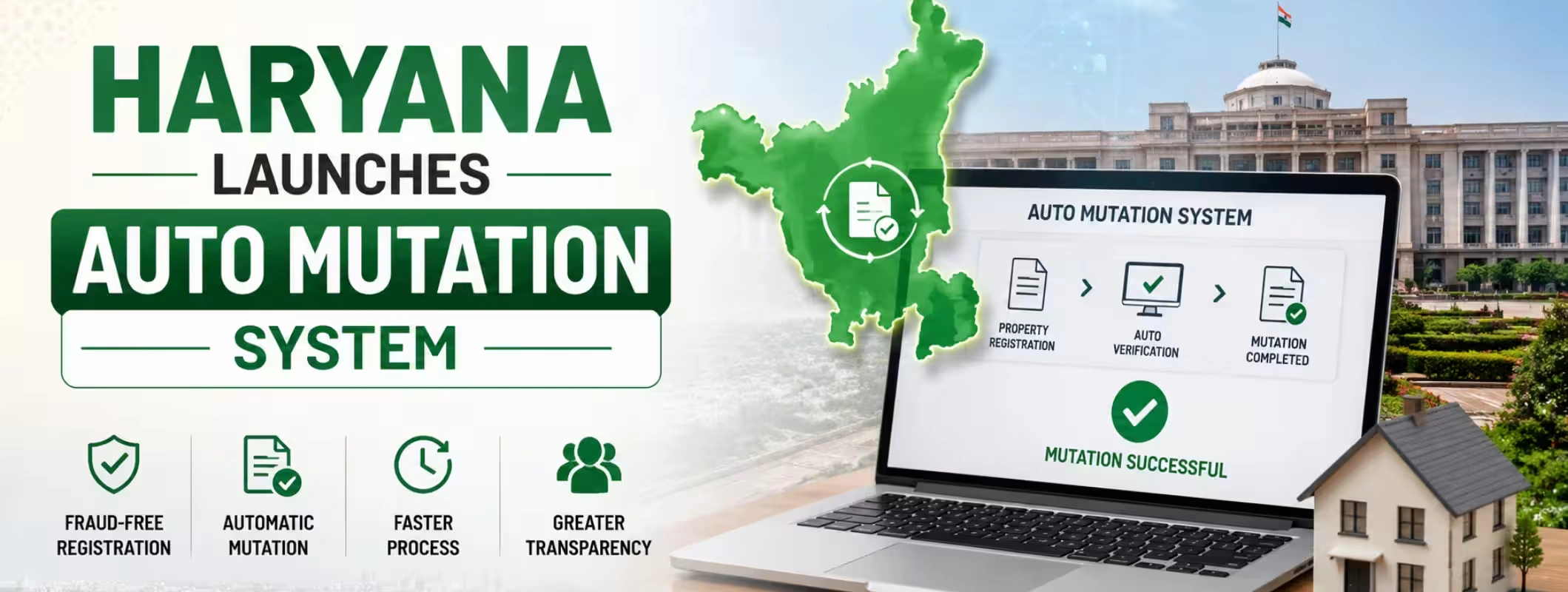
- The system started on a pilot basis in Manesar and is planned to expand across all tehsils in Gurgaon and then other districts of Haryana. Under this reform, mutation will be triggered automatically after property registration instead of forcing buyers to visit patwar offices separately.
- Mutation is important because registration records the sale deed, but mutation updates the buyer’s name in land or revenue records. Without mutation, property records may still show the seller’s name, creating room for misuse.
- Haryana’s land record ecosystem already includes WEB-HALRIS, an integrated system for deed registration, Jamabandi, mutation, Khasra Girdawari, and related land records.
- For buyers, this is a positive step, but it does not replace legal due diligence. Before buying land, residential plots, commercial property, or agricultural land in Haryana, you should still verify title, Jamabandi, mutation status, encumbrance, zoning, ownership chain, and possession.
- Platforms like 2Bigha can help buyers and sellers explore verified property in Haryana with better listing clarity, land-focused discovery, and a structured subscription plan.
Introduction: Why Haryana’s Auto Mutation System Matters for Real Estate
Haryana is one of India’s most active real estate markets. From Gurgaon and Faridabad to Sonipat, Panipat, Karnal, Rohtak, Jhajjar, Rewari, Manesar, and Sohna, the state attracts homebuyers, land investors, NRIs, developers, industrial buyers, and commercial property investors.
But strong real estate demand also brings risk. Property fraud in Haryana has often happened because buyers focus only on registry and ignore mutation, Jamabandi, ownership verification, and land record updates. In many cases, a buyer completes the sale deed but does not get mutation done on time. This leaves the old owner’s name in revenue records and creates space for disputes, duplicate sale attempts, illegal possession claims, or resale fraud.
This is where the Haryana auto mutation system becomes important.
The new system aims to connect property registration Haryana with mutation after property registration. Once the registry is completed, the mutation process can start automatically through the digital land records system. This can reduce delay, cut unnecessary visits to patwari offices, and improve secure property ownership.
For anyone planning to buy property in Haryana, buy land in Haryana, sell property in Haryana, or invest in residential plots in Haryana, this reform is a major update.
What is Property Mutation in Haryana?
Property mutation is the process of updating ownership details in land or revenue records after a property transaction. In simple language, it means the government record starts showing the buyer as the new owner after registration.
A sale deed proves that a transaction has been registered. Mutation updates the land record to reflect that change.
For example, if you buy a plot in Manesar, Gurgaon, Faridabad, Sonipat, or Panipat, the registry is one step. After that, the buyer’s name must be updated in land records. If mutation is not completed, the revenue record may still show the seller’s name.
That gap is dangerous.
It can create confusion during resale, bank loan processing, inheritance, land measurement, partition, legal dispute, or future verification. Haryana’s auto mutation system is designed to close this gap faster.
Haryana Auto Mutation System Explained
The auto mutation system Haryana is a digital process where mutation starts automatically after a property is registered. According to recent reports, Haryana launched the system in Manesar on a pilot basis to prevent fraud, especially cases where one plot is sold to multiple buyers. The system is expected to expand to all tehsils in Gurgaon and then other districts.
Under the new system, citizens will not need to run separately from one office to another after registration. The mutation process will be triggered through the WEB-HALRIS server after completion of the registry for transactions such as sale, gift, mortgage with possession, and family transfer.
This is important because Haryana already has a digital land record backbone. WEB-HALRIS is a web-enabled integrated solution for deed registration and land records management, with modules for deed registration, Jamabandi, mutation, Khasra Girdawari, and reports.
In short, Haryana auto mutation connects three important things:
- Property registration
- Land record update
- Buyer ownership verification
This can make the land mutation process in Haryana faster, more transparent, and less dependent on manual follow-ups.
How Auto Mutation Works in Haryana
The process is designed to reduce manual delay after registry. Here is a simple explanation.
| Step | What Happens | Why It Matters |
| 1. Property registration | Buyer and seller complete registry through the official system | Creates legal record of transfer |
| 2. Auto trigger | Mutation request starts automatically after registry | Buyer does not need separate manual follow-up |
| 3. Digital record check | Existing and new ownership details are checked in the system | Reduces mismatch and duplicate-sale risk |
| 4. Objection window | Public objection period is given | Protects parties if there is a dispute |
| 5. Approval | If no objection is raised, mutation is approved within the defined timeline | Buyer’s name gets updated in land records |
| 6. Mutation copy | Buyer can obtain mutation copy from the tehsil office or check status online | Helps future resale, loan, and ownership proof |
The system includes an objection window. For registered properties, a seven-day public notice is issued, and if no objection is filed, mutation is automatically approved on the eighth day. For non-registered transactions, the notice period is 15 days, with approval on the 16th day if no objection is filed.
This is a strong step because it gives speed without completely removing public objection rights.
Also Read: Haryana Government Introduces Faceless Property Registration System: What It Means for Buyers
Why Haryana Introduced Auto Mutation
Haryana introduced the system to reduce delays, corruption, and property fraud. Earlier, many buyers completed registry but did not complete mutation. Some people had to visit patwar offices multiple times and faced delays or extra unofficial costs.
This delay created a loophole. If land records still showed the seller’s name, fraudsters could attempt another transaction or create confusion around ownership.
The new auto mutation property registration Haryana process targets that loophole.
It supports:
- Faster ownership transfer
- Reduced patwari-level dependency
- Better digital land records Haryana
- Lower chance of duplicate sale
- Improved buyer confidence
- Cleaner land registry system Haryana
- Better transparency in real estate transactions
For a state like Haryana, where land values are high in NCR and industrial belts, this reform is practical and timely.
Why Mutation Matters More Than Many Buyers Think
Many first-time buyers believe, “Registry ho gayi, ab sab ho gaya.”
That thinking is risky.
Registry is important, but mutation is also necessary for clean property records. The official Haryana deed registration ecosystem includes services for Jamabandi, mutation status, mutation orders, encumbrance certificate, collector rates, stamp duty, and urban and rural property records.
Mutation helps in:
- Confirming ownership in revenue records
- Paying land revenue or property-related dues
- Selling the property in future
- Applying for loans or approvals
- Avoiding disputes during inheritance
- Checking land ownership transfer Haryana
- Preventing misuse by previous owner
If you are buying land, plot, farmhouse land, agricultural land, or commercial property Haryana, mutation should never be ignored.
Before Auto Mutation vs After Auto Mutation
| Point | Earlier Manual Process | Haryana Auto Mutation System |
| Mutation start | Buyer had to apply separately after registry | Mutation starts automatically after registration |
| Office visits | Multiple visits to patwari or tehsil office | Reduced physical follow-up |
| Delay risk | High, especially if files were pending | Lower due to digital trigger |
| Fraud risk | Higher if seller’s name remained in records | Lower because records update faster |
| Transparency | Buyer depended heavily on local officials | Status can be tracked through digital systems |
| Objection process | Manual and slower | Defined objection window |
| Buyer confidence | Lower in disputed or high-value areas | Better if record update happens on time |
This change can improve trust in Haryana real estate, especially for buyers who live outside the state or NRIs who cannot follow up physically every week.
Impact on Property Fraud Prevention in Haryana
The biggest benefit of the Haryana auto mutation system is fraud prevention.
Property fraud often happens when records are not updated. A seller may complete registry with one buyer, but if mutation remains pending, the seller’s name may still appear in land records. This creates confusion for the next buyer, broker, lender, or local authority.
Auto mutation can reduce such risks by updating records quickly after registry.
It can help prevent:
- Same plot sold to multiple buyers
- Old owner misuse after registry
- Delayed ownership transfer
- Patwari-level manipulation
- Hidden pending mutation cases
- Fake ownership claims
- Disputes during resale
The reform does not remove the need for legal checks, but it strengthens the system after registration.
Haryana Digital Land Records: The Bigger Picture
Haryana has been digitising land and property records through WEB-HALRIS. NIC describes WEB-HALRIS as a web-enabled system used for deed registration and land records management in Haryana, covering modules such as registration, Jamabandi, mutation, Khasra Girdawari, and reports.
NIC also notes that WEB-HALRIS has been implemented across 143 tehsils and sub-tehsils of Haryana since 2018.
The system includes features such as:
- Integration of deed registration and land records
- e-GRAS integration for e-stamping
- Appointment for deed registration
- Online mutation workflow
- Integration with urban property records
- Collector rate and stamp duty services
- Record-of-right copies
- Registered deed copies
WEB-HALRIS has already reduced mutation processing time and improved online access to updated Record of Rights, which helps reduce litigation and fraud.
The auto mutation system is therefore not a random isolated update. It is part of Haryana’s larger move toward digital property records.
What Buyers Should Check Before Buying Property in Haryana
Even with auto mutation, buyers must do due diligence. A digital system can reduce fraud, but it cannot protect you if you buy disputed land without checking documents.
Use this checklist before buying land in Haryana.
| Buyer Checklist | Why It Matters |
| Check Jamabandi | Confirms land ownership and rights record |
| Verify mutation status | Shows whether previous transfers were updated |
| Check registered deed chain | Confirms how ownership moved from one person to another |
| Check encumbrance | Helps identify mortgage, charge, or legal burden |
| Verify seller identity | Prevents impersonation fraud |
| Confirm possession | Ownership documents and actual possession should match |
| Check khasra/khewat details | Avoids wrong land identification |
| Review zoning and land use | Agricultural, residential, commercial, and controlled-area rules differ |
| Check Section 7A/NOC requirement | Important in many Haryana urbanising areas |
| Verify collector rate and market rate | Prevents undervaluation and overpricing |
| Use banking channels | Creates clean payment proof |
| Take legal opinion | Reduces title risk |
This checklist is especially important if you are searching for verified property in Haryana, residential plots Haryana, commercial property Haryana, or safe property investment Haryana.
What Sellers Should Do Before Selling Property in Haryana
If you want to sell property in Haryana, auto mutation can make the buyer more confident, but your documents must be ready.
Before listing your land or plot, prepare:
- Updated Jamabandi
- Mutation copy
- Registry documents
- Identity proof
- Possession proof
- Site photos
- Location map
- Khasra and khewat details
- Any NOC or approval, if applicable
- Loan clearance certificate, if mortgaged earlier
A seller with clean documents gets better-quality buyers. In today’s market, serious buyers do not trust vague claims like “registry clear hai.” They want proof.
This is where platforms like 2Bigha can help land sellers present property details in a more organised way and reach buyers who are actively searching for land, plots, and property opportunities.
How This Reform Can Impact Haryana Real Estate
Haryana real estate news matters because the state has high-value land markets. Gurgaon, Faridabad, Manesar, Sohna, Jhajjar, Sonipat, Panipat, Karnal, Ambala, Panchkula, and Rewari all attract different types of buyers.
The auto mutation system can support the market in five ways.
1. Better Buyer Confidence
When mutation happens faster, buyers feel safer. This is especially useful for NRIs, investors from Delhi-NCR, and first-time land buyers.
2. Cleaner Property Records
Digital mutation reduces the gap between sale deeds and revenue records. That improves property ownership verification in Haryana.
3. Faster Resale
A property with updated mutation is easier to resell. Buyers, banks, and lawyers prefer clean ownership records.
4. Less Dependence on Middlemen
Earlier, many buyers depended on local agents or patwari-level follow-up after registration. Digital systems reduce that dependency.
5. More Trust in Land Transactions
Land transactions in Haryana often involve high values. Transparency can improve investor confidence, especially in plotted development, farmhouse land, industrial land, and commercial property.
Impact on Different Property Types
| Property Type | Auto Mutation Benefit | Buyer Caution |
| Residential plots | Faster ownership update after registry | Check zoning, road, and title |
| Agricultural land | Better revenue record update | Check land ceiling, ownership, and transfer rules |
| Commercial property | Cleaner ownership trail for resale | Check land use and approval |
| Farmhouse land | Reduces ownership confusion | Check controlled area and construction rules |
| Industrial land | Helps documentation and transfer clarity | Verify HSIIDC/CLU/NOC conditions |
| Inherited property | Can support clearer transfer records | Check family settlement and succession documents |
Auto mutation improves the record update process, but it does not make every property safe. A wrong property with fast mutation is still a wrong investment.
Haryana Property Registration: What Still Needs Care
The Government of Haryana’s property registration procedure already includes e-registration, e-stamping, appointment, document scrutiny, presence at the Sub Registrar Office, photographs, witnesses, and deed delivery. The official procedure notes that e-registration and e-stamping are mandated to support online application, document verification, and secure e-payments.
That means buyers should not treat registration as a casual formality.
Before registration, carefully review:
- Sale deed draft
- Seller name and buyer name
- Plot number, khasra number, and area
- Boundaries
- Payment terms
- Possession clause
- Existing loan or mortgage
- NOC requirement
- Stamp duty calculation
- Witness details
Once the sale deed is registered, auto mutation may help move the record update faster. But if your sale deed contains errors, mutation cannot solve everything.
Common Property Fraud Risks in Haryana
Haryana’s real estate market is active, but fraud risks still exist. Buyers should stay alert.
Common risks include:
- Same land sold to more than one buyer
- Fake power of attorney
- Old mutation not updated
- Disputed inheritance property
- Wrong khasra number shown to buyer
- Agricultural land sold as residential plot
- No legal road access
- Mortgaged property sold without bank clearance
- Builder or dealer selling unapproved plots
- Controlled-area restrictions ignored
The Haryana auto mutation system can reduce some fraud risks after registry, but it cannot replace pre-purchase verification.
Role of 2Bigha in Safe Property Discovery
Property buyers today want transparency. They want to know where the land is located, who is selling it, what type of land it is, and whether the listing looks genuine.
2Bigha can support this need by helping buyers and sellers explore land and plot opportunities in a more organised way. For people searching for buy land in Haryana, residential plots Haryana, verified property in Haryana, or safe property investment Haryana, a land-focused platform can reduce confusion and improve property discovery.
- For sellers, 2Bigha can improve property visibility.
- For buyers, it can help compare land and plot options more clearly.
For investors, it can make the search process more structured, especially in markets where local information is scattered and documentation matters.
The 2Bigha subscription plan can help serious users access property opportunities with a more focused approach.
What This Means for Gurgaon, Manesar, and NCR Buyers
The system started from Manesar, which is important because Manesar and Gurgaon have high-value land and property markets. These areas see strong demand for residential plots, industrial land, commercial property, builder floors, farmhouses, and plotted developments.
For Gurgaon and Manesar buyers, auto mutation can help reduce one of the biggest fears: paying for a property but struggling later to get ownership updated in records.
However, Gurgaon and Manesar also have complex land rules in many areas. Buyers must still verify:
- Revenue record
- ULB or HSVP property record, where applicable
- Town and Country Planning restrictions
- Section 7A applicability
- Builder license status
- CLU or land use approval
- Litigation or stay orders
- Possession and boundary clarity
Haryana’s digital system can help, but high-value NCR property still needs legal checking.
Practical Example: How Auto Mutation Can Protect a Buyer
Suppose a buyer purchases land in Manesar.
Earlier, the buyer completed registry and then had to follow up separately for mutation. If mutation stayed pending, the old owner’s name could remain in revenue records. A dishonest seller might try to create another deal or confuse another buyer.
With auto mutation, the system can trigger mutation after registry, issue the objection notice, and approve mutation if no objection comes within the defined period.
This makes ownership transfer cleaner and reduces the window for fraud.
That is why Haryana auto mutation system explained is not just a government update. It is a practical buyer-safety reform.
Summary Table: What Buyers Should Remember
| Topic | Simple Explanation |
| Registry | Legal registration of sale deed |
| Mutation | Updating buyer’s name in land records |
| Auto mutation | Mutation starts automatically after registration |
| Main benefit | Reduces delay and fraud risk |
| Pilot location | Manesar |
| Expansion plan | Gurgaon tehsils first, then other Haryana districts |
| Buyer action | Still verify title, Jamabandi, mutation, encumbrance, and zoning |
| Best use | Safer land, plot, house, shop, and commercial property transfer |
Final Thoughts
Haryana’s auto mutation system is a strong step toward safer and more transparent real estate transactions. It directly addresses a common problem: buyers completing registry but struggling later with mutation.
For Haryana, this reform can reduce property fraud, speed up ownership transfer, and improve trust in digital property records. For buyers, it means fewer office visits, faster mutation processing, and better protection after registration.
But do not become careless.
Before buying land, plots, houses, shops, or commercial property in Haryana, check every document. Verify Jamabandi, mutation status, registry chain, encumbrance, seller identity, land use, and possession. Digital systems help honest buyers, but due diligence still protects your money.
For safer discovery of land and plot opportunities, platforms like 2Bigha can help buyers and sellers navigate Haryana’s real estate market with better structure, visibility, and confidence.
FAQs - Frequently Asked Questions
1. What is the Haryana auto mutation system?
The Haryana auto mutation system is a digital process where mutation starts automatically after property registration. It helps update the buyer’s name in land records without requiring repeated manual visits to patwari offices. The system started on a pilot basis in Manesar and is planned to expand further.
2. Why is property mutation important in Haryana?
Property mutation is important because it updates ownership in land or revenue records after registration. Without mutation, the land record may still show the seller’s name, which can create fraud risk, resale problems, loan issues, and ownership disputes.
3. Does auto mutation prevent all property fraud?
No. Auto mutation reduces fraud risk after registration, especially duplicate sale risk caused by delayed mutation. But buyers must still check title, Jamabandi, encumbrance, land use, possession, seller identity, and legal approvals before buying property.
4. How can I check mutation status in Haryana?
Haryana’s Jamabandi portal provides mutation-related services such as checking mutation status, viewing mutation orders, and checking mutation of deed and objection options.
5. Is it safe to buy land in Haryana after this system?
It is safer than before if the property is legally clear and the mutation process works correctly. Still, you should never buy land only on verbal assurance. Always verify land records, registry chain, mutation history, road access, zoning, and any dispute before payment.