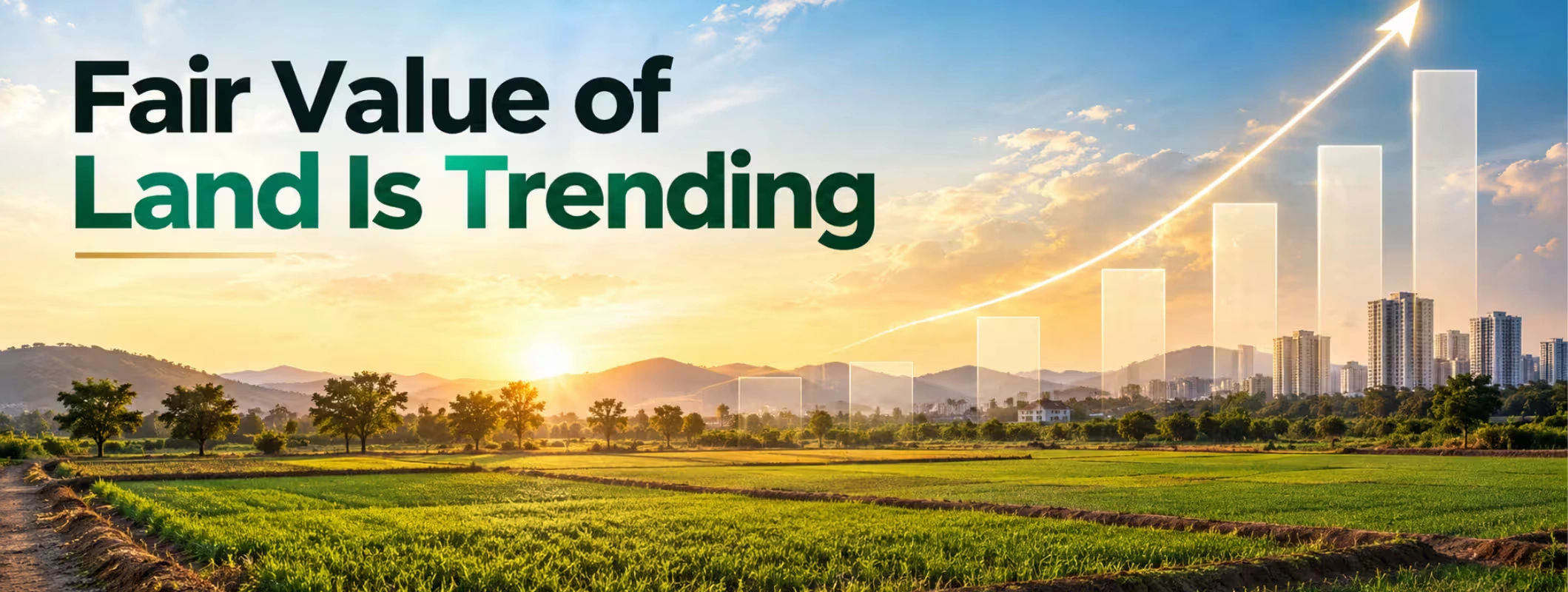
In case you have been following real estate news recently, you must have come across the term "fair value of land." It is not a new term but has suddenly gained importance due to revisions in the standards for fair value being made in a number of states, which is affecting everyone ranging from the small-scale farmer having only two acres of land to someone looking to buy residential land. So what exactly is it, and why should you be concerned, excited, or not bothered at all about it?
What Is Fair Value of Land, Really?
Fair value, sometimes called guideline value, circle rate, or ready reckoner rate depending on the state, is the minimum value the government assigns to land in a particular area. It's the baseline figure used to calculate stamp duty and registration charges during a property transaction. You can sell land above this value, but rarely below it, at least not on paper. It's important not to confuse fair value with market value:
- Fair value is government-fixed, revised periodically, and used for tax and registration purposes
- Market value is what a buyer is actually willing to pay, driven by demand, location, and negotiation
- In fast-growing areas, market value often runs well above fair value
- In stagnant or oversupplied areas, the two can be surprisingly close
Why Is This Suddenly Trending?
A few things have converged this year. Several states have announced revisions to their fair value tables, some for the first time in years, and in a handful of high-growth districts, the jump has been sharp enough to make headlines. Add to that rising interest in farmland purchase as an investment category, and you get a topic that's showing up everywhere from finance newsletters to local news. Here's roughly what's driving the conversation:
- Periodic government revaluation exercises catching up after years of stagnant rates
- Infrastructure announcements (expressways, industrial corridors) pushing certain belts up sharply
- Growing retail interest in agricultural and semi-urban land as an asset class
- Buyers and sellers both trying to understand how a fair value hike changes their numbers
How a Fair Value Change Affects Property Owners?
If you already own land, a fair value revision doesn't change your ownership, but it does change a few practical things.
Impact Area | What Changes |
Stamp duty (future sale) | Calculated on the higher of fair value or transaction value |
Property tax (in some states) | May be linked to revised valuation |
Loan against land | Banks often use fair value as a reference point for collateral |
Perceived resale value | A higher fair value can nudge market expectations upward |
Capital gains calculation | Fair value can factor into how gains are assessed on sale |
For someone holding land purely as an asset, a fair value increase is generally good news on paper. It signals that the government sees the area's worth rising, which can be relevant when considering a farmland purchase or evaluating an existing property. But it's worth remembering that fair value catching up doesn't automatically mean buyers will pay more; that still depends on real demand.
How It Affects Buyers?
For buyers, a fair value revision has a more immediate, practical effect: it changes the minimum amount you'll pay stamp duty on, regardless of what you negotiate with the seller. A few things buyers should keep in mind:
- Always check the current fair value for the specific survey number, not just the general area average
- A revision announced mid-year can catch buyers off guard if they were budgeting based on old figures
- In areas where fair value has jumped sharply, negotiating the actual sale price becomes more important, since stamp duty is now a higher fixed cost regardless
- If you're comparing options while browsing agriculture land for sale, factor in the current fair value alongside the asking price, not just the asking price alone
Checking Fair Value Before You Buy or Sell
This is one of those steps people skip and then regret. Most states now publish fair value tables online, searchable by district, village, or survey number. Before you commit to any transaction, whether you're planning a farm land purchase or getting ready to sell land, it's worth pulling the current figure directly from the state portal rather than relying on what a broker tells you. Quick checklist before any transaction:
- Pull the latest fair value for the exact plot, not a nearby one
- Compare it against recent actual transaction prices in the area, if available
- Factor the fair value into your stamp duty estimate before finalizing a budget
- Ask the seller (or buyer) if the land has been reclassified recently, since that can shift the applicable rate
Fair Value and Farmland: A Growing Overlap
Farmland used to sit somewhat outside this conversation, since agricultural land in many areas carried low or nominal fair value. That's shifting in pockets close to expanding towns and infrastructure corridors, where crop land for sale listings are increasingly priced closer to their revised fair value rather than old, outdated benchmarks.
This matters for anyone comparing farmland for sell options across regions. Two plots that look similar on paper can carry very different fair values depending on proximity to a highway project or a town's expansion plan, and that difference shows up directly in your transaction cost.
What This Means If You're Planning to Sell?
If you're currently in land selling mode, a recent fair value revision in your area can actually work in your favour, since it often nudges buyer expectations upward and can make your asking price look more justified. That said, don't assume the fair value figure alone will convince a buyer. It's a useful anchor, but the final price still comes down to condition, access roads, nearby development, and how motivated both sides are.
How Bigha Helps You Navigate This?
Fair value revisions are exactly the kind of detail that's easy to miss if you're not actively tracking your state's land revenue notifications. At Bigha, our listings are built around verified land data, so when you're browsing plots, comparing regions, or evaluating a farm before a purchase, you're working with information that reflects the current picture, not outdated assumptions.
Whether you're exploring listings, preparing to sell your own land, or simply trying to understand how a valuation change affects a plot you already own, visit 2Bigha to check verified listings, request a land report, or list your property with clear, transparent details.
Disclaimer: This article is for informational purposes only and should not be considered investment, legal, financial, or property advice. Real estate regulations, infrastructure plans, market conditions, and government policies may change over time. Readers are advised to verify information with relevant authorities and consult qualified professionals before making any investment or property-related decisions.