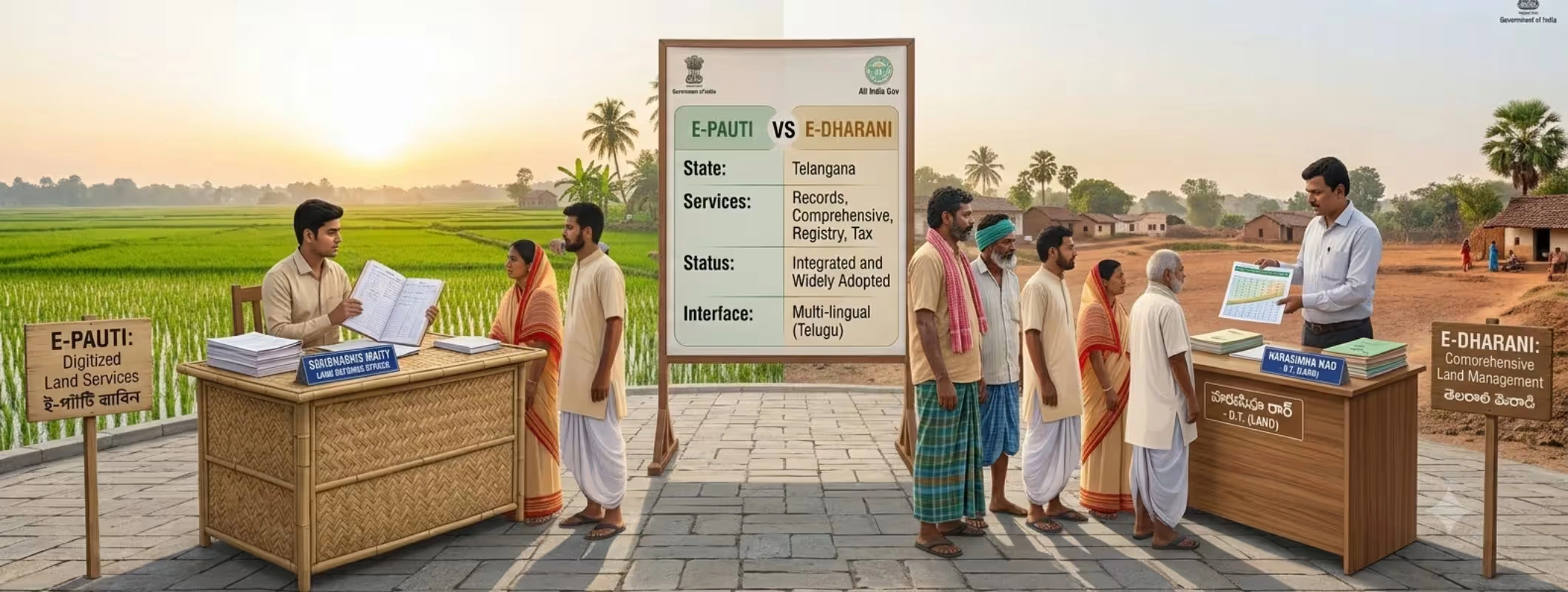
Two names keep popping up whenever land records in India come up online: e-Pauti and e-Dharani. They sound almost like cousins. Both are government portals, both have "digital land" written all over them, and both get thrown around loosely by people who haven't actually used either one. But they're built for completely different jobs, in completely different states. If you're trying to buy land in Odisha, or you've got your eye on a plot for sale in Telangana, this mix-up can actually waste your afternoon. You might land on the wrong portal, get confused why ownership details aren't showing up, and assume the site is broken. It isn't. You're just looking in the wrong place.
So What Is e-Pauti, Exactly?
e-Pauti belongs to Odisha. It's run by the state's Revenue and Disaster Management Department, and its entire job is collecting land revenue online, the small annual tax called Khajana that every landowner in the state technically owes. Before this existed, paying that tax meant an actual trip to the Tahasil office. Standing around, filling a form, waiting for a stamped receipt. Now you type in your district, tahasil, village, and Khata number; the system pulls up whatever you owe (including old arrears, if there are any), and you pay through UPI or net banking. Receipt lands in seconds. That's really it, though. e-Pauti does not tell you who owns a plot. It won't show mutation history. It's a tax tool, not a records tool.
Things e-Pauti Handles
- Land revenue (Khajana) payments, yearly
- Cess charges and pending arrears
- Instant digital receipts
- A history of what's been paid so far
For actual ownership records, Record of Rights, Khatiyan, that sort of thing, Odisha has a separate system called Bhulekh. People confuse the two constantly, and honestly, the names don't help.
And e-Dharani?
e-Dharani, or just Dharani as most people call it, is Telangana's answer to the same problem, except it tried to do a lot more. Launched back in November 2020, Dharani wasn't just about tax. It combined land registration, mutation, and record-keeping into one single portal. The pitch was simple: one place for everything land-related, no more running between the registrar's office and the revenue office. Nice idea. Didn't quite work out that way. Farmers and buyers kept reporting locked records, painfully slow corrections, and basically no clear way to appeal when something went wrong. Enough complaints piled up that the state eventually decided to scrap it and start over.
Enter Bhu Bharati
In April 2025, Telangana rolled out Bhu Bharati, under a new law, the Telangana Bhu Bharati (Record of Rights in Land) Act, 2024. The big shift here is structural. Dharani ran everything through one centralized system. Bhu Bharati hands power back to local officials, Tahsildars, and RDOs, so corrections and grievances don't get stuck in some faraway queue. It also cut the number of service modules from a clunky 33 down to just 6, which alone makes it far less confusing for someone opening the portal for the first time. So technically, if you're checking land for sale in Telangana today, you're using Bhu Bharati. Old habits die hard though, and plenty of people, brokers included, still call the whole system "Dharani" out of pure muscle memory.
Quick Comparison
| Feature | e-Pauti (Odisha) | e-Dharani / Bhu Bharati (Telangana) |
|---|---|---|
| Main Job | Paying land revenue | Registration and record management |
| State | Odisha | Telangana |
| Shows Who Owns the Land | No | Yes |
| Handles Mutation | No | Yes |
| Handles Registration | No | Yes |
| Pairs With | Bhulekh Odisha | Was standalone; now Bhu Bharati |
| Launch | Ongoing, under the Revenue Department | Dharani in 2020, Bhu Bharati in 2025 |
Why Does Any Of This Matters If You're Actually Buying Land?
Here's the thing nobody tells you upfront: a good price on a plot means nothing if the paperwork doesn't hold up six months later. Checking the right portal for the right document is honestly half of due diligence. Buying in Odisha? Confirm land revenue is cleared through e-Pauti, then go check ownership separately on Bhulekh. Looking at farmland for sale in Telangana instead? Pull ownership and mutation history straight from Bhu Bharati; that one portal now covers what Dharani used to split across two or three offline steps.
Skip either check and you're rolling the dice. A seller can have a spotless e-Pauti payment record and still be sitting on a shaky Record of Rights. The same risk applies the other way around in Telangana. Before you sell land, or agree to purchase any, cross-check both the revenue side and the ownership side, no matter which state you're dealing in.
A Short Checklist Before You Sign Anything
- Land revenue dues cleared? (e-Pauti, if it's Odisha)
- Latest Record of Rights or Pahani pulled? (Bhulekh for Odisha, Bhu Bharati for Telangana)
- Any mutation applications pending?
- Survey number matching across every document you've got?
- Certified Encumbrance Certificate in hand, not just the free view?
- Land classification checked, so you're not buying government or assigned land by accident?
Mistakes People Keep Making With These Portals
A handful of errors show up over and over, and almost all of them come from assuming one portal covers everything. Thinking e-Pauti proves ownership is probably the biggest one. A clean tax receipt says nothing about who legally owns the plot, or whether there's a dispute quietly sitting somewhere. Pair it with Bhulekh, always. Treating "Dharani" and "Bhu Bharati" as the same thing without checking dates is another. Anything recorded before April 2025 might still be tied to the old Dharani framework, worth confirming which system last touched a given entry.
People also skip the certified version of a document because the free one looks fine on screen. Banks and courts don't accept that free view though. The certified copy costs a little extra, but it's the one that actually holds up. And then there's land classification, genuinely easy to overlook. Whether you're set on purchasing land in Odisha or closing a deal on farmland for sale in Telangana, double-check it isn't marked government, assigned, or prohibited property. This one habit alone prevents a huge chunk of disputes later on.
How 2Bigha Makes This Easier?
Going through these websites like e-Pauti and Bhu Bharati is only half the battle. You have to ensure that your paperwork is in order. Even then, it still needs a safe environment to execute the transaction. This is where 2Bigha fits into the picture. 2Bigha is a platform specially designed to help you buy and sell farmland or agricultural lands across India. Unlike traditional practices that require you to go through multiple listing sites, or even rely on a broker who is not always a hundred percent genuine, you get a Verified Land Listing on the very same platform- right from the location details to the price context.
Even the sellers benefit in a way that they get access to a broader spectrum of genuine buyers in one place. Instead of going through numerous negotiations with the buyers, it becomes convenient for both parties involved when buying land in Odisha or Telangana or anywhere else. The platform is created with the sole purpose of streamlining the process of buying land in a much safer and more secure manner.
Conclusion
The names of e-Pauti and e-Dharani make one feel that these systems are twins, yet they solve absolutely different issues in different regions. In Odisha, e-Pauti automatically pays your tax on the land. As for e-Dharani (or, currently, Bhu Bharati), it was an initiative to create a full-fledged land registry in Telangana, and it is being continuously improved, taking into account the feedback from farmers and landowners. Here comes the conclusion – find out which system is to be used for your case. Purchasing or selling land in Odisha and Telangana, respectively? Consider revenue payment and land ownership registration separately. And the rest will work just fine.
Disclaimer: This article is for informational purposes only and should not be considered investment, legal, financial, or property advice. Real estate regulations, infrastructure plans, market conditions, and government policies may change over time. Readers are advised to verify information with relevant authorities and consult qualified professionals before making any investment or property-related decisions.