Key Takeaways
- If you want the stronger capital appreciation story, Dwarka Expressway looks ahead right now because the corridor has already benefited from the Haryana section opening in 2024, the Delhi section in 2025, and a defined Gurugram Metro spur plan linked to the corridor.
- If you want a more established, lived-in micro-market with mature residential catchments, schools, malls, and daily-use social infrastructure, Sohna Road still holds value, but its upside is more selective and more dependent on local congestion relief and corridor upgrades.
- Current portal data shows higher average asking rates on Sohna Road than on Dwarka Expressway, which reflects the presence of established premium pockets on Sohna Road. But Dwarka Expressway has much deeper inventory and stronger new-launch momentum, which often matters more for investors chasing long-term corridor growth.
- In plain terms, Dwarka Expressway suits aggressive investors and premium buyers, while Sohna Road suits end-users and buyers who value present-day usability over pure future upside. That is an inference based on infrastructure status, launch concentration, inventory depth, and connectivity direction.
- Also remember that Gurugram collector rates for 2026–27 are now in effect, and recent reporting says some areas saw sizable upward revisions. That can influence transaction cost calculations and minimum valuation benchmarks at registration.
If you are asking where to invest in Gurugram in 2026, my pick is Dwarka Expressway for investment-led buying and Sohna Road for use-led buying.
Why? Because Dwarka Expressway is no longer just a future promise. The 19 km Haryana section was inaugurated in March 2024, the 10.1 km Delhi section followed in August 2025, and the official Gurugram Metro plan includes a 1.85 km spur to Dwarka Expressway. Add to that the fact that Gurugram led NCR residential launches in Q1 2026, with Dwarka Expressway accounting for a major share of launches, and the corridor clearly has momentum.
Sohna Road is not a weak market. Far from it. It remains one of the best-known residential and mixed-use corridors in Gurugram, and current portal averages even place its asking rates above Dwarka Expressway on some datasets. But the case here is different: Sohna Road is more of an established urban corridor than a breakout corridor. Its next wave of upside depends heavily on smoother mobility, SPR upgrades, better internal road links, and how fast the Bhondsi-side transit plans turn from proposal into execution.
Why This Comparison Matters Now
Gurugram is not moving as one single real estate market anymore. Different micro-markets are behaving differently. Cushman & Wakefield’s Q1 2026 Delhi-NCR residential update says Gurugram contributed 73% of NCR launches, and a large share of those launches came from peripheral growth corridors including Manesar, Dwarka Expressway, and New Gurgaon. That tells you one thing clearly: money, developer attention, and buyer interest are shifting toward corridors with fresh infrastructure and expansion headroom.
At the same time, JLL’s 2025 India residential view showed premium housing gaining share while mass housing lost share. That matters because both Dwarka Expressway and key Sohna Road pockets increasingly compete in mid-segment, high-end, and luxury-led demand rather than plain budget demand.
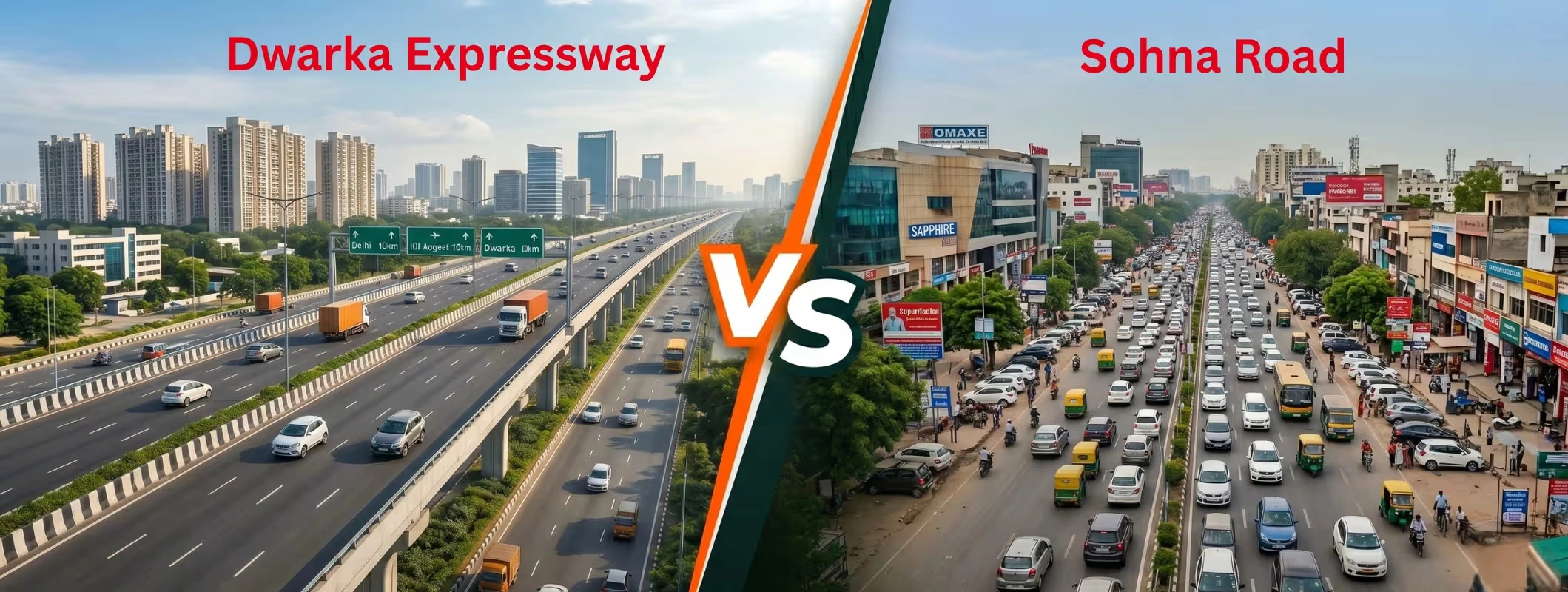
Dwarka Expressway Vs Sohna Road: Quick Comparison Table
| Factor | Dwarka Expressway | Sohna Road |
| Investment profile | Stronger for capital appreciation and corridor-led growth | Stronger for immediate livability and established use |
| Infrastructure story | Big recent trigger already delivered | Upgrade story still improving in layers |
| Delhi access | Strong advantage | Good, but not the same direct positioning |
| Airport and NCR connectivity | Strong corridor appeal | Good regional connectivity, but less defining than Dwarka |
| Metro angle | Official corridor includes Dwarka spur | Bhondsi-side metro link is still proposal / consultant stage |
| Inventory depth | Larger listing base and wider project spread | Smaller listing base, more selective pockets |
| Buyer fit | Investors, premium buyers, long-hold allocators | End-users, family buyers, selective investors |
| Risk | Entry prices already moved up in many pockets | Congestion, patchy internal mobility, and uneven upside |
| 2026 verdict | Better for investment-first buying | Better for comfort-first buying |
This summary is based on current official infrastructure status, metro planning, recent GMDA mobility work, and portal-level pricing and inventory data.
Dwarka Expressway: Why Investors are Watching it Closely
Dwarka Expressway has moved from “wait and watch” to “already re-rated.” The biggest reason is simple: infrastructure execution is visible now. The Haryana section was inaugurated in March 2024, and the Delhi section was slated for inauguration in August 2025 with multimodal links to Yashobhoomi, the Blue Line, the Orange Line, and the upcoming Bijwasan railway station. That kind of connectivity does not just improve commute time on paper. It changes how the corridor is perceived by buyers, developers, and employers.
Then comes the metro layer. Gurugram Metro Rail Limited says the approved 28.5 km corridor includes a 1.85 km spur from Basai Village to Dwarka Expressway, and the corridor is intended to link residential, commercial, and industrial areas while serving the fast-developing TOD zone along the expressway. That is exactly the kind of planning signal that long-term investors track.
The launch and supply story also supports the bullish view. Cushman & Wakefield’s Q1 2026 Delhi-NCR residential report says Gurugram led regional launches and Dwarka Expressway alone accounted for 36% of Q1 launches in the NCR mix cited for Gurugram’s activity. That means developer conviction is already concentrated here.
Portal data shows scale too. Housing.com lists over 5,300 properties for sale on Dwarka Expressway and an average price of around ₹12,782 per sq ft, with a very wide spread from entry-level to ultra-premium stock. That matters because it gives the corridor depth across buyer budgets, not just one luxury niche.
Another reason Dwarka Expressway remains attractive is its narrative advantage. In real estate, narrative matters almost as much as data. A corridor that connects Delhi and Gurugram more seamlessly, gains metro support, benefits from expressway-led decongestion, and keeps attracting new launches usually stays in the investor conversation longer than a mature corridor with fewer surprise triggers. That is why Dwarka Expressway property investment still looks stronger than Sohna Road real estate investment if your goal is growth over the next few years. This is an inference from the current infrastructure and launch pattern, not a guaranteed return forecast.
Sohna Road: Still Relevant, But For A Different Reason
Sohna Road is one of those Gurugram corridors that buyers already understand. It is not trying to become visible. It is already visible. The reason people still shortlist it is because it offers a more settled residential experience, especially for buyers who care about schools, hospitals, shopping, office access, and day-to-day convenience rather than only future appreciation. Current Housing.com data shows an average asking price of about ₹14,311 per sq ft on Sohna Road, which is actually above Dwarka Expressway on that dataset.
But the challenge with Sohna Road is that the next leg of growth depends on mobility fixes. GMDA has floated work for widening the Southern Peripheral Road from Vatika Chowk to Ghata Village, and recent reports say the authority is also pushing service roads and missing links to ease traffic and improve internal movement toward Sohna Road. Those are good signs, but they also tell you something important: the corridor still needs traffic relief and network strengthening.
The metro angle is also less mature than Dwarka’s. Recent reporting says a consultant has been appointed for a proposed 17.09 km Gurugram–Bhondsi metro corridor connecting Bhondsi Village, Subhash Chowk, Rajiv Chowk, Sohna Chowk, and the railway station, with a further extension toward Sohna only being considered later. That makes the transit upside real enough to watch, but not yet strong enough to treat as a finished investment trigger.
So when people ask whether Sohna Road property prices can still rise, the answer is yes, but probably in a more pocket-specific way. Good projects, better access points, and assets near stronger social infrastructure can still perform well. But as a full corridor, Sohna Road feels more like a steady, selective market than the headline growth story Dwarka Expressway currently represents. That is an inference based on the maturity of the corridor, the current works underway, and the stage of transit planning.
Price Comparison: What the Numbers are Really Saying
A lot of buyers make one mistake when reading portal prices. They compare averages and stop there. That is not enough.
On current Housing.com data, Dwarka Expressway averages about ₹12,782 per sq ft, while Sohna Road averages about ₹14,311 per sq ft. On the surface, that makes Sohna Road look more expensive. But averages hide micro-market differences. Sohna Road includes established premium pockets and built-up urban catchments, while Dwarka Expressway still has a broader spread across plotted, mid-segment, premium, and ultra-premium stock. Dwarka also has far deeper active inventory, which suggests a broader investment universe.
If you are comparing Dwarka Expressway property rates and Sohna Road property prices, do not ask only, “Which one is cheaper?” Ask, “Which one still has stronger re-rating potential after accounting for access, project quality, possession timeline, and future infrastructure?” Right now, that question still tilts toward Dwarka Expressway. That conclusion is an inference from corridor infrastructure delivery, launch concentration, metro alignment, and inventory profile.
Where to Invest in Gurugram: Investor Profiles
Choose Dwarka Expressway if:
You are buying for 5–8 year wealth creation, want a corridor that still has narrative momentum, prefer premium or aspirational projects, and are comfortable entering a market where prices have already moved but may still be supported by structural connectivity gains. The corridor’s official expressway delivery, Delhi-side completion, metro spur, and ongoing launch strength make it the more obvious choice for investors asking about high ROI areas in Gurgaon and the best investment location in Gurgaon right now.
Choose Sohna Road if:
You are buying for self-use, want a more familiar residential ecosystem, prefer established urban living over future-led speculation, and want to stay within a corridor that already functions as part of daily Gurugram life. Sohna Road makes sense for families, professionals, and practical buyers who value what exists today more than what may arrive tomorrow.
Split strategy:
If your budget allows only one purchase and your goal is pure investment, go Dwarka. If your goal is mixed use and you want a home that works immediately, Sohna Road can still win. If you are building a portfolio, Dwarka Expressway can be the growth bet and Sohna Road can be the stability bet.
Factor Many Buyers Ignore: Collector Rates And Transaction Cost
Gurugram’s 2026–27 collector rates are now live on the official district site, and recent coverage says several areas saw upward revisions, in some cases sharply. That matters because even when market prices are negotiated, registration and stamp-duty calculations depend on official valuation benchmarks. So before you buy property in Dwarka Expressway or invest in Sohna Road Gurgaon, calculate not just the base unit price, but also registration-linked outgo, holding power, and resale friction.
Final Verdict
For a 2026 buyer asking Dwarka Expressway vs Sohna Road, this is the cleanest answer:
Dwarka Expressway is the better investment corridor. Sohna Road is the better comfort corridor.
Dwarka wins because the infrastructure story is more decisive, the growth narrative is stronger, launch momentum is clearer, and future mobility support is more formally mapped. Sohna Road still works, but more as a practical residential choice than the sharpest growth trade.
So if your question is best place to invest in Gurgaon, the answer is Dwarka Expressway. If your question is best area to buy flat in Gurugram for balanced everyday living, Sohna Road deserves a serious look.
Buyer Checklist Before You Decide
- Check whether your target project is truly on the main corridor or only using the corridor name for marketing.
- Compare possession status, not just brochure promises.
- Review builder delivery history and exact access roads.
- Calculate total acquisition cost after registration-related outgo.
- Visit once in weekday peak hours and once on a weekend.
- Judge the micro-location, not just the macro corridor.
How 2Bigha Can Help
If you are comparing Gurugram investment options, a platform like 2Bigha can make the search more structured instead of random. You can position the 2Bigha subscription plan as a smart way to track shortlisted properties, compare locations more consistently, and stay organised while you move from browsing to real decision-making. In a market like Gurugram, where corridor, sector, access road, and timing can completely change the investment outcome, a more disciplined discovery process is not optional. It is necessary.
FAQs - Frequently Asked Questions
1) Which is better in 2026: Dwarka Expressway or Sohna Road?
For investment, Dwarka Expressway looks better because the corridor now has completed expressway triggers, Delhi-side connectivity reinforcement, strong launch concentration, and an official metro spur plan. Sohna Road remains a solid residential choice, but its next jump depends more on congestion relief and future transit execution.
2) Is Sohna Road still a good place to buy property in Gurugram?
Yes, especially for end-users and families who want a more established corridor with active residential life and everyday convenience. But from a pure investment angle, the upside appears more selective than corridor-wide.
3) Are property prices higher on Sohna Road than on Dwarka Expressway?
On current Housing.com averages, yes: Sohna Road is shown around ₹14,311 per sq ft versus about ₹12,782 per sq ft on Dwarka Expressway. But averages can be misleading because each corridor contains very different project types and price bands.
4) Why is Dwarka Expressway getting so much investor attention?
Because it combines recent infrastructure delivery, Delhi-Gurugram connectivity gains, metro support, and heavy developer focus. That mix is rare and usually drives long-hold investor interest.
5) Is metro connectivity better for Dwarka Expressway or Sohna Road?
Right now, Dwarka Expressway has a stronger formal signal because the official Gurugram Metro plan includes a spur to the corridor. Sohna Road’s broader metro upside is still at the proposal and consultant stage through the Gurugram–Bhondsi plan.
6) Will 2026 collector rates affect buying decisions in Gurugram?
Yes. Higher official collector rates can affect minimum valuation, registry calculations, and overall transaction cost. Buyers should factor this in before finalising any deal.