List Your Land
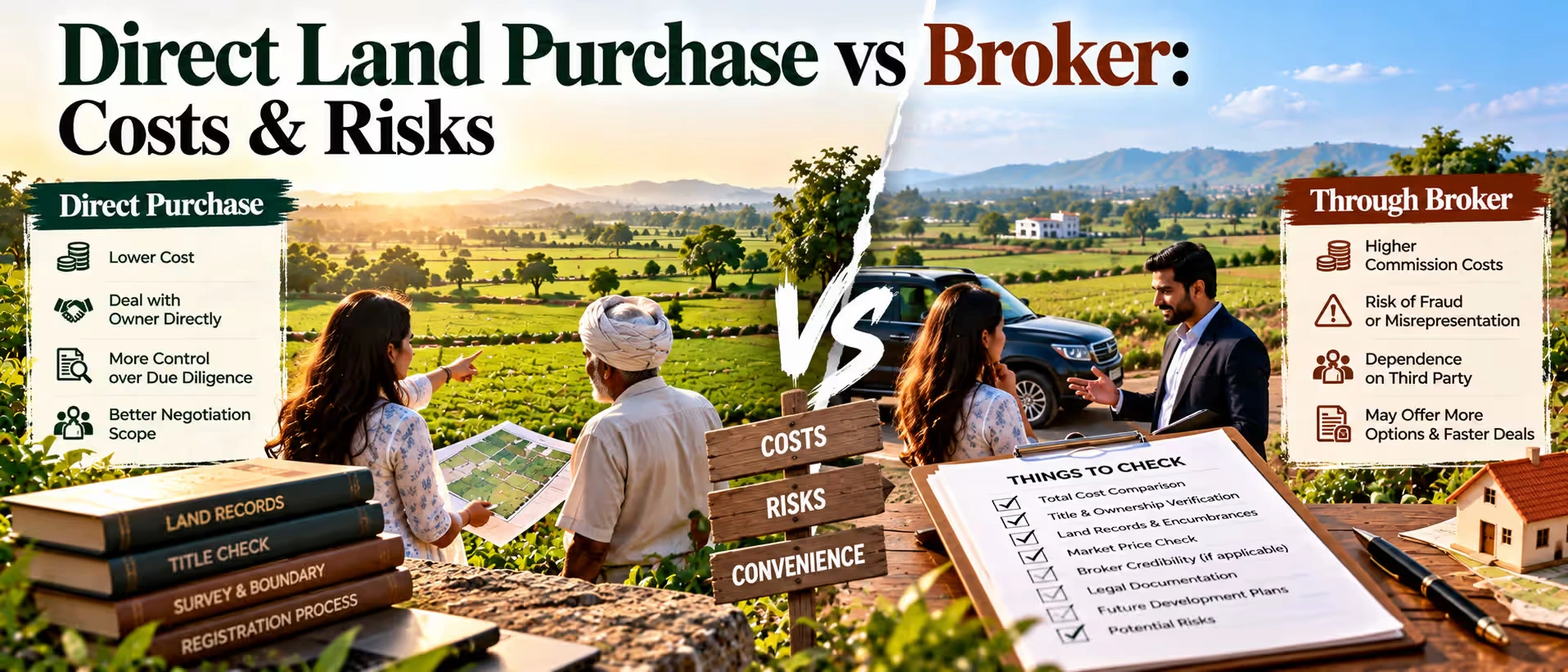
Everybody who begins to look for land in India is forced to make an early choice – to contact the owner himself or go through a broker. Both are widespread ways to do business; both can be successful, and both can go awry. It goes faster through a broker, though he is paid for his services; going through him means no need to carry out any verifications yourself. However, this guide compares them concerning the above criteria and some more.
Owner vs Broker at a Glance
| Factor | Buying From the Owner | Buying Through a Broker |
|---|---|---|
| Commission | None | Commonly 1% to 2% of deal value, varies by region |
| Price negotiation | Direct with the seller | Passes through a middleman |
| Access to listings | Limited to what you can find | Wider, including unlisted plots |
| Document checks | Fully your responsibility | Often assumed, rarely guaranteed |
| Speed | Slower to find, faster to close | Faster to find, depends on broker follow-up |
| Accountability | Direct with the seller | Unclear if the broker is unregistered |
| Best for | Buyers who know the area and can verify records | Buyers new to a location or short on time |
What Each Route Really Costs?
The obvious extra cost of a broker is commission. In many parts of India, it ranges from 1% to 2% of the transaction value, with the buyer, seller, or both paying depending on local custom or negotiation. For a ₹50 lakh deal, that amounts to ₹50,000 to ₹1 lakh. Whether buying through a broker or selling property online, always clarify the commission and payment terms in writing before proceeding. Costs that don't depend on the route are stamp duty, registration charges, legal fees for a title check, and any survey or demarcation expense. These stay the same whether or not a broker is involved.
The hidden costs are not far behind. While the quoted brokerage fee of the broker may contain the markup over and above what the owner really wants, the payment made by you might not even carry a commission cost. In contrast, a buyer who chooses to go for it all alone without the necessary research might have to shell out much more later due to a title dispute or inability to convert his property. An individual looking at agriculture land for sale independently is just spending his money wisely when he does his due diligence.
Rules regarding payments cannot be ignored. The Income Tax Act restricts any cash transactions related to the transfer of property. Taking an advance of ₹20,000 or more in cash for the transfer of immovable property is prohibited under Section 269SS, while taking an advance of ₹2 lakh or more in cash comes under Section 269ST. Use bank transfers and maintain records. A TDS of 1% under Section 194-IA is applicable in case of property purchase of value ₹50 lakh or more, except rural agricultural lands.
Buying Directly From the Owner
Where It Works Well?
- There is no commission to be paid to the broker.
- You get to talk to the actual owner of the property, enabling you to discuss the property's background, any disputes, and boundaries.
- It is also easier for you to negotiate on the price since there is nobody else influencing the figures.
- In case of any future dispute on the boundaries or access, a good relationship with the vendor would be helpful.
Where It Gets Risky?
- Finding sellers is harder. Someone typing plot for sale near me into a search bar will see mostly broker listings, and genuine owner listings take more effort to find.
- You can't assume the person in front of you is the lawful owner. Impersonation and forged documents are real problems in land deals.
- There is no one to help if the other side stops responding after a token amount has been paid.
- You must handle the legal process yourself or hire a lawyer to do it.
Buying Through a Broker
Where It Works Well?
- The brokers have all the information about the locally prevailing price, the minute details of the village, as well as the names of the sellers who are willing to sell.
- This is important because within a span of very short time they can show different options, and this makes comparison easier.
- A good broker coordinates between the buyer, seller, and Sub-Registrar's office.
- In case the person resides in some other city or country, the help locally will prove beneficial.
Where It Gets Risky?
- Most land brokers are not regulated. While RERA mandates registration of agents selling properties in RERA-registered projects, a broker selling a plot of agricultural land in isolation from any such project would not fall under this ambit.
- The motive of the broker is to close the deal; hence, any negative information can be downplayed.
- Some brokers work on behalf of both parties or hold an undisclosed margin.
- Any verbal guarantee regarding conversion, access, or future development holds no legal weight until it is documented.
- Brokers often urge buyers to make the payment fast as there are other buyers waiting.
Anyone who does a farm search through brokers alone should treat every claim as unverified until the records confirm it.
Checks You Must Do Whichever Route You Take
The route doesn’t influence the paperwork process. Whether buying directly from an owner or through a broker, owner vs broker listed land requires the same essential checks: verify ownership documents, confirm land records, check for legal disputes, and ensure all approvals are in place before proceeding.
- Verify identity. The buyer needs to check the ID of the seller, compare the seller’s name with that in the land records, and physically meet the owner at least once.
- Check revenue records. The buyer must obtain the extract about ownership, area of land, category of land, and its notes, which will be published on the land records portal.
- Check the title history. Previous deeds should be checked for an uninterrupted chain of title transfer.
- Obtain an encumbrance certificate. Such a certificate demonstrates mortgages and loans and registration of transfer.
- Check land use category. It is required to be certain that the land use category allows such activities like construction.
- Check acquisition or transfer. Government notifications, master planning, and restrictions on transfers should be checked.
- Establish accessibility. A parcel without a legal road entry point will not be easily utilized nor easily sold.
- View the property. Visit the boundaries of the plot accompanied by the revenue map and talk to the neighboring landowners.
- Consult all co-owners. Every heir or co-owner needs to sign the sale deed.
- Register the sale deed. The sale deed should be registered with the sub-registrar’s office.
Documents to Collect
| Document | Purpose |
| Registered sale deed and earlier deeds | Proves the chain of ownership |
| Revenue record extract | Confirms owner, area and land type |
| Encumbrance certificate | Shows loans and legal burdens |
| Mutation entry | Confirms the latest transfer was recorded |
| Land use or conversion order | Needed for non-agricultural use |
| Tax receipts | Shows dues are cleared |
| ID proof and photographs of seller | Confirms identity |
| Sale agreement with payment schedule | Records price, advance and timelines |
Warning Signs in Either Type of Deal
- A price well below nearby registered deals with no clear reason
- Pressure to pay an advance before documents are shared
- The seller or broker avoids meeting at the sub-registrar's office
- Sale on power of attorney instead of a registered sale deed
- Names or survey numbers that differ between documents
- Reluctance to allow a lawyer to review the papers
- Requests for large cash payments
Which Route Suits You?
Going direct suits you if you know the area, have time to do the checks and can pay a lawyer to review the title. A broker suits you better if you are new to the location, need several options quickly, or can't visit often, as long as you treat the broker as a facilitator and not as a source of legal assurance. Many buyers combine both: they use a broker to find the plot, then run every check themselves and deal with the owner directly at the signing stage. If you are comparing farmlands near me options in a district you don't know well, ask a local lawyer for a title opinion before you commit, regardless of who brought you the deal.
How 2Bigha Fits In?
"2Bigha is an e-commerce website for land and farmland. Here, customers can look at the listings, while sellers can post their land for sale." Buyers can order a Land Report to view their important documents prior to the sale and can make use of the Book a Visit feature to visit the land. For sellers, online selling of their properties will ensure that buyers do not need to rely on one local real estate broker to find a buyer, and the availability of records ensures authenticity of the listing.
Disclaimer: This article is for informational purposes only and should not be considered investment, legal, financial, or property advice. Real estate regulations, infrastructure plans, market conditions, and government policies may change over time. Readers are advised to verify information with relevant authorities and consult qualified professionals before making any investment or property-related decisions.