Key Takeaways
- Buying land in India is not about choosing only between an owner listed land deal and a broker listed land deal. The safer choice is the one where ownership, documents, boundaries, access road, land use, and payment terms are properly verified.
- A direct owner property deal can save brokerage cost and give you better control over negotiation. But it can also become risky if the seller does not understand legal documentation, inheritance issues, pending loans, or land-use restrictions.
- A broker assisted property buying process can be helpful when the broker is genuine, experienced, locally connected, and transparent. But it becomes unsafe when the broker hides the real owner, pushes urgency, gives verbal promises, or avoids document sharing.
- The safest way to buy land in India is to shortlist through verified land listings, confirm the seller’s identity, check government land records, review the title chain, verify encumbrance, inspect the site physically, and complete payment only through a registered sale deed.
- Platforms like 2Bigha help buyers compare land options through map-based listings, land insights, verified ownership-oriented information, and seller/agent discovery. 2Bigha also highlights subscription options for users who want better property visibility, which can help serious sellers and agents present land more professionally.
Introduction: The Real Question is Not Owner vs Broker, It is Safety vs Risk
Land buying in India has changed. Earlier, most buyers depended on local brokers, relatives, village contacts, newspaper ads, or roadside boards. Today, buyers search online for owner listed land, broker listed land, verified plots for sale, and direct owner land sale options before visiting the site.
This shift is good because buyers now have more choices. But it has also created a new problem: too many listings, too many middlemen, and too much confusion.
Some buyers believe that buying land directly from the owner is always better because there is no broker commission. Others trust brokers because they think a local real estate consultant can handle negotiation and paperwork better. Both views are partly correct, but both can be dangerous if you skip due diligence.
Here is the honest answer: owner listed land can be safe, and broker listed land can also be safe. Both can also be risky.
The safety of the deal depends on:
- Who actually owns the land
- Whether the seller has the legal right to sell
- Whether the documents match the ground reality
- Whether the land use supports your purpose
- Whether the broker, if involved, is transparent
- Whether the transaction is registered properly
In India, land is not like buying a mobile phone or a car. Every plot has a history. Ownership may have passed through family inheritance, partition, sale deed, gift deed, court order, or mutation. The land may also have agricultural restrictions, road access issues, zoning limitations, family disputes, unpaid loans, or boundary mismatches.
That is why this blog explains owner vs broker listed land, the pros and cons of each, the safest way to buy land, and how platforms like 2Bigha can help buyers, sellers, agents, and land investors make cleaner decisions.
What is Owner Listed Land
Owner listed land means the land is listed directly by the owner, co-owner, family member, or authorised representative. In simple terms, the buyer deals directly with the person who claims ownership of the land.
This type of listing is common for:
- Agricultural land
- Farmhouse plots
- Residential plots
- Ancestral land
- Village land
- Land resale deals
- Small investment parcels
- Direct owner property sale
Many buyers prefer this route because it feels more transparent. You can speak directly with the owner, understand why they are selling, negotiate the price, and avoid paying brokerage.
But direct owner deals are not automatically safe. Sometimes the person showing the land may not be the only owner. In many Indian land deals, the land may belong to multiple family members. One person may be handling the sale, but all legal heirs or co-owners may need to sign the sale deed.
So, when you buy land from owner, do not stop at verbal confirmation. Ask for legal proof.
What is Broker Listed Land
Broker listed land means the property is listed by a real estate broker, land consultant, agent, or local property dealer on behalf of the owner.
A broker may help with:
- Finding suitable land options
- Coordinating site visits
- Negotiating price
- Connecting buyer and seller
- Explaining local market rates
- Arranging documents
- Helping with registration coordination
- Handling communication between both parties
A good broker can save time, especially when you are buying land in another city, district, or state. For example, if you are looking for land near Jaipur, Alwar, Gurgaon, Pune, Hyderabad, Lucknow, or Bangalore, a local broker may know which villages have better road access, where prices are moving, and which parcels have legal complications.
But the broker route has its own risks. Some brokers push deals without proper verification. Some show the same land to multiple buyers. Some quote inflated prices. Some hide the owner until the last moment. Some work without written authorisation.
That is why broker property services should be judged by transparency, documentation, and accountability, not by sweet talk.
State RERA portals in India maintain project and agent-related regulatory information, and RERA was created to regulate and promote the real estate sector and establish state authorities for monitoring and dispute resolution in covered real estate matters. For land deals, especially plotted developments or project-linked transactions, buyers should check whether RERA registration applies and whether the agent or project details can be verified through the relevant state portal.
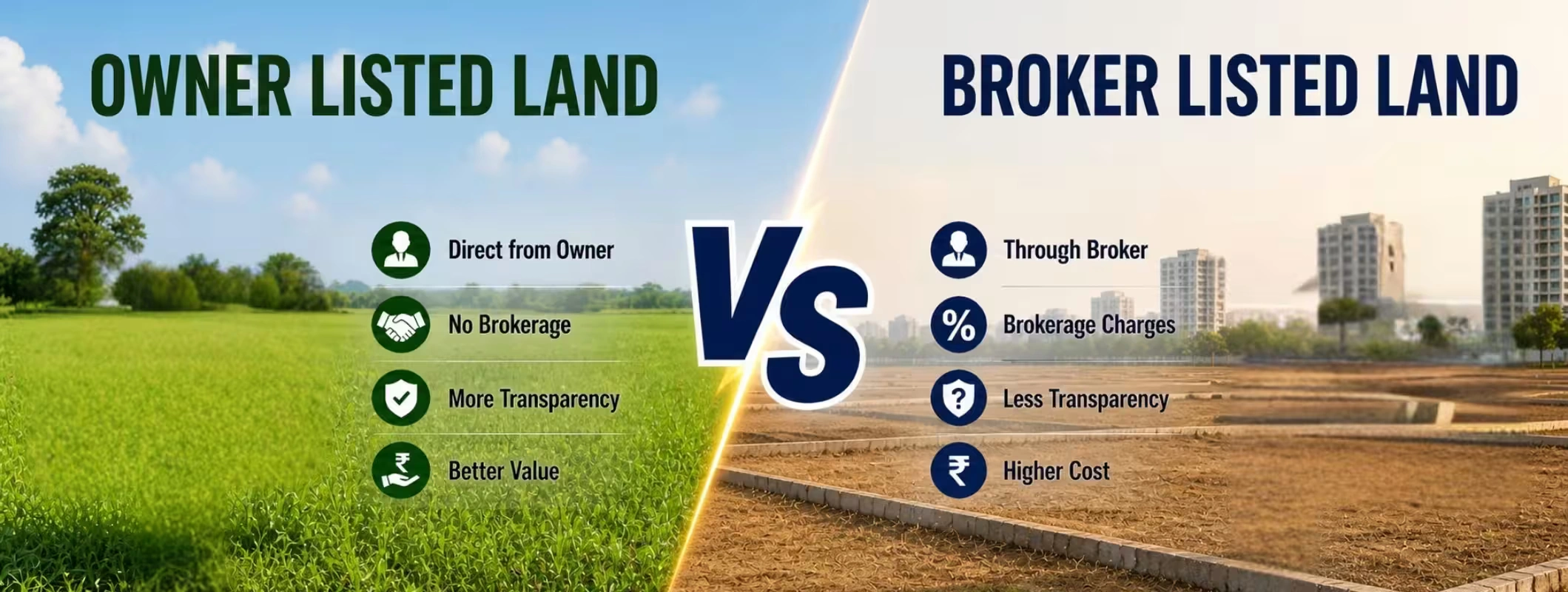
Owner vs Broker Listed Land: Quick Comparison Table
| Factor | Owner Listed Land | Broker Listed Land |
| Main contact | Direct owner, co-owner, or authorised seller | Broker, agent, consultant, or property dealer |
| Cost | May save brokerage | May include broker commission or service fee |
| Negotiation | Direct and sometimes more flexible | Broker may negotiate, but may also add margin |
| Transparency | High if owner shares documents openly | High only if broker reveals owner and documents |
| Risk level | Risky if ownership, heirs, or title chain are unclear | Risky if broker is unregistered, unauthorised, or dishonest |
| Best for | Buyers who can do due diligence and legal checks | Buyers who need local market support and property discovery |
| Main advantage | Direct communication and possible better price | More options, local knowledge, faster shortlisting |
| Main concern | Seller may lack legal clarity or hide disputes | Broker may push unsuitable land or hide facts |
| Safety rule | Verify owner identity and legal title | Verify broker authority and owner documents |
| Better choice | Good for informed buyers | Good when broker is verified and documented |
Simple Answer: If the owner is genuine and the documents are clean, owner listed land can be a strong choice. If the broker is verified, authorised, and transparent, broker listed land can also be a safe choice. The safest option is not “owner” or “broker”; it is a verified land deal.
Benefits of Buying Owner Listed Land
1. You Can Speak Directly With the Seller
The biggest benefit of buy land directly from owner is direct communication. You can ask why the owner is selling, how long they have owned the land, whether there are disputes, whether the land has road access, and whether the price is negotiable.
Direct conversation often reveals useful details that do not appear in online listings. For example, the owner may tell you about nearby development, water availability, boundary history, village access, family partition, or past offers.
2. You May Save Brokerage Cost
Many buyers search for land without broker because they want to avoid commission. This makes sense, especially in high-value land deals where brokerage can become a significant cost.
However, saving brokerage should not mean skipping legal verification. If you save ₹1 lakh in brokerage but later discover a title defect, unpaid loan, or boundary issue, the loss can be much higher.
3. Negotiation Can Be Cleaner
In direct owner property deals, negotiation is usually faster. You do not have to pass every offer through a middleman. If the owner is serious, you may close the deal with clearer terms.
For example, you can discuss:
- Token amount
- Payment schedule
- Registration date
- Possession timeline
- Boundary marking
- Document sharing
- Tax and registration expenses
This makes the process easier when both sides are transparent.
4. Better Understanding of Land History
An owner may know the real story of the property. They may know when the land was purchased, how it came into the family, whether any part was sold earlier, and whether neighbours have raised boundary objections.
This is useful in agricultural and semi-rural land transactions because local history matters. A clean-looking plot on paper can still have practical issues on the ground.
5. Good for Sellers Who Want Control
Owner listing is also useful for sellers. If someone wants to sell land without broker, they can list the property online, share photos, mention survey details, and speak directly with buyers.
But sellers must present the land professionally. A vague listing with no map, no clear area, no ownership details, and no proper images will not build trust.
This is where 2Bigha can help. Its land-focused platform allows buyers to explore land on a map and access land prices, ownership-oriented insights, and property information for better decision-making. Sellers can also list land through the platform and even start selling via WhatsApp, which is useful for owners who are not comfortable with complex online forms.
Risks of Buying Owner Listed Land
1. The Owner May Not Be the Only Legal Owner
This is one of the biggest risks in Indian land deals. The person showing you the land may be one of several co-owners. The land may belong to siblings, parents, cousins, legal heirs, or a Hindu Undivided Family.
If all required parties do not sign the sale deed, the transaction can create disputes later.
- Before paying token money, check:
- Name on title documents
- Names in revenue records
- Family tree, where needed
- Legal heir certificate, where applicable
- Partition deed, if land was divided
- Consent from all co-owners
- Power of attorney, if someone else is selling
2. The Seller May Not Understand Legal Requirements
A genuine owner can still make mistakes. Many landowners know the land physically but may not understand legal paperwork. They may not have updated mutation records. They may not know whether the land has an old loan entry, court case, acquisition notice, or conversion restriction.
So, even if the owner seems honest, you still need professional verification.
3. Boundary and Access Issues Can Be Hidden
Some land parcels look attractive during a site visit but may not have proper access road, demarcated boundaries, or clear approach rights. This is common in agricultural land and village-side plots.
Always check:
- Survey map
- Actual boundary stones
- Approach road width
- Right of way
- Neighbouring land claims
- Government road records
- Canal, forest, grazing, or common land restrictions
4. Verbal Promises Are Common
In direct owner deals, buyers often trust verbal statements like:
- “Road will come soon.”
- “Conversion is easy.”
- “Mutation will be done later.”
- “Everyone in the family agrees.”
- “Registry can happen anytime.”
- “This land is clear, no need to check too much.”
Do not accept such statements without documents. Land buying should not run on emotions or village-level assurances. It should run on documents, records, maps, and registered agreements.
Benefits of Buying Broker Listed Land
1. More Property Options
A good broker can show multiple options in the same budget and location. This is useful when you are comparing farmland, residential plots, commercial plots, or land resale deals across different villages or localities.
For example, if you are looking for land near a highway, temple corridor, industrial belt, tourist route, or upcoming township, a local broker may know options that are not listed online yet.
2. Local Market Knowledge
Land prices are highly local. Two plots in the same village can have different values because of road width, frontage, shape, soil, water source, nearby development, or future access.
A genuine broker can explain:
- Fair market price
- Recent nearby transactions
- Buyer demand in the area
- Local development plans
- Village-level risks
- Practical resale potential
This can help you avoid overpaying.
3. Faster Site Visits and Coordination
If you are an outstation buyer, a broker can coordinate site visits, meet the owner, arrange documents, and help you understand local procedures. This saves time. For example, if you live in Delhi but want to buy land in Rajasthan, Haryana, Uttar Pradesh, or Uttarakhand, a local land buying consultant can help you shortlist properties before you travel.
4. Help With Negotiation
Some buyers are not comfortable negotiating directly with owners. A broker can manage the negotiation and reduce friction between buyer and seller. However, this only works when the broker is neutral and transparent. If the broker is secretly adding a margin or pushing only high-commission listings, the buyer may lose money.
5. Useful for Complex Deals
Broker support can be useful when the deal involves:
- Multiple owners
- Agricultural land
- Large parcels
- Land aggregation
- Farmhouse plots
- Commercial conversion potential
- Buyer from another city
- Local revenue office coordination
But again, the broker should not replace legal due diligence. Use the broker for market support. Use a lawyer and official records for verification.
Risks of Broker Listed Land
1. Hidden Commission or Price Loading
Some brokers do not clearly disclose their commission. They may quote a higher price to the buyer and negotiate a lower price with the seller. This creates mistrust.
Before proceeding, ask:
- What is your brokerage?
- Who will pay the commission?
- Is the price quoted final or negotiable?
- Do you have owner authorisation?
- Can I speak directly with the owner before token payment?
Put commission terms in writing. Do not rely on verbal clarity.
2. No Written Mandate From Owner
A broker should ideally have written permission from the owner to market the property. Without this, the broker may not be authorised to sell or negotiate.
Ask for:
- Owner consent letter
- Broker mandate
- Owner contact details
- Broker ID or business details
- RERA registration where applicable
- Proof of past transactions, if available
For RERA-covered projects, some state RERA portals provide agent registration and project-related information. For example, MahaRERA lists sections for real estate agent registration, renewals, registered agents, and deregistered agents. This does not automatically cover every private agricultural resale, but it gives buyers a useful habit: verify the person handling the transaction wherever official verification is available.
3. Pressure Selling
A common red flag is urgency:
- “Token do today, otherwise land will go.”
- “Many buyers are waiting.”
- “Owner is leaving tomorrow.”
- “Documents will be shared after advance.”
- “No need for lawyer, I know everything.”
A genuine deal can wait for basic verification. A risky deal usually pushes speed before clarity.
4. Broker May Hide the Actual Problem
Some brokers avoid mentioning problems because they only get paid when the transaction closes. They may hide:
- Family dispute
- Loan entry
- Road issue
- Land-use restriction
- Litigation
- Acquisition risk
- Boundary mismatch
- Low resale demand
- Overpriced valuation
This is why buyers must independently verify land documents.
Which is Safer: Owner Listed Land or Broker Listed Land
The safer option depends on verification.
Owner listed land is safer when:
- The seller’s name matches the title and revenue records
- All co-owners agree to sell
- The seller shares documents before token payment
- The land has clear access and boundaries
- A lawyer confirms the title chain
- The sale deed is registered properly
- Payment is made through traceable banking channels
Broker listed land is safer when:
- The broker reveals the owner early
- The broker has written authorisation
- The broker does not block document verification
- Commission terms are transparent
- The broker is registered where applicable
- The buyer can directly verify official records
- The deal is completed through proper legal process
So, the real comparison is not owner vs broker listed land. The real comparison is:
- verified deal vs unverified deal
- documented deal vs verbal deal
- transparent listing vs hidden information
- legal ownership vs claimed ownership
If you follow this logic, you will make better decisions.
Also Read: Verified Land vs Unverified Land: How to Decide
Property Verification Checklist Before Buying Land in India
Use this checklist whether you are buying from an owner or through a broker.
| Verification Area | What to Check | Why It Matters |
| Seller identity | Aadhaar, PAN, address proof, photos, signatures | Confirms seller identity |
| Ownership title | Sale deed, gift deed, partition deed, inheritance proof | Confirms legal ownership |
| Title chain | Previous sale deeds for 15–30 years where possible | Shows ownership history |
| Revenue records | Jamabandi, 7/12, RTC, Pahani, Khata, mutation | Confirms government record status |
| Encumbrance Certificate | Mortgage, registered transactions, liens | Helps detect registered liabilities |
| Land use | Agricultural, residential, commercial, industrial | Confirms whether your intended use is allowed |
| Boundary | Survey map, site demarcation, fencing, neighbouring plots | Prevents boundary disputes |
| Access road | Public road, private road, right of way | Ensures practical usability |
| Litigation | Court records, local enquiry, lawyer search | Avoids disputed property |
| Conversion status | NA conversion, CLU, zoning approval if needed | Important for non-agricultural use |
| Tax dues | Property tax, land revenue, electricity/water dues | Avoids unpaid liability |
| Seller authority | Power of attorney, co-owner consent, board resolution | Confirms right to sell |
| Registration | Stamp duty, registration fee, registered sale deed | Makes transfer legally valid |
| Mutation after sale | Update buyer name in revenue/local records | Confirms post-sale record update |
An Encumbrance Certificate records registered transactions linked to a property; for example, Karnataka’s registration department explains that when mortgage, sale, or other deeds are registered, an EC is issued in Form 15.Land records are also being digitised under government initiatives such as the Digital India Land Records Modernization Programme, which aims to modernise land record management, reduce land/property disputes, and improve transparency.
Step-by-Step Direct Land Buying Guide in India
Step 1: Define Your Purpose Clearly
Before searching for land, decide why you are buying it.
- Are you buying for farming?
- Weekend farmhouse?
- Long-term investment?
- Commercial use?
- Warehouse?
- Residential plotting?
- Resale appreciation?
- Retirement home?
Your purpose decides what kind of land you should buy. Agricultural land may be good for farming or long-term holding, but it may not support commercial construction without conversion. Commercial land may offer stronger business potential, but it usually costs more and needs stricter compliance.
Step 2: Shortlist Verified Listings
Start with listings that provide clear location, area, pricing, ownership information, road access, and photos. Avoid vague listings that only say “urgent sale” or “best land investment.”
2Bigha helps buyers explore agricultural land and farmland through interactive map-based discovery, making it easier to compare land locations and options. It also has a section where users can browse verified agents and owners, with filters such as verified-only and most listings first.
Step 3: Speak With the Owner or Verified Representative
Even if the land is listed by a broker, ask to speak with the owner before paying any money. This helps you confirm whether the seller is aware of the deal and agrees to the listed price.
Ask simple but important questions:
- Who owns the land?
- How did you acquire it?
- Are there other co-owners?
- Is there any loan or dispute?
- Is the land currently cultivated or vacant?
- Is there road access?
- Are all documents available?
- Why are you selling?
Step 4: Check Online Land Records
Every state has its own land record system. Depending on the state, you may need to check portals for RTC, 7/12 extract, Jamabandi, Bhulekh, Khata, mutation, survey records, and registration details.
For example, Karnataka’s Bhoomi system digitised manual RTCs and made ownership and mutation-related records available through the land records database. Similar state-specific systems exist across India, although names and processes differ.
Step 5: Take a Lawyer’s Title Opinion
Never buy land only because the owner or broker says it is clear. Hire a property lawyer who understands land transactions in that state.
The lawyer should review:
- Title documents
- Revenue records
- Mutation history
- Encumbrance Certificate
- Family ownership trail
- Court risk
- Conversion and land-use issues
- Power of attorney, if any
- Agreement to sell
- Sale deed draft
This is not an extra cost. It is protection.
Step 6: Conduct Physical Site Verification
Visit the land. Do not rely only on photos or map pins.
Check:
- Exact location
- Boundary stones
- Road access
- Nearby development
- Electricity availability
- Water source
- Drainage
- Neighbouring land use
- Encroachments
- Actual land size
- Slope, soil, and usability
If possible, take a local surveyor or patwari/revenue expert to confirm the boundaries.
Step 7: Pay Token Only After Basic Verification
Many buyers make the mistake of paying token money too early. Do not do that.
Before token payment, confirm:
- Seller identity
- Basic title
- Document availability
- Final price
- Refund terms
- Registration timeline
- Who pays taxes and charges
- Brokerage terms, if broker involved
Pay through bank transfer, not cash. Mention payment details in writing.
Step 8: Register the Sale Deed
A land transaction is not complete just because money is paid. It must be properly registered as per the applicable state process.
Stamp duty and registration charges vary by state, property type, value, and buyer category. Always check the latest state registration department rules before closing the deal.
Step 9: Complete Mutation After Registration
After registration, apply for mutation or record update in the buyer’s name. This is important because it updates revenue or local authority records.
Many buyers complete registry and forget mutation. That is a mistake. Mutation helps prove possession and tax responsibility in government records.
Red Flags in Owner Listed Land Deals
Be careful if you notice these warning signs:
- The seller refuses to share documents
- The seller says documents will be shown only after token payment
- Only one family member is negotiating, but land has multiple heirs
- The land is much cheaper than nearby market rate
- The seller avoids written agreement
- Boundary is not clear on the ground
- Access road is informal or disputed
- Mutation is pending for many years
- The owner says “registry will be done” but cannot explain documents
- The seller wants large cash payment
- The land is under litigation or family dispute
- The land use does not match your purpose
A cheap land deal can become expensive if the title is weak.
Red Flags in Broker Listed Land Deals
Avoid or pause the deal if the broker:
- Does not reveal the owner
- Refuses direct owner meeting
- Pushes urgent token payment
- Has no written authorisation
- Quotes different prices to different buyers
- Avoids document sharing
- Promises guaranteed conversion
- Says legal verification is not needed
- Asks for cash brokerage without receipt
- Shows land without exact survey number
- Claims “inside information” without proof
- Uses emotional pressure or fear of missing out
A professional broker will not fear verification. A doubtful broker will always rush the buyer.
Owner Listed Land: Best Situations to Choose It
Owner listed land may be better when:
- You already understand land buying basics
- You have access to a good property lawyer
- The owner is transparent and cooperative
- The property documents are complete
- All co-owners are available for signing
- The land is not legally complicated
- You want to avoid broker commission
- You want direct negotiation
- You can physically inspect the land
- You can verify official land records
This route works well for informed buyers. It also works for buyers using reliable platforms where owner property deals are easier to compare.
Broker Listed Land: Best Situations to Choose It
Broker listed land may be better when:
- You are new to the location
- You do not know local land prices
- You need multiple options quickly
- The property is in a rural or semi-urban area
- You are buying from another city
- The broker is verified and transparent
- The broker has written owner authorisation
- You need help with site visits and coordination
- The broker shares documents before token payment
- Commission terms are clear
A good broker can be useful. A bad broker can be costly. Choose carefully.
How 2Bigha Helps Buyers Compare Owner and Broker Listed Land
Land buyers in India need more than random property listings. They need location clarity, land visibility, ownership-oriented information, and a better way to compare opportunities.
2Bigha is built around land discovery, especially agricultural land and farmland. The platform highlights map-based land search, land prices, investment opportunities, verified ownership records, and property insights for confident decision-making.
Here is how 2Bigha can support safer land discovery:
1. Map-Based Land Search
Land is location-sensitive. A small difference in road access, village boundary, water source, or nearby development can change the value. 2Bigha’s map-led experience helps buyers visually explore land instead of depending only on text listings.
2. Owner and Agent Discovery
2Bigha has a section for real estate agents and property owners, with verified agent/owner discovery and filters. This helps buyers compare who is listing the property and whether the listing source looks credible.
3. Better Visibility for Sellers
Owners who want to sell land without broker can use online listing support instead of depending only on local networks. 2Bigha’s sell page allows users to start selling by logging in or sharing land details through WhatsApp for listing support.
4. Subscription Plan for Better Property Visibility
For serious sellers, agents, and land professionals, subscription plans can help improve property visibility and make listings easier to discover. 2Bigha’s app launch blog notes that the platform highlights seller support and subscription options for users who want better property visibility.
This matters because land selling is not only about posting a listing. It is about presenting land with clear location, useful details, trust signals, and buyer-friendly information.
5. Useful for Land Investors
If you are comparing farmland, owner listed land, broker listed land, or verified plots for sale, 2Bigha can help you shortlist options before you begin legal due diligence.
Important point: No platform should replace legal verification. Use 2Bigha for discovery, comparison, and visibility. Use official records, lawyers, and site verification for final safety.
Buyer Safety Checklist: Before Paying Token Money
Use this checklist before giving even a small advance.
- Confirm seller identity
- Confirm ownership documents
- Check all co-owners
- Ask for latest revenue record
- Check Encumbrance Certificate
- Verify survey number
- Visit the site physically
- Check access road
- Check boundaries
- Confirm land-use classification
- Ask about disputes or loans
- Discuss registration timeline
- Confirm broker commission in writing
- Make token payment only through bank
- Sign a written agreement
- Mention refund terms clearly
If the seller or broker refuses these basic steps, walk away.
Documents to Check Before Buying Land in India
The exact documents depend on the state and land type, but these are commonly required.
Ownership Documents
- Sale deed
- Mother deed
- Gift deed, if applicable
- Partition deed, if applicable
- Will or probate, if applicable
- Legal heir certificate, where needed
Power of attorney, if seller is represented by someone else
Revenue and Land Records
- Jamabandi
- 7/12 extract
- RTC/Pahani
- Khata
- Mutation record
- Survey map
- Village map
- Land revenue tax receipts
Legal and Transaction Documents
- Encumbrance Certificate
- Property tax receipt
- No-dues certificate
- Agreement to sell
- Sale deed draft
- Identity proof of seller and buyer
- PAN card
- Aadhaar
- Photographs
- Bank payment proof
Use-Specific Documents
- Land conversion order
- CLU approval
- Zoning certificate
- RERA details, if applicable
- Layout approval
- NA order
- Agricultural eligibility documents, if required by state law
Land rules vary by state. For example, agricultural land purchase rules in Karnataka, Maharashtra, Himachal Pradesh, Uttarakhand, Sikkim, and other states can differ. Always check state-specific legal eligibility before buying farmland.
How to Avoid Property Fraud in Owner and Broker Land Deals
Do Not Pay in Cash: Cash payments create risk. Use bank transfer, cheque, demand draft, or another traceable channel. Keep receipts and written confirmation.
Do Not Trust Only Photocopies: Ask for original documents during verification. Photocopies can be edited or incomplete.
Do Not Skip Local Enquiry: Speak with neighbours, village officials, local revenue staff, and nearby landowners. Local enquiry can reveal disputes that documents may not clearly show.
Do Not Ignore Road Access: Land without legal access can become almost unusable. Check whether the road is public, private, disputed, seasonal, or only informal.
Do Not Buy Based on Future Promise
Avoid buying only because someone says:
- Highway is coming
- Airport is coming
- Township is coming
- Commercial conversion is guaranteed
- Price will double soon
Future development can increase land value, but only if the base title and location are strong.
Do Not Ignore Land Use: Agricultural land cannot automatically be used for commercial or residential construction. Conversion rules vary by state and authority.
Do Not Rely Only on Broker Words: Even if the broker is known locally, verify everything independently.
Owner Property Listing Advantages for Sellers
If you are a landowner, listing directly can help you:
- Reach serious buyers
- Avoid unnecessary middlemen
- Control pricing
- Explain land features directly
- Negotiate better
- Protect your margin
- Build buyer trust with documents
But your listing must be professional. Buyers do not trust vague land posts. Add:
- Clear location
- Land area
- Road access
- Photos and videos
- Survey details
- Price expectation
- Ownership status
- Nearby landmarks
- Water/electricity details
- Land-use details
- Contact process
A verified and detailed listing attracts better buyers than a random “land for sale” post.
Broker Property Services: What a Good Broker Should Provide
A professional broker should offer more than just a phone number.
A good broker should:
- Share genuine listings
- Disclose owner details at the right stage
- Provide written commission terms
- Help arrange site visits
- Share market insights
- Coordinate documents
- Avoid false promises
- Allow legal verification
- Respect buyer due diligence
- Avoid pressure selling
A broker who only says “trust me” is not enough. In land deals, trust must be supported by documents.
Final Verdict: Which is Better and Safer
Choose owner listed land if:
- You want direct negotiation
- You want to avoid brokerage
- The seller is genuine
- Documents are clear
- All owners are ready to sign
- You have legal support
- You can verify everything independently
Choose broker listed land if:
- You need local support
- You want more options
- You are buying from another city
- The broker is verified
- Commission is transparent
- Owner details are shared
- Documents are available
- The broker allows legal checks
The safest choice is:
- A verified land listing
- A transparent seller
- A documented broker, if involved
- A clean title
- A proper site visit
- A lawyer-reviewed sale deed
- A registered transaction
- A completed mutation
Do not buy land because it is cheap. Do not buy because the broker is persuasive. Do not buy because the owner seems nice. Buy only when the land is legally, physically, and financially clear.
Conclusion: Safe Land Purchase in India Needs Verification, Not Guesswork
The debate around owner vs broker listed land is important, but it should not distract you from the real issue: safety.
A direct owner land sale can be a great deal if the owner is genuine, documents are clean, and the transaction is registered properly. A broker listed property can also be a smart choice if the broker is verified, transparent, and useful in the buying process.
But in both cases, you must check title, land records, encumbrance, access, boundaries, land use, seller authority, and registration process.
For buyers, platforms like 2Bigha make land discovery more organised through map-based listings, owner and agent discovery, property insights, and land-focused search. For sellers and agents, 2Bigha’s listing support and subscription options can improve visibility and help serious buyers find relevant land opportunities.
The safest way to buy land in India is simple:
Search smart. Verify deeply. Pay safely. Register properly. Update records after purchase.
That is how you protect your money, avoid land deal risks, and make a confident land investment.
FAQs: Owner vs Broker Listed Land
1. Is owner listed land safer than broker listed land?
Owner listed land is not automatically safer. It can be safe if the seller is the genuine legal owner, all documents are clear, and all co-owners are ready to sign. But it can be risky if ownership is disputed, mutation is pending, or the seller hides legal issues. Always verify documents before paying.
2. Is it better to buy land directly from owner?
Buying directly from the owner can help you save brokerage and negotiate clearly. It is better when the owner shares documents, confirms legal ownership, and agrees to proper registration. However, you should still hire a property lawyer and check official land records.
3. What are the risks of buying land without a broker?
The main risks are poor document understanding, hidden co-owners, unclear title chain, boundary disputes, road access issues, and lack of local market knowledge. If you buy land without broker support, you must handle verification carefully.
4. What are the benefits of broker assisted property buying?
A broker can help you find more options, understand local prices, arrange site visits, and coordinate with sellers. Broker assisted property buying is useful when the broker is genuine, transparent, and willing to share owner and document details.
5. How do I know if a broker is genuine?
Ask for broker identity, business details, written owner authorisation, commission terms, and RERA registration where applicable. Also check whether the broker allows you to meet the owner and verify documents before token payment.
6. What documents should I check before buying land?
Check sale deed, title chain, revenue records, mutation, Encumbrance Certificate, survey map, tax receipts, seller ID proof, land-use documents, conversion approval if needed, and co-owner consent. For agricultural land, also check state-specific eligibility rules.
7. Can I sell land without broker?
Yes, you can sell land without broker by listing it directly on a trusted land platform, sharing clear property details, keeping documents ready, and speaking directly with buyers. Platforms like 2Bigha support land listing and seller visibility for agricultural land and farmland.
8. What is the safest way to buy land in India?
The safest way is to shortlist verified land listings, confirm seller identity, verify land records, check Encumbrance Certificate, inspect the site, confirm boundaries and access, take legal opinion, pay through banking channels, register the sale deed, and complete mutation after purchase.
9. Should I pay token money before document verification?
No. You should not pay token money before basic document verification. At minimum, check seller identity, title documents, land records, and sale terms. If you pay token money, use bank transfer and sign a written agreement with refund conditions.
10. How can 2Bigha help in buying land?
2Bigha helps buyers explore agricultural land and farmland through map-based listings, land insights, verified ownership-oriented information, and owner/agent discovery. It helps buyers shortlist better options, but final legal verification should always be done through official records and legal experts.