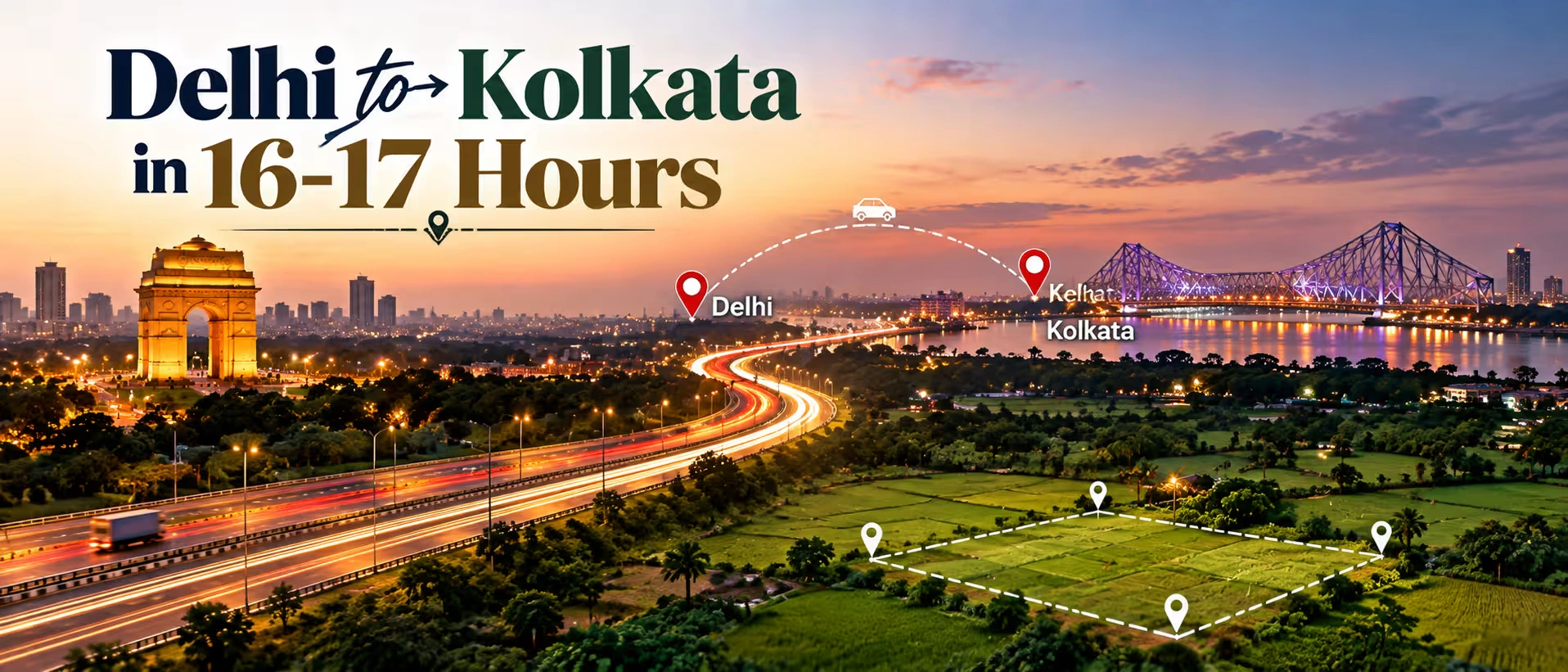
It is common knowledge that travel by car from Delhi to Kolkata is not an easy task, especially when time is a factor. The journey is bound to take more than a day's worth of time. There are long waits in the town bypasses, delays at the crossings, and many hours stuck behind trucks. This is why the talk of a 16-17-hour drive has taken the nation by storm. The proposal is not the construction of a lone highway but rather a combination of expressways and improved highways that connect Delhi, Uttar Pradesh, Bihar, Jharkhand, and West Bengal in one smooth journey.
What Is Actually Being Built?
The figure of 16-17 hours arises from connecting the present fast routes with a new one. There is an expressway from Delhi to Varanasi via Yamuna Expressway, Lucknow-Agra Expressway and Purvanchal Expressway. The Delhi to Varanasi trip is reported to be slightly over 10 hours long.
This gap will be bridged by building the Varanasi Ranchi Kolkata Expressway, or NH 319 B. It will be a 6-lane greenfield highway covering a length of 610 km from near the Varanasi Ring Road to Uluberia in West Bengal. Its estimated cost is said to be of the order of ₹31,700 crore. The present road distance between Varanasi and Kolkata is about 690 km, thus saving another 80km. This can be represented as follows:
| Stretch | Role in the corridor | States touched |
| Delhi to Agra | Existing fast road, entry point | Delhi, Uttar Pradesh |
| Agra to Lucknow | Lucknow-Agra Expressway | Uttar Pradesh |
| Lucknow to Varanasi | Purvanchal Expressway link | Uttar Pradesh |
| Varanasi to Kolkata | New six-lane greenfield road | Uttar Pradesh, Bihar, Jharkhand, West Bengal |
Timelines for big road projects tend to slip, so please treat any completion date as a target and not a promise. Officials have spoken about 2026 for the new stretch, but the ground reality can differ from section to section.
Why the Time Saving Is Bigger Than It Looks?
A few hours saved on paper feels small. On the road, it changes a lot.
- Trucks move faster. Freight from eastern India to the north can shift a full day sooner.
- Fewer stops. Access-controlled roads mean no local traffic cutting across.
- Safer driving. Six lanes and proper dividers reduce head-on risk.
- Predictable timing. Businesses can plan deliveries in hours, not guesses.
For families, Delhi to Siliguri in 6 hours could turn a road trip that once felt impossible into a far more manageable journey, potentially requiring just one night halt. For businesses, it could bring the two markets closer together, making Delhi and Siliguri behave more like neighbouring markets.
Cities and Towns That Gain Along the Route
Expressways do not just move traffic. They change where people want to live and work. The towns near interchanges usually feel it first.
| Region | Why it matters | What may change |
| Varanasi belt | Starting point of the new road | Hotels, warehouses, roadside retail |
| Sasaram and Aurangabad (Bihar) | Passing points on the alignment | Small industrial plots, fuel stops |
| Ranchi and nearby Jharkhand | Major mid-route city | Logistics parks, housing demand |
| Bankura and Purulia side | Approach to Bengal | Farm-to-market access |
| Howrah and Uluberia | Final link to Kolkata | Warehousing, suburban housing |
If you are only looking at big cities, you will miss the real story. The smaller stops between them are where price movement often begins, because the base price is low and access suddenly improves.
What It Means for Buyers Near Delhi?
Delhi sits at the start of this chain, and buyers here usually think about the capital's own pressure. Space is scarce, rules are tight, and prices are high. When a new long-distance road lifts the value of the wider region, people start reading the map differently.
If you are searching for a plot in Delhi, keep in mind that the city itself has very limited free land. Much of what gets sold sits in regularised colonies, village abadi areas, or pockets that need careful title checks. The expressway will not create new space inside the city, but it does make the surrounding belt more attractive for people who want easy road access to the east.
Buyers who want something bigger often look at the fringe. A farm land for sale in Delhi listing usually points to outer villages where holdings are larger, and the rules around use are stricter. Before you pay anything, check the land use category, the revenue record, and whether the parcel is in a notified zone. A farm plot with a clear record is a very different thing from one with a pending dispute.
Reading the Delhi Market Without Getting Carried Away
It is tempting to believe every road announcement will double land rates. It rarely works like that. Here is a more grounded way to look at it.
- Distance to the entry point matters. Land closer to an interchange gains more than land far from it.
- Use category decides value. Agricultural, residential, and commercial land follow different price logic.
- Paper comes first. A clean title is worth more than a rumour of a new road.
- Time horizon is key. Infrastructure effects usually play out over years, not weeks.
Anyone holding land in Delhi who is thinking of selling should also watch the neighbouring markets. When roads improve outward connectivity, buyers sometimes shift attention to cheaper regions, which can soften demand for some Delhi pockets while strengthening others. Price your land on fresh comparable sales, not on old memories of what a neighbour got.
The Kolkata End of the Story
The eastern end of the corridor is where Bengal meets the rest of the network. Kolkata has always had a strong housing market, and faster road links to the north can widen its reach. Logistics firms, small manufacturers, and warehouse operators look at exactly this type of connection when picking sites.
Anyone hunting for a plot for sale in Kolkata should look beyond the core city. The central areas are dense and priced accordingly. The outer belt toward Howrah, Uluberia, and the southern and western fringes usually offers more room and lower entry cost. These are the areas that tend to react when a major highway lands nearby. A few checks are worth doing before you sign anything in Bengal:
- Confirm the plot's mutation and record of rights.
- Ask whether the land is under any acquisition notice for the expressway or other projects.
- Check flood history, since some low areas near the river belt behave differently in the monsoon.
- Verify the exact road access, not just the distance on a map.
If You Own Land and Want to Sell
Owners often ask whether now is the right time. There is no single answer, but a few points help you decide. Someone planning to sell land in Kolkata should first find out whether the parcel falls near a proposed interchange or link road. Land like that can fetch a better price once the road opens, so an early sale at an average rate may not be the smartest move. On the other hand, if your plot is far from any planned access, waiting for a road-driven jump may not pay off.
| Situation | Suggested approach |
| Plot near a planned interchange | Track progress, avoid rushing a sale |
| Plot far from any new road | Sell if you need the money, price on local comparables |
| Disputed or unclear title | Fix the paperwork first |
| Land under acquisition notice | Get compensation details before any deal |
Serious buyers pay more for clean, well-documented land. Spending a few weeks on paperwork before you list can raise your final price more than any road news.
Risks You Should Not Ignore
Not every rumour becomes reality. Please keep these in mind:
- Delays. Land acquisition and clearances can push a completion date back by years.
- Alignment changes. The final route can shift from what early maps show.
- Speculation. Brokers sometimes push inflated prices right after an announcement.
- Acquisition. Some owners along the alignment may lose part of their land.
- Legal gaps. Old records in several states are still messy.
A calm, document-first approach protects you from most of these.
How 2Bigha Helps You Buy and Sell Land Across India?
Whether your interest lies near Delhi, along the Bihar and Jharkhand stretch, or around Kolkata, the biggest headache is usually the same: finding land you can trust. That is where 2Bigha comes in. It is a marketplace for agricultural land and farmland in India, built so that buyers and sellers deal with real listings and not guesswork. Here is what you can do on the platform:
- Browse listings and filter by state, district, and budget.
- Look at land that has gone through background checks before it is shown.
- List your own property and reach genuine buyers directly.
- Book a visit to see a plot in person before you decide.
If you are new to land buying, start small, ask a lot of questions, and never skip the document check. A platform that puts verification first saves you both money and stress.
Practical Checklist Before You Act
- Decide your purpose: investment, farming, a farmhouse or a future home.
- Fix a budget that includes registration, stamp duty and legal fees.
- Check the land use category and the latest record.
- Visit the site more than once, at different times of day.
- Speak to neighbours and local residents about access and disputes.
- Get a lawyer to read the papers before any advance payment.
Final Thoughts
A journey from Delhi to Kolkata in 16-17 hours isn’t just an experience but also an indicator of how East and North India are being brought closer together, since, after all, land prices tend to be dictated by road routes. That said, road connectivity comes into play if your plot has its documents in order
Disclaimer: This article is for informational purposes only and should not be considered investment, legal, financial, or property advice. Real estate regulations, infrastructure plans, market conditions, and government policies may change over time. Readers are advised to verify information with relevant authorities and consult qualified professionals before making any investment or property-related decisions.