List Your Land
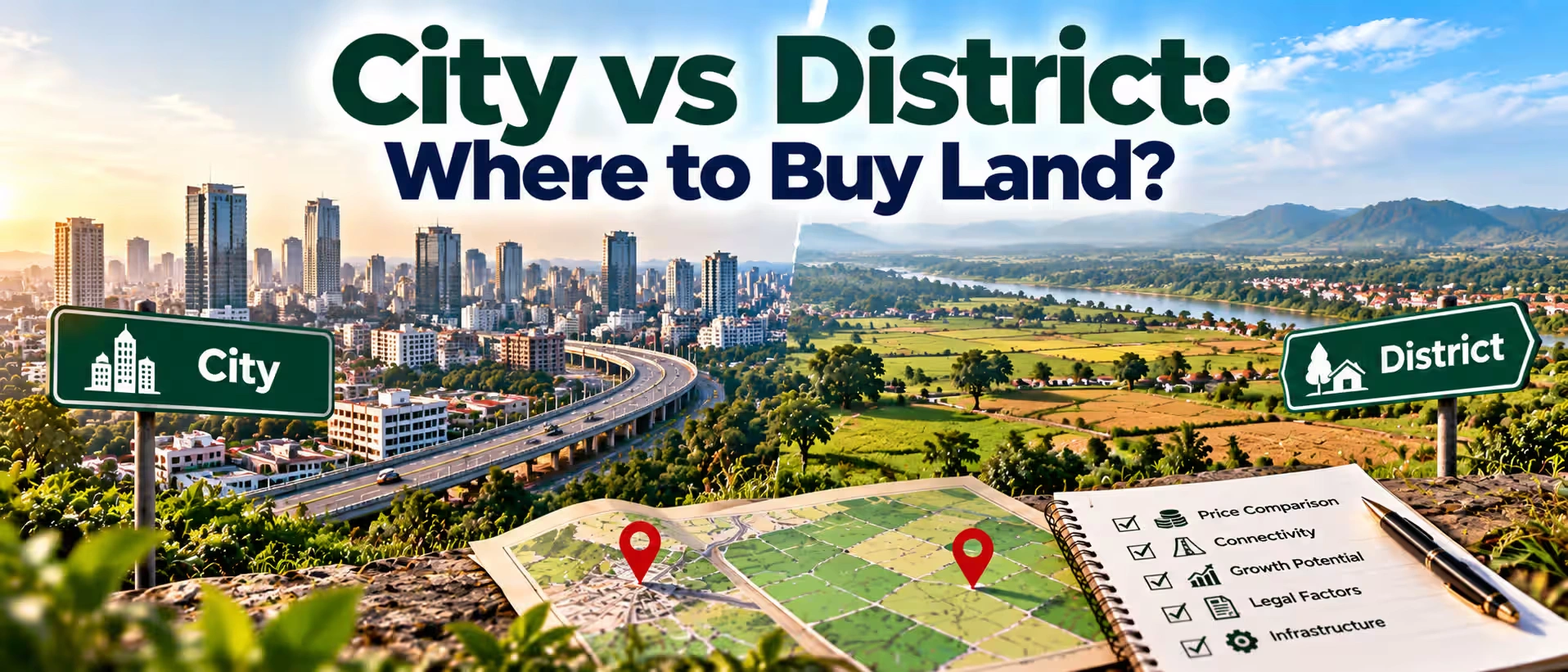
Most buyers start a farmland search close to home, usually within an hour or two of the city they live in, and only later ask whether that was the right circle to draw. A plot twenty minutes from a city and a plot in a district village two hours away can look similar in a photo. The price, the paperwork, the resale options, and the work involved in owning each one are quite different. This guide compares city-edge land with district land on the points that actually change the outcome, so you can decide where to begin before you spend weekends on site visits.
City vs District Land at a Glance
| Factor | City edge | District or village belt |
|---|---|---|
| Price per bigha or acre | Higher | Lower |
| Distance from where you live | Short | Longer |
| Resale and buyer pool | Wide, more brokers and investors | Narrower, mostly local buyers |
| Land use rules | Often covered by master plans and zoning | Mostly agricultural zone |
| Chance of conversion or development | Higher | Lower |
| Day-to-day management | Easier | Needs a caretaker or local contact |
| Typical use | Weekend farm, farmhouse, investment | Active farming, long hold |
Why Location Type Matters Before You Pick a Plot?
Finding farmland near me through maps or listing sites results in you having access to a list of farmlands ordered according to proximity. This is just one of the many factors to consider. What kind of place it is, whether it is on the outskirts of a city or within a district, will determine how much you pay, the legality of your purchase, its operational costs, and its marketability.
A good way to look at it is to consider what you really need that piece of land for. If you intend to use it during weekends, produce some food, and have the choice to sell quickly, then the outskirts of the city will be suitable. If you intend to produce on a bigger scale at reduced costs and are prepared to wait years for any changes in prices, then the district outskirts will be suitable.
City Edge Land: What You Gain and What You Give Up?
City fringe land is near roads, markets, sources of water, and services. Accessing it takes less than an hour, something which will be crucial if you plan to monitor the construction yourself. Brokers are busy in such areas; it’s easy to meet buyers, and a valuation from the bank will be available. Some disadvantages include:
- Higher costs. Much of what you are paying for in the purchase is the location and not necessarily the land itself.
- Master Plan zoning surprises. There is a good chance that, according to the master plan, your plot may be classified as green belt, expansion road, residential, or agricultural.
- Acquisition risk. City fringe land near planned road works, railway tracks, or airports is subject to notification.
- Listing of the plot for sale with the incorrect description. The plot is marketed as a ready-to-build plot while on paper it is still considered an agricultural land plot.
- Small-sized land plots. Many city fringe plots are very small and fragmented.
If your search turns up a plot for sale near me that looks cheap by city standards, ask what the zone is and whether the road in front is public or private before you ask anything else.
District Land: What You Gain and What You Give Up?
Deeper land within a district is generally cheaper per acre, more uniformly distributed, and more likely to be put to its intended use. Soil fertility, water availability, and cultivation records are easier to assess, since adjacent parcels are being cultivated. The disadvantages are related primarily to access and liquidity issues:
- Greater travel distance. Frequent visits are not possible, which means supervision has to be delegated to a caretaker or a family member.
- Longer time to sell. Remote parcels are visited by fewer buyers, and sales take longer.
- Poorer infrastructure. Access roads, power supply, and cell phone reception are limited.
- Low price volatility. In the absence of any local development, prices change little.
- Custom is important. Boundaries and traditions are taken into account in a rural area, and an outsider may overlook them.
Remote does not always equal inexpensive. Well-connected land located next to a district road may be similar in price to the fringe city parcel, so prices have to be compared to recent sales, not asking prices.
Price, Access and Rules When Looking at Agriculture Land for Sale
While looking through plots for sale in either one of these two types of regions, consider three points apart from the price of the property.
Access. Does the plot have an accessible route that is usable in all seasons? A plot that does not have any proof of access can prove to be less valuable than its actual value.
Purchase eligibility criteria. Some states limit purchases of agricultural lands to people who are not recognized as agriculturists, or require some special permissions. Some others have particular conditions for tribal or protected lands. Check out the status of your region before you get infatuated with the plot.
The use and conversion of the agricultural land. The agricultural land will require a formal conversion in most cases. In some areas, construction of a farmhouse within a part of the plot is permitted, while in other cases, it is not. Check it with the local revenue or planning department.
Rates are different in terms of what the government has listed as a guideline or circle rate and what buyers pay for the plots.
Also Read: City vs. Suburb Land Investment: Cost, Growth and ROI Compared
City vs District Compared on Costs, Risk and Effort
| Question | City edge | District belt |
| Entry cost | Higher | Lower |
| Holding cost (visits, caretaker, fencing) | Lower on travel, higher on taxes and fencing | Higher on travel and supervision |
| Biggest legal risk | Zoning and acquisition | Boundary and inheritance disputes |
| Biggest practical risk | Plots sold as something they are not | Poor access and thin infrastructure |
| Exit time | Usually shorter | Usually longer |
| Best for | Weekend farm, near-term flexibility | Cultivation, long hold |
Neither column is better in general. The better choice is the one whose risks you can actually manage.
How Location Affects Land Selling?
This same distinction applies even from the perspective of the landowner. Selling land close to a city involves more calls, more brokers, and more comparison with adjacent sales, but also more difficult questions regarding zoning and conversion. Selling land within a district belt involves fewer calls, but the majority of them are from neighbors, farmers from the area, and a few outsiders who have done their homework.
If you might consider selling in the future, you need to figure out now what kind of buyer you will be dealing with. Selling city-edge land with known zoning and an existing road is simple enough. Selling district land with a good history, water, and known crop production is just as simple, but you will have to find your audience.
A Simple Way to Decide Where to Look
- State your purpose. Weekend getaway, active agriculture, investment, or home of the future – all of these are different circles.
- Decide on the distance that you will cover. If you will not come once a month, the plot located three hours away will be too much trouble.
- Establish the budget with some margin. It should include registration, legal investigation, survey, fencing, and a caretaker.
- Choose two or three plots of different kinds. Compare the actual registration price in both of them.
- Look through the documents for every plot. State the land portal and compare the khata/khasra/ equivalent document and the seller’s documents.
- Visit the plots in different seasons. Pay attention to the water supply, access, and drainage in rainy and dry seasons.
- Consult the local authority on the limitations. Zoning, acquisition, and permission regulations are cheaper to find out before payment.
- Choose the plot with the problems that you can deal with. Negotiate.
Using 2Bigha to Compare and Sell Land
A listing platform helps you see city and district plots side by side without driving to each one first. 2Bigha lets buyers browse farm listings, compare details, and contact owners. You can see how listings appear on the farms page. Whatever you find online still needs the same record and site checks as any other plot. If you own land and want to sell land of your own, a complete listing makes it easier for the right buyers to find you. Keep these ready:
- Village or locality, with survey, khasra, or khata numbers
- Area in the local unit, with the acre equivalent
- A recent copy of the land record
- Photos of the boundary and the approach road
- Water source and current use
- Your expected price range
Disclaimer: This article is for informational purposes only and should not be considered investment, legal, financial, or property advice. Real estate regulations, infrastructure plans, market conditions, and government policies may change over time. Readers are advised to verify information with relevant authorities and consult qualified professionals before making any investment or property-related decisions.