Most buyers notice the price first. When one listing under agriculture land for sale shows a rate well below what neighbouring parcels are getting, it feels like a find, and the urge to call the seller the same day is hard to resist. The trouble is that a low rate in a rural market usually has a reason behind it, and the reason tends to show up later as a legal notice, a blocked road, or a borewell that runs dry by March. This guide walks through what to check before you treat a low price as a bargain.
Why Agricultural Land Gets Priced Below the Market?
There is no such thing as a free discount in real estate. There may be times when the owner of the property wants quick money. This is an absolutely legitimate reason for the discount. The discount may happen because there is something wrong with the property that other potential buyers have noticed and declined to buy.
| Reason for the low price | What it usually means for you |
| Disputed ownership among family members | A court case or a stay order may surface after you pay |
| No proper road to the plot | You may need to negotiate passage through someone else's field |
| Poor or saline soil | Higher input cost and weaker yield |
| Water table has dropped | Borewell depth and cost may rise every few years |
| Land is inside a restricted or reserved zone | Resale and bank loans may be difficult |
| Seller is in a hurry or lives abroad | Often genuine, but paperwork may be incomplete or held by relatives |
A low price is not always a warning sign. It only becomes a good deal once you have ruled out the items in that table.
Start With Ownership and Land Records
The first document to look at is the record of rights for the state you are buying in. This is the Jamabandi in Rajasthan, Haryana, and Punjab, the Khatauni in Uttar Pradesh, and the 7/12 extract in Maharashtra and Gujarat. The name on that record should match the person who is selling, and the survey or khasra number should match the one written on the sale papers.
Anyone doing a farmland search online tends to focus on photos and price, but the record is what actually tells you whether the seller has the right to sell. A few things deserve a close read:
- Mutation status. If the seller inherited the land, verify whether the name has been formally changed in the revenue record. Land that remains in a relative's name can still be sold, but it requires more paperwork and more caution.
- Number of co-owners. If the record lists several names, every one of them or a valid power of attorney from each must be involved in the sale.
- Chain of ownership. Request the two or three transfers. A plot that has changed hands five times in four years deserves a question or two.
- Entries in the remarks column. Mortgages, government acquisition notices and court orders sometimes appear here in a line that can be easily skipped.
It also helps to get an encumbrance or no-dues certificate from the sub‑registrar office. This tells you whether the land is mortgaged or has a registered claim against it over a fixed period.
Walk the Plot and Confirm Access
The land is shown on paper, while the piece of land may be completely different from what the buyer expected. Go through it at least once, preferably with someone who knows the boundaries, and correlate the findings with the map included with the deed.
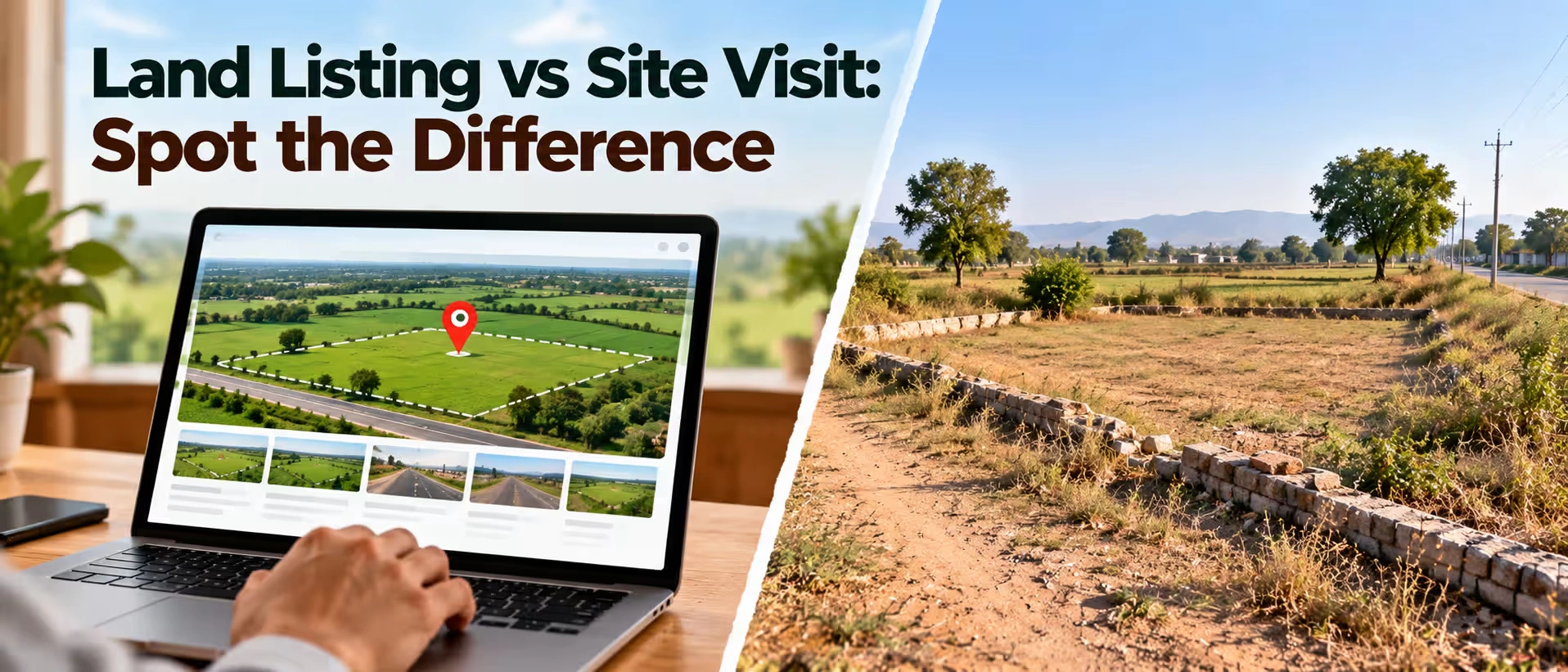
When buyers scroll through land for sale in and around me and choose a few favorites, then one question about buying the property usually gets omitted. Even if the plot looks fine in the drone image does not mean that the land has an official right of access. If there is only a neighbor's field that is used to reach it, then the buyer depends on his will forever. What should be confirmed during the visit:
- If there is a motorable road leading to the plot and to whom it belongs
- If the plot boundaries match the boundaries shown on the map, and if any boundary stones are missing or moved
- If somebody is cultivating it, grazing cattle, or residing
- If there is any power line, canal, pipelines, or drains passing across it
- Is a neighbor likely to object if a buyer fences the land
Spend some time talking to people in nearby fields and the village. They may share details the seller leaves out, such as whether the plot floods during the monsoon or has a history of boundary disputes. These local insights can help you understand the difference between cheap land and undervalued land before making a purchase.
Water, Soil and Land Use
Water determines what can be grown and the cost of growing it. Find out how deep the borewell already dug is, for how many months it provides water, and if the neighbors have recently been forced to go deeper. In case there is any canal or river close by, check if the property has any right over the water body or not.
Soil analysis also needs to be carried out properly. A visual analysis can give some clues, but an actual lab analysis will provide the pH value, organic carbon content, salinity, and nutritional composition of the soil. Soil test facilities are available from the state agriculture department and various Krishi Vigyan Kendras at nominal cost.
While searching for farm lands near me on the internet, one must consider the issue of land use status as well. The property may be listed as agricultural land in records, but may be classified under a different use category in the development plan of the local government.
| What to check | Where to check it | Why it matters |
| Land use classification | Revenue office, local development authority | Decides whether you can build or convert |
| Soil health | Government or private soil lab | Affects crop choice and yield |
| Water source and depth | Local farmers, borewell records | Affects irrigation cost |
| Flood or waterlogging history | Neighbours, village panchayat | Affects crop loss risk |
| Buyer eligibility rules | Revenue department | Some states restrict non-farmers from buying agricultural land |
That last row catches people off guard. Several states place limits on who can buy agricultural land, and a sale to an ineligible buyer can be questioned or cancelled later. Confirm your own eligibility before you commit to anything.
Dues, Loans and Legal Cases
You could directly enquire from the seller if the land has been mortgaged for crop finance or Kisan Credit Card. Sometimes, banks don’t update their entries in the revenue record in time; so even if the mortgage was paid off long ago, it may appear in the record. In case there is an existing mortgage, the bank has a stake in the land, and you need its clearance for the transaction.
Land revenue or taxes paid to the local body must be up-to-date too. Enquire about the last receipt. The dues, in some cases, are inheritable by the buyer.
Now, see if there are any legal proceedings involving the land. You can go through the e-Courts website by entering the name of the seller and the district where the land is located. You can also ask a local advocate to check if there are any litigation cases pending in the civil court against the seller.
How to Tell Whether the Rate Is Actually Low?
A plot is cheap only in comparison with something. Before you decide that a price is too good to ignore, collect three or four recent sale rates for similar land in the same village or the next one. Registered sale deeds at the sub-registrar office are the most reliable source, since asking prices on listings are often higher than what the land finally sells for.
Compare the circle rate or guideline value too. If the quoted price is far below the government rate, that gap can raise questions about how much of the payment will be shown in the deed, and it can create tax trouble for you as the buyer. Land selling at a price that looks unrealistically low is something to understand, not something to grab.
You can also judge the rate against what the land can earn. If the plot has reliable water and good soil, a price slightly above the local average may still be better value than a bargain plot that needs a new borewell, a new road, and two years of soil repair.
A Short Checklist Before You Pay a Token Amount
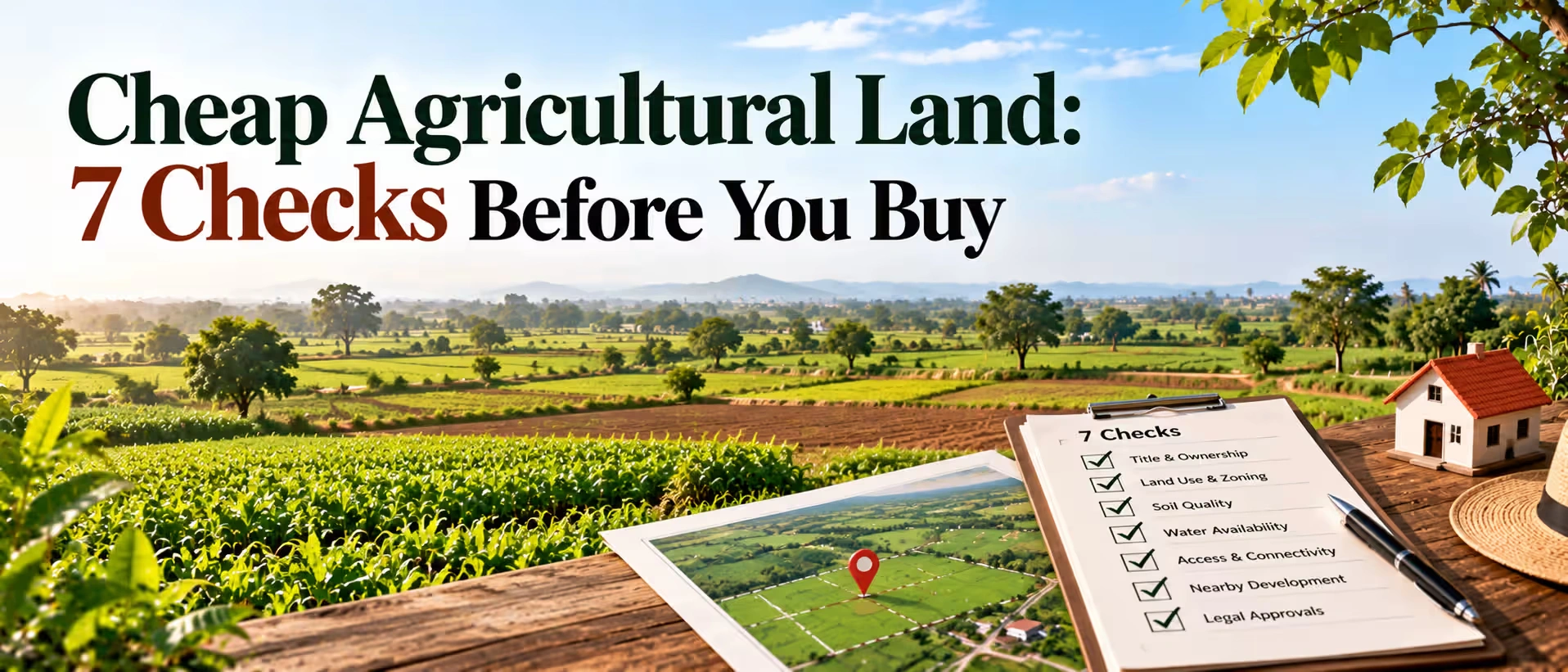
- Seller’s name is verified against the title document.
- Mutation is complete and current.
- All co-owners consent or authorize in writing.
- Encumbrance Certificate is obtained.
- Boundaries are as per the land layout plan.
- Road accessibility is documented by written proof.
- Water and soil are tested.
- Land usage is farming land not earmarked for acquisition.
- There are no existing loans/ dues/pending cases.
- Your own eligibility for buying is verified.
- Deeds of sale from nearby land in recent times are compared with your quoted price.
Even if two or three items in the above list are not clear, do not hand over the token money till it gets cleared. A real buyer will not have any problem waiting for a few days.
Using 2Bigha to Shortlist and Verify Land
All this is feasible on your own; however, it may take quite some effort and traveling. 2Bigha is an e-marketplace of agricultural lands in India, created in such a way that a buyer could compare offers, check information about the location, and ask for verification all from one place. A buyer can browse through listings on the website, order Background Verification Reports, and schedule a site visit using Book a Visit, without having to contact the brokers separately.
If you are going to sell your land, the process will be reversed, but on the same platform. Selling land via a verified listing means showing your property to those people who are looking for agricultural land, and keeping all the documents in one place. In either case, the idea is to minimize surprises between shortlisting a plot and signing the deed.
Disclaimer: This article is for informational purposes only and should not be considered investment, legal, financial, or property advice. Real estate regulations, infrastructure plans, market conditions, and government policies may change over time. Readers are advised to verify information with relevant authorities and consult qualified professionals before making any investment or property-related decisions.