List Your Land
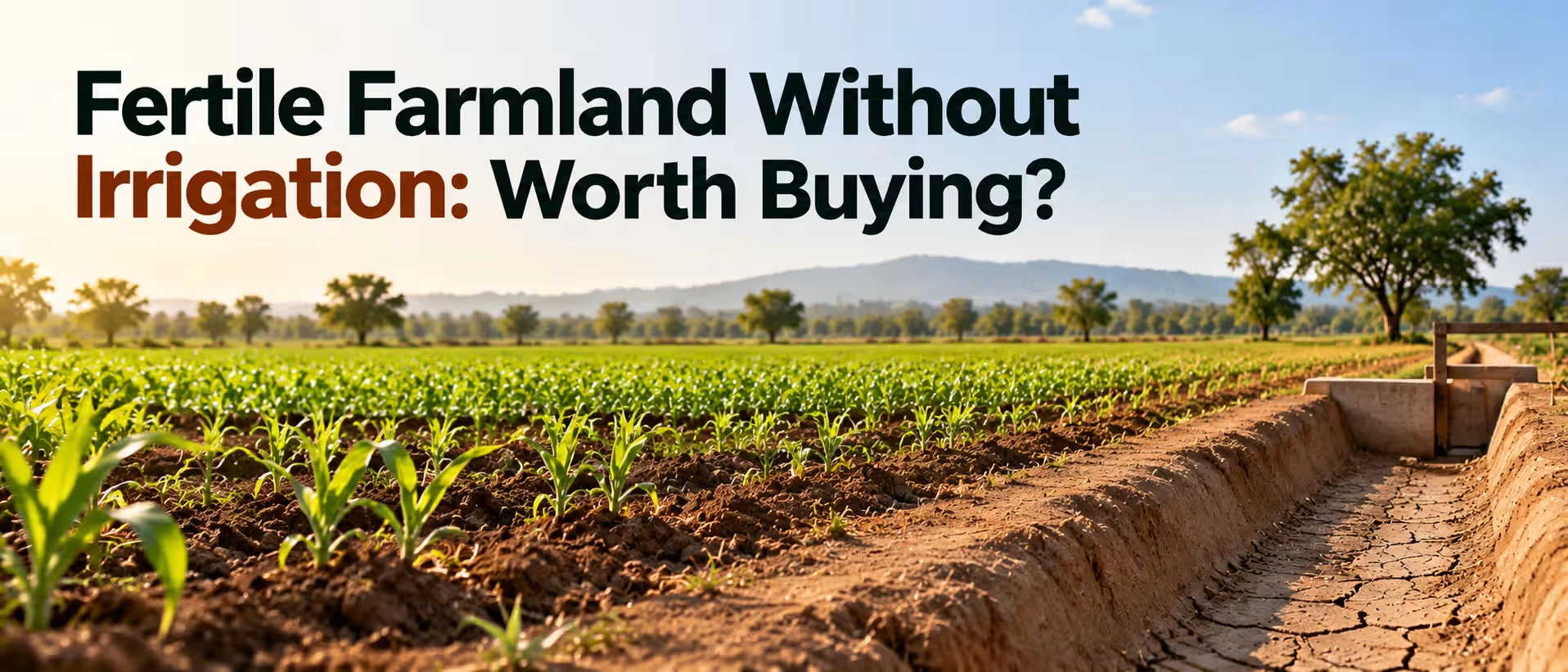
Almost every farmland search throws up a few listings that look too good to ignore: deep black or alluvial soil, a road on one side, and a price well below the irrigated plots around it. The catch is usually in the fine print, because there's no borewell, no canal, and no tank nearby. Whether that land is a bargain or a trap depends on your plan for it, your budget, and how much water you can realistically bring in later. This guide walks through how rainfed land behaves, what to check before paying, and when it actually makes sense.
What "Without Irrigation" Really Means?
An uncultivated plot without irrigation is not necessarily a plot without water. This is because an assured supply of water is missing, so there is no need to turn it on when the crop needs it. In almost all cases, this kind of plot will be rain-fed; and so, the farmer will have to rely on the monsoon and moisture left in the soil. There are certain impacts that come with this:
- Only one crop can be grown in a year, mainly during the kharif season.
- A bad or late monsoon affects the whole season’s earnings.
- Crop options become limited to drought-resistant crops.
- Land prices remain low; thus, fewer chances of rapid appreciation.
The fertile soil helps here, because the moisture retained by the fertile soil leads to higher yield in bigha than poor soil receiving the same rainfall.
Where Fertile but Unirrigated Land Can Make Sense?
It's not compulsory to have a borewell right from day one by any buyer. There are certain scenarios where rainfed land would do just fine.
Your choice of crops requires a minimum water supply. Millets, pulses, groundnut, mustard, gram, jowar, or similar crops are planted on rain-fed land in different states. Your profit won't be equal to the crops grown in irrigated lands like vegetables and sugarcane; however, it will cost much less.
Your purchase is for future use. Some buyers purchase cheap land and arrange for a water source through the way of a borewell, farm pond, or even a canal. When the place is expected to have an irrigation facility, then there would be huge gains from the same, but it's purely a risky venture and requires proof like sanctioned projects.
You have plans for a farmhouse, plantation, or a plot just for weekends. If your intention to buy a piece of agriculture land for sale is to build a house, plant some trees, or use it as a weekend retreat, then much water won't be needed.
Where It Goes Wrong?
The biggest danger lies with buyers who see fertile land and believe that the water issue will take care of itself. The following are some of the most common issues:
- The level of the groundwater is deep, or the groundwater has declined in previous years, making a bore well either expensive or impractical.
- The water that comes to the surface is salty or too hard for agricultural use.
- The land falls within an overexploited or critically overexploited water zone for which a permit would be required to dig another bore well.
- There is no access to a canal due to the distance from it.
- "Water is available in abundance around the place" is said by the vendor, but nothing in writing is shown.
While considering plots of land near me for purchase, buyers need to consider water separately on their checklist alongside others like title deed and accessibility.
Read More: Own Farmland Already? More Land or Liquid Assets for Your Money
Water Checks to Do Before You Pay
Investigate these aspects prior to discussing the price.
- Talk to nearby farmers. Ask them about the depth of their borewells, amount of water available, and whether there are any dry borewells. They will be more aware of the soil than anyone else listed.
- Check the groundwater information. The groundwater department of the state governments and the Central Ground Water Board issue district- and block-wise reports on the status of the block, whether it is safe, semi-critical, critical, or over-exploited.
- See the rainfall pattern. The India Meteorological Department publishes the rainfall details of the district. See how many poor monsoon years the area has experienced.
- Identify the nearest canal, tank, or river. Identify whether the plot lies in a canal command area and whether there are any water rights in the land records.
- Inspect the land in the dry months. Inspect the land in April or May when water stress is visible. The land which looks green in August can be dry in summer.
- Get the soil and water testing done. A soil test report and a water quality test are inexpensive as compared to the cost of purchasing the land.
Ways to Bring Water to Rainfed Land
If you decide to go ahead, there are several routes. Costs depend on the area, soil, depth, and size of the plot, so get local quotes before you commit.
| Option | Works best when | Things to watch |
| Borewell or tubewell | Groundwater is at a reasonable depth | Failure risk, depth, power or solar cost, local permission |
| Farm pond | Rainfall is decent, and land has some slope | Land taken up, lining cost, evaporation |
| Rainwater harvesting | Roof or ground catchment is available | Only useful for modest needs |
| Canal or lift irrigation | A scheme or source is close by | Approvals, shared access, delays |
| Drip or sprinkler system | You already have some water | Saves water but doesn't create it |
Drip and sprinklers are often mentioned as the answer, but they only stretch what you have. They can't fix a plot with no source at all.
Is It Worth It? A Quick Comparison
| Factor | Rainfed fertile land | Irrigated land |
|---|---|---|
| Purchase price | Usually lower | Usually higher |
| Crops per year | Mostly one | Often two or more |
| Income stability | Depends on monsoon | More predictable |
| Extra investment | Often needed for water | Lower |
| Resale demand | Narrower | Broader |
| Best for | Low-water crops, long-term holders, farmhouses | Commercial farming, steady income |
In short, the land is worth buying when the price gap is large, a water source is realistic, and your plan fits dry-land farming. It's not worth it when you're counting on two or three crops a year with no proven water.
If You're the One Selling
Owners of rainfed land often wonder how to price it fairly. In land selling, buyers ask about water first, so have the facts ready: borewell details of nearby plots, rainfall history, soil report, and any canal plans. A seller who shows these honestly usually closes faster than one who avoids the topic. If you decide on selling property online, add clear photos taken in different seasons, the khasra or survey number, and a short note about the best crops for the area, which helps serious buyers decide quickly.
How 2Bigha Can Help?
2bigha is an Indian market for farm lands where you can search for farm land for sale in the various states and view them and even book an appointment prior to making a decision. When searching for farmlands near me type inquiries, the team assists in assessing the availability of water, land documentation, as well as surrounding areas prior to paying for them. Farmers can also put up their farmland on 2bigha.ai.
Quick Checklist Before You Buy
- Discuss with at least three neighboring farmers about water
- Check the groundwater classification of the block
- Look into rainfall for several years past
- Visit the site at least once during the dry period
- Undertake tests for soil and water
- Ensure good title and mutation and an access road
- Cost of water augmentation versus price differential
Disclaimer: This article is for informational purposes only and should not be considered investment, legal, financial, or property advice. Real estate regulations, infrastructure plans, market conditions, and government policies may change over time. Readers are advised to verify information with relevant authorities and consult qualified professionals before making any investment or property-related decisions.