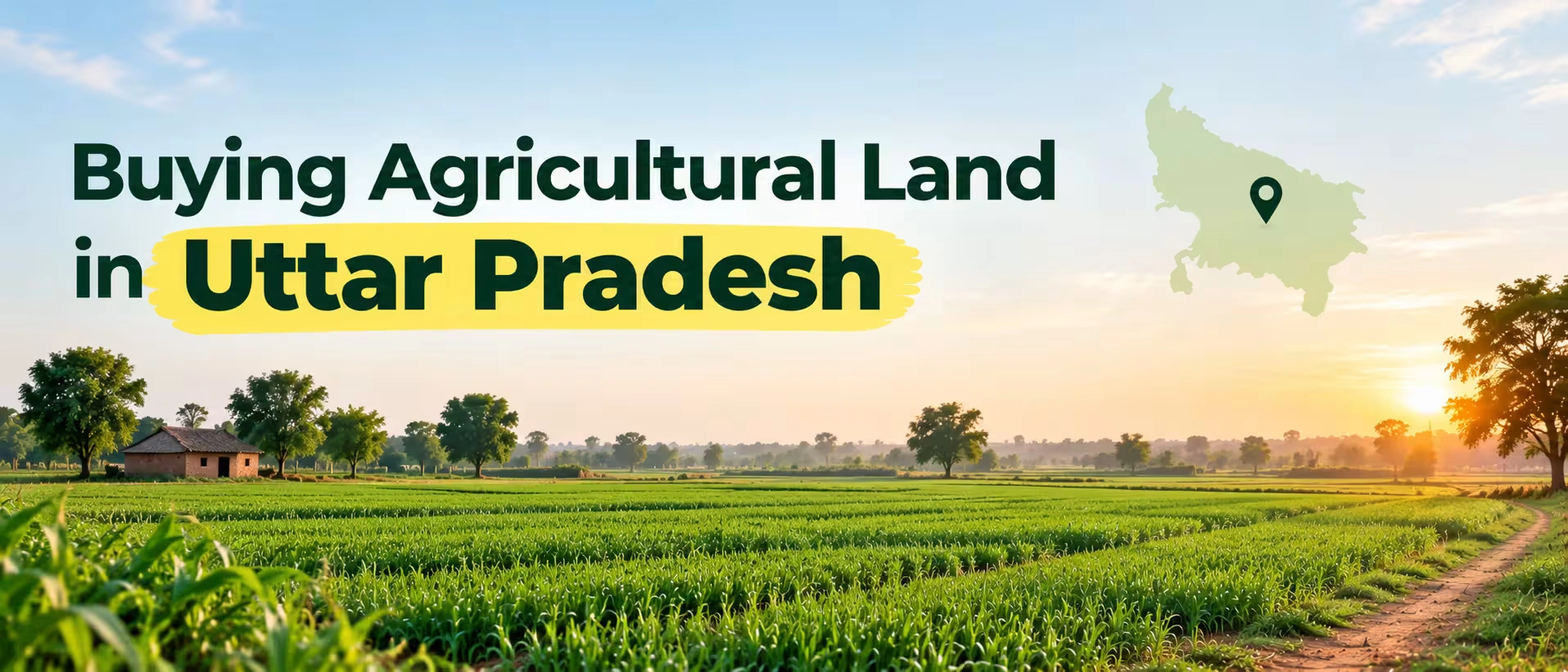
Uttar Pradesh is one of the biggest farming states in the country, and you can see it the moment you leave a city. Drive an hour in any direction, and you'll pass wheat, paddy, sugarcane, or a mango orchard. So it's no surprise that many first-time buyers start their search with agricultural land for sale in Uttar Pradesh. The catch is that the state is huge, the rules are specific, and a deal that looks simple can get messy fast. This guide covers where to look, what the law says, which papers to check, what it costs, and how to close without regrets.
Why Buyers Keep Looking at Uttar Pradesh?
There are a number of factors that continue to attract people to the state. The Gangetic plain region provides it with fertile soil, and canals and tube wells are common throughout the area. Expressways and the Defence Corridor have made it possible for some districts, which were earlier considered “too far”, to be accessible now. Compared to the price of land offered by Punjab or Haryana, even though it is decreasing near highways, the entry price of land in most of the districts is still lower. Here are some of the factors that motivate buyers:
- Income from agriculture through wheat, rice, sugarcane, and potato
- Orchard and horticulture, particularly mango and guava
- Investment in land in anticipation of future appreciation in upcoming corridors
- Weekend farmhouse near Delhi, Lucknow, or Kanpur
Know the Main Regions Before You Pick a District
The state isn't one market. It's several, and each behaves differently. Spend an afternoon understanding this table before you spend a rupee.
| Region | Example districts | What the land is known for | What to watch out for |
| Western UP | Meerut, Muzaffarnagar, Saharanpur, Bijnor | Sugarcane, wheat, strong irrigation | Higher prices near NCR, small split holdings |
| Awadh and Central UP | Lucknow, Barabanki, Sitapur, Raebareli | Mixed crops, mango belt, city growth | Fast price jumps near Lucknow |
| Bundelkhand | Jhansi, Banda, Chitrakoot, Lalitpur | Pulses, lower prices, large plots | Water shortage, check irrigation first |
| Purvanchal | Gorakhpur, Azamgarh, Ghazipur, Varanasi | Paddy, wheat, expressway corridors | Flood-prone patches, family disputes |
| Terai | Pilibhit, Lakhimpur Kheri | Rice, sugarcane, fertile belt | Forest and wildlife area limits, waterlogging |
When you search for farm land for sale in Uttar Pradesh, you'll notice that listings bunch up near highways. That's normal. Just don't pay an expressway premium for a plot that has no proper approach road. A field two kilometres inside, reached by a kutcha path, is a different product altogether.
What the Law Says About Who Can Buy?
The regulations regarding farmland in the state are found in the Uttar Pradesh Revenue Code, 2006. You do not have to read through the entire document. The relevant provisions are those below:
- Holding Ceiling: Usually, a person or family can own up to 12.5 acres of land in total. A sale beyond the above would leave room for contestation.
- Types of ownership: Bhumidhar land with transferable rights can be sold, while land with non-transferable rights would first require a license from the district magistrate.
- Scheduled Castes' landowners: Any land owned by an SC member family cannot be bought by another family without being granted permission from the district magistrate.
- Land from Government or gram sabhas: Stay away from such land. Some landowners are unaware that they may not be able to buy the land because of disputes over the same with the gram sabha land.
- NRIs and OCIs: According to FEMA, NRIs and OCIs cannot buy agriculture land or a farmhouse.
Amendments have been made concerning land conversions and land buyers across different Uttar Pradesh districts over time. Check the Uttar Pradesh Districts List 2026 and confirm the current rules before making any advance payment to a seller.
Step by Step: How to Buy Farmland Safely?
Step 1: Decide what the land is for
Farming, an orchard, a long hold, or a farm stay? The answer changes your budget, your location, and the size you need. Write it down before you visit anything.
Step 2: Visit the site more than once
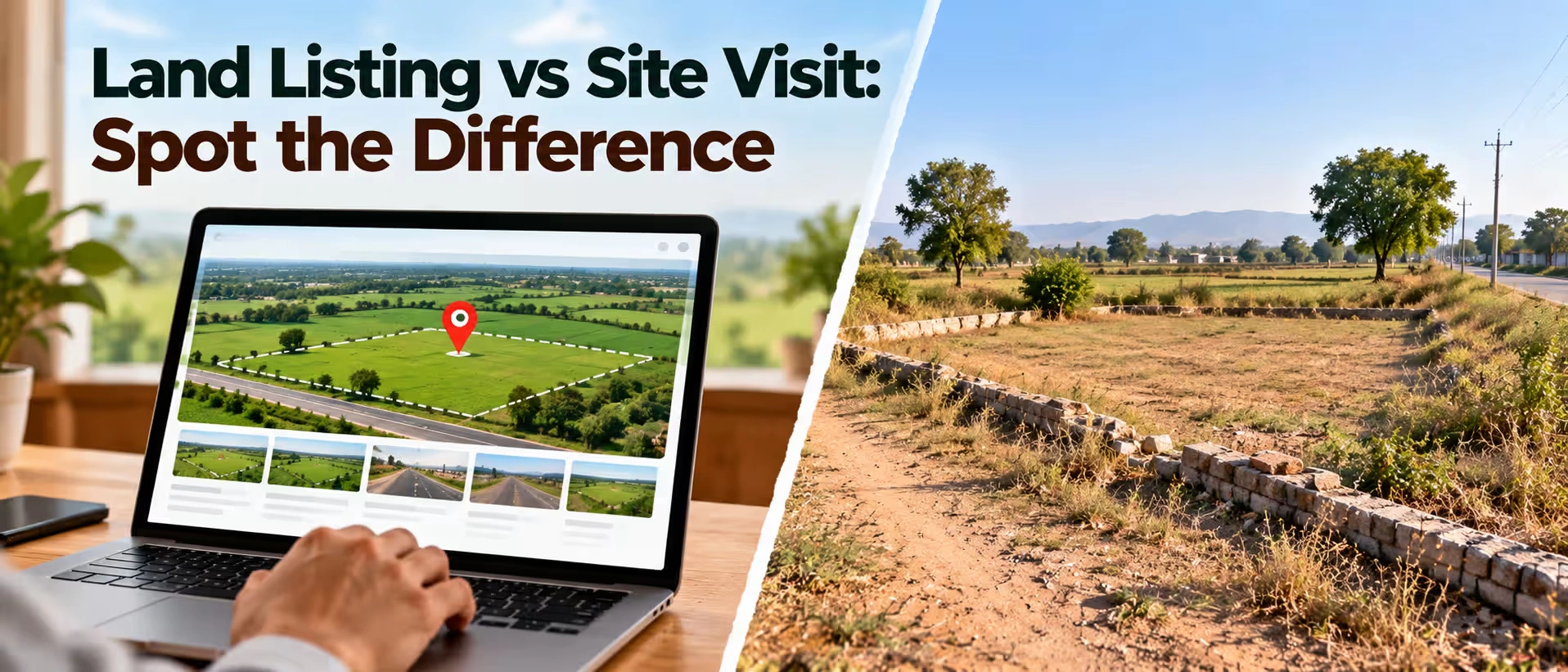
Go in the morning and again after rain if you can. Look at the approach road, water source, soil colour, neighbouring crops, and whether anyone is actually farming it. Talk to two or three people in the nearest village. They'll tell you things no document will.
Step 3: Pull the land records
UP records are online on the state's Bhulekh portal. Search by district, tehsil, village, and Gata (plot) number, then check the Khatauni and the field map. If you want a full walkthrough of the map, our guide on the Aks Shajra in Uttar Pradesh is a useful read.
| Document | What it tells you | Where to get it |
| Khatauni | Who owns and holds the land, area, and entries | Bhulekh UP portal or tehsil |
| Khasra or Gata number | The exact plot and its recorded area | Bhulekh UP portal |
| Aks Shajra (field map) | Shape of the plot and its boundaries | Bhulekh UP portal or Lekhpal |
| Seller's earlier sale deed | How the seller became the owner | Sub-Registrar office |
| Encumbrance certificate | Loans, mortgages, and attachments | Sub-Registrar office |
| Land revenue receipts | Whether dues are cleared | Tehsil |
Step 4: Verify the seller
The name on the Khatauni should match the name on the ID. If the land came through inheritance, every legal heir has to sign. One missing sibling is enough to freeze a deal years later.
Step 5: Check for loans and court cases
Many farmers hold Kisan Credit Card loans against their land. Ask for a no-dues letter from the bank, get the encumbrance certificate, and run a quick search for pending cases at the local civil court.
Step 6: Check the boundaries on the ground
Request the Lekhpal or any private surveyor to measure the land and mark the corners. Compare the field with the Aks Shajra. A field that is "two bigha" on paper but a little less in reality is more common than one thinks.
Step 7: Sign an agreement and give token money
Write down the price, terms of payment, time frame, and consequences of default by any party in an agreement. Don’t make big cash payments without a receipt.
Step 8: Register the sale deed
The sale deed is signed before the sub-registrar, in the presence of two witnesses. The process of registration is done via the state’s IGRS portal, where the slots can be booked online.
Step 9: Mutation
People skip this step, and it costs them dearly later. After the registration, dakhil kharij should be applied for to get yourself registered in place of the seller in the revenue record.
What Does It Really Cost?
Don't budget only for the price per bigha. Add the extras.
Cost | Rough guide | Notes |
Stamp duty | Around 7% of sale price or circle rate, whichever is higher | A rebate for women buyers may apply |
Registration fee | Around 1% | Check the latest slab on the IGRS portal |
Legal and document fees | Varies by lawyer and case | Worth paying for on any large plot |
Survey and demarcation | Small, per visit | Do it before paying the balance |
Mutation fee | Low | Plus time and follow-up |
Rates get revised, so confirm them on the official portal before you finalise the number.
Mistakes That Cost Buyers the Most
- Purchase from photocopies of the Khatauni rather than getting an online copy
- Reliance on brokers regarding demarcation of boundaries
- Neglect of co-owners residing elsewhere
- Full payment before the deed registration process
- Skipping the mutation stage even after a deal
- Acquisition of a plot without a proper road passage
How to Sell Land in Uttar Pradesh the Right Way?
Maybe you're on the other side of the table. If you plan to sell land in Uttar Pradesh, the preparation is almost the mirror image of buying. Buyers look for clean papers, so give them clean papers.
- Ensure that your paperwork is up-to-date. You must have your name on the recent Khatauni, and your share of the property should already be mutated.
- Pay off all your dues and loans, and get a no-dues letter from the bank.
- Have all necessary papers at hand – old deeds, bills, the map, and your identity card.
- Ask for the proper price. Check the circle rate against the value of nearby plots.
- Be straightforward about the access route, water, and possible disputes – this will make things simpler.
- Register the document and help the buyer mutate it.
Regarding the tax question, the rural agricultural plot that is outside of certain distances from a municipality is generally not considered a capital asset, and thus no capital gains tax applies. However, it changes if the property is located near a city. Consult with a chartered accountant before signing.
Find Verified Land with 2Bigha
Going through forwarded WhatsApp messages and local brokers is time-consuming, and it's hard to know whom you can trust. 2Bigha is a platform designed only for agricultural land and farmland in India. It allows you to search for agricultural land for sale in Uttar Pradesh on one single website and use Background Verification Reports to see what's really behind the offer. Once you find the plot that suits your needs, you can use Book a Visit and see it in reality.
Landowners can list their land on 2Bigha as well. Selling land in Uttar Pradesh means reaching genuine buyers interested in farmland without waiting for a potential buyer to contact you. In addition, you can learn what a 2Bigha Land Report includes before buying a piece of land.
Disclaimer: This article is for informational purposes only and should not be considered investment, legal, financial, or property advice. Real estate regulations, infrastructure plans, market conditions, and government policies may change over time. Readers are advised to verify information with relevant authorities and consult qualified professionals before making any investment or property-related decisions.