Bulandshahr has quietly moved from a "wait and watch" district to one of the more talked-about names in NCR's land investment circles. Ask any broker in Khurja or Sikandrabad what's changed in the last two years, and the answer is almost always the same — road connectivity, industrial spillover from Greater Noida, and the pull of the upcoming Noida International Airport at Jewar. This piece looks at where the real opportunity lies in 2026, how to evaluate a plot in Bulandshahr properly, and what buyers and sellers of agricultural land need to know before signing anything.
Key Takeaways
- Bulandshahr's growth is driven by three real, verifiable factors: NH-91 (GT Road) connectivity, proximity to the Jewar airport corridor, and industrial expansion around Sikandrabad and Khurja — not just speculative hype.
- Agriculture land for sale in Bulandshahr remains cheaper than neighbouring Greater Noida and Dadri belts, but pricing varies sharply by tehsil, so location-level research matters more than district-level averages.
- Buying agricultural land in Uttar Pradesh comes with legal boundaries — land ceiling limits, bhumidhari rights, and SC/ST transfer restrictions — that every buyer should verify before booking a plot.
- Sikandrabad, Khurja, Jahangirabad, and the GT Road belt near Aurangabad/Agota are currently the most active micro-markets for future appreciation.
- If you're looking to sell land in Bulandshahr, correct documentation and mutation records matter far more to a serious buyer than the asking price.
Why Bulandshahr Is on Investors Radar in 2026
A decade ago, Bulandshahr was seen mostly as an agricultural district sitting between Delhi and Aligarh — known for pottery in Khurja, sugarcane fields, and a fairly sleepy real estate market. That picture has been changing, and it's worth understanding why before you put money into any plot.
The district sits directly on NH-91 (GT Road), which connects Delhi to Aligarh, Kanpur, and further into eastern UP. This single road has done more for Bulandshahr's property market than any single government scheme, because it puts industrial towns like Sikandrabad and Dadri within a comfortable commute of Greater Noida. The Eastern Peripheral Expressway also touches this belt, with an interchange planned near Dankaur that feeds directly into the GT Road corridor — and that's not a small detail for anyone tracking logistics-driven land demand.
Then there's Jewar. The Noida International Airport is still under construction, but the ripple effect on land prices across the entire Yamuna Expressway and GT Road belt has already started. A 25-km, four-lane link road connecting GT Road (and effectively the Khurja–Bulandshahr stretch) to the airport has been approved by the UP government, specifically to improve multi-modal connectivity between Bulandshahr, Meerut, Ghaziabad, and the airport zone. That's the kind of infrastructure commitment that genuinely shifts land value over a 5–7 year horizon, not just a marketing line used by local dealers.
Add to this the industrial base — Sikandrabad's industrial area has hosted manufacturing units for decades, and Khurja continues to be one of India's recognised ceramics and pottery hubs, exporting to both domestic and international markets. Agriculture is still the largest contributor to the local economy, with wheat, sugarcane, maize, and paddy dominating the cropping pattern, which is exactly why demand for agriculture land for sale in Bulandshahr has stayed consistent even through slower real estate cycles elsewhere.
I'd be doing readers a disservice if I painted this as a guaranteed boom, though. Bulandshahr is still a Tier-3 market in terms of registered transaction volume, and price appreciation here is uneven — some pockets near GT Road have moved meaningfully in the last two years, while interior tehsils have barely budged. That unevenness is exactly why picking the right micro-market matters more than picking the district.
Also Read: Sahibabad Land Investment: Is 2026 the Right Time to Buy?
Best Areas to Watch for Future Growth
Here's an honest breakdown of the pockets that are actually seeing buyer interest right now, based on connectivity, industrial proximity, and upcoming infrastructure — not just brochure promises.
Sikandrabad and the GT Road industrial belt remain the strongest bet for anyone thinking commercially. This is the closest Bulandshahr sub-market to Greater Noida and Dadri, and it already has an established industrial base. Land here trades at a premium compared to the rest of the district, but the demand is real — driven by warehousing, small manufacturing units, and logistics operators looking for cheaper land than Greater Noida offers.
Khurja deserves attention beyond its pottery legacy. With the proposed link road to Jewar airport routed through this stretch, Khurja is positioned to benefit from both industrial and residential spillover. It's also a well-established town with its own local economy, so it isn't purely a speculative play — there's genuine local demand backing up any investor interest.
Jahangirabad and Shikarpur, tehsils to the northeast of Bulandshahr city, are seeing early-stage interest from buyers looking for larger agricultural holdings at lower entry prices. These areas are less connected right now, but they sit within the district's broader growth corridor and tend to attract long-horizon investors rather than quick flippers.
Aurangabad and Agota, closer to Bulandshahr city itself, work well for buyers who want a plot in Bulandshahr for eventual residential or mixed use rather than pure agricultural holding. Civil Lines and Avas Vikas Colony within Bulandshahr city continue to command stable values because of their administrative significance and existing infrastructure, though land parcels here are smaller and priced more like urban plots than farmland.
Anupshahr and Debai, along the Ganga belt, remain more agrarian in character. Land here is genuinely cheap, and for buyers specifically looking for farming operations or long-term land banking rather than quick appreciation, this stretch offers real value — provided you're comfortable with a longer wait for infrastructure to catch up.
| Area | Best Suited For | Connectivity Strength | Investment Horizon |
|---|---|---|---|
| Sikandrabad | Industrial / commercial plots | High (NH-91, EPE proximity) | Short to mid-term |
| Khurja | Mixed residential + industrial | Improving (Jewar link road) | Mid-term |
| Jahangirabad / Shikarpur | Agricultural land, land banking | Moderate | Long-term |
| Aurangabad / Agota | Residential plots, urban expansion | Good (near Bulandshahr city) | Short to mid-term |
| Anupshahr / Debai | Farming, low-cost land banking | Limited currently | Long-term |
Agricultural Land vs Residential Plots — What Should You Buy?
This is the question most first-time buyers get wrong, and it's worth slowing down on. A lot of people search for agriculture land for sale in Bulandshahr assuming they can build a farmhouse or convert it for residential use whenever they want. That's not how it works under UP land law.
Agricultural land in Uttar Pradesh stays classified as agricultural until it's formally converted through a land-use change process — this typically involves the district administration and, depending on the parcel's location, the local development authority. Until that conversion is recorded, you legally cannot construct a residential or commercial structure on it, no matter what a local dealer tells you. I've seen buyers in this belt pay for land assuming conversion was "just paperwork," only to find the process takes months and isn't guaranteed.
If your intent is genuinely agricultural — farming, orchards, or long-term land holding — then buying agricultural land in Bulandshahr still makes financial sense given the price gap versus Greater Noida and Ghaziabad. If your intent is to eventually build a home or run a commercial operation, you're better off looking at a plot in Bulandshahr that's already earmarked for residential or commercial use, or budgeting realistically for the conversion process and timeline.
Legal Points Every Buyer Should Check
Uttar Pradesh doesn't follow a simple "only registered farmers can buy" rule the way some other states do, but there are real restrictions that catch people off guard:
- Ceiling limits: Under the UP Imposition of Ceiling on Land Holdings Act, an individual or family unit is generally capped at around 12.5 acres of agricultural holding, subject to how the family's existing holdings are counted. This isn't a formality — exceeding it can invite legal complications.
- Bhumidhari rights: The seller needs to hold transferable rights (bhumidhari with transferable rights) over the parcel. Land held under non-transferable rights, or by an asami, generally cannot be sold, and any such transfer risks being void.
- SC/ST land transfers: Land originally allotted to a Scheduled Caste or Scheduled Tribe bhumidhar cannot be sold to a buyer outside that category without prior written permission from the Collector.
- Foreign nationals and NRIs: A person who is not an Indian citizen generally cannot acquire agricultural land in UP without prior government approval, and NRIs face restrictions under FEMA on purchasing (though not inheriting) agricultural land.
None of this should scare you off — it just means due diligence isn't optional. Pull the khatauni (record of rights), check the mutation history, and confirm the land's classification through the local tehsil office or the state's IGRSUP registration portal before you pay any token amount.
How to Search for Land the Smart Way
A genuine farm search in Bulandshahr still runs into a basic problem — a large share of land here isn't listed on any platform at all. Local dealers hold informal inventories, prices are quoted verbally, and the same parcel sometimes gets shown to three different buyers at three different prices. This is where using proper real estate websites actually saves you money and time, not just effort.
Portals that specialise in land and plotted development — rather than only urban apartments — tend to have better ground-level data for districts like Bulandshahr. This is also where 2Bigha has built a genuinely useful niche: instead of treating land listings as an afterthought to residential projects, the platform focuses specifically on plots, agricultural parcels, and farmland across UP's growth corridors, with clearer documentation checks than what you'd typically get from a local agent's WhatsApp forward. For a district like Bulandshahr, where record-keeping is still fragmented, that kind of structured listing and verification genuinely matters — it's the difference between a smooth transaction and months of back-and-forth over missing paperwork.
Whichever platform you use, apply the same filters: verified title documents, updated mutation records, clear boundary demarcation (many disputes here stem from unclear chak-bandi boundaries after consolidation), and — for agricultural land — confirmation of the current land-use classification.
Selling Land in Bulandshahr — What Actually Gets You a Fair Price
If you're on the other side of the transaction and want to sell land in Bulandshahr, the biggest mistake sellers make is assuming price is the only lever. In my experience tracking this market, buyers — especially serious ones from Delhi-NCR — are far more sensitive to documentation clarity than to a 5-10% price gap.
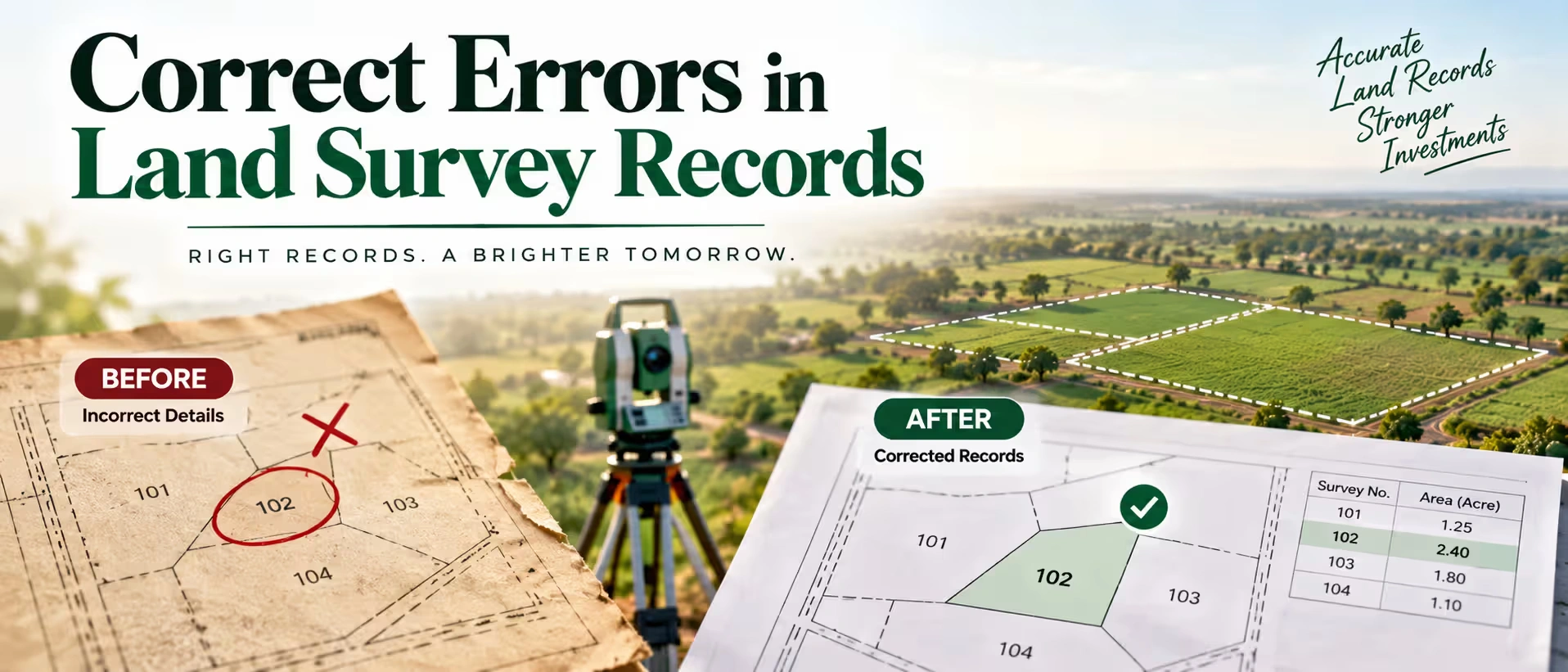
Before listing, get your mutation (dakhil-kharij) updated in your name if it isn't already. Buyers routinely walk away from parcels where the seller's name doesn't match current revenue records, even if the underlying ownership isn't actually in dispute — it just signals risk. Keep your khatauni, sale deed (or inheritance documents), and any encumbrance certificate ready before you start showing the land. If the parcel has multiple co-owners or heirs, get consent documented upfront; a large share of stalled land deals in this belt fall apart at the last stage because one family member wasn't formally on board.
Pricing realistically also matters more here than in urban markets. Bulandshahr's land values vary by tehsil, road-facing status, and proximity to GT Road or the upcoming airport link — a parcel two kilometres off the highway can be priced 20-30% lower than one directly facing it, and sellers who ignore this gap often see their listings sit unsold for months.
Due Diligence Checklist Before You Buy or Sell
- Confirm current land classification (agricultural vs converted) through tehsil records
- Verify the seller's bhumidhari status and transferable rights
- Check mutation (dakhil-kharij) history for the last 10-15 years
- Physically verify boundaries against the revenue map — don't rely on verbal descriptions
- Confirm there's no pending litigation or Collector-level restriction on the parcel
- Cross-check the registered sale price against circle rates for the tehsil
- If buying for eventual construction, ask specifically about land-use conversion status and timeline
- Keep a lawyer or a documentation specialist involved for the final sale deed review
Where Property Management Fits In
For buyers who won't be physically present in Bulandshahr regularly — a growing segment, given how many investors here are based in Delhi, Noida, or even further away — engaging a property management service for boundary upkeep, tenant/lease coordination on agricultural land, or simply periodic site visits can prevent the kind of encroachment and neglect issues that quietly erode land value over the years. It's a small added cost that protects a much larger investment.
Looking Ahead — Is Bulandshahr Worth It in 2026?
I'll be direct here: Bulandshahr isn't a market for someone chasing quick, dramatic returns. What it offers is a genuinely improving infrastructure story — GT Road connectivity, industrial demand around Sikandrabad, the Jewar airport link road, and consistent agricultural economics — at price points that are still meaningfully lower than Greater Noida or Ghaziabad. That combination tends to reward patient buyers more than speculative ones.
If you're evaluating agricultural land for sale in Uttar Pradesh more broadly, Bulandshahr compares favourably against several other districts precisely because its infrastructure commitments are already funded and underway, not just proposed. That said, do your homework tehsil by tehsil — this is not a district where "Bulandshahr" as a single label tells you enough. The difference between a GT Road-facing plot in Sikandrabad and an interior parcel in Debai is not a small one, and treating them as comparable is how buyers end up disappointed.
Disclaimer: This article is for general informational purposes only and does not constitute legal, financial, or investment advice. Land laws, ceiling limits, and conversion processes are subject to change and can vary by tehsil. Please consult a qualified legal professional and verify all revenue records independently before buying or selling land in Bulandshahr or elsewhere in Uttar Pradesh.