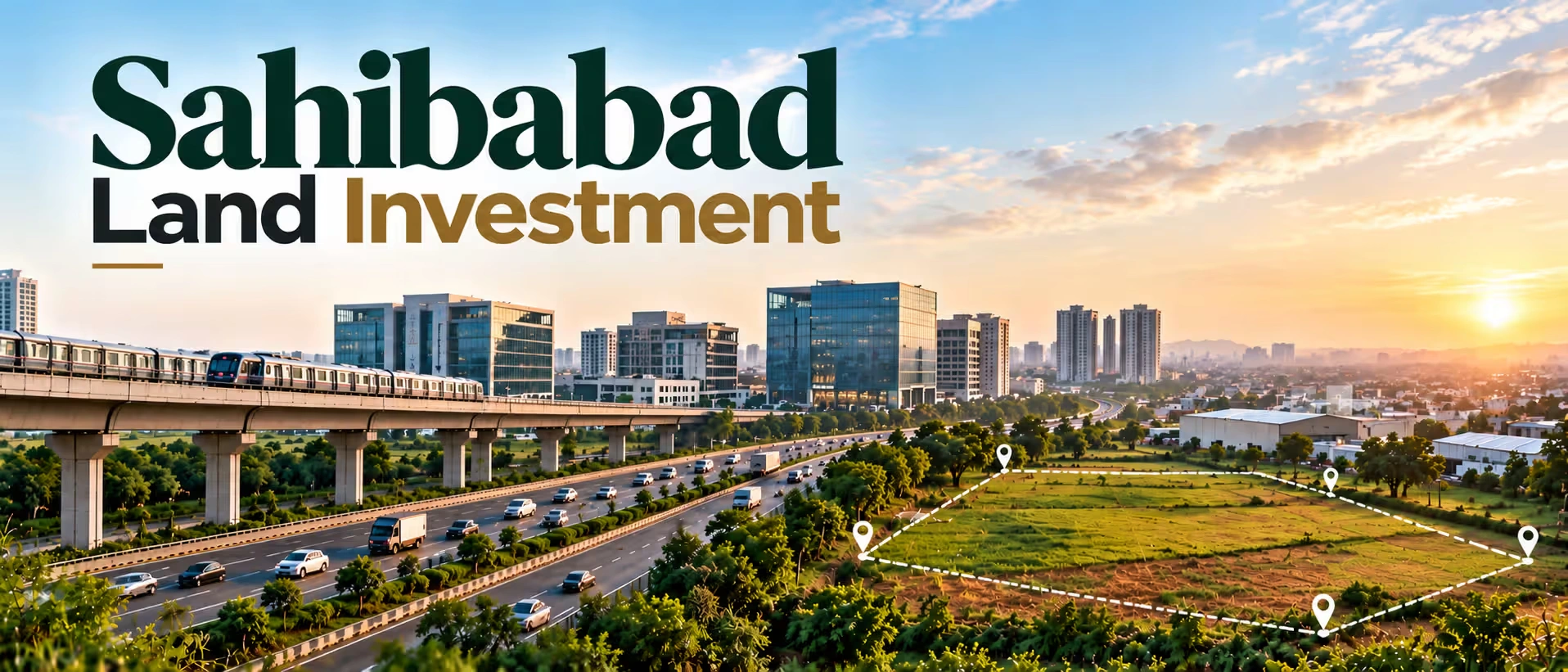
Quick Answer: Sahibabad is turning into one of Ghaziabad's more serious land investment zones in 2026, mainly because the Namo Bharat RRTS corridor is fully operational, industrial and residential demand is climbing together, and land prices along the transit belt have already moved up 35–40% in recent years. If you're looking to buy for the long term (5–10 years), 2026 is a reasonable entry window — but the right plot, the right paperwork, and the right platform matter more than the year on the calendar.
Key Takeaways
- Sahibabad benefits from an operational Namo Bharat RRTS station, direct rail access to Delhi and Meerut, and proximity to the Delhi–Meerut Expressway — all of which have historically pushed up land values in similar NCR corridors.
- Circle rates in Sahibabad currently range roughly between Rs 29,000 and Rs 46,000 per sq m depending on the sector and road width, giving buyers a useful floor price for negotiation.
- A plot in Sahibabad near an established sector or main road tends to hold value better than land in unapproved layouts — always check the master plan zoning before signing anything.
- If you're doing a farmland search in Sahibabad, be extra careful about land-use conversion rules, since agricultural plots can't simply be built on without the right approvals.
- A proposed new RRTS corridor connecting Ghaziabad to Noida International Airport could add another layer of appreciation to the region over the next few years.
Why Sahibabad Is Suddenly on Every Investor's Radar
Ask any broker who's worked the Ghaziabad market for the last decade, and they'll tell you Sahibabad used to be the "in-between" locality — not quite Delhi, not quite the newer Ghaziabad townships, just a busy industrial-residential stretch that people passed through on their way somewhere else. That's changed quite a bit.
The single biggest shift has been connectivity. The Sahibabad RRTS station, part of the Delhi–Meerut Namo Bharat line, has been running since late 2023, linking the area directly to Anand Vihar, Sarai Kale Khan, and further up towards Meerut. For someone commuting to central Delhi or even Meerut for work, that's a genuine game-changer — travel times that used to eat two hours now take a fraction of that.
And it's not just Sahibabad. Industry data shows land values along the RRTS corridor in Ghaziabad have risen by roughly 35–40% over the past few years, and neighbouring Indirapuram has seen an even sharper 73% jump in property prices over five years, according to a Square Yards market report. Sahibabad, sitting right on this same connectivity spine, is riding a similar wave, just a step behind in terms of price appreciation — which is exactly why many investors see it as still having room to run.
There's also a fresh development worth watching: a proposed 72-km Namo Bharat corridor connecting Ghaziabad to the upcoming Noida International Airport at Jewar, expected to cut travel time to the airport down to around 50 minutes. If this project moves forward as planned, areas like Sahibabad that sit along or near future transit nodes could see another round of demand.
Understanding the Land Market in Sahibabad
Sahibabad isn't one uniform block of land — it's a mix of established residential sectors, industrial zones, and pockets that are still agricultural or semi-developed. This matters a lot when you're deciding what kind of land actually fits your goal.
If You Want a Residential Plot in Sahibabad
A plot in Sahibabad located in a developed sector, close to Vasundhara, Vaishali, or the Link Road stretch, generally commands a premium because the infrastructure — roads, drainage, electricity — is already in place. Recent market estimates put the average price per square foot in Sahibabad at around Rs 9,000–9,300, though this varies quite a bit by sector and how close you are to the main roads. Circle rate data shows the gap clearly: land between GT Road and the railway line is priced lower than plots in the "Before Link Road" zone, where rates touch Rs 42,000–46,000 per square metre for wider roads.
The practical takeaway here: don't just look at the sticker price of the plot. Walk the area, check whether the road width matches what's mentioned in your sale documents, and confirm the sector falls under an approved layout from the Ghaziabad Development Authority (GDA). A lot of disputes in this belt trace back to plots sold on paper roads that never got built.
If You're Doing a Farmland Search in Sahibabad
This is where I'd urge extra caution. A farmland search in Sahibabad usually leads buyers to the outer fringes — areas still classified as agricultural under the local land-use plan. These plots are often cheaper per acre than residential land, and that's the whole appeal for a lot of first-time land buyers who assume they're getting a bargain.
But here's the catch: agricultural land can't be freely converted to residential or commercial use. You'll need a land-use change (often called "diversion" or conversion permission) from the relevant authority before you can build anything other than farm structures on it. Skipping this step is one of the most common — and costly — mistakes people make when buying agricultural land anywhere in the NCR, not just Sahibabad. Always verify:
- Whether the land falls inside or outside the Ghaziabad Master Plan's urbanisable limits
- The current land-use classification in revenue records (khasra/khatauni)
- Whether any conversion charges or NOCs are pending
- Actual physical access to the plot — many agricultural parcels are landlocked without a formal right of way
If you're buying purely as a long-term appreciation play rather than for farming, agricultural land near Sahibabad's outer edges can still make sense — but treat it as a 7–10 year horizon investment, not a quick flip.
Price Snapshot: Sahibabad Land Rates (Illustrative)
| Location within Sahibabad | Circle Rate (per sq m, up to 9m road) | Circle Rate (per sq m, 9–18m road) | Typical Use |
|---|---|---|---|
| Between Link Road & Railway Line | ~Rs 29,000 | ~Rs 31,000 | Residential/mixed |
| Before Link Road | ~Rs 42,000 | ~Rs 43,000 | Residential (premium) |
| Between GT Road & Railway Line | ~Rs 33,000 | ~Rs 35,000 | Residential/commercial |
| Shyam Park Main | ~Rs 31,000 | ~Rs 34,000 | Residential |
| Om Nagar | ~Rs 32,000 | ~Rs 33,000 | Residential |
Note: Circle rates are government-notified minimum valuation benchmarks and usually sit below actual market transaction prices. Always confirm current rates with the GDA or a local sub-registrar before finalising a deal.
How to Buy Land in Ghaziabad (Sahibabad Specifically) Without Regretting It
Most people who've been burned in NCR land deals didn't lose money because the location was bad — they lost money because they skipped a document check or trusted a verbal promise from a broker. If you're planning to buy land in Ghaziabad, and Sahibabad specifically, here's a due-diligence sequence worth following:
- Verify the title chain. Get the last 30 years of ownership records, if possible, and confirm there's no pending litigation.
- Check the encumbrance certificate. This tells you if the land is mortgaged or has any legal charges against it.
- Match the layout plan with GDA records. A plot that "looks" developed on the ground still needs to match an approved layout on paper.
- Confirm land-use classification. Residential, commercial, industrial, or agricultural — this single detail changes everything about what you can legally do with the land.
- Visit during both a weekday and a weekend. Traffic patterns, noise levels, and waterlogging (a real issue in parts of Ghaziabad during monsoon) show up differently depending on when you visit.
- Get a local lawyer, not just a broker's word. A property lawyer's fee is small compared to the cost of an unclear title.
This isn't meant to scare anyone off — Sahibabad remains a genuinely promising pocket. It's just that land deals reward patience far more than they reward speed.
Where to Search, List, and Compare: The Role of Real Estate Platforms
A decade ago, buying or selling land in a locality like Sahibabad meant relying almost entirely on local brokers and word-of-mouth. That's shifted heavily online now, and it's mostly a good thing — you get price transparency, photos, and at least a first layer of listing verification before you even step out of the house.
Among real estate websites in India, the more useful ones for land specifically (as opposed to just apartments) tend to focus on verified plot and farmland listings with clear ownership documentation. This is exactly the gap 2Bigha has built itself around — it's designed for land and plot transactions rather than treating land as an afterthought category buried under apartment listings. For someone doing a serious farmland search in Sahibabad or comparing plot prices across sectors, having a platform that actually verifies land documents before listing saves a lot of back-and-forth with unreliable brokers.
If you already own land and are looking to sell land in Sahibabad, the listing platform you choose matters just as much as your asking price. A good listing should include:
- Clear, recent photos of the actual plot (not stock images)
- Exact survey/khasra number and area in both sq ft and sq yards
- Circle rate reference so buyers can sanity-check your asking price
- Road width and connectivity details — this is often the deciding factor for buyers evaluating a plot in Sahibabad
Listing on a platform like 2Bigha that specialises in land transactions, alongside standard advertising on broader property portals, generally gets you a wider, more serious buyer pool than relying on a single local dealer network.
For NRI landowners or anyone managing multiple plots from a distance, it's also worth knowing that many platforms and local agencies now offer a property management service covering everything from site upkeep to tenant/tenant-free monitoring, which can be genuinely useful if you're not based in Ghaziabad year-round.
Sahibabad vs Nearby Micro-Markets: A Quick Comparison
| Factor | Sahibabad | Indirapuram | Loni / Outer Ghaziabad |
|---|---|---|---|
| RRTS/Metro access | Operational RRTS station | Metro + upcoming RRTS | Limited, developing |
| 5-year price growth (approx.) | Rising, tracking RRTS belt | ~73% (Square Yards data) | Slower, more speculative |
| Land type available | Residential + industrial + some agricultural | Mostly residential/developed | Largely agricultural/semi-rural |
| Entry price point | Moderate | Higher | Lower |
| Best suited for | Balanced growth + rental demand | Premium appreciation | Long-horizon land banking |
Is 2026 Actually the Right Time to Buy?
Here's the honest, unhyped view: there's no single "perfect" year to buy land — but there are better and worse phases within a growth cycle, and Sahibabad currently sits in an interesting one. The RRTS infrastructure is already built and running, which means you're not betting on a promise; the connectivity benefit is real and measurable today. At the same time, prices haven't yet caught up to what fully mature corridors like Indirapuram command, which is where the opportunity lies for buyers with a medium-to-long holding period.
Where I'd push back on the "buy now, no matter what" narrative is this: land investment only works if you match the plot type to your actual goal. If you want rental income or quick resale, a residential plot in Sahibabad near an established sector makes more sense than agricultural land. If you're building generational wealth over a decade and can wait out conversion timelines, well-located agricultural land on the city's fringes could offer sharper upside — but only after proper legal verification.
2026 looks like a sound entry point for disciplined buyers who do their homework. It's not the moment for anyone hoping for a guaranteed quick flip.
Disclaimer: This article is for general informational purposes only and does not constitute legal, financial, or investment advice. Land prices, circle rates, and infrastructure timelines mentioned here are based on publicly available data at the time of writing and may change. Please consult a qualified property lawyer, financial advisor, or the relevant local authority (GDA/sub-registrar) before making any land purchase or sale decision.