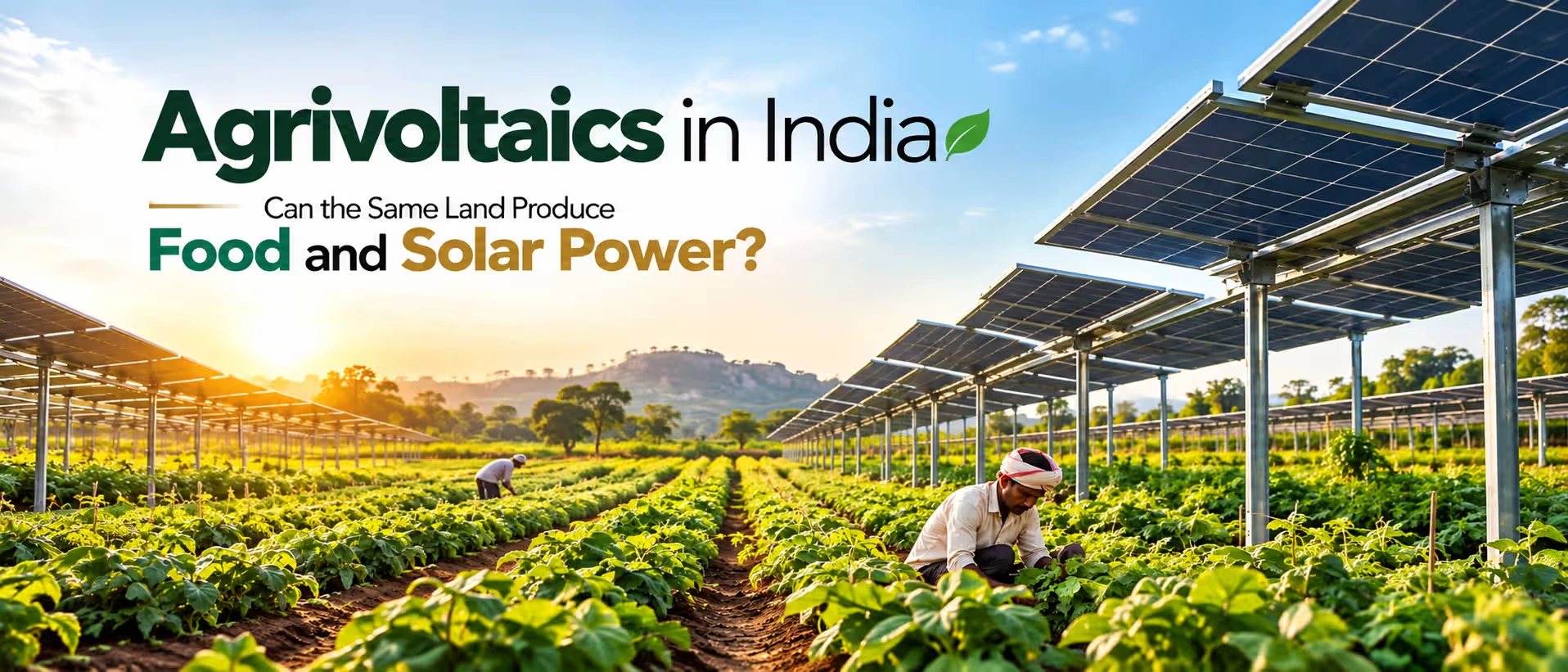
Picture a field with solar panels raised on stilts, sunlight filtering through the gaps, and crops growing quietly underneath. It sounds like something out of a pilot project in Europe, but it's already happening in parts of India, and it's raising a question that farmland owners haven't had to think about before: what if your land didn't have to choose between farming and energy generation? That's the basic idea behind agrivoltaics, and it's slowly becoming relevant to anyone buying or holding farming land in India.
What Is Agrivoltaics, Really?
Agrivoltaics is just the use of a single plot of land for two purposes: crop production and harnessing energy from the sun. The solar panels are put up at elevated heights to allow sunshine to reach the crops planted under the raised platforms where the solar panels are placed.
This is nothing new on a global scale since countries such as Germany, Japan, and the United States have been conducting pilot projects involving agrivoltaics for over a decade now. In India, agrivoltaics has gained momentum due to two reasons coming together at the same time: the need for income generation among farmers and generation of renewable energy.
Why the sudden interest here?
- Farmer can earn not only from crop production but also from electricity production on the same land
- Panels help in reducing the evaporation of water and provide some shade, which is beneficial for shade-loving crops
- Renewable energy goals of India have compelled the state governments to give full support to this concept
- The land that gave only one source of income can give two sources of income now
How This Changes What Makes Land Valuable?
For years, the value of farmland has come down to a fairly predictable set of factors: soil quality, water access, and how close it sits to a market. Agrivoltaics adds a new layer entirely, and it shifts what buyers scanning plots for sale near me might actually be looking for.
| What Mattered Before | What Matters Now, Too |
|---|---|
| Soil fertility | Grid connectivity for feeding power back |
| Rainfall and irrigation access | Sunlight exposure and panel orientation potential |
| Distance to local mandi | Eligibility under state solar-agri schemes |
| Large flat stretches only | Even smaller plots can work with the right setup |
| Single seasonal income | Dual income from crops and power generation |
This doesn't mean every plot suddenly becomes solar-ready. Structural investment, grid access, and crop selection all need to line up. But it does mean land that was previously judged on farming merit alone is now being looked at through a wider lens.
Which Crops Actually Work Under Panels?
Not all crops are suitable for low-light conditions; therefore, agrivoltaics systems usually opt for shade-tolerant crops instead of full-sun crops.
- Leafy vegetables such as spinach and fenugreek fare well in partial shade conditions
- Turmeric and ginger belong to the category of shade-tolerant root crops that have been successful in some pilot projects
- Some pulse crops can adjust reasonably well based on the panel height and distance
- Fodder crops can be considered where grazing land is preferred over food crops
- Most cereal crops such as wheat perform poorly in shade; thus, they are not usually the first preference
It becomes crucial to mention that spacing and panel height play an important role in this regard. In case of poor design of the system, crop yields may be adversely affected.
The Buyer's Perspective
If you're browsing agriculture land for sale with an eye toward future flexibility, agrivoltaic potential is worth factoring in, even if you're not planning to install panels immediately. A few practical checks help:
- Confirm proximity to an electricity grid connection point
- Check whether the state has an active agrivoltaic or solar-agri subsidy scheme
- Look at the land's sun exposure across seasons, not just at one point in time
- Verify there's no existing restriction on land use that would block mixed agri-solar setups
Land that ticks these boxes tends to hold appeal beyond just traditional farming buyers, which can matter a lot if you ever decide to resell.
What This Means If You're Selling?
If you currently own farming land that has decent grid access and sits in a region where state solar policy is active, that's a detail worth surfacing clearly when you list it. A lot of land selling happens through informal, local channels where this kind of nuance simply gets lost. Buyers who understand agrivoltaics are often willing to pay more for land that already has the basic infrastructure in place, but only if they actually know about it. This is exactly where selling property online through a proper listing platform makes a real difference. A niche buyer looking specifically for dual-use agri-solar land isn't going to find your plot through a local broker's phone list. They're going to search for it.
State-Level Support (Illustrative Snapshot)
Support for agrivoltaics varies quite a bit depending on the state, and schemes are updated fairly often. Here's a general sense of what's out there:
| State | Type of Support |
|---|---|
| Rajasthan | Active solar-agri pilot zones and land lease models |
| Gujarat | Strong existing solar infrastructure, growing agrivoltaic interest |
| Maharashtra | Farmer-focused renewable energy schemes with agri tie-ins |
| Tamil Nadu | Research-backed agrivoltaic pilot projects |
Always check current eligibility directly with the state renewable energy department, since these programs shift year to year.
Is This a Real Shift, or Just an Experiment?
Good question indeed. The agrivoltaic systems in India today are not yet mainstream, but it is pretty clear which way things are going. India's renewable energy goals will not be reduced anytime soon, and the availability of land will always remain an issue. Integrating food production and energy production in one area addresses a genuine issue rather than being a fashion trend. In the coming years, it will not be surprising to see some states adopting new policies in favor of agrivoltaics and more customers starting to inquire about grid access, similar to how they are currently doing for water access.
Explore Farmland With Future-Ready Potential on 2Bigha
Whether you're looking for traditional farming land or land with future agrivoltaic potential, having clear, verified details makes the decision easier. 2Bigha helps buyers explore agriculture land for sale across India with background-verified listings and transparent information on location, connectivity, and land specifics. If you're a landowner thinking about selling property online, 2Bigha gives your listing visibility among buyers actively searching for land with genuine long-term value, not just casual browsers scrolling through local classifieds.
Disclaimer: This article is for informational purposes only and should not be considered investment, legal, financial, or property advice. Real estate regulations, infrastructure plans, market conditions, and government policies may change over time. Readers are advised to verify information with relevant authorities and consult qualified professionals before making any investment or property-related decisions.