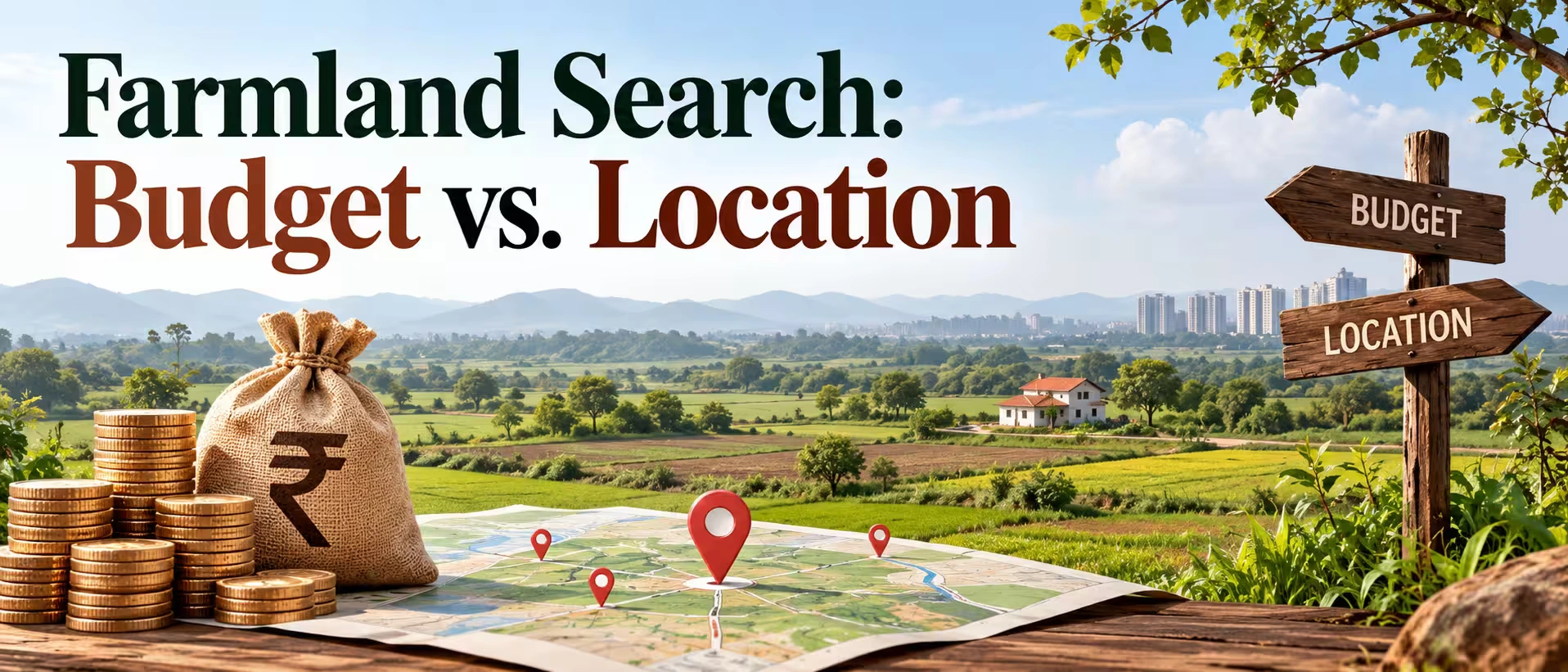
When people embark on searching for agricultural land, they tend to use one of the two common approaches from the outset. Those who have their budget in mind will be curious to know what they will get for their money. On the other hand, those with particular districts or towns in mind may want to see how well they can fare in terms of finding agricultural land in such places. These are both legitimate approaches that will take people to a bad deal if followed blindly.
How a Budget-First Search Works?
In a budget-first search, you fix a number before you look at a single plot. Say you have ₹20 lakh set aside, so you type land for sale near me into a portal, filter by price, and scroll through whatever fits under that ceiling. The appeal is obvious. You don't waste time on listings you can't afford, you avoid getting emotionally attached to a plot that's out of reach, and the whole process feels controlled.
It also suits people who are buying with a loan or with a fixed amount from a sale or a bonus, since there's no flexibility to stretch. A clear ceiling forces discipline, and discipline matters in a market where sellers often quote high and leave room for bargaining.
Where a Budget-First Search Goes Wrong?
The trouble starts when the budget is treated as the price of the land alone. The real cost of buying agricultural land is usually higher than the quoted rate, and people who forget this end up either overspending or cutting corners on checks.
| Factor | Can push price up | Can push price down |
|---|---|---|
| Road and electricity | Direct, legal access | Narrow or disputed lane |
| Land category | Clear private holding | Doubtful or common land entry |
| Future use | Supportive development plan | Green belt or reserved zone |
| Surroundings | Quiet, clean edge | Drain, dumping, noisy activity |
| Water | Reliable source | Falling water table |
If your ₹20 lakh includes all of these, the land itself may only get ₹16 or 17 lakh, which changes what you can realistically shortlist. Another weakness is that a strict budget filter pushes you toward whatever is cheapest in the price band, and the cheapest plots in a band are often cheap for a reason, such as poor access, doubtful records, or a location where nobody else wants to buy.
How a Location-First Search Works?
A location-first search flips the order. You pick a town, a taluka, or a corridor, and then look at what's on offer, whatever the price turns out to be. If you've been searching farm land for sale near me because you want a plot within a two-hour drive of your home, you're already doing this without calling it that.
This method will work best in situations where the place is the main reason for the purchase. It is essential that a weekend farm be accessible. The investment near the upcoming expressway depends on the particular stretch. The farming project is dependent on the soil quality, rainfall, and the market in the area. One can create an image of the area and understand the movement of prices in the area.
Where a Location-First Search Goes Wrong?
A location can get under your skin and cause you to overspend. A piece of land close to the highway, city border, or a well-known tourist destination tends to cost more money, and if you have already settled your mind on the particular piece of land, you won’t be able to resist such price offers. There are additional complications. In the case of a narrow and well-known belt, there can only be four to five options, which leaves the buyer who is rigid about the location with not much choice.
There is yet another complication, since having an impressive name does not always mean the same as having impressive land. A village with an old temple or new road may be lacking in water, be contested property, or not have a right of passage at all.
Budget and Location Side by Side
| Point | Budget-first | Location-first |
| Starting question | How much can I spend? | Where do I want to be? |
| Biggest strength | Keeps spending under control | Builds deep knowledge of one area |
| Biggest risk | Ends up with cheap, weak plots | Overpays for a favourite place |
| Works best for | Fixed funds, first-time buyers | Weekend homes, planned projects |
| Number of options | Wide but scattered | Narrow but focused |
| What it may miss | Hidden costs, access, resale | Price comparison across regions |
Neither column is clearly better. They just solve different problems, so the real skill is knowing which problem you have first.
A Combined Method That Works Better
Most buyers will eventually use both filters in sequence. If you're planning to buy land in Sehore, start by narrowing down locations based on your budget and long-term goals, then compare individual plots for legal clarity, accessibility, and appreciation potential.
- Firstly, figure out your budget for purchasing the land after calculating the total cost of registering and developing the property, and use it to determine the true cost of purchasing the land.
- Secondly, set a travel limit or a limit of regions rather than focusing on one particular village, i.e., everything within a range of about three hours away from your city.
- Then, in those regions, shortlist 2 or 3 belts in which land within your budget can give you some decent value.
- Check out agricultural land for sale near me in those belts and evaluate them based on their accessibility, water availability, paperwork, and chances of resale.
- Finally, select the top 2 or 3, visit them, and check the documentation first before negotiating with them.
Thus, the budget makes sure you don't go overboard, and the location filter makes sure that you do not end up going too far from your planned destination.
Which Approach Suits Which Buyer?
Each type of buyer needs to rely more on some filters than others.
- New buyer without much money: Start with the budget, then find the most connected location within the budget.
- Weekend farm buyer: Start with travel time since you will be commuting to it regularly, then check what your budget allows within the range.
- Investor interested in infrastructure development: Start with the corridor or project, then check how the prices vary along the way and what is reasonable.
- Buyer planning to farm on the land: Start with the soil, water resources, and local market – these factors determine whether the land is profitable.
- Retired person looking for a quiet piece of land: Start with a couple of districts you like, then see what is available in those districts and safe to purchase.
When browsing through a farm for sale, if you cannot figure out which category you fit into, think of which option you would regret more – overspending or being too far from home.
How 2Bigha Helps You Search Both Ways?
2Bigha is an online platform that serves as a marketplace for farmland and agricultural land all over India. It enables you to filter results based on location along with your preferred type of land and budget. This way, it is much easier to experiment with both filtering techniques on one screen and observe their results. After picking the land that suits your needs, you can order Background Verification Reports and Schedule Visit without the help of a broker for every step of this process.
The same logic applies to owners. If you are thinking about selling property online, a good listing needs both the budget side and the location side: a clear price expectation and honest details about the area, access, and water. Buyers who search by budget and buyers who search by location will both land on your page, and that is useful if you want land selling near me style searches to reach people who are actually ready to visit.
Disclaimer: This article is for informational purposes only and should not be considered investment, legal, financial, or property advice. Real estate regulations, infrastructure plans, market conditions, and government policies may change over time. Readers are advised to verify information with relevant authorities and consult qualified professionals before making any investment or property-related decisions.