List Your Land
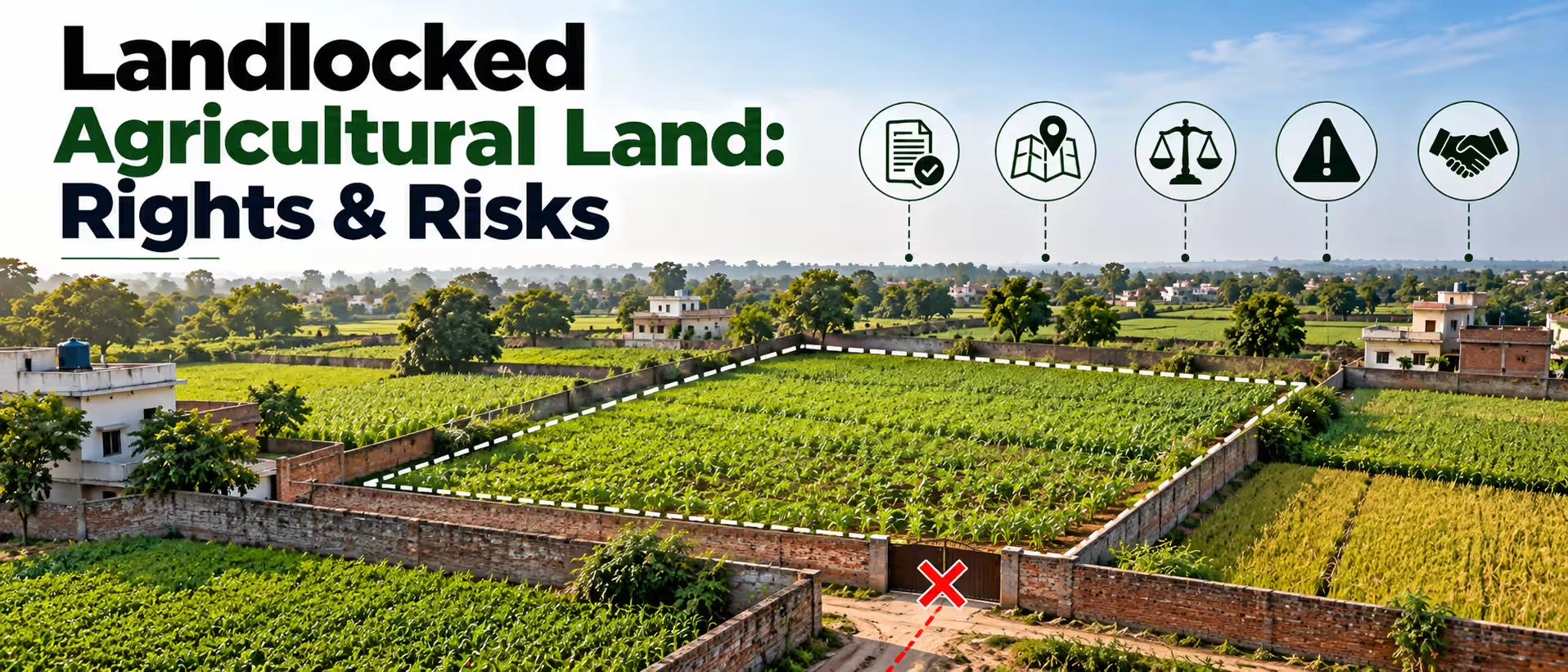
Land located at the back of another person's property is usually sold for much less than the property in front of it, and the price looks like a great deal. The problem is that it will be difficult to farm land that cannot be accessed legally, to obtain financing, and to sell. This guide highlights what the law says regarding access to landlocked land and what to consider before buying.
Why Road Access Decides the Value of a Plot?
Buyers who search for farmlands near me usually compare size, soil and price, and they tend to notice access only when they stand at the edge of the field and see no path. Road access affects almost everything that follows the purchase: moving tractors and harvested crops, bringing in labour and inputs, building a farmhouse or a shed, and getting a valuation or a bank loan.
A plot of land that is surrounded by other lands will have fewer buyers because everyone wants a piece of land that one can access without requesting from a neighbor. It is for this reason that one checks access along with the deed to the land.
What "No Direct Road Access" Actually Means?
Three different situations get lumped together under this phrase, and each has a different legal position.
| Situation | What it means |
| Plot is landlocked, no path at all | The only way in is across someone else's land |
| Plot has a rough track used by farmers | There is a practical path, but its legal status is unclear |
| Plot has a recorded village path or revenue road | Access exists in the records, but it may be narrow or encroached |
The legal question in each case is whether you have an enforceable right to use that route, because use alone, without a right, can be stopped by the neighbour the day the plot changes hands.
Legal Rights of Way: Easement of Necessity and Prescription
An easement refers to the right to pass across another person's land in order to get access to your own land. The law governing easement in India is the Indian Easements Act, 1882. The usual farm search for landlocked pieces of property will always point to two provisions of this Act.
Easement of necessity (section 13). This kind of easement occurs where there is division or sale of land such that one part can only be accessed via the other. It is based on absolute necessity and is created upon the severance of tenements. In a reported case in the High Court, it was found that a cart track was an easement of necessity as it was the only means of accessing the plaintiff's land. The partition deed was found to cater for it despite it not being written in the deed. The courts take the word 'necessity' literally. In another case, the Bombay High Court found that the alternative access from the main road made the easement a matter of convenience and not necessity. The right comes to an end when the necessity ceases, for instance with the construction of a new road.
Easement by prescription (Section 15). This is an acquired right. A right of way that has been used in peace, in openness and in accordance with the right without cessation for a period of twenty years becomes an absolute right. Usually, the period is around thirty years if the path goes across the property of the government. There have been cases where the Supreme Court has rejected such rights if there is insufficient evidence. In a case decided in 2024, "many years" as a period of use was insufficient because it lacked evidence of twenty years of continuous use.
As a purchaser, the key point is that these rights need proof and can be disputed in court if the need arises. The easement transfers with the land if the land is transferred, unless there is something else said, but it will help only if the right already existed.
Other Ways to Secure Access Before You Buy
It is best to establish your access rights in writing before registration and through a court order afterward. Agricultural Land Road Access Rules can help you understand the typical ways to resolve the issue. The following are some common options:
- A registered right of way deed from the neighbour across whose land you have to make a passage; it must include the width, the path that can be taken and the use (trucks, tractors, cars, etc., not just pedestrians).
- To buy strips of land that connect the plot to the main road, which will give you ownership of land and not just the right of passage.
- Revenue paths or village roads marked in the village survey maps and land records, which should be authenticated by patwari/revenue officials.
- Sale deed clause giving details about the path of access if the plot owner also owns the land in between.
- Purchase of both plots which lie beside each other if the front plot belongs to the road.
A verbal promise of a neighbour or the owner of the land to the buyer means nothing legally as a new neighbour or buyer can come into the picture anytime.
Documents and Records to Verify Before Buying
Anyone browsing land for sale near me listings that mention "interior plot" or "behind farm" should ask for papers that prove access, in addition to the usual title documents:
- Most recent land record
- Field plan indicating the property and its surroundings, along with any path shown in the records
- Registration document of any existing easement/right of way
- Earlier sale deeds mentioning access to that property
- Confirmation of any path or road being a public path from the revenue department
- Encumbrance certificate
- Drawing of the path as per the surveyor showing the actual path
The comparison can be made between the two, i.e., the route in documents versus the route in real life, as routes in records usually differ from those used by the farmers in reality.
Key Risks of Buying Land Without Direct Road Access
| Risk | Why it matters | How to reduce it |
| Neighbour blocks the path | You can lose practical access overnight | Get a registered right of way before buying |
| Right cannot be proved | Courts need clear evidence of 20 years of use or true necessity | Collect documents and witness statements early |
| Alternative route exists | A claim of necessity can fail | Check whether any other approach is possible |
| Path is too narrow | Tractors and trucks cannot pass | Fix the width in the deed |
| Long litigation | Disputes can take years | Settle access before paying the full amount |
| Loan or valuation refused | Banks avoid plots without legal access | Keep the access papers ready |
| Low resale value | Fewer buyers will consider the plot | Price in the access risk or secure the right |
Step-by-Step Checklist Before You Pay
- For agricultural lands for sale near me without frontage, here is what you should do:
- Find out where the piece of land is located on the village map and identify the neighbors.
- Walk the path from the road to the plot and take pictures.
- Identify the owner of each field you walk through.
- Find out if there is a path or road that has been documented in the revenue records.
- Talk to the neighbors and find out about the access history of previous owners.
- Get the seller to give you a registered right-of-way deed, or negotiate for a strip purchase.
- Get the title and the access documents checked by a lawyer.
- Make payments in installments and retain the last one until the access deed is registered.
What Sellers Should Prepare?
Owners with an interior plot get better offers when the access question is already answered. Selling property online works best when the listing is honest about the route and backed by papers. Keep ready the land records, the village map with the path marked, any registered easement deed, and a short written statement from the neighbours who allow passage. If no right exists, it can be worth arranging one before listing, since a plot with a registered way is easier to sell and usually fetches a better price than one with only a verbal arrangement.
How 2Bigha Helps You Buy and Sell Land With Clear Access?
It is very difficult to identify the issues regarding access in a listing, and that is where 2Bigha comes in. This platform provides a listing of agricultural lands and farmlands in India, with background verification reports that check the ownership documents and other factors before you make the commitment. You do not have to go through a broker to view the listing, book site visits, and compare plots.
For the sellers, 2Bigha gives you access to buyers looking for farmland with all your documents listed in a systematic manner. Visit 2Bigha to see the listings or to list your land.
Disclaimer: This article is for informational purposes only and should not be considered investment, legal, financial, or property advice. Real estate regulations, infrastructure plans, market conditions, and government policies may change over time. Readers are advised to verify information with relevant authorities and consult qualified professionals before making any investment or property-related decisions.