List Your Land
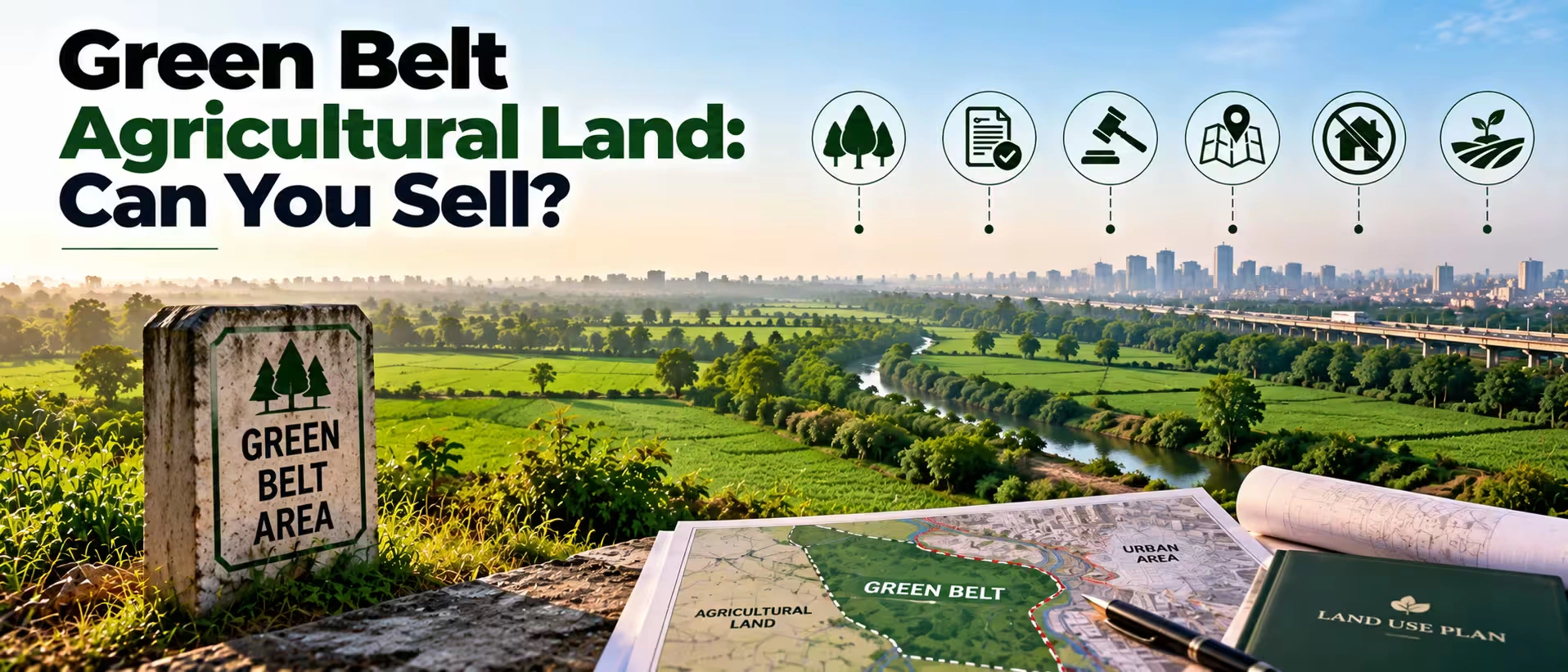
Many owners and purchasers tend to consider that green belt land cannot be sold. On the other hand, some vendors hold the opposite view and offer green belt land as land that will be used for residential purposes in the future. But in most cases, the truth lies somewhere in between. The land can be sold or purchased like any other piece of land. However, the activities possible to carry out with the land after buying it will be limited by the master plan.
The Short Answer: Sale Is Usually Allowed, Free Use Is Not
Ownership of land and permission to develop it are two separate things. A green belt or restricted zone label normally controls land use, and it does not stop a sale deed from being registered. People who look at farmlands near me listings in fast-growing areas often find green belt plots at lower prices, and the discount exists because the zoning limits what can be built there.
However, there are other cases where certain requirements will be imposed by the state regarding who can purchase agricultural land, the minimum size of the agricultural plot, and whether the purchase requires approval. In this case, the purchase of an agricultural plot located in a green belt can be lawful without each transaction going smoothly. In any case, it is safer to assume that the transaction is legal, while the intended use is not.
What Green Belt and Restricted Development Zones Mean?
A master plan or regional plan categorizes lands into zones like residential zones, commercial zones, industrial zones, agricultural zones, and green or conservation zones. Green belt lands are open spaces around a city and are meant to be buffers to prevent urban sprawl and safeguard the farmlands, water resources, and ecology. The green belt lands in Delhi's plan, for example, are defined as protected peripheral buffer zones where only farmhouses can be built in specified areas. The restricted development zones function similarly.
Some other names you will come across include agricultural zone, no development zone, natural conservation zone, eco-sensitive area, and controlled area.
What You Can and Cannot Do on Land in These Zones?
When you do a farm search in an area covered by a master plan, treat the zone map as seriously as the soil report. Green Belt Land Rules help you understand the restrictions that may apply to the property. The typical position looks like this:
| Activity | Typical position in green belt or agricultural zones |
|---|---|
| Farming, horticulture, orchards | Allowed |
| Farm sheds, storage, watchman room | Usually allowed within size limits |
| Farmhouse | Allowed in some plans with conditions, barred in others |
| Residential colony or plots | Generally not allowed |
| Commercial or industrial use | Generally not allowed without special permission |
| Land use change (conversion) | Often not available, or only through the plan amendment route |
Regarding Delhi, there was an answer in the parliament indicating that although it is a permitted activity in the green belt as per the master plan, it is also a fact that actions are taken by the local bodies from time to time to demolish unauthorized construction. The key lesson here is that although the activity of a farmhouse is permitted, it should conform to the size and area conditions. This requirement is common in other states as well, as the construction of buildings on agricultural land is not permitted without a change of land use certificate.
Why Sellers Cannot Promise Conversion?
A dispute often arises where the seller informs the buyer that the land will be converted for residential purposes shortly. Courts have been getting stricter on such matters. For instance, the Rajasthan High Court ruling in a case decided in July 2026 held that after notification of the land as green belt under the master plan, every body involved in the planning and conversion of the land, granting of pattas, and regulation must act in line with the master plan.
Any action taken that contradicts it is considered illegal and is therefore subject to being quashed. This means that an order for conversion, a patta, or even a regularization that goes against the master plan can be quashed at a later date. In effect, this would leave the buyer with the plot of land that is unusable. One land portal site that monitors master plans is not afraid to say so.
Records and Zoning Proof to Verify Before Buying
A buyer who finds a plot for sale near me with a low price in a planning area should collect these documents before paying anything:
- Latest document reflecting the land record and mutation entries under the name of the seller
- Master Plan/Development Plan extract with the zone in which the survey number falls
- Zoning order or land use certificate issued by the planning authority
- Order changing the land use, if any, claimed by the seller along with its date and conditions
- Village map indicating the location of the plot with respect to abadi, road, and other zones
- Encumbrance certificate
- Notice of acquisition, demolition, or litigation proceedings, if any
- Information about any other restrictions, like forestry, water body, highway, etc.
Do not rely only on the seller's representation of the seller regarding the zone in which the property falls. Obtain this information from the planning authority in writing.
Key Risks of Buying Land in a Green Belt or Restricted Zone
| Risk | Why it matters | How to reduce it |
| No permission to build | The plot may stay vacant or farm only | Ask for the zone certificate and permitted uses |
| False conversion claim | A cancelled order can wipe out the value | Verify the order with the issuing office |
| Demolition of illegal structures | Authorities can remove unauthorised buildings | Build only within the approved limits |
| Plan change in future | A new master plan may tighten or relax the zone | Check the draft plan and pending notifications |
| Limited buyers | Resale takes longer | Price in the restriction |
| Loan refused | Banks avoid land with unclear use | Prepare to buy with your own funds |
| Overlapping restrictions | A plot can be in green belt and near a river or forest too | Check every layer, not only the master plan |
Step by Step Checklist Before You Pay
If you are looking at agriculture land for sale in a planning area, a sensible order is:
- Discover which authority and which master plan apply to the village.
- Identify the survey number from the plan and the zone.
- Obtain a zoning or land use certificate in writing.
- Discover what can be built under the zone, for example, agriculture, farm building, or farmhouse, and their area limitations.
- Discover if there is any conversion, and confirm this at the place of issue.
- Search for draft plans or notices of acquisitions.
- Seek legal or town planning advice on zoning regulations and title documents.
- Discover if your proposed use suits the zone and walk away if it doesn’t.
- Make payments in installments after delivery of documents.
What Sellers Should Prepare?
Landowners with green belt or restricted zone land make better offers if they are upfront about the zone. The land documents should be at hand, an extract from the master plan with the zone information, a brief list of allowable uses, any approvals that have been made, and a clear statement of what is not allowable. Buyers who are aware of the restrictions before visiting the property will be able to negotiate much more easily and will not retract their offer once they register.
How 2Bigha Helps You Buy and Sell Land With Clear Zoning?
Zoning is one of the easiest points to miss in a listing, and that is where 2Bigha helps. The platform lists agricultural land and farmland across India, with background verification reports that review ownership records and other checks before you commit. Buyers can browse listings, book site visits and compare options without depending on a broker.
If you are thinking about selling property online, 2Bigha puts your plot in front of buyers who are already searching for farmland, with your documents presented in an organised way. Visit 2Bigha to explore listings or to list your land.
Disclaimer: This article is for informational purposes only and should not be considered investment, legal, financial, or property advice. Real estate regulations, infrastructure plans, market conditions, and government policies may change over time. Readers are advised to verify information with relevant authorities and consult qualified professionals before making any investment or property-related decisions.