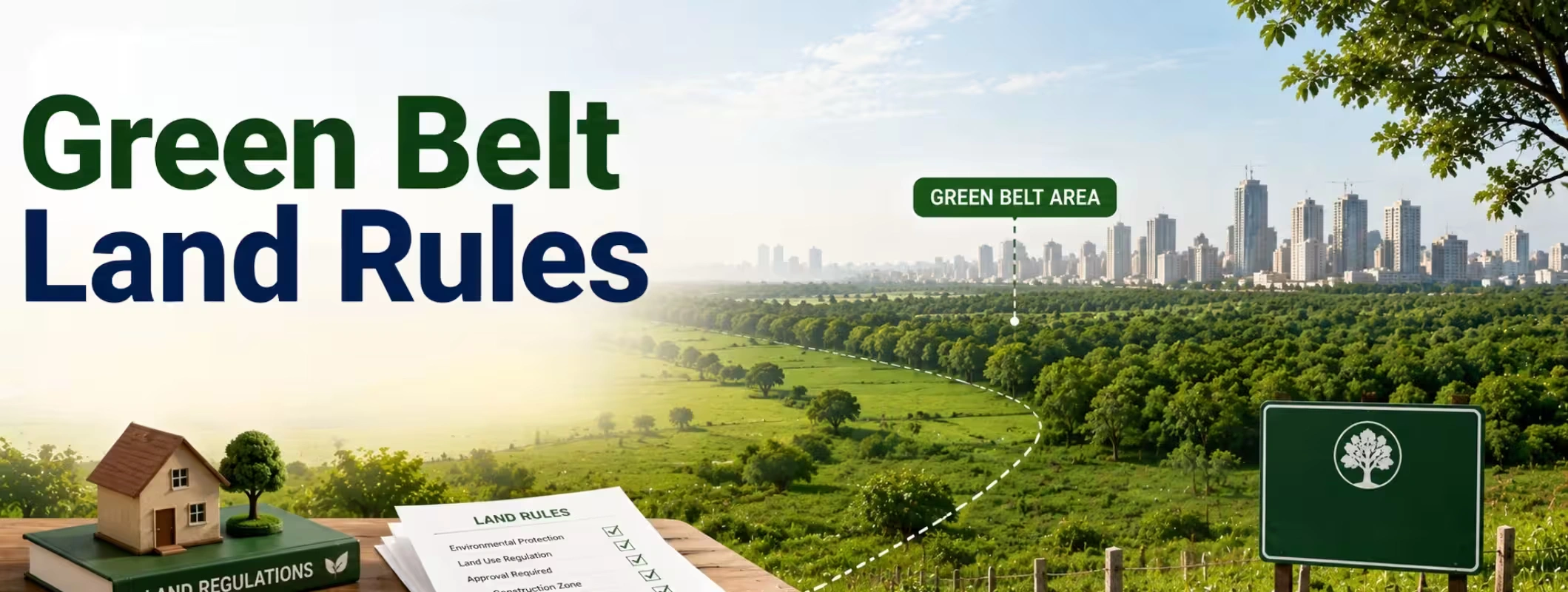
You have discovered what seems to be a piece of land that will meet all your needs. It is a good place, it is not too expensive, and it is accessible from all sides. The moment you hear it lies in a “green belt,” everything changes drastically. Such an attitude is understandable. There are a lot of issues connected with green belt land that most buyers are not aware of until it is too late. This manual is going to shed light on them.
What Is Green Belt Land, Exactly?
Green belt areas are those designated in the master plan of a city that have heavy restrictions for development of any sort. Green belts are purposely designed by town planning authorities to serve the purpose of preventing unplanned and uncontrollable growth of cities. Once an area is identified as a green belt, the area cannot simply be developed even though the owner wants to construct his/her building on the plot. The purpose of having such zones is to ensure that land remains available as open space and acts as a boundary between other land uses. India does not have a single act covering the green belt issue at the national level. Every state in India has its own town and country planning acts along with the municipal development authorities. Trusted land platforms can help you verify land listings by providing key property details, making it easier to understand land descriptions and avoid investing in plots with development restrictions.
Why Do Green Belts Exist in the First Place?
It's easy to see green belt rules as just another difficult rule or slow step in an official process. But there's real reasoning behind them.
- They act as a buffer between residential areas and polluting industries.
- They help absorb harmful things like dust, noise, and vehicle emissions near highways and factories.
- They protect fertile farmland from getting taken away by real estate expansion.
- They preserve water bodies, rivers, and natural drainage systems.
- They give fast-growing cities some breathing room instead of endless concrete.
Cities that ignore this kind of planning become liable to deal with worse air quality, water shortages, and heat later. So while a green belt tag can feel like a roadblock for one landowner, it usually exists to protect something bigger.
Types of Green Belt Zones
Not all green belt land is created for the same reason. You can see the major green belts mentioned below.
Agricultural green belts protect farmland from being converted for construction. These zones keep fertile land available for farming and dependent activities like dairy or horticulture, rather than losing it to housing projects.
Ecological green belts cover forests, wildlife corridors, and other environmentally sensitive land. These often overlap with protected forest areas and come with even stricter rules than a standard agricultural greenbelt.
Buffer green belts surround highways, industrial parks, and airports. Their main job is cutting down pollution and noise before it reaches nearby residential pockets.
What's Actually Allowed on Green Belt Land?
This is where most confusion comes from. Green belt doesn't mean the land is completely off-limits for everything.
| Activity | Generally Allowed | Generally Restricted |
|---|---|---|
| Farming and Horticulture | Yes | — |
| Tree Plantation | Yes | — |
| Public Parks and Recreational Spaces | Yes, with approval | — |
| Public Toilets or Basic Amenities | Yes, on a limited scale | — |
| Residential Construction | No | Yes, unless the land is de-notified |
| Industrial or Commercial Buildings | No | Yes |
| Change of Land Use Without Approval | No | Yes |
ActivityGenerally AllowedGenerally RestrictedFarming and HorticultureYes—Tree PlantationYes—Public Parks and Recreational SpacesYes, with approval—Public Toilets or Basic AmenitiesYes, on a limited scale—Residential ConstructionNoYes, unless the land is de-notifiedIndustrial or Commercial BuildingsNoYesChange of Land Use Without ApprovalNoYes
If you're planning to buy land that falls in a green belt zone expecting to build a home later, it's worth checking the local master plan first. In most cases, the land needs to be officially reclassified before any residential or commercial construction is legally allowed.
Can Green Belt Land Be Converted?
Yes, but it is not a straightforward exercise in completing forms. Getting green belt land converted for development purposes involves a land-use change application by the relevant town planning or development authorities. This usually entails the submission of an NA order, payment of relevant conversion charges, and proof that the conversion conforms to the master plan of that area. Such applications are seldom approved by the authorities and, when they happen, they are generally due to particular projects of public interest as opposed to individual projects.
A person wishing to buy land close to the outer ring road of Chennai and develop it as a residential property, for example, has to complete this process before he or she can legally erect buildings. Failure to follow this procedure is one of the major reasons for the issuance of demolition notices after some time.
How to Check If a Plot Falls Under Green Belt?
Before you buy land anywhere, it is very important to know the zoning status. A plot can look completely normal and still sit inside a green belt boundary that isn't obvious just by looking at it.
- Check the local development authority's master plan or zonal map.
- Use the state's online GIS or land-use portal, where available.
- Visit the municipal or town planning office directly for confirmation.
- Ask for the land-use certificate from the seller before finalizing anything.
Buyers looking at farmland for sale near Noida expanding sectors, or trying to sell land close to an industrial corridor in Gujarat, should treat this check as non-negotiable. A plot's green belt status can significantly affect both its price and what you're legally allowed to do with it.
What Happens If You Build Without Approval?
Construction on green belt land that has not been converted appropriately may not be just an insignificant issue. It is considered unauthorized construction by the authorities, and the consequences may range from fines to demolition of the property itself in case the situation is grave. It is precisely for this reason that it is crucial to conduct all due diligence prior to purchasing land that is located close to the outskirts of any urban area.
Green Belt Rules and Land Investment
Green belt land is not necessarily a bad investment choice for those who have a long-term perspective in their plans. It would be a fair choice to consider for an investment, if one intends to engage in agriculture or simply hold land in a rapidly developing region, for example. The main thing here is to set the appropriate expectations. In case one buys land hoping that sooner or later there will come a time when it gets de-notified and its price rises immediately – this is speculation rather than a sure result.
How 2Bigha Helps You Navigate Land Zoning?
It is amongst the most difficult factors to verify independently, especially if you are looking at buying land in cities/regions that you have never been to before. 2Bigha is a land marketplace platform that specializes in the transactional data of agricultural lands and farmland in India. Be it buying land in a tier-2 booming city, evaluating a plot that might be in a zone that is developing into an industrial belt, or even selling land, 2Bigha can help you get insights into the factors that really matter – including location information, which buyers sometimes realize much too late.
For a person trying to decide between farmland for sale in a green belt zone and land that has been cleared out for residential purposes, having access to verified listings and location information certainly becomes a safer choice to make.
Conclusion
There is a very good reason as to why these green belt rules can still be implemented even when they delay your transaction process. Green belts are meant to protect agricultural land, help with controlling pollution, as well as avoid urban sprawl. Just because there could be some constraints to using a particular land you are eyeing does not automatically translate into it being unusable at all. You may want to check its zoning for the allowable uses and keep in mind that everything takes time.
Disclaimer: This article is for informational purposes only and should not be considered investment, legal, financial, or property advice. Real estate regulations, infrastructure plans, market conditions, and government policies may change over time. Readers are advised to verify information with relevant authorities and consult qualified professionals before making any investment or property-related decisions.