Key Takeaways
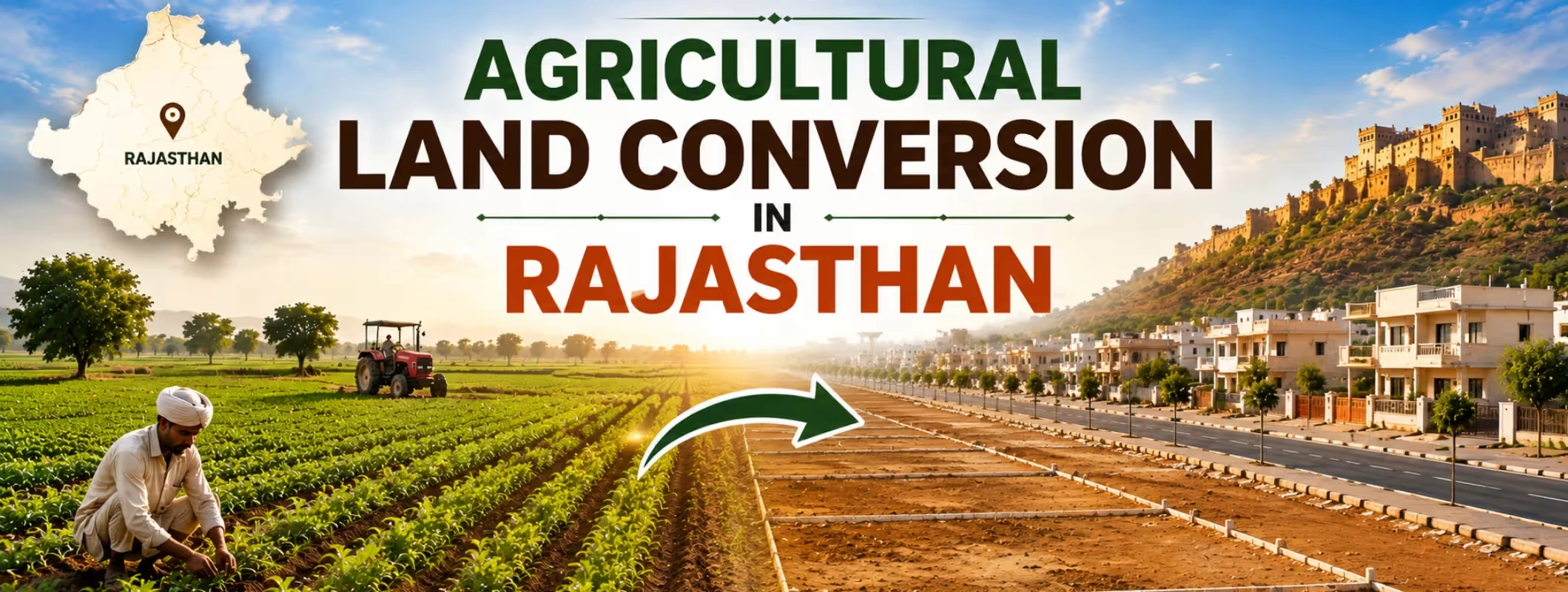
- Agricultural land conversion in Rajasthan means legally changing farmland use from agricultural purpose to residential, commercial, industrial, institutional, tourism, solar, or another approved non-agricultural use.
- In Rajasthan, rural agricultural land conversion is governed under the Rajasthan Land Revenue Act, 1956 and the Rajasthan Land Revenue rules for conversion of agricultural land for non-agricultural purposes in rural areas. The official rules mention Section 90-A of the Rajasthan Land Revenue Act, 1956 as the legal basis for conversion.
- You should not buy, sell, develop, or advertise farmland as residential plots unless the land has proper conversion approval, layout permissions where required, registry clarity, mutation status, and updated land records.
- Conversion charges depend on land use, area, DLC rate, purchase rate mentioned in the registered sale deed, and the prescribed government rate. For example, the official Rajasthan conversion charge table lists residential unit conversion as ₹5 per sq. meter or 5% of the DLC rate or 5% of the purchase rate, whichever is higher.
- For buyers, converted land is usually safer than raw agricultural land because it reduces legal uncertainty. For sellers, conversion can improve marketability, especially for residential plots, commercial land, farmhouse projects, and investment-ready parcels.
- Platforms like 2Bigha help buyers and sellers explore land opportunities with map based listings, location visibility, land-area checking, and subscription-based listing support for better reach.
Introduction: Why Agricultural Land Conversion in Rajasthan Matters
Rajasthan has become one of India’s most active land investment markets. Jaipur, Ajmer, Alwar, Neemrana, Udaipur, Kota, Jodhpur, Bikaner, Sikar, and highway-connected belts are seeing strong demand for farmhouses, plotted developments, warehouses, resorts, weekend homes, solar projects, industrial parcels, and commercial roadside land.
But here is the mistake many buyers make: they see farmland near a road, city, industrial area, temple corridor, or tourism belt and assume they can build anything on it.
That is not how land use works.
Agricultural land in Rajasthan is legally meant for agricultural activity unless it is converted for non-agricultural use. So, if a buyer wants to build a house, resort, shop, warehouse, factory, residential colony, commercial building, or farmhouse project, they need to check whether the land has proper conversion permission.
This is where agricultural land conversion in Rajasthan becomes important.
Land conversion protects buyers, sellers, developers, investors, and agents from future disputes. It also helps the government regulate land use, zoning, infrastructure planning, and revenue records. Without proper conversion, even a high-potential land parcel can become risky.
What is Agricultural Land Conversion in Rajasthan?
Agricultural land conversion in Rajasthan is the legal process of changing the recorded use of farmland into a non-agricultural purpose.
In simple words, it means the land record should no longer show the parcel only as agricultural land if the owner wants to use it for another approved purpose.
Common land conversion purposes include:
- Residential use
- Residential colony or plotted project
- Commercial use
- Industrial use
- Institutional use
- Medical facilities
- Tourism units
- Public utility use
- Solar or renewable energy projects
- Food processing units
- Other approved non-agricultural purposes
The official rural conversion rules are called the Rajasthan Land Revenue (Conversion of Agricultural Land for Non-Agricultural Purposes in Rural Areas) Rules, 2007, and they apply to rural areas across Rajasthan.
For urban areas, development authority or local body rules may also apply. For example, land falling under Jaipur Development Authority, Urban Improvement Trust, municipal limits, or master plan areas may need additional permissions, layout approval, building plan approval, or local authority clearance.
Why Do People Convert Agricultural Land in Rajasthan?
People convert agricultural land for practical, legal, and commercial reasons.
A farmer may want to sell land to a developer. A family may want to build a farmhouse. An investor may want to hold land near an upcoming highway. A business may need land for warehousing, resort development, solar projects, or commercial roadside use. A builder may want to create residential plots.
But unless the land use is changed legally, the project may face objections later.
Main Reasons for Rajasthan Land Conversion
1. Residential Development
Many buyers want to convert agricultural land to residential Rajasthan use, especially near Jaipur, Ajmer, Alwar, Sikar, Tonk, Udaipur, Jodhpur, and fast-growing highway belts. Residential conversion is useful for houses, villas, plotted colonies, weekend homes, and gated farmhouse communities.
2. Commercial Use
Commercial conversion is needed for shops, showrooms, hotels, warehouses, restaurants, fuel stations, roadside businesses, and other business-related construction.
3. Industrial Projects
Industrial conversion helps businesses set up factories, processing units, logistics facilities, cold storage, manufacturing units, and industrial estates.
4. Tourism and Hospitality
Rajasthan’s tourism economy is strong. Resorts, boutique stays, desert camps, heritage-style retreats, and wellness properties often need land conversion depending on land location and project use.
5. Better Resale Value
Converted land generally attracts more serious buyers because it reduces uncertainty. A parcel with clear land use, updated records, proper registry, mutation, and conversion certificate can command stronger market confidence.
6. Safer Investment
Investors prefer land with clear legal status. When land has proper conversion approval, buyers can better understand what they are allowed to build or develop.
Rajasthan Land Conversion Rules: What Buyers and Sellers Must Know
Rajasthan land conversion rules are not just paperwork. They decide whether the land can legally be used for the intended purpose.
The rural conversion rules were framed under powers connected with Section 90-A of the Rajasthan Land Revenue Act, 1956. The official document clearly states that the rules were made for conversion of agricultural land for non-agricultural purposes in rural areas.
Important Legal Points
Land use must match approval.
If land is converted for residential use, using it for a large commercial activity may require fresh permission or purpose change.
Conversion charges must be paid.
The applicant needs to pay the applicable premium/conversion charges as per the land use category.
Land records must be updated.
After conversion, mutation and land record updates become important. Buyers should check Jamabandi, mutation status, registry documents, and authority approvals.
Layout and building approval may be needed.
The official rules mention that after issuing the conversion order, layout plan and building plan procedures must be followed as prescribed.
SC/ST land restrictions need careful review.
Rajasthan has specific protections and restrictions related to land belonging to Scheduled Caste and Scheduled Tribe khatedars. Buyers should never ignore this point.
Urban and rural rules may differ.
A land parcel near city expansion zones may fall under a development authority, municipal body, UIT, RIICO area, master plan zone, or other local planning regulation.
Also Read: Planning to Buy Agricultural Land in Rajasthan? Know the Rules and Eligibility
Agricultural Land Conversion Rajasthan: Rural vs Urban Area
Before applying for conversion, first identify where the land falls. The process can differ depending on whether the land is in a rural revenue area or an urban/development authority area.
| Factor | Rural Land Conversion | Urban / Development Authority Area |
| Common authority | Tehsildar, SDO, Collector or prescribed revenue authority | JDA, UIT, municipal body, development authority, local planning authority |
| Main legal angle | Rajasthan Land Revenue conversion rules | Urban area rules, master plan, zoning, layout approval, building regulations |
| Common use cases | Farmhouse, small residential use, rural commercial use, industrial use, tourism, solar | Residential plots, colonies, commercial projects, apartments, institutional use |
| Key documents | Jamabandi, revenue map, Khasra details, ownership proof, application form | Title documents, site plan, layout plan, zoning status, conversion papers, local approvals |
| Risk if ignored | Illegal land use, penalty, future sale issue | Registry issue, building permission rejection, project delay, buyer dispute |
Step-by-Step Process: How to Convert Agricultural Land in Rajasthan
The exact process can vary by location, land category, area, use type, and authority. Still, most cases follow a similar flow.
Step 1: Check Land Ownership and Title
Start with ownership verification. Check whether the seller is the actual khatedar or legal owner.
Review:
- Jamabandi
- Khasra number
- Khata number
- Mutation records
- Registry deed
- Revenue map
- Encumbrance status
- Litigation status
- Possession status
- Loan or mortgage status
- SC/ST land status, if applicable
Do not rely only on verbal assurance from a broker or seller. Rajasthan land laws require proper document verification.
Step 2: Check Existing Land Use
Confirm whether the land is agricultural, converted, residential, commercial, industrial, pasture, forest, government land, charagah, gair mumkin, or any restricted category.
This step is important because not every parcel can be converted easily. Some land categories may require special permission or may not be eligible for normal conversion.
Step 3: Check Master Plan and Zoning
If the land falls near a city, town, highway, industrial belt, or development corridor, check the master plan and zoning status.
For example, a parcel may look suitable for residential plotting, but the local plan may reserve it for agriculture, road widening, green belt, industrial use, public utility, or another controlled purpose.
Step 4: Decide the Purpose of Conversion
You must clearly mention the purpose:
- Residential unit
- Residential colony/project
- Commercial purpose
- Industrial purpose
- Institutional purpose
- Medical facility
- Tourism unit
- Solar project
- Public utility
- Food processing unit
The conversion charges and approval conditions change according to the intended use.
Step 5: Prepare Documents
The official rural conversion application form asks for details such as applicant name, Aadhaar number, address, mobile number, email ID, SC/ST status, district, tehsil, village, Khasra number, area, and latest Jamabandi copy.
Common documents required for land conversion in Rajasthan include:
- Application form
- Latest Jamabandi
- Revenue map / site map
- Khasra details
- Registered sale deed or title document
- Identity proof
- Address proof
- Affidavit or undertaking, if required
- NOC from relevant department, if applicable
- Layout plan, if required
- Building plan, if required
- Proof of payment of conversion charges
- Power of attorney, if someone applies on behalf of the owner
- Land demarcation report, where needed
Step 6: Submit Application to the Prescribed Authority
The application is submitted to the prescribed authority depending on the area and land use. This may include Tehsildar, SDO, District Collector, development authority, municipal body, or another designated authority.
For online processes, some areas may allow digital submission or online tracking through government portals or authority-specific systems. However, availability can vary by district and land category.
Step 7: Site Verification and Department Review
The authority may verify land records, boundaries, existing land use, road access, nearby development, objections, zoning, and legal restrictions.
In some cases, reports may be taken from revenue officials, patwari, tehsildar, town planning department, local body, or development authority.
Step 8: Pay Conversion Charges
After assessment, the applicant must pay applicable conversion charges. Charges depend on the purpose of conversion and valuation basis.
Step 9: Receive Conversion Order / Certificate
If approved, the authority issues a conversion order or certificate. This document is important for registry, resale, construction permission, layout approval, financing, and future due diligence.
Step 10: Update Mutation and Land Records
After conversion, ensure the land records reflect the updated status. Land mutation Rajasthan records should match the latest legal position.
This is where many buyers face issues. They get a conversion order but do not check whether the revenue records, registry records, and local authority records are aligned.
Rajasthan Land Conversion Charges: How Fees are Calculated
Land conversion charges Rajasthan depend on land use category and valuation. The official conversion charge table mentions rates based on per-square-meter charges or percentage of DLC rate/purchase rate, whichever is higher in many cases.
Here is a simplified explanation.
| Conversion Purpose | General Charge Basis as per Official Table |
| Residential unit | ₹5 per sq. meter or 5% of DLC rate or 5% of purchase rate, whichever is higher |
| Residential colony/project | ₹7.50 per sq. meter or 7.5% of DLC rate or 7.5% of purchase rate, whichever is higher |
| Commercial purpose | ₹10 per sq. meter or 10% of DLC rate or 10% of purchase rate, whichever is higher |
| Industrial area / industrial purpose | ₹5 per sq. meter or 5% of DLC rate or 5% of purchase rate, whichever is higher |
| Public utility | No premium up to 10,000 sq. meters; charges apply beyond that as prescribed |
| Institutional purpose | ₹5 per sq. meter or 10% of DLC rate or 10% of purchase rate, whichever is higher |
| Medical facilities | ₹10 per sq. meter or 10% of DLC rate or 10% of purchase rate, whichever is higher |
| Solar / wind / biomass projects | 10% of the rate prescribed for industrial purpose |
Important: Fees can change through government notifications. Always verify the latest rate with the local revenue office, development authority, or qualified real estate legal advisor before making payment or quoting charges to a buyer.
What is DLC Rate in Rajasthan Land Conversion?
DLC stands for District Level Committee rate. It is the government-notified minimum valuation rate for land and property in a specific area.
In land conversion, DLC rate matters because conversion charges may be calculated as a percentage of the DLC rate, purchase rate, or prescribed per-square-meter rate, whichever is higher.
For example, if agricultural land is located near a fast-growing highway or urban expansion area, its DLC rate may be higher than a remote rural parcel. That can increase the conversion cost.
Why Buyers Should Check DLC Rate
DLC rate affects:
- Stamp duty
- Registration value
- Conversion charges
- Minimum property valuation
- Buyer budget
- Resale planning
- Investment feasibility
Before buying conversion-ready farmland, check the current DLC rate for that exact village, Khasra, road category, and land classification.
Documents Required for Land Conversion Rajasthan
Here is a practical checklist for buyers, sellers, land consultants, and agents.
| Document | Why It Matters |
| Latest Jamabandi | Confirms ownership and land classification |
| Khasra map / revenue map | Shows land location and boundaries |
| Sale deed / title deed | Proves ownership transfer history |
| Mutation record | Confirms name update in revenue records |
| Identity proof | Verifies applicant details |
| Address proof | Required for application |
| Site plan | Helps authority understand land location |
| Layout plan | Needed for plotting, colonies, or development projects |
| NOC, if required | Needed in restricted or controlled cases |
| Conversion fee receipt | Proof of payment |
| Conversion order/certificate | Final legal proof of land use change |
| Encumbrance check | Confirms loan, dispute, or charge on land |
| SC/ST status declaration | Important for restricted land transactions |
Buyer Checklist Before Buying Converted Land in Rajasthan
Buying converted land sounds safe, but you still need due diligence.
Use this checklist before buying plots Rajasthan after conversion or commercial land Rajasthan for sale.
Legal Checklist
- Check original title documents.
- Verify current Jamabandi.
- Match Khasra number with site location.
- Confirm whether land conversion is for the same use you need.
- Check if the conversion order covers the full land area or only a part.
- Verify mutation after conversion.
- Check road access and legal approach road.
- Confirm master plan zoning.
- Check whether layout approval is required.
- Check if the plot is part of an approved colony or informal subdivision.
- Verify whether any land is under acquisition, road widening, forest, charagah, or government restriction.
- Confirm no pending litigation.
- Check whether the seller has the right to sell.
- Use a local property lawyer before final payment.
Practical Checklist
- Visit the land physically.
- Compare map boundary with actual boundary.
- Speak to nearby landowners.
- Check water, electricity, and road availability.
- Understand future development potential.
- Compare nearby DLC rate and market rate.
- Avoid cash-heavy undocumented deals.
- Do not buy only on broker promises.
Agricultural Land vs Converted Land in Rajasthan
| Factor | Agricultural Land | Converted / NA Land |
| Legal use | Farming and related use | Approved non-agricultural use |
| Construction freedom | Limited | Depends on conversion purpose and building rules |
| Buyer risk | Higher if buyer wants development | Lower if documents are clear |
| Resale market | Farmer/investor focused | Wider buyer pool |
| Loan possibility | Case-specific | Often easier if approvals are clear |
| Price | Usually lower | Usually higher |
| Documentation burden | Title and land category verification | Title + conversion + mutation + layout verification |
| Best for | Farming, land banking, long-term holding | Residential, commercial, industrial, plotting, development |
Can You Convert Agricultural Land to Residential in Rajasthan?
Yes, agricultural land can be converted for residential use in Rajasthan if it meets legal, zoning, ownership, and authority requirements.
But buyers must understand the difference between:
Residential unit conversion
This may apply when the land is converted for an individual residential purpose.
Residential colony/project conversion
This applies when land is used for plotted development, township, colony, or project-based residential development. Charges and approvals can differ.
The official conversion charge table separates residential unit and residential colony/project categories, with different charge rates.
So, if someone says “this farmland is converted for residential,” ask:
- Converted for individual residential use or colony use?
- Full land or partial land?
- Which Khasra numbers are included?
- Is the layout approved?
- Is mutation updated?
- Can individual plots be legally sold?
- Is the land under any development authority?
This one check can save lakhs of rupees and years of legal trouble.
Can You Convert Agricultural Land to Commercial Use in Rajasthan?
Yes, agriculture to commercial land Rajasthan conversion is possible where rules permit it.
Commercial conversion may be needed for:
- Shops
- Resorts
- Hotels
- Warehouses
- Showrooms
- Restaurants
- Petrol pumps
- Highway-facing businesses
- Commercial complexes
- Service centers
- Logistics facilities
The official conversion charge table lists commercial purposes at ₹10 per sq. meter or 10% of DLC rate or 10% of purchase rate, whichever is higher.
Commercial conversion can be more expensive than residential conversion, but it may also create higher value if the land is near a road, tourism zone, city entry point, industrial area, or business corridor.
Common Mistakes in Rajasthan Land Conversion
1. Buying Land Without Checking Conversion Status
Many buyers only check registry documents. That is not enough. Registry shows transfer, but land use tells you what you can legally do with the property.
2. Assuming Farmhouse Means No Conversion Needed
A farmhouse may still require permission depending on area, structure, land use, local authority rules, and development type. Always check before construction.
3. Ignoring Khasra-Level Details
A conversion order may cover only specific Khasra numbers or partial areas. Buyers must match the document with the exact land being sold.
4. Not Checking SC/ST Land Restrictions
This is a serious legal risk in Rajasthan. Never buy land without checking whether any ownership or transfer restriction applies.
5. Confusing Mutation With Conversion
Mutation updates ownership records. Conversion changes land use. Both are important, but they are not the same.
6. Buying Plots in an Unapproved Layout
Some sellers divide agricultural land into small plots without proper conversion and layout approval. Such plots may look affordable but can create registry, construction, and resale problems.
7. Not Checking Local Authority Rules
Land near Jaipur, Ajmer, Udaipur, Jodhpur, Kota, Alwar, or fast-growing towns may fall under local development control. Revenue conversion alone may not be enough for full project approval.
Why Converted Land Has Strong Demand in Rajasthan
Rajasthan is not just a tourism state anymore. It is becoming a land investment hotspot because of expressways, industrial corridors, religious tourism, warehousing, renewable energy, logistics, and urban expansion.
Converted land is in demand because it gives buyers more clarity.
High-Demand Converted Land Categories
Residential plots near cities
Buyers want legally usable plots near Jaipur, Ajmer, Alwar, Udaipur, Sikar, Tonk, and Jodhpur.
Commercial highway land
Road-facing land near expressways, bypasses, and industrial routes can attract business buyers.
Farmhouse and weekend home land
Lifestyle buyers prefer land with clear access, legal status, and future resale potential.
Industrial and warehouse land
Neemrana, Bhiwadi, Jaipur-Ajmer belt, Delhi-Mumbai Industrial Corridor influence zones, and logistics corridors are attractive for businesses.
Tourism land
Udaipur, Pushkar, Jaisalmer, Jaipur outskirts, Ranthambore belt, and heritage-tourism locations have hospitality potential.
How 2Bigha Helps Buyers and Sellers in Rajasthan Land Deals
Buying land in Rajasthan can be confusing because every parcel has its own location, Khasra details, road access, land use, legal status, and investment value. 2Bigha helps simplify this discovery stage.
On 2Bigha, buyers can explore land and farmhouse opportunities through map-based listings. This makes it easier to understand location, surrounding development, nearby roads, and land area visibility before taking the next step.
For sellers, agents, and landowners, 2Bigha helps improve listing reach. Instead of depending only on local word-of-mouth, sellers can present land to a wider audience looking for farmland, converted land, farmhouse plots, and investment-ready parcels.
How 2Bigha Adds Value
- Map-based land listing experience
- Easier location discovery
- Better visibility for land sellers
- Helpful for farmland, farmhouse, plots, and land investment searches
- Supports buyers in comparing locations before site visits
- Useful for agents, builders, and landowners who want qualified visibility
- Subscription Package options for sellers who want better listing exposure
Important Note: 2Bigha helps with land discovery and listing visibility. Buyers should still verify title, conversion certificate, registry, mutation, land use, zoning, and legal documents before making payment.
Should You Buy Agricultural Land Before Conversion or Converted Land?
The answer depends on your goal.
Buy Agricultural Land If:
- You want long-term land banking.
- You understand Rajasthan land laws.
- You are comfortable with legal due diligence.
- You plan to apply for conversion later.
- You are buying for farming or agricultural use.
- You have local legal support.
Buy Converted Land If:
- You want residential or commercial use.
- You want faster development readiness.
- You prefer lower legal uncertainty.
- You need clearer resale potential.
- You want to build soon.
- You are buying land or project land.
For most first time buyers, converted land is safer. For experienced investors, raw agricultural land can offer upside, but only when due diligence is strong.
Land Conversion Time in Rajasthan
The time required for land conversion in Rajasthan depends on:
- Location
- Land category
- Ownership clarity
- Objections
- Authority workload
- Survey and inspection
- Missing documents
- Zoning restrictions
- NOC requirements
- Whether layout approval is needed
In simple cases, the process may move faster. In complex cases, it can take longer, especially when land falls under development authority limits, dispute zones, restricted categories, or project-based use.
Do not believe anyone who gives a guaranteed timeline without checking documents.
Who Should Help You With Rajasthan Land Conversion?
Land conversion is a legal and revenue process. You may need help from:
- Real estate legal advisor Rajasthan
- Revenue document expert
- Local land consultant
- Patwari/tehsil-level documentation support
- Architect or planner for layout
- Development authority consultant
- Property registration advisor
- NA conversion agents Rajasthan, where legally operating
- Chartered valuation or property consultant, if required
Choose professionals carefully. Avoid people who promise “100% approval” without checking the land record.
Final Advice for Buyers, Sellers and Investors
Agricultural land conversion in Rajasthan can unlock strong value, but only when done correctly. A converted parcel can become a residential plot, commercial asset, farmhouse project, industrial site, tourism property, or investment-ready land. But one missing document can turn a profitable deal into a legal headache.
Before buying or selling land, check three things clearly:
What is the current land use?
What use is legally approved?
Do the land records match the seller’s claim?
Use 2Bigha to discover land opportunities, compare locations, and list your property with better visibility. But treat document verification as non-negotiable. The best land deal is not just the cheapest one. It is the one with clear title, legal use, clean records, and realistic development potential.