
 List Your Land
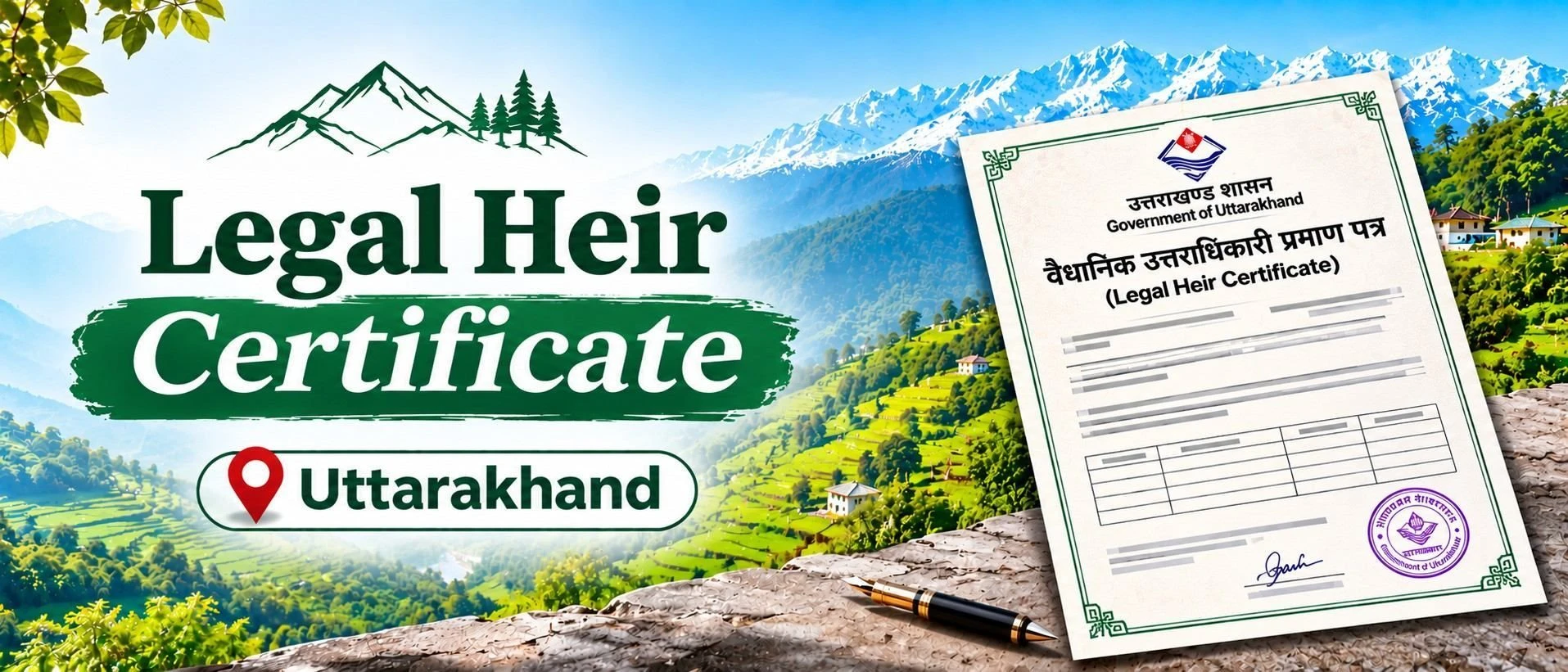
A legal heir certificate, also known as a Waris certificate, is the document issued by Uttarakhand's Revenue Department that formally confirms who the surviving family members of a deceased person are, particularly when there's no registered will. Establishing legal heirship properly matters because property transfer, bank settlements, pension benefits, and insurance claims all stall without this document in hand. This guide covers how the application process works through the Tehsildar's office, what documents you need, and where families commonly run into delays. Whether you're settling a parent's estate, transferring inherited land before listing it on real estate listing websites, or working through buying agricultural land that's part of a larger family holding, this is the certificate you'll need first.
Section 1 — What is a Legal Heir Certificate in Uttarakhand?
Definition: A legal heir certificate is an official document confirming the lawful surviving heirs of a deceased person, issued to help initiate the transfer of assets and property when there's no registered will.
Usually, this process starts at the local Tehsildar/Taluk office, although applicants can also opt to approach the local district civil court via a lawyer. The file, once submitted, is then forwarded to a Revenue Inspector or Patwari, and he does an actual on-ground checkup involving checking of the papers and verifying the family tree, along with a possible visit to the house of the applicant. The process continues only after the report comes to the Tehsildar.
It's worth understanding upfront that a legal heir certificate and a succession certificate aren't interchangeable, even though families sometimes assume otherwise. The legal heir certificate, issued administratively by the Tehsildar, works well for routine matters like mutation, pension claims, and bank settlements. A succession certificate that is granted to you by a civil court under the Indian Succession Act is a certificate that has more legal validity and is essential when there is a dispute regarding the property or for moving valuable movable property. For anyone dealing with farm land for sale that's part of an inherited holding, knowing which certificate actually applies to your situation saves considerable time.
State-specific note: The validity period of the legal heir certificate in Uttarakhand has been enhanced to lifelong, per government order, meaning once issued, it doesn't require periodic renewal for continued use.
Expert Tip: Request five to ten certified copies of the death certificate at the time of issue, not just one or two. Nearly every downstream claim — bank settlement, insurance, pension, mutation, and the Tehsildar's own file — wants its own original copy, and running back for reissues later adds unnecessary delay to an already multi-step process.
Section 2 — How to Get a Legal Heir Certificate in Uttarakhand?
Applications can be initiated online through the e-District portal or filed directly at the Tehsildar's office, though field verification remains the same either way. Here's how the paths compare:
Method | Cost | Time | Legally valid for property/financial use? |
Online (e-District Uttarakhand) | Nominal fee | 15–30 days for uncontested cases | Yes |
Offline (Tehsildar/Taluk office) | Nominal fee | 15–30 days | Yes |
Civil court succession certificate | Court fees, case-dependent | Longer, weeks to months | Yes, for disputed/high-value assets |
Visit the e-District Uttarakhand portal. Register on edistrict.uk.gov.in using your mobile number and basic details.
Fill out the legal heir certificate application. Enter details of the deceased and all claimed heirs.
Upload supporting documents. Attach the death certificate, ID proofs, relationship documents, and the signed affidavit.
Pay the applicable fee. Complete payment through the portal.
Track and download. Check application status online and download the certificate once sanctioned.
Visit the Tehsildar or Taluk office. Approach the office covering the deceased's last place of residence, or contact a lawyer to approach the district civil court.
Obtain and fill the application form. Collect the prescribed form along with a sample copy for reference.
Attach documents and affidavit. Submit the signed form with all supporting documents, affixed with the applicable stamp.
Undergo verification. A Revenue Inspector or Patwari conducts a field inquiry, verifying details and the family tree.
Receive the sanctioned certificate. Once the Tehsildar is satisfied with the verification report, the certificate is issued within 15 to 30 days.
Whatever path you take, the field verification procedure will generally be the most time-consuming part of the entire procedure. The fact that you remain persistent with the Revenue Inspector can make all the difference in getting your report to the Tehsildar for the final sanctioning.
Section 3 — What Does a Legal Heir Certificate Contain?
A properly issued certificate lists specific details establishing the family's claim.
Field | What it means | What to check |
Deceased's Details | Name, date of death, last residence | Must match the death certificate exactly |
Names of All Heirs | Every surviving legal heir listed | Should include spouse, children, and parents as applicable under succession law |
Relationship to Deceased | How each heir is related | Should match the submitted relationship proof |
Record/Reference Number | Unique entry number for the application | Needed for tracking and future reference |
Issuing Tehsildar | Authority that sanctioned the certificate | Confirms jurisdiction over the deceased's residence |
Good sign: A correctly issued certificate lists every eligible heir accurately, matches the death certificate details, and carries a clear reference number along with the sanctioning Tehsildar's details.
Section 4 — Common Issues & How to Fix Them?
Applicants pursuing a legal heir certificate in Uttarakhand run into a recurring set of avoidable delays, most tied to incomplete documentation or unclear expectations about the field verification stage. Before relying on informal guidance, the Legal Heir Certificate Uttarakhand official website is the most direct source for current application steps and fees.
Field verification taking longer than expected – The Patwari or Revenue Inspector's ground inquiry is typically the slowest step in the process. Fix: follow up consistently with the verification officer's office rather than waiting passively for updates.
Missing relationship proof for one or more heirs – Applications with incomplete documentation for any claimed heir often get sent back. Fix: gather relationship proof — birth certificate, marriage certificate, or family register — for every heir before submitting.
Only one certified death certificate copy obtained – Applicants sometimes run short when multiple institutions each want their own original. Fix: request five to ten certified copies at the time of issue to cover bank, insurance, pension, and mutation claims separately.
Confusion between legal heir certificate and succession certificate – Families assume the Tehsildar-issued document covers all situations. Fix: For disputed inheritance or high-value movable assets, pursue a succession certificate through civil court instead.
Disputes among family members over heirship – Disagreements can stall the application indefinitely at the verification stage. Fix: resolve such disputes separately, potentially through court proceedings, before expecting the Tehsildar to issue a certificate.
Application form filled incorrectly or incompletely – Errors in the initial form submission cause avoidable rejections. Fix: use the sample form provided by the office as a reference, and double-check all applicant and deceased details before signing.
Section 5 — Recent Changes in 2026
As of August 2026, legal heir certificate applications in Uttarakhand continue to be processed through the e-District portal alongside offline Tehsildar office submissions, with the standard 15 to 30-day processing window for complete, uncontested applications remaining consistent across districts.
Section 6 — Why a Legal Heir Certificate Matters for Property Owners?
Required before mutation of inherited land can proceed at the local Tehsil office
Enables bank account settlements and access to a deceased family member's funds
Supports pension, insurance, and government scheme claims tied to the deceased
Establishes clear documentation useful when preparing to list inherited land on property listing sites
Provides administrative proof of heirship for straightforward cases without needing a lengthy court process
Reduces delays when family members later pursue selling property online for jointly inherited land
Makes it easier to list a farm for sell confidently once every heir's share is clearly documented
Section 7 — Legal Heir Certificate vs. Succession Certificate
These two are often confused, though they carry different legal weight.
Aspect | Legal Heir Certificate | Succession Certificate |
Issued by | Tehsildar (Revenue Department) | Civil Court, under the Indian Succession Act |
Used for | Mutation, pension, bank settlements, routine claims | High-value movable assets, disputed estates, debts, securities |
Process | Administrative, with Patwari field verification | Judicial, involves a court petition |
Time taken | 15 to 30 days typically | Weeks to months, often longer |
For most families handling straightforward inheritance of agriculture land for buy situations passed down within the family, the Tehsildar-issued certificate is sufficient. A succession certificate becomes necessary mainly when the estate is contested or involves high-value movable assets requiring stronger legal standing.
Section 8 — Related Documents
Khatauni Uttarakhand guide for checking family landholding records
Intkal Mutation guide for updating ownership after inheritance
Encumbrance Certificate guide for checking claims on inherited property
Property Document Checklist guide for pre-purchase verification
Khasra Number guide for verifying individual plot details
